60 Product Manager Interview Questions and Answers (With Case Studies)
J
By Nuthana Reddy
August 12, 202614 min read
Published on August 12, 2026
SHARE THIS ARTICLE
Table Of Content
Product Manager Interview Questions: Product Sense
Product Strategy Questions
Product Analytics Interview Questions
Behavioural Product Manager Interview Questions
Key Insights
Product Manager interviews assess product sense, strategy, analytics, technical understanding, prioritisation, communication, and decision-making under incomplete information.
Strong interview responses should focus on understanding the customer problem, stating assumptions, evaluating options, and connecting recommendations to customer and business impact.
Product case studies require structured thinking, including defining the objective and target user, identifying the problem, exploring solutions, prioritising an approach, and selecting relevant success metrics.
Preparing real examples from professional experience can help demonstrate leadership, stakeholder management, conflict resolution, prioritisation, customer impact, and decision-making skills.
In this blog, you'll learn how to prepare for 60 Product Manager interview questions covering product sense, strategy, analytics, behavioural situations, technical concepts, case studies, and practical interview preparation.
Product management interviews are designed to test much more than your knowledge of products. Hiring managers want to understand how you think, solve customer problems, prioritise competing requirements, interpret data, communicate with stakeholders, and make decisions when information is incomplete.
Whether you are an experienced Product Manager, an aspiring Associate Product Manager, or a professional transitioning from engineering, marketing, consulting, or business roles, preparing for product manager interview questions can help you approach interviews with greater confidence.
Product interviews commonly cover product sense, strategy, analytics, behavioural situations, technical understanding, prioritisation, and case studies. The best answers are structured around the problem, your assumptions, your reasoning, and the expected business or customer impact.
Here are 60 commonly asked Product Manager interview questions with concise answer frameworks and examples.
Product Manager Interview Questions: Product Sense
1. What does a Product Manager do?
A Product Manager identifies customer problems, defines product strategy, prioritises opportunities, coordinates cross-functional teams, and measures product success. The role connects customer needs with business and technology objectives.
2. What makes a good Product Manager?
A good Product Manager combines customer empathy, strategic thinking, analytical ability, communication, prioritisation, and execution skills. They should be comfortable making decisions while balancing customer value, business impact, and technical feasibility.
3. How do you identify a good product opportunity?
Start by understanding the customer problem rather than jumping to a solution. Analyse user feedback, market trends, behavioural data, competitor offerings, and business objectives. Then evaluate the opportunity based on customer impact, market potential, feasibility, and strategic alignment.
4. How do you define a successful product?
Success depends on the product objective. Define measurable metrics such as activation, retention, engagement, conversion, revenue, customer satisfaction, or adoption. The chosen metric should directly connect to the product’s intended outcome.
5. How would you improve a product you use every day?
First identify the target user and their primary goal. Then identify friction points using personal observation, user research, reviews, and product data. Prioritise the biggest problem and propose solutions based on expected impact rather than personal preference.
6. How would you improve Google Maps?
I would segment users such as commuters, travellers, delivery professionals, and pedestrians. I would identify major pain points for each segment, such as inaccurate ETAs, route changes, parking, or public transport information. I would then prioritise improvements based on user impact, frequency, feasibility, and business value.
7. How would you improve an e-commerce checkout?
I would analyse the checkout funnel to identify where users drop off. Possible issues could include unexpected costs, complicated forms, payment failures, or lack of preferred payment methods. I would test solutions such as simplified checkout, transparent pricing, saved payment information, and better error messaging.
8. Design a product for senior citizens.
I would begin with user research to understand mobility, accessibility, digital literacy, safety, and communication needs. The product should use simple navigation, readable interfaces, clear instructions, and accessible support. Usability testing would validate whether the design actually solves the intended problems.
9. How would you build a product for college students?
I would first segment students based on their needs, such as academic learning, career preparation, social interaction, orfinancial management. I would identify the most significant unmet need and develop an MVP around it before expanding the product.
10. What is product-market fit?
Product-market fit occurs when a product successfully solves a meaningful customer problem and demonstrates sustained demand. Indicators can include strong retention, organic growth, repeat usage, customer satisfaction, and willingness to pay.
Product Strategy Questions
11. What is your approach to product strategy?
I start with the company vision and customer problem. I then assess market opportunities, target users, competitive positioning, product differentiation, business objectives, and available resources before defining strategic priorities.
12. How do you prioritise product features?
I consider customer impact, business value, urgency, strategic alignment, development effort, and risk. Frameworks such as RICE or Kano can provide structure, but prioritisation should ultimately reflect the product’s objectives.
13. What would you do if the CEO wants one feature but customers want another?
I would understand the reasoning behind both requests and evaluate them using evidence. I would compare customer impact, strategic value, revenue potential, urgency, and implementation effort. The decision should be based on product objectives and data rather than hierarchy alone.
14. How do you create a product roadmap?
A roadmap should connect business objectives with customer problems and product initiatives. I would define strategic goals, prioritise initiatives, estimate dependencies and constraints, and communicate the roadmap clearly while keeping enough flexibility to respond to changing information..
15. What is an MVP?
A Minimum Viable Product is the simplest version of a product that allows a team to test a meaningful hypothesis with real users. An MVP should generate learning rather than simply represent a smaller version of the final product.
16. How do you decide what goes into an MVP?
I identify the core customer problem and the minimum functionality needed to solve or validate it. Features that do not contribute directly to the primary hypothesis should generally be postponed.
17. How would you launch a product in a crowded market?
I would identify a specific customer segment and unmet need instead of attempting to compete broadly. The strategy would focus on differentiated value, clear positioning, a targeted GTM strategy, and measurable acquisition and retention goals.
18. How do you analyse competitors?
I compare competitors based on target users, value proposition, features, pricing, positioning, distribution, customer experience, and strengths and weaknesses. Competitive analysis should inform strategy without turning the product into a copy of another company.
19. What is a product vision?
A product vision describes the future state the product aims to create for its customers. It provides long-term direction and helps teams make consistent decisions.
20. How do you balance short-term and long-term priorities?
I separate initiatives based on strategic importance, urgency, customer impact, and dependencies. Short-term initiatives can address immediate business needs, while a portion of product capacity should remain dedicated to long-term strategic goals.
It depends on the product and its objective. Common metrics include acquisition, activation, engagement, retention, conversion, revenue, churn, and customer satisfaction.
22. What is a North Star Metric?
A North Star Metric captures the core value a product provides to customers and serves as a directional measure for the product team. For example, a music-streaming platform might track meaningful listening activity.
23. DAU has dropped by 20%. What would you do?
I would first verify the data and identify when the decline started. Then I would segment the change by geography, platform, user type, acquisition channel, and product version. I would investigate recent releases, technical issues, external events, and behavioural changes before proposing solutions.
24. Revenue increased but users decreased. Is that good?
Not necessarily. Revenue growth may indicate better monetisation, but declining users could create a long-term problem. I would examine retention, customer lifetime value, acquisition costs, revenue concentration, and whether the revenue increase is sustainable.
25. How would you measure a new feature?
Define a baseline and establish the feature’s objective. Metrics could include adoption, engagement, conversion, retention, task completion, customer satisfaction, and downstream business impact.
26. What is A/B testing?
A/B testing compares two versions of a product experience with different user groups to determine whether a change produces a measurable difference in a selected metric.
27. A/B test results show no improvement. What do you do?
I would determine whether the hypothesis was incorrect, the sample was insufficient, implementation failed, or the metric did not capture the intended outcome. A negative result can still provide valuable product learning.
28. How would you measure user engagement?
I would define engagement based on meaningful actions rather than simply counting sessions. Depending on the product, this could include completed tasks, content consumption, transactions, or recurring usage.
29. What is churn?
Churn represents customers or users who stop using or paying for a product during a defined period. Understanding why users churn is often more valuable than simply measuring the churn rate.
30. What would you do if a metric suddenly increased?
I would first verify whether the increase is genuine. Then I would investigate product changes, marketing campaigns, user segments, tracking changes, external events, and potential data anomalies before interpreting the result.
Behavioural Product Manager Interview Questions
31. Tell me about a product you worked on.
Use a structured response covering the problem, target users, your responsibility, actions taken, challenges, and measurable outcome.
32. Tell me about a product decision you got wrong.
Choose a genuine example and focus on what you learned. Explain how you identified the mistake and what process you changed afterwards.
33. Tell me about a conflict with an engineer.
Explain the disagreement objectively, demonstrate that you listened to the technical concern, and describe how you used evidence or a structured decision-makingprocess to reach an outcome.
34. Tell me about a difficult stakeholder.
Explain the stakeholder’s perspective, the underlying disagreement, how you communicated, and how you reached alignment.
35. Tell me about a failed product launch.
Focus on the root cause rather than assigning blame. Discuss what went wrong, how you responded, and what you changed for future launches.
36. How do you handle ambiguity?
I break the problem into smaller questions, identify assumptions, gather available evidence, and determine what information is necessary to make a decision. I avoid waiting for perfect information when a reversible decision can be made.
37. How do you handle pressure?
I prioritise based on business and customer impact, clarify expectations, communicate risks early, and maintain focus on the most important outcomes.
38. Tell me about a time you influenced someone without authority.
Describe a situation where you used data, customer insights, clear communication, or collaboration to gain support for an idea.
39. How do you manage disagreement within a team?
I encourage everyone to explain their reasoning and bring the discussion back to the shared product objective. Evidence and customer impact should guide the final decision.
40. What is your biggest strength as a Product Manager?
Choose a strength relevant to the role, such as analytical thinking, customer empathy, communication, or execution, and support it with a specific example.
Free Courses
Stakeholder Communication & Negotiation Skill Sets
A Product Manager does not need to code like an engineer but should understand technical concepts well enough to communicate with engineering teams, understand constraints, and make informed product decisions.
42. What is an API?
An API allows different software systems to communicate and exchange information through defined interfaces and rules.
43. What is SQL used for?
SQL is used to query and analyse data stored in relational databases. Product Managers can use SQL to investigate user behaviour, product metrics, and business questions.
44. What is cloud computing?
Cloud computing provides computing resources such as storage,databases, networking, and processing through remote infrastructure rather than relying entirely on local hardware.
45. How do you work with engineers?
I involve engineers early, provide clear context and desired outcomes, discuss constraints openly, and allow technical teams to contribute to solution design.
46. What is technical debt?
Technical debt refers to the future cost created when teams choose a quick or imperfect technical solution instead of a more sustainable approach. Product Managers need to balance technical debt with customer and business priorities.
47. How would you prioritise a technical improvement?
I would evaluate its impact on reliability, security, scalability, development speed, customer experience, and business risk. Technical improvements should be connected to measurable product or operational outcomes wherever possible.
48. What is scalability?
Scalability is the ability of a system to handle increasing users, traffic, transactions, or workloads without unacceptable deterioration in performance.
49. How do you explain a technical concept to a non-technical stakeholder?
I avoid unnecessary jargon and explain the concept through business impact, customer implications, risks, and simple examples.
50. How do you estimate development effort?
I work with engineering teams to understand complexity, dependencies, uncertainty, and resource requirements. Estimates should be treated as informed projections rather than absolute commitments.
51. A food-delivery app has falling orders. How would you investigate?
I would analyse the funnel from app visits to restaurant selection, checkout, payment, and completed orders. I would segment the decline by location, customer type, device, restaurant category, and time period. I would also investigate pricing, delivery times, availability, competitors, and technical issues before selecting interventions.
52. A streaming platform has high acquisition but poor retention. What would you do?
I would analyse where users stop engaging. Cohort analysis could identify when churn occurs. I would investigate content discovery, catalogue relevance, onboarding, pricing, product experience, and content availability before testing retention initiatives.
53. Design a product for first-time investors.
I would focus on reducing complexity and building trust. The MVP could provide simple onboarding, educational explanations, risk information, portfolio tracking, and guided investment options. Success could be measured through activation, completed investments, retention, and customer satisfaction.
54. An e-commerce app has high cart abandonment. What would you investigate?
I would examine checkout-stage drop-offs and segment users by device, geography, payment method, order value, and new versus returning status. I would investigate shipping costs, payment failures, account requirements, delivery timelines, and unexpected charges.
55. Build a product for remote workers.
I would first identify the most important pain point—communication, productivity, collaboration, wellbeing, or workspace management. I would validate the problem with research and build an MVP around one high-frequency problem rather than creating an overly broad platform.
56. Your product receives thousands of feature requests. How do you prioritise them?
I would categorise requests by customer segment and problem, identify recurring needs, quantify demand where possible, and compare them against strategic priorities. A feature should not automatically be prioritised simply because many users request it.
57. A competitor launches a major feature. What do you do?
I would avoid reacting immediately. First assess whether the feature affects our customers, positioning, retention, or competitive advantage. If it addresses a genuine gap, I would evaluate whether to build, partner, differentiate, or deliberately ignore it.
58. Your product has strong downloads but low activation. What would you do?
I would map the onboarding funnel and identify the exact step where users fail to reach the product’s core value. I would test improvements to onboarding, messaging, permissions, navigation, and first-use experience.
59. You have one month to launch an MVP. What would you prioritise?
I would define the core customer problem and success metric first. Then I would identify the minimum functionality required to validate the central hypothesis, align engineering and design teams, remove non-essential features, and establish a clear launch and measurement plan.
60. Why should we hire you as a Product Manager?
The answer should connect your experience directly to the company’s product challenges. Highlight your strongest transferable skills, relevant product experience, analytical ability, customer understanding, and ability to collaborate across functions. End with the specific value you believe you can bring to the organisation.
How to Prepare for Product Manager Interviews
Preparing for product manager interview questions requires more than memorising model answers. Interviewers are often evaluating how you structure unfamiliar problems.
Start by learning common product frameworks, but avoid using them mechanically. Practice product design, estimation, prioritisation, analytics, strategy, technical, and behavioural questions.
Case studies deserve particular attention. When answering a case, clarify the objective, identify the target user, define the problem, state assumptions, explore solutions, prioritise one approach, and explain how you would measure success.
You should also prepare several real examples from your professional experience. These can demonstrate leadership, conflict resolution,stakeholder management, failure, prioritisation, customer impact, and decision-making.
Finally, practise thinking aloud. Product interviews are designed to evaluate your reasoning, so the interviewer needs to understand how you arrive at your conclusion.
Build Product Management Skills With IIT Roorkee
Professionals looking for structured product management education can consider the Post Graduate Certificate Programme in Strategic Product Management from IIT Roorkee’s Continuing Education Centre. The five-month live-online programme includes a mandatory 3–4 day campus visit and covers product strategy, user research, product analytics, product roadmaps, business models, GTM strategy, branding, AI in product management, and technical essentials such as SQL and APIs. The programme also includes case-based learning, hands-on sessions, industry expert interactions, and a Build Your Own Product (BYOP) project. The current eligibility requirement is a bachelor’s degree or equivalent with a minimum of 50% aggregate marks. Participants who meet the stated assessment and attendance criteria can receive an IIT Roorkee certificate. Jaro Education also provides career services such as resume building, LinkedIn optimisation, and career enhancement sessions; these services do not constitute a job or promotion guarantee.
Conclusion
Product management interviews test your ability to think from multiple perspectives. A strong candidate must understand customers, business objectives, technology, data, strategy, and execution.
The best way to prepare for product manager interview questions is to combine structured frameworks with real-world reasoning. Practise answering product design questions, analyse case studies, understand key metrics, prepare behavioural examples, and become comfortable discussing technical concepts.
Remember that there is rarely one perfect answer in product management. What matters is how clearly you define the problem, explain your assumptions, evaluate alternatives, make trade-offs, and connect your recommendation to measurable customer and business outcomes.
With consistent practice and practical product exposure, you can approach Product Manager interviews with greater confidence and demonstrate the strategic thinking employers are looking for.
Frequently Asked Questions
Common questions cover product design, product strategy, prioritisation, analytics, behavioural situations, technical concepts, and case studies. Interviewers may ask candidates to improve an existing product, interpret a metric change, prioritise features, or solve a customer problem.
Start by clarifying the objective and target user. Define the problem, state your assumptions, identify possible solutions, prioritise an approach, and explain the metrics you would use to measure success. Communicate your reasoning throughout rather than jumping directly to a solution.
The level of technical knowledge depends on the role. Product Managers working on technology-heavy products should understand concepts such as APIs, databases, cloud computing, SQL, system architecture, and technical debt well enough to collaborate effectively with engineering teams.
Start by learning product management fundamentals and practising product case studies. Take on product-related responsibilities in your current role, build product case studies or projects, develop analytics and customer research skills, and prepare examples demonstrating leadership and cross-functional collaboration.
The most important skills include structured problem-solving, customer empathy, product sense, analytical thinking, prioritisation, communication, stakeholder management, business understanding, and the ability to make decisions using incomplete information.
Nuthana Reddy
Nuthana Reddy is a Senior Manager at Procter & Gamble, specializing in operations, digitization, and cross-functional leadership. She has driven multimillion-dollar impact through innovation, process optimization, and strategic execution across global markets.
Get Free Upskilling Guidance
Fill in the details for a free consultation
Related Courses
Explore our programs
Post Graduate Certificate Programme in Strategic Product Management
 HOME > BLOG > Business Management > 60 Product Manager Interview Questions and Answers (With Case Studies)
 August 12, 2026
 14 min read





 Key Insights
 ChatGPT
 Perplexity
 Claude
 Grok
Grok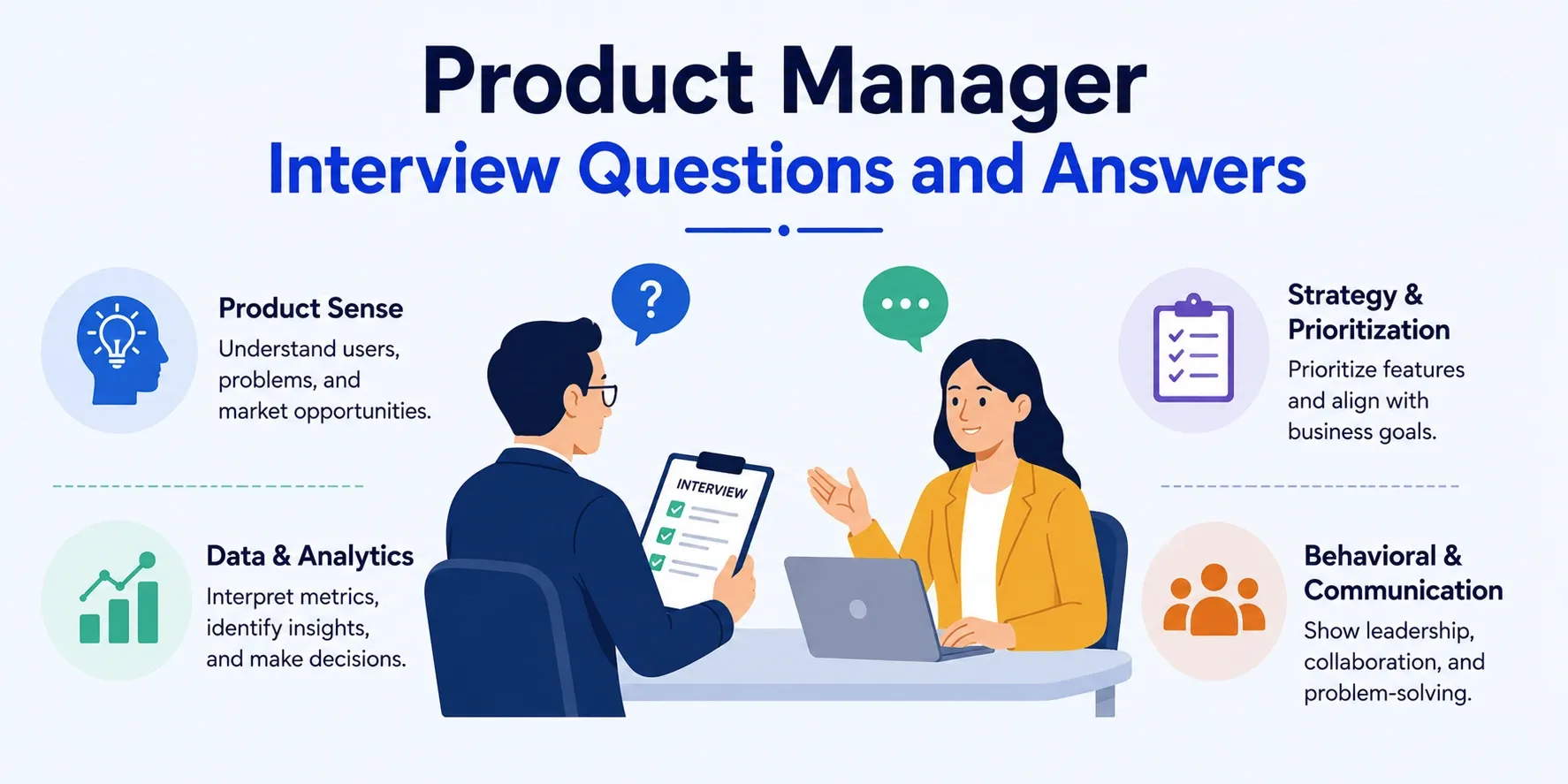








 ROI Calculator