Product Management Trends are increasingly centered on AI adoption, with 73% of product managers using AI tools weekly or daily.
Product management is a strong career choice in 2026 as AI product management expands across fintech, healthcare, SaaS, e-commerce, and other digital industries.
Product Managers who can combine customer insights, business strategy, data, and AI are well positioned for roles with greater product ownership and leadership opportunities.
Another major shift is toward outcome-based planning, with 42% of product managers using outcome-based roadmaps.
Build practical product management capabilities through AI-powered solutions, data-driven strategies, hands-on projects, and real-world product challenges.
The IIT Roorkee Strategic Product Management Programme also offers 25+ hands-on projects, integrated labs, and a capstone-focused learning experience.
Product management remains a strong career for professionals who enjoy solving customer problems while balancing business, technology, and strategy. With 96% of product teams using AI consistently, AI literacy is becoming increasingly important for aspiring and existingproduct managers. The role is also becoming more strategic, with 53% of product professionals identifying systems-level thinking as critical. Skills in AI product management, customer research, analytics, prioritization, and communication can help professionals grow into senior and leadership roles.
The future of product management will be shaped by professionals who can connect strategic thinking with technology, data, and customer needs. As AI and digital tools continue to evolve, PMs who adapt quickly and make informed decisions will stay ahead. Combining business understanding with strong product judgment will be key to long-term growth.
Top Product Management Trends Transforming the Product Life Cycle
1. AI-Powered Product Decisions
AI is transforming how product managers research, analyze, and prioritize opportunities. A survey of 379 product professionals found that 96% use AI consistently, while 94% use it daily or often. AI helps PMs synthesize feedback, spot patterns, accelerate research, and support prioritization. However, human judgment remains essential for context and strategic decisions. The focus is shifting toward using AI for efficiency while PMs spend more time on customers, experimentation, and strategy.
2. Outcome-Focused Product Management Roadmaps
Product teams are shifting from fixed feature lists toward outcome-driven product management roadmaps. Modern roadmaps connect strategic priorities with measurable customer and business outcomes. Each roadmap highlights the problem, expected impact, and key metrics for measuring success. Teams can adapt priorities as market dynamics, customer expectations, and product insights evolve. This approach strengthens alignment across product, engineering, marketing, and leadership.
3. Continuous Product Life Cycle Management
Modern products require attention long after launch. Teams increasingly use customer feedback, product analytics, and market signals throughout product life cycle management.
This creates a continuous cycle of identifying problems, improving features, measuring adoption, and finding new opportunities. PMs can recognize when a product needs optimization, repositioning, expansion, or retirement. The entire life cycle becomes an ongoing process where each stage informs the next decision.
4. Data-Backed Product Prioritization
Product decisions are increasingly driven by evidence rather than assumptions or stakeholder opinions. PMs can use customer research, usage patterns, revenue data, retention metrics, and market insights to evaluate opportunities. The goal is not complex analytics, but using the right evidence at the right stage. Data helps teams justify investments, challenge assumptions, and measure product outcomes.
5. Consolidation of Product Management Tools
Product teams are becoming more selective about the technology they use. Many are moving toward product management tools that bring strategy, roadmapping, prioritization, and collaboration together. This tool consolidation can reduce duplicated information and improve visibility across teams. Connected workflows also make it easier to move from customer insights to prioritization and execution.
6. Product Portfolio Thinking
As companies manage multiple products, PMs increasingly need to consider how each product fits into the wider business. Aproduct management portfolio approach evaluates investment, revenue potential, customer value, risks, and resources across products. This helps leaders decide where to invest, reduce resources, and balance short-term improvements with long-term opportunities. It also connects product decisions with broader business priorities and commercial goals.
7. Greater Focus on Strategic Product Leadership
The role of the product manager is expanding beyond feature delivery and coordination. Recent research found that 52% of product professionals considerstrategic thinking critical, while 53% value systems-level thinking in the AI era. PMs increasingly need to connect customer needs, markets, technology, and business priorities. The future will favor PMs who can make complex decisions, influence teams, and drive measurable business outcomes.
How AI Product Management Is Changing the Product Manager Role
AI is taking over execution-heavy Product Manager tasks, including PRD drafting, feedback analysis, competitive research, and user-story creation. In fact, 73% of PMs use AI tools weekly or daily. This shift allows PMs to focus more on customer understanding, prioritization, strategy, and decision-making. AI also helps teams analyze information and adjust priorities faster. As product management tools become more AI-powered, PMs need to focus less on coordination and more on defining the right problems.
AI can also help identify patterns in customer behavior, market trends, and product performance. This enables teams to respond faster while keeping product decisions focused on customer and business needs. The future of product management will favor PMs who combine AI fluency, strong product judgment, and business-focused decision-making. .
From Product Management Roadmaps to Real-Time Decisions
A product management roadmap is shifting from a fixed delivery schedule to a flexible decision-making framework. Instead of locking teams into features months in advance, PMs can prioritize outcomes, review customer feedback, and adjust initiatives as new information emerges. This is especially important as AI accelerates product development and makes it easier to build and test ideas quickly.
Real-time product decisions now depend on combining customer feedback, product analytics, market signals, and business priorities. With connected product management tools, teams can identify changes in user behavior and respond faster – whether that means accelerating an initiative, changing its scope, or dropping it altogether. The goal is not to abandon roadmaps, but to make them more adaptive and closely connected to evidence while aligning with the product management trends.
Visual project planning, sprint management, timelines, and cross-functional collaboration
Linear
Lightweight issue tracking, product planning, project management, and development workflows
Airtable
Building customizable product workflows, databases, automations, and team processes
Airfocus
Product prioritization, strategic planning, roadmaps, and feedback management
Chisel
Product strategy, roadmaps, feedback collection, and stakeholder alignment
Canny
Collecting customer feedback, feature requests, votes, roadmaps, and changelogs
Building a Future-Ready Product Management Portfolio
Choose Strong Product Case Studies: Select 2–4 projects that demonstrate your ability to identify customer problems, research markets, and develop practical product solutions.
Show Your Product Strategy: Explain your target users, value proposition, competitive landscape, and decisions to demonstrate strategic product thinking.
Create a Product Management Roadmap: Show how you prioritized features, defined milestones, and connected initiatives to measurable outcomes using a product management roadmap.
Highlight AI Product Management Experience: Include an AI-based product or feature to demonstrate your understanding of AI applications, user value, responsible product decisions, and keep product management trends.
Demonstrate Product Management Tools: Mention relevant product management tools such as Jira, Figma, or analytics platforms and show how you used them to support your product work.
Product Management Career Path and Salary Prospects
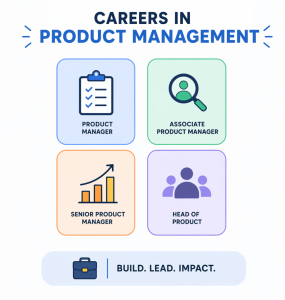
A career in product management can progress from Associate Product Manager to Product Manager, Senior Product Manager, and eventually Head of Product. As responsibilities grow, professionals take greater ownership of strategy, teams, revenue, and business outcomes. Keeping up with Product Management Trends, including AI adoption, data-driven decision-making, and outcome-focused product strategy, can help professionals build relevant expertise and strengthen their long-term career prospects.
Role
Indicative Salary in India
Associate Product Manager
₹10–22 LPA
Product Manager
₹20–40 LPA
Senior Product Manager
₹35–60 LPA
Head of Product
₹60 LPA–₹1.5 Cr+
Free Courses
Stakeholder Communication & Negotiation Skill Sets
If you’re looking to strengthen your product management expertise, the IIT Roorkee Strategic Product Management Certification, offered in collaboration with Jaro Education, provides a 5-month hybrid learning experience. The programme covers product life cycle management, user research, analytics, product strategy, and go-to-market execution which follows product management trends. With case studies and a hands-on “Build Your Own Product” project, learners can apply concepts to practical product challenges. The programme is designed for aspiring and working professionals who want to build relevant product management capabilities and stay prepared for the evolving demands of the industry.
Bachelor’s degree/equivalent with minimum 50% marks
Certification
Certificate from CEC, IIT Roorkee, subject to assessment and attendance requirements
Key Areas
Product strategy, user research, analytics, product lifecycle management, AI, business models, and GTM
Tools Covered
JIRA, Figma, Google Analytics, SQL, and APIs
Practical Learning
Build Your Own Product (BYOP), hands-on sessions, case studies, and industry-led sessions
Product Frameworks
Product roadmaps, OKRs, RICE, KANO, Business Model Canvas, and GTM frameworks
Programme Fee
₹1,55,000 + GST included
Final Thoughts
Product Management Trends are reshaping how products are researched, developed, launched, and improved. AI-powered workflows, flexible roadmaps, customer-focused discovery, data-driven decisions, and outcome-based strategies are making product management more strategic and dynamic.
For aspiring and working professionals, these changes create opportunities across technology, fintech, SaaS, healthcare, and e-commerce. Developing expertise in AI product management, product strategy, analytics, and product life cycle management can help professionals stay relevant. Practical projects and a strong portfolio can further demonstrate real-world capabilities.
Ultimately, successful product managers need strategic thinking, adaptability, customer focus, and strong decision-making skills. Staying updated with Product Management Trends and continuously building practical expertise can help professionals remain competitive and progress toward senior product and leadership roles.
Frequently Asked Questions
Product Management trends include AI-powered product management, outcome-based roadmaps, real-time decision-making, product analytics, and strategic product leadership. These trends are changing how PMs plan and manage products.
Yes, product management offers opportunities across technology, fintech, SaaS, healthcare, and e-commerce. Strong skills in AI, data, strategy, and customer understanding can improve career prospects.
AI helps PMs analyze feedback, conduct research, prioritize opportunities, and automate repetitive tasks. This allows them to spend more time on strategy, innovation, and customer-focused decisions.
Important skills include product strategy, customer research, analytics, prioritization, communication, problem-solving, and AI literacy. Strong stakeholder management is also essential for cross-functional product leadership.
A product management roadmap outlines product priorities, goals, and planned initiatives. Modern roadmaps are flexible, allowing teams to respond to customer feedback and changing market conditions.
Popular tools include Jira, Jira Product Discovery, Aha!, Linear, Figma, Airtable, and analytics platforms. They support activities such as roadmapping, research, collaboration, prioritization, and product tracking.
Manya Tohani
Personal Growth Mentor
Manya Tohani is a Personal Growth Mentor and content strategist, helping individuals build strong personal brands and accelerate career growth. With 8M+ impressions and experience mentoring students, she empowers others through actionable guidance, resilience, and real-world insights.
Get Free Upskilling Guidance
Fill in the details for a free consultation
Related Courses
Explore our programs
Post Graduate Certificate Programme in Product & Brand Management
 HOME > BLOG > Career Guidance > The 2026 Product Management Landscape: From Market Rebound to Strategic Rebirth
 April 20, 2026
 7 min read





 Key Insights
 ChatGPT
 Perplexity
 Claude
 Grok
Grok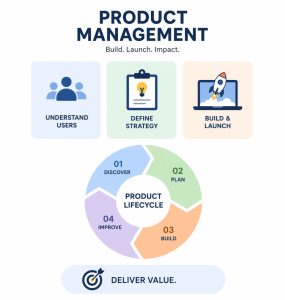









 ROI Calculator