HOME > BLOG > Business Management > The Complete Product Management Hub: Career Guide, Certifications, Interviews & Salary (2026)
Business Management
The Complete Product Management Hub: Career Guide, Certifications, Interviews & Salary (2026)
J
By Nuthana Reddy
August 5, 20267 min read
Last updated on September 17, 2026
SHARE THIS ARTICLE
Table Of Content
What Is Product Management?
Why Product Management Is Growing in India
Skills Every Product Manager Needs
Product Management Career Paths
Product management has become one of the most sought-after career paths in today's business landscape. As organizations across industries embrace digital transformation, the demand for professionals who can build customer-centric products, align business goals with technology, and drive innovation has increased significantly. From startups to Fortune 500 companies, every business is looking for skilled product managers who can bridge the gap between customers, engineering teams, marketing, and leadership.
Whether you're a student exploring career options, a working professional planning a transition, or an experienced manager looking to upskill, this comprehensive guide covers everything you need to know about product management. You'll learn what product management is, career opportunities, salary trends, interview preparation strategies, certifications, and recommended programmes that can help you accelerate your growth.
Product management is the process of planning, developing, launching, and continuously improving products that solve customer problems while achieving business objectives.
A product manager acts as the link between multiple teams including engineering, design, sales, marketing, operations, finance, and customer support. Instead of focusing only on building features, product managers ensure that the right product is built for the right audience at the right time.
The role combines business strategy, technology, customer research,analytics, and leadership. Every major decision—from identifying market opportunities to prioritising features and measuring product success—typically involves the product manager.
Modern product management revolves around answering three critical questions:
What problem are we solving?
Who are we solving it for?
Why is solving this problem valuable?
Successful product managers use customer insights, market research, competitor analysis, and business metrics to make informed decisions throughout the product lifecycle.
India has become one of the world’s fastest-growing technology ecosystems. Thousands of startups, SaaS companies, fintech firms, healthcare platforms, AI companies, and global capability centres are creating digital products for domestic and international markets.
This growth has significantly increased the demand for skilled product managers.
Several factors are driving this demand:
Digital transformation across industries
Growth of AI-powered products
Expansion of e-commerce
Rising investments in startups
Increased focus on customer experience
Global companies setting up product teams in India
Companies are no longer hiring product managers only for software businesses. Today, professionals are needed across banking, healthcare, education, manufacturing, logistics, retail, telecom, automotive, and consumer goods.
Free Courses
Stakeholder Communication & Negotiation Skill Sets
Product management is a multidisciplinary profession. Success requires both technical understanding and strong business acumen.
Some of the most important skills include:
Strategic Thinking
Product managers define long-term product vision and ensure every decision aligns with business objectives.
Customer Research
Understanding customer pain points through interviews, surveys, usability testing, and behavioural analytics is central to product success.
Data Analysis
Modern product managers rely heavily on metrics like customer retention, churn rate, conversion rate, activation rate, revenue growth, and engagement.
Communication
Since product managers coordinate with cross-functional teams daily, excellent communication is essential.
Prioritisation
Resources are always limited. Product managers must decide which features deserve immediate attention and which can wait.
Leadership Without Authority
Unlike functional managers, product managers rarely have direct authority over engineering or design teams. Their influence depends on collaboration, negotiation, and stakeholder management.
Business Understanding
Knowledge of pricing strategies, market positioning, customer acquisition, revenue models, and competitive analysis helps product managers make stronger decisions.
Product Management Career Paths
One of the biggest advantages of entering product management is the variety of career opportunities available.
Many professionals enter product management after working in software engineering, marketing, business analysis, consulting,operations, UX design, or sales.
A typical career progression looks like this:
Associate Product Manager (APM)
This entry-level role focuses on product research, documentation, market analysis, feature planning, and supporting senior product managers.
Product Manager
A product manager independently owns specific products or product modules. Responsibilities include roadmap planning, customer interviews, stakeholder management, and product launches.
Senior Product Manager
Senior product managers lead larger products, mentor junior professionals, manage complex roadmaps, and collaborate with leadership teams.
Group Product Manager
This role oversees multiple products while coordinating several product managers and ensuring strategic alignment.
Director of Product
Directors define product strategy for business units while working closely with engineering leaders and executives.
Vice President (VP) of Product
VPs oversee the complete product organisation, define innovation strategy, manage budgets, and drive business growth.
Chief Product Officer (CPO)
The CPO is responsible for the overall product vision of an organisation and plays a key role in executive decision-making.
Product management also opens doors to entrepreneurship, consulting, general management, venture capital, and startup leadership.
Product Management Salary in India (2026)
Product management continues to be among the highest-paying career options in India’s technology and business sectors.
Actual salaries vary depending on experience, location, company size, product complexity, industry, and individual performance.
Experience Level
Typical Role
Average Annual Salary (INR)
0–2 Years
Associate Product Manager
₹8–15 LPA
2–5 Years
Product Manager
₹15–28 LPA
5–8 Years
Senior Product Manager
₹28–45 LPA
8–12 Years
Group Product Manager
₹40–65 LPA
12–15 Years
Director of Product
₹60 LPA–₹1.2 Cr
15+ Years
VP Product / Chief Product Officer
₹1 Crore+
Large technology companies, unicorn startups, fintech firms, and global product organisations often provide additional benefits such as stock options, performance bonuses, and long-term incentives.
How to Become a Product Manager
Many aspiring professionals believe they need an engineering degree to enter product management. While technical knowledge is valuable, professionals from diverse backgrounds successfully transition into this field every year.
The journey generally includes four stages.
First, build a strong understanding of product management principles including customer discovery, product strategy, agile development, roadmap planning, prioritisation frameworks, and business metrics.
Second, develop practical experience by working on real projects, internships, startup initiatives, side projects, or product case studies.
Third, learn commonly used tools such as Jira, Confluence, Figma, Mixpanel, Google Analytics, SQL, Notion, and Excel.
Finally, strengthen your profile through recognised certifications and executive education programmes that provide structured learning and industry exposure.
Product Management Interview Preparation
Product management interviews evaluate far more than technical knowledge. Recruiters assess how candidates think, solve problems, communicate ideas, and prioritise business decisions.
Preparation should include structured practice across several areas.
Product Design Questions
Interviewers may ask candidates to design products for a specific audience or improve an existing product.
Examples include:
Design a fitness app for senior citizens.
Improve Google Maps.
Build a product for college students.
The focus should be on identifying customer problems, defining user personas, prioritising features, and explaining trade-offs.
Product Strategy Questions
Candidates may be asked questions like:
How would you increase revenue for an OTT platform?
Should a company launch a subscription model?
How would you enter a new market?
Strong answers combine business thinking with customer insights.
Candidates should be comfortable interpreting business metrics and making evidence-based recommendations.
Behavioural Questions
These assess leadership, collaboration, conflict resolution, and communication.
Examples include:
Tell us about a difficult stakeholder.
Describe a failed project.
Explain how you handled disagreements.
Using the STAR (Situation, Task, Action, Result) framework helps structure responses effectively.
Product Case Studies
Many companies conduct live case discussions where candidates analyse customer problems and recommend solutions within limited time.
Practising mock interviews and solving real product cases significantly improves confidence.
Top Product Management Certifications
A structured certification can accelerate your transition into product management by providing industry-relevant knowledge, practical frameworks, and networking opportunities.
When choosing a programme, consider:
Industry recognition
Curriculum relevance
Faculty expertise
Live projects or case studies
Alumni network
Flexibility for working professionals
Career support
Executive programmes offered by leading institutions often combine strategic management with practical product thinking, making them valuable for professionals seeking career advancement.
Future of Product Management
The role of product managers is evolving rapidly as artificial intelligence, automation, and digital transformation reshape businesses.
Future product managers will need stronger capabilities in AI product development, data-driven decision-making, sustainability, platform strategy, and customer experience design.
Organisations increasingly expect product managers to combine technical understanding with business leadership. Rather than simply managing roadmaps, they will influence organisational strategy, innovation, and revenue growth.
As AI handles repetitive tasks, human skills such as strategic thinking, creativity, customer empathy, and cross-functional leadership will become even more valuable.
Recommended Product Management Programmes
Professionals looking to strengthen their product management expertise can consider the following executive programmes offered through Jaro Education.
This executive programme is designed for professionals who want to build expertise in product strategy, innovation, customer-centric product development,market research, product lifecycle management, and business growth. Participants gain exposure to industry-relevant frameworks, practical case studies, and strategic decision-making skills that are valuable across technology and business sectors.
DuratIon: 5 Months
Mode of Learning: Live Online (with campus immersion)
This programme focuses on integrating product management with brand strategy, helping professionals understand consumer behaviour, product positioning, marketing strategy, innovation, pricing, and business growth. It is suitable for professionals seeking leadership roles in product and brand management across industries.
Duration: 10 Months
Mode of Learning: Direct to Device (with campus immersion)
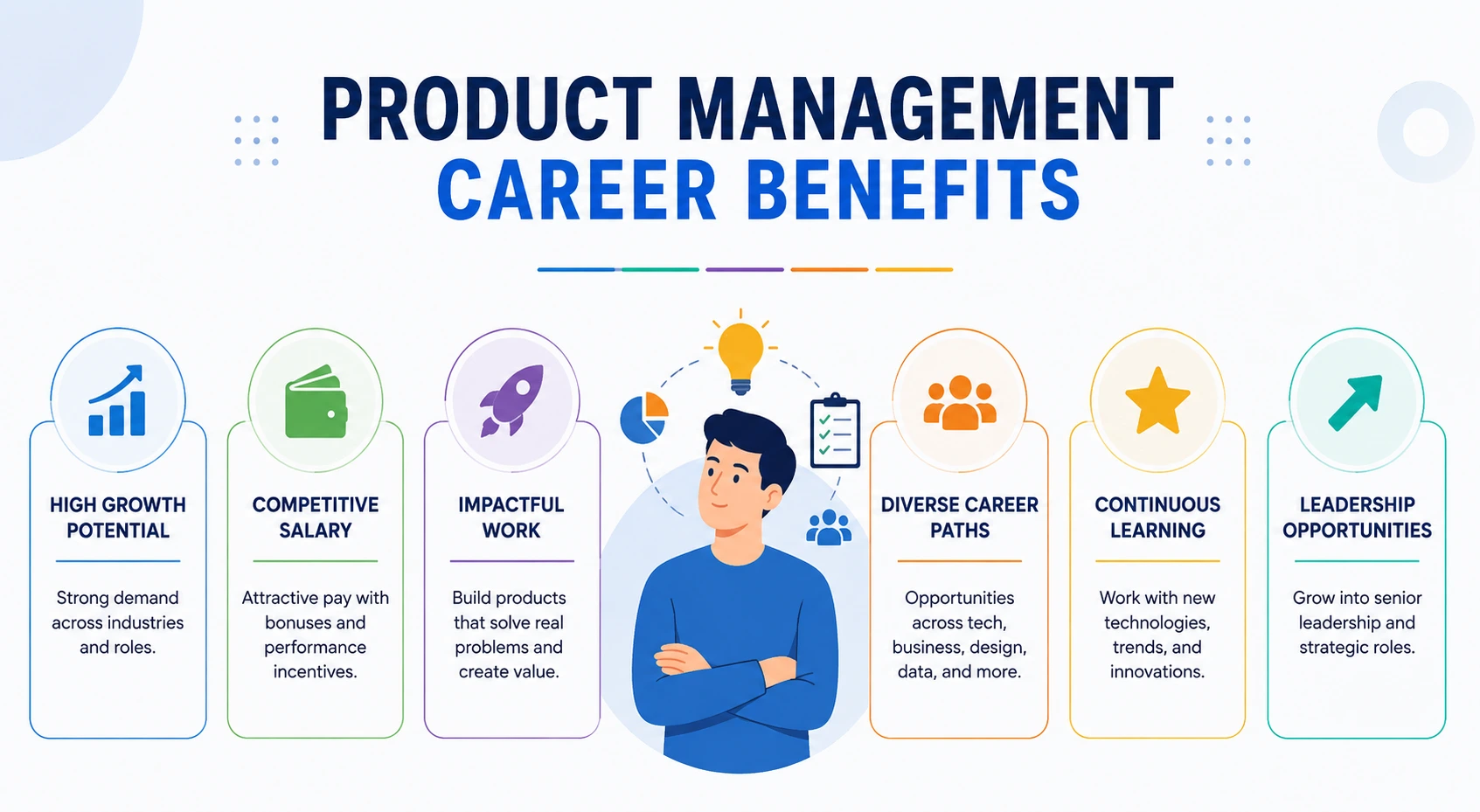
Product management has emerged as one of the most dynamic and rewarding careers for professionals who enjoy solving customer problems, working across diverse teams, and driving business innovation. With opportunities spanning technology, finance, healthcare, retail, manufacturing, and beyond, the role offers strong career progression and competitive compensation.
Whether you’re starting your journey or looking to advance into leadership roles, investing in the right skills, practical experience, and recognised certifications can significantly enhance your career prospects. Use this hub as your starting point, then explore specialised resources on product strategy, interview preparation, salary trends, certifications, and career pathways to continue building your expertise.
Frequently Asked Questions
Yes. Product management offers excellent career growth, competitive salaries, leadership opportunities, and demand across technology as well as non-technology industries.
Yes. Many companies hire Associate Product Managers (APMs). Internships, certifications, product case studies, and practical projects can improve employability.
Coding is not mandatory for every role. However, understanding software development processes, APIs, databases, and technical concepts helps product managers collaborate more effectively with engineering teams.
Production manager jobs are available across a wide range of industries, including:
Manufacturing and heavy industries.
Automotive and aerospace.
Food and beverage processing.
Pharmaceutical and chemical sectors.
Textiles, garments, and consumer goods.
Electronics and FMCG companies.
Product management focuses on deciding what should be built and why, while project management focuses on how and when work is executed to deliver projects successfully.
Nuthana Reddy
Nuthana Reddy is a Senior Manager at Procter & Gamble, specializing in operations, digitization, and cross-functional leadership. She has driven multimillion-dollar impact through innovation, process optimization, and strategic execution across global markets.
Get Free Upskilling Guidance
Fill in the details for a free consultation
Related Courses
Explore our programs
Post Graduate Certificate Programme in Strategic Product Management
 HOME > BLOG > Business Management > The Complete Product Management Hub: Career Guide, Certifications, Interviews & Salary (2026)
 August 5, 2026
 7 min read





 ChatGPT
 Perplexity
 Claude
 Grok
Grok








 ROI Calculator