 HOME > BLOG > Design Thinking > Analytical Thinking v/s Critical Thinking: Key Differences Explained
Analytical Thinking v/s Critical Thinking: Key Differences Explained
 December 9, 2025
 5 min read




Table Of Content
- Analytical Thinking Meaning
- Critical Thinking Meaning
- Key Difference Between Analytical and Critical Thinking
- Tips to Improve Analytical Thinking
Decision-making is one of the most essential parts of our daily lives. There are various situations where we are involved in making multiple decisions for both personal and professional lives. This is where critical and analytical skills come into play. These two types of cognitive skills are most often used interchangeably, but they have distinct differences. Critical thinking is about assessing information and making decisions based on evidence, while analytical thinking demands breaking down complex information into its small parts to understand its underlying structure.
So, if you’re interested in becoming a more productive problem solver in life or at work, you may work on enhancing these skills.
In this article, we will provide a clear understanding of the difference between analytical and critical thinking, and provide tips on how to improve each skill.
 ChatGPT
 Perplexity
 Claude
 Grok
GrokAnalytical Thinking Meaning
Let’s understand analytical thinking in detail. Analytical thinking is a process of breaking it down. It helps you take a complex idea, problem, or situation and divide it into smaller, clearer sections. If you can break it down into components, you can then analyse the themes, patterns, or causes.
Well, you can think of analytical thinking as using a microscope because it is helpful to understand something at a smaller level.
You use analytical thinking in the following ways.
- Analyze data
- Troubleshoot an issue
- Detect patterns
- Break tasks into steps
- Analyse the cause-and-effect of something.
Critical Thinking Meaning
Critical thinking is the process of evaluating information. Rather than break it down, you step back and analyse from a “big-picture” view. You analyse from a perspective of suggesting or asking whether the assumptions are correct, whether bias is being used on the subject, whether the information is trustworthy, and generally whether thinking about it or acting in a certain way is “best”.You can use critical thinking in the following ways.
- Compare alternatives
- Analyze intent
- Judge whether something is true
- Working through an ethical dilemma
- Making decisions from a long-term perspective.
Key Difference Between Analytical and Critical Thinking
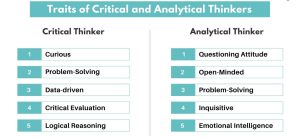 *risely.me
The difference between analytical thinking and critical thinking generally lies in the application, focus, and process. However, there are other categories in which both skills are differentiated. Let’s have a look at those categories:
| Category | Analytical Thinking | Critical Thinking |
| Primary Purpose | To break down complex information into smaller, understandable parts. | To evaluate information and make sound, logical judgments. |
| Focus Area | Understanding structure, patterns, and components. | Interpreting meaning, identifying biases, and judging credibility. |
| Main Question: It Answers | “How does this work?” or “What are the parts?” | “Is this true?”, “Is this reliable?”, or “What should I decide?” |
| Process | Linear and systematic—gather data → break down → analyse → conclude. | Iterative and flexible—ask questions → examine evidence → challenge assumptions → conclude. |
| Goal | To achieve clarity and understand the core components of a problem. | To reach the most reasonable, unbiased, and evidence-based decision. |
| Approach to Information | Analytical thinking follows the Breakdown, Classify, Organise approach. | Judge, validate, compare, interpret. |
| Use of Evidence | Focuses on factual details, data points, and measurable aspects. | Analyses meaning, context, assumptions, and reliability of evidence. |
| Type of Skill | More cognitive and technical. | More evaluative and philosophical. |
| Emotional Involvement | Emotion-neutral; relies purely on logic and facts. | Considers emotions, ethics, impacts, and alternative perspectives. |
| Problem-Solving Style | Finds root causes, identifies patterns, uncovers structures. | Evaluates solutions, weighs pros and cons, and selects the best option. |
| Scope | Narrow and deep—zooming into specific details. | Broad and wide—looking at the bigger picture. |
| Time Orientation | Short-term understanding—“What is happening?” | Long-term implications—“What will happen if…?” |
| Dependency | Depends heavily on available data and information. | Depends on interpretation, reasoning, and judgment. |
| Decision-Making Role | Helps to understand the problem before deciding. | Helps choose the best solution after understanding. |
| Best Used For | Data analysis, research, troubleshooting, diagnostics, and logical tasks. | Strategy building, ethical decisions, evaluating proposals, and policy-making. |
| Common Tools Involved | Charts, numbers, statistics, frameworks, models. | Debates, discussions, reflection, questioning frameworks. |
| Examples in Life | Breaking down a budget, analysing sales data, and solving a math problem. | Deciding whether to trust information online, comparing two job offers. |
| Examples at Work | Root-cause analysis, auditing, coding, and financial analysis. | Leadership decisions, evaluating strategies, hiring choices, and risk assessment. |
| Outcome | Insight, clarity, and understanding of problem components. | Judgement, decision, and conclusion about the best course of action. |
Tips to Improve Analytical Thinking
If you want to improve your analytical thinking abilities, here are a few practical steps that can help you out:
Practice brain games and puzzles:
Playing games like Sudoku or doing riddles, logic puzzles, etc., helps develop your skills to see patterns and think step-by-step.
Break problems into smaller steps:
If you have a considerable workload to finish all at once, break it down into smaller segments. Breaking problems down helps with understanding the construct of the problem better.
Practice looking at data:
Look at charts, reports, budgets, or surveys to help you identify trends, causes, and insights that the data may point to. Engaging with the data processes your brain into more logical and objective thoughts.
Do a case-study analysis:
Reading cases helps you get exposed to different types of problems and helps develop your learning of how solutions are created.
Reverse engineer:
Take a system, process, or product, and then mentally index down how it was put together or organised – this creates skills to understand things from the inside out.
Tips To Improve Critical Thinking
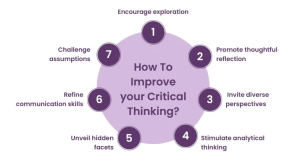 *theknowledgeacademy.com
Here are a few ways to enhance your critical thinking abilities:
Challenge your beliefs:
Don’t assume your beliefs or opinions are true. Consider whether they come from facts, habits, or bias.
Have Others’ perspectives:
Talk to people about different viewpoints or read different opinions to develop your perspective.
Read argumentative pieces:
Understand how authors lay out their arguments, what evidence they rely on and whether their reasoning is right or wrong.
Think before acting:
Take the time to think before you act. Taking time to consider and compare information will help you avoid judgment errors.
The Bottom Line
In a nutshell, enhancing your analytical and critical thinking skills is not a one-time activity, but a process that evolves from practice, new experiences, and conscious deliberation over time. If you would like to take these skills to a more applied, career-oriented level, you may want to consider registering for a Data Science certification program or taking online degree courses, such as an Online MBA through Jaro Education.
Being one of India’s leading online higher education and upskilling platforms, we bring industry-recognised programmes and advanced courses certification to enhance your skills and professional growth. Visit our website to explore our active programmes and register today.
Frequently Asked Questions
To enhance your analytical thinking skills, engage in puzzles, decompose complex issues into smaller components, focus on data interpretation practices, study and practice case analyses, and continually ask “Why?” and “How?” for deeper meaning.
Challenging your assumptions, trying out new perspectives, reading opinion-based articles, analysing arguments, and revisiting your previously made decisions are the best types of activities that will have a powerful impact on your critical thinking development.
Yes. You can develop analytical thinking and critical thinking with daily habits—problem-solving, reflective thinking, and quality content consumption—although structured content can help expedite the learning process.
These skills will allow you to make better informed decisions, analyse data for interpretation, work through problems, think strategically, and incorporate complex tasks into your daily role—all of which will be valued in almost any profession.
Related Courses
Explore our programs






Find a Program made just for YOU
We'll help you find the right fit for your solution. Let's get you connected with the perfect solution.
Is Your Upskilling Effort worth it?
 ROI Calculator

Are Your Skills Meeting Job Demands?
Try our Skill Gap tool
Experience Lifelong Learning and Connect with Like-minded Professionals
Explore Jaro Connect
