
How to Develop Strategic Thinking Skills for Career Success
 December 11, 2025
 8 min read




Table Of Content
- What is Strategic Thinking?
- What Are Strategic Thinking Skills?
- 6 Ways To Develop Strategic Thinking Skills
- How Jaro Education Can Help You Build Your Career
Think of the last time you were in your workplace as part of a strategy meeting or brainstorming discussion. You likely faced either a difficult problem to solve or a significant organisational objective. What did you do? Did you willingly contribute ideas, propose a plan, and move the conversation forward? Or, did you sit back, quietly observing your colleagues making contributions?
In today’s workplace, strategic thinking is one of the most important skills to possess, and for good reason. People who can connect the dots, see a higher-level perspective, and think into the future are often the big innovators.
Moreover, strategic thinking is not only for elite executives. Anyone can become a strategic thinker with awareness, curiosity, and practice. Let us consider ways you can strengthen your strategic thinking abilities and showcase them the next time you are part of a significant decision-making discussion. But before that we will give you an overview of what is strategic thinking and what are the most important strategic thinking skills. Let’s begin.
 ChatGPT
 Perplexity
 Claude
 Grok
GrokWhat is Strategic Thinking?
Strategic thinking is simply the capability to solve complex situations, predict challenges, and take actions that align with longer-term aspirations. It entails more than just “solving problems” meanwhile, it is also about developing an accurate understanding of why something has happened and how your actions today contribute to the outcomes you seek for tomorrow.In the work-related context, strategic thinking is a process of thinking about your department or division in the broader context of the organization. It is about identifying how your everyday work contributes to the company’s mission and properly anticipating what actions to take next to cultivate sustained growth.
In contrast to tactical thinking, which is focused on short-term action, strategically thinking takes a broader view. It is about recognizing trends and patterns, as well as assessing risks and spotting opportunities, that others may overlook. Being able to think strategically, will enable professionals to be smarter planners, more effective leaders, and will help professionals be able to respond more confidently in an ever-changing business environment.
*kapable.club
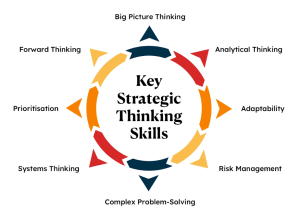
What Are Strategic Thinking Skills?
As a professional, if you want to have a bigger perspective to understand where the organisation is today and where it wants to be tomorrow, it is important to have the right skills. So, here’s the breakdown of essential strategic thinking skills that every professional should develop:
- Analytical Skills: Analytical skills are used when one is able to evaluate various data, including performance measures and financial reports, market signals, competitive condition, and prepare to reveal patterns and new insights, and initiate development of thoughtful, grounded, and evidence based strategies.
- Communication Skills: Once you have the great ideas, the importance of clearly communicating that idea is essential. Communication will assure that the teams are aligned with the vision, collaborative with similar outcomes, and influenced with the establishment of shared goals.
- Problem-Solving Skills: When you are dealing with a sales drop, process improvement, or a new challenge, problem solving is the most important part of strategic thinking. You creatively and logically link problems to solutions.
- Planning and Management Skills: Thinking strategically and execution are two sides of the coin. After you strategically think and plan, you’ll need structured project management and planning skills to implement your vision.
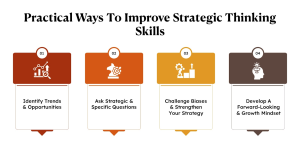
6 Ways To Develop Strategic Thinking Skills
 *kapable.club
1. Be Willing to Experiment
One of the simplest ways to enhance your strategic thinking is to be open to experimentation. A lot of professionals want to work on projects they already know; they don’t want to leave their comfort zone. But the places that you truly grow is by leaving that comfort zone.
You can start small; offer to work on new projects or ask if you can improve and streamline old ways of doing things. Ask yourself:
- “Why do we do it that way?”
- “What if we try it a different way?”
Once you start to question the current assumptions, this starts to open up a whole new realm of a better way of doing things. Gather data, find resources, and determine what success will look like in this experiment. Once you try the idea, review the outcome and take notes on what worked and what didn’t.
The more you experiment with your judgment, the more refined it becomes. Even when your attempt doesn’t work, the lessons you learn from this experience will be helpful in informing your strategies in the future. This is a sign of a real strategist.
2. Evaluate the External Landscape
If you only focus on your work and day-to-day responsibilities, you’ll lose sight of the larger, broader view. To adopt a strategic mindset, you must see everything in relation to outside components that relate to you, your role, your team, and your organisation.
To make space for systemic thinking, first look around you:
- How are other teams within your organization addressing similar problems?
- What are the innovative practices that they might be using that might work for you?
Next, you can start to look outside of the organization to industry trends, competitor activity and global shifts. Seeing the effect of technology, public policy and economic movements influence your market is key to anticipating potential moves.
Ask yourself:
- Are we in a leadership position in our field or lagging?
- What challenges and/or opportunities might arise in a year?
A good strategist doesn’t simply respond when change takes place, they think ahead in preparing for changes to come. Regularly assessing what’s going on in the outside world will ensure your work remains at the tipping point of being relevant.
3. Consider Multiple Scenarios
Let’s be honest here, in an unpredictable world, hope is a terrible strategy. Strategic thinkers always adopt a plan B strategy.
When developing plans, think through as two or three possible scenarios:
- Best-case scenario – Everything goes according to plan.
- Mid-case scenario – Some obstacles arise, but they are manageable.
- Worst-case scenario – Significant disruption occurs, calling for a change in direction.
For each scenario, think through:
- What risks and trade-offs exist?
- What unknowns could derail this plan?
- How will you manage flexibility in responding to changes?
Once you are finished with a project, don’t forget to assess what worked and what didn’t. Having an ongoing “post-mortem” assessment process will allow you to capture valuable learnings for your next planning process.
4. Engage Others in the Process
Regardless of your level of proficiency, successful strategies are rarely made alone. Involving other people into your process will enable you to see blind spots, test your assumptions, and sharpen your ideas.
Use those opportunities to engage others, especially your colleagues from different departments or even different cultures, and ask them for their observations:
- How do they see the problem at hand?
- What risks or opportunities do they see?
It is important to remember that collaboration is not simply an agreement, but importantly alignment. To that end, you want to build alignment through active listening and transparent communication, which sets the expectation that everyone is moving toward the same vision. Strategic thinkers are skilled at realising their success rests in people working together rather than in silos.
5. Communicate in Terms of Impact
You may come up with the most brilliant idea, but if you can’t communicate it, it might never see the light of the day. This is why communication is such an important part of strategic thinking.
When you are presenting ideas, don’t stop at what you are proposing, explain why it is important.
Connect your ideas to larger organizational objectives. For example:
- How do your ideas increase efficiency, reduce costs, or create customer happiness?
- What does your approach add to the long-term health of the organization?
Change your style based on your audience. For example, when speaking to executives, focus on business impact and scalability. When brainstorming with peers, focus on the value of working together and getting it done.
6. Make It a Daily Habit
Strategic thinking isn’t a switch you choose to flip on for your annual reviews or for your planning process – it is part of your daily practice.
Try to ask yourself small but mighty questions daily, like:
- “How does this assignment support our larger goals?”
- “Is there an easier, more efficient way to do this?”
- “What future contingencies might this decision impact?”
Asking yourself these questions throughout your day will help you train your mind towards critical and strategic thinking. You will start to consistently connect your daily activity to the broader, strategic objectives of the organization.
*mckinsey.com




How Jaro Education Can Help You Build Your Career
Strategic thinking skills require us not only to learn theories but also to put together structured knowledge and principles of leadership within professional contexts. That is the mission of Jaro Education.
Jaro Education is a leading online higher education platform and collaborates with leading universities and institutes to create programs that are relevant to industry in management, business strategy, and leadership. Our online degree courses and certification programs are designed for freshers and working professionals to develop and grow their analytical, problem-solving, and planful-strategic thinking, which is of great value for your career development.
When you choose Jaro, you’ll receive:
- Programs that have international recognition, providing further depth to your decision-making framework with deeper decision-making and leadership.
- Flexible online learning, compatible with your commitments and responsibilities, while ensuring an academic rigor.
- Guidance from mentors, who are leaders in industry, that will help you navigate real-world challenges with strategy.
- Career support that includes networking and counseling for effective and successful application to your workplace.
Conclusion
In an ever-changing business world, strategic thinking is a game-changer. It allows you to step outside of challenges, think about problems that may arise, and create opportunities for long-term success. But remember that strategic thinkers are not born. They are developed with experience, learning, and ongoing reflection about their experiences. Therefore, start small, be inquisitive, and practice daily with the above mentioned steps for building strategic thinking
Frequently Asked Questions
Related Courses
Explore our programs





Find a Program made just for YOU
We'll help you find the right fit for your solution. Let's get you connected with the perfect solution.
Is Your Upskilling Effort worth it?
 ROI Calculator

Are Your Skills Meeting Job Demands?
Try our Skill Gap tool
Experience Lifelong Learning and Connect with Like-minded Professionals
Explore Jaro Connect
