HOME > BLOG > Career Development > Product Manager vs Data Scientist: Which Role Pays More and Which Is Harder to Break Into?
Career Development
Product Manager vs Data Scientist: Which Role Pays More and Which Is Harder to Break Into?
J
By Nuthana Reddy
July 29, 202613 min read
Published on July 29, 2026
SHARE THIS ARTICLE
Table Of Content
Understanding the Role of a Product Manager
Understanding the Role of a Data Scientist
Product Manager vs Data Scientist: Key Responsibilities
Skills Required for Product Managers
This comprehensive guide compares both careers based on salaries, required skills, job responsibilities, career growth, and the difficulty of breaking into each field. Discover which role aligns best with your interests, strengths, and long-term career goals in today's evolving tech landscape.
Over the past decade, Product Managers and Data Scientists have emerged as two of the most sought-after professionals in the technology industry. As organizations become increasingly data-driven and customer-centric, both roles play a critical part in building products, solving business problems, and driving innovation. Consequently, professionals and fresh graduates often find themselves asking an important question: Which career is better—Product Manager or Data Scientist?
While both professions offer attractive salaries, exciting career paths, and opportunities to work with cutting-edge technologies, they differ significantly in terms of responsibilities, required skills, educational background, and entry barriers. A Product Manager acts as the bridge between business, technology, and users, ensuring that products solve real customer problems. A Data Scientist, on the other hand, focuses on extracting meaningful insights from large datasets using statistical analysis, programming, and machine learning.
Choosing between these careers isn't simply about selecting the one with the higher salary. It also depends on your interests, strengths, career aspirations, and willingness to learn technical or business skills. Some professionals enjoy working closely with customers, defining product strategies, and collaborating with multiple teams, while others are passionate about coding, mathematics, artificial intelligence, and uncovering patterns in data.
This article compares Product Managers and Data Scientists across several important parameters, including job responsibilities, required skills, salary potential, career growth, hiring demand, and the difficulty of entering each profession. By the end, you'll have a clearer understanding of which role aligns better with your career goals.
A Product Manager (PM) is often described as the “CEO of a product,” although the role involves influence rather than authority. Product Managers are responsible for defining what products should be built, why they should be built, and how they create value for customers and businesses.
Instead of writing code every day, Product Managers spend much of their time understanding customer needs, conducting market research, defining product roadmaps, prioritizing features, and coordinating with engineering, design, marketing, sales, and leadership teams.
Their primary objective is to ensure that a product meets customer expectations while also achieving business goals. Whether it’s launching a new mobile application, improving an e-commerce platform, or developing AI-powered software, Product Managers oversee the product journey from concept to launch and beyond.
A typical day for a Product Manager involves stakeholder meetings, analyzing customer feedback, reviewing product performance metrics, prioritizing development tasks, and making strategic decisionsthat influence the product’s future.
As companies increasingly adopt digital transformation, the demand for skilled Product Managers continues to grow across industries including fintech, healthcare, e-commerce, SaaS, automotive, and consumer technology.
Understanding the Role of a Data Scientist
A Data Scientist transforms raw data into actionable business insights. Organizations today generate enormous volumes of structured and unstructured data through websites, mobile apps, customer transactions, sensors, and digital platforms. Data Scientists help businesses understand this information and make informed decisions.
Unlike Product Managers, Data Scientists spend most of their time working with programming languages, statistical models, databases, machine learning algorithms, and visualization tools.
Their work generally includes collecting data, cleaning datasets, identifying trends, building predictive models, testing hypotheses, and communicating insights to business leaders.
For example, an online retailer may use Data Scientists to predict customer purchasing behavior, while a bank might employ them to detect fraudulent transactions. Healthcare organizations use Data Scientists to improve diagnosis accuracy, and streaming platforms rely on them to recommend personalized content.
The role requires a strong analytical mindset and the ability to solve complex business problems through quantitative methods.
Product Manager vs Data Scientist: Key Responsibilities
Although both professionals contribute to organizational success, their day-to-day responsibilities are quite different.
The Product Manager focuses primarily on what should be built, while the Data Scientist answers what the data reveals and what decisions should be made based on evidence.
Skills Required for Product Managers
A Product Manager requires a balanced mix of business knowledge, communication skills, analytical thinking, and leadership abilities. While technical knowledge is beneficial, the role is not entirely dependent on programming expertise.
Successful Product Managers are typically strong communicators who can align diverse teams toward common objectives. They need to understand customer behavior, market trends, competitive landscapes, and business strategies.
Modern Product Managers also benefit from familiarity with AI, cloud computing, and data analytics, as technology increasingly shapes product development.
The Data Scientist role is considerably more technical and demands expertise in mathematics, programming, and statistical analysis.
Professionals entering this field are expected to work with large datasets, write efficient code, and develop machine learning models that solve business challenges.
Key technical competencies include knowledge of Python or R, SQL, probability, statistics, data visualization, machine learning, deep learning fundamentals, and cloud-based analytics platforms.
Apart from technical expertise, Data Scientists also require strong problem-solving skills, business understanding, and the ability to communicate complex analytical findings in a simple manner.
As artificial intelligence continues to evolve, professionals who combine machine learning expertise with domain knowledge are becoming increasingly valuable across industries.
Educational Background
One of the biggest differences between these careers lies in educational expectations.
Many Product Managers come from diverse educational backgrounds, including engineering, business administration, economics, marketing, finance, and even design. Some professionals transition into Product Managementafter gaining experience in software development, consulting, project management, or digital marketing.
Data Scientists, however, generally require a stronger quantitative foundation. Employers often prefer candidates with degrees in computer science, statistics, mathematics, economics, engineering, or related disciplines.
Although certifications and online learning have made career transitions easier, mastering Data Science still requires considerable technical learning compared to Product Management.
Which Role Pays More?
Compensation is often one of the biggest deciding factors for professionals exploring these careers.
At the entry level, Data Scientists frequently earn slightly higher salaries because of the technical complexity of the role and the relatively limited supply of skilled professionals. Companies are willing to pay a premium for candidates who possess expertise in machine learning, programming, andadvanced analytics.
However, salary growth tells a more nuanced story.
As Product Managers gain experience and move into senior leadership positions such as Senior Product Manager, Group Product Manager, Director of Product, or Vice President of Product, their compensation can increase dramatically. These roles often include bonuses, stock options, and performance incentives, especially in technology companies and startups.
Data Scientists also experience significant salary growth, particularly when progressing into positions such as Senior Data Scientist, Machine Learning Engineer, AI Specialist, or Head of Data Science.
In large global technology companies, compensation for both professions can be exceptionally competitive, often exceeding industry averages due to stock grants and performance-based rewards.
Generally speaking, experienced professionals in either career can command high salaries, but Product Managers in leadership positions often have a higher long-term earning ceiling because they directly influence business strategy and revenue generation.
Salary Comparison
The table below provides a broad comparison of average annual salary ranges. Actual compensation varies depending on country, experience, company size, industry, and technical expertise.
Experience
Product Manager
Data Scientist
Entry Level
$75,000–$110,000
$85,000–$120,000
Mid-Level
$110,000–$160,000
$120,000–$170,000
Senior Level
$160,000–$250,000+
$150,000–$230,000+
While Data Scientists often enjoy a higher starting salary, senior Product Managers and Product Leaders can surpass them in overall compensation, particularly in high-growth technology firms.
This is perhaps the most debated question among aspiring professionals.
From a purely technical perspective, Data Science is generally more difficult to enter. Candidates need to master programming, statistics, linear algebra, machine learning,data engineering concepts, and analytical thinking before becoming job-ready. Building a strong portfolio with real-world projects is also essential.
Product Management, on the other hand, has fewer technical barriers but demands a different set of competencies. Employers often prefer candidates with prior industry experience, strong communication skills, business acumen, and an understanding of customer needs. Many Product Managers transition into the role from software engineering, business analysis, consulting, marketing, or UX design.
While breaking into Product Management without experience can be challenging, the learning curve is often less technical than that of Data Science. However, success in Product Management depends heavily on strategic thinking, stakeholder management, and leadership capabilities rather than coding expertise.
Career Growth Opportunities
Both Product Managers and Data Scientists enjoy strong long-term career prospects, but their career trajectories differ significantly.
A Product Manager’s growth is largely tied to leadership and strategic decision-making. As professionals gain experience, they begin managing larger products, leading multiple teams, and influencing company-wide business strategies. Their career progression often moves from Associate Product Manager to Product Manager, Senior Product Manager, Group Product Manager, Director of Product, Vice President of Product, and eventually Chief Product Officer(CPO). Professionals with exceptional leadership skills may even transition into executive management roles or become startup founders.
Data Scientists, meanwhile, follow a more technical growth path. They begin as Junior Data Scientists or Data Analysts before progressing to Senior Data Scientist, Lead Data Scientist, Principal Data Scientist, Machine Learning Engineer, AI Architect, Head of Data Science, and Chief Data Officer. Their advancement depends heavily on technical expertise, research capabilities, and experience with large-scale AI and machine learning systems.
While Product Management offers broader business leadership opportunities, Data Science provides deeper specialization in advanced technologies. The better option depends on whether you prefer managing people and products or solving technical problems through data.
Industry Demand: Which Career Has Better Job Opportunities?
Digital transformation has significantly increased the demand for both Product Managers and Data Scientists across industries. However, the type of demand differs.
Product Managers are required wherever organizations build digital products or services. Technology companies, fintech firms, healthcare providers, e-commerce businesses, manufacturing companies, and even government organizations increasingly hire Product Managers to oversee digital initiatives and customer-centric innovation.
Data Scientists, on the other hand, are in demand wherever organizations rely on data-driven decision-making. Industries such as banking, insurance, pharmaceuticals, retail, logistics, telecommunications, cybersecurity, and artificial intelligence actively recruit professionals capable of extracting insights from large datasets.
Although Data Science remains one of the fastest-growing technical careers, Product Management has experienced equally strong growth due to the rapid expansion of software products and digital businesses.
The demand for both roles is expected to remain strong over the coming years, with companies continuing to invest heavily in artificial intelligence, automation, cloud computing, and digital product development.
Impact of Artificial Intelligence on Both Careers
Artificial Intelligence is reshaping nearly every profession, and Product Management and Data Science are no exceptions.
For Data Scientists, AI has automated several repetitive tasks such as data cleaning, feature engineering, and model generation. Modern AI-assisted tools allow professionals to develop machine learning models more efficiently. However, this does not reduce the importance of Data Scientists. Instead, their responsibilities are shifting toward solving complex business problems, validating AI-generated models, ensuring ethical AI implementation, and interpreting results.
Product Managers are also benefiting from AI. AI-powered analytics tools help them understand customer behavior, predict market trends, prioritize product features, and make data-backed decisions faster than before. Additionally, many organizations now require Product Managers to understand AI-powered products, generative AI applications, and responsible AI governance.
Rather than replacing these professionals, AI is increasing expectations. Both Product Managers and Data Scientists are expected to work alongside AI tools while focusing on strategic thinking, creativity, and business impact.
Work-life balance often depends more on the company culture than on the profession itself. Nevertheless, there are noticeable differences between the two roles.
Product Managers frequently coordinate with multiple teams, attend stakeholder meetings, handle product launches, and manage changing priorities. During major product releases or critical business initiatives, longer working hours are common. The role involves constant communication and decision-making, making it mentally demanding.
Data Scientists generally spend more time working independently on technical tasks such as coding, data analysis, experimentation, and model development. Although project deadlines can create periods of high workload, the role often offers greater flexibility and uninterrupted focus time.
Professionals who enjoy collaboration, fast-paced environments, and cross-functional leadership may find Product Management more engaging. Those who prefer deep technical work and analytical problem-solving may appreciate the work style of Data Science.
Technical Complexity
One of the most significant distinctions between these careers lies in their technical requirements.
Data Science has a steeper learning curve because it requires expertise in multiple technical domains. A successful Data Scientist is expected to understand programming languages such as Python or R, SQL databases, statistics, probability, linear algebra, machine learning algorithms, data visualization, and cloud computing platforms. Continuous learning is essential because technologies evolve rapidly.
Product Management, while less dependent on coding, demands broad business knowledge. Professionals must understand customer psychology, market dynamics, software development processes, product lifecycle management, user experience, financial planning, and stakeholder communication. They also need strong decision-making abilities, leadership skills, and the capacity to balance competing priorities.
In simple terms, Data Science is technically deeper, while Product Management is strategically broader.
Which Role Is Better for Fresh Graduates?
Fresh graduates often wonder which profession offers a smoother entry into the technology industry.
Graduates with backgrounds in computer science, engineering, mathematics, statistics, or economics may find Data Science a more natural progression because it builds upon their academic knowledge. However, employers often expect practical experience through internships, research projects, or machine learning portfolios.
Breaking directly into Product Management as a fresher is generally more challenging because companies prefer candidates with business exposure or product development experience. Many professionals enter Product Management after working as software engineers, business analysts, consultants, UX designers, or marketing specialists.
That said, Associate Product Manager (APM) programs offered by leading technology companies have created opportunities for talented fresh graduates with exceptional analytical and communication skills.
Transitioning Into These Careers
Career transitions into both professions have become increasingly common.
Professionals from software engineering, quality assurance, digital marketing, consulting, finance, and business analysis frequently transition into Product Management by developing product thinking, customer research capabilities, and strategic decision-making skills.
Similarly, professionals from mathematics, engineering, economics, business intelligence, and software development often move into Data Science by learning programming, machine learning, statistics, and data analytics through certifications, online courses, and hands-on projects.
Neither career requires a rigid educational pathway, but consistent skill development and practical experience remain essential.
Advantages and Challenges of Product Management
Product Management offers professionals the opportunity to shape products that millions of users may interact with daily. The role provides exposure to multiple business functions, making it ideal for individuals who enjoy solving customer problems while influencing organizational strategy.
The profession also offers attractive compensation, leadership opportunities, and the possibility of advancing into executive positions.
However, the role comes with challenges. Product Managers frequently deal with conflicting stakeholder expectations, shifting priorities, tight deadlines, and difficult trade-offs. Success often depends on communication, negotiation, and decision-making under uncertainty.
Advantages and Challenges of Data Science
Data Science appeals to individuals who enjoy mathematics, programming, and analytical thinking. It provides opportunities to work with advanced technologies such as artificial intelligence, machine learning, and predictive analytics.
Professionals in this field often solve complex business challenges and contribute directly to innovation across industries. Technical expertise also makes Data Scientists valuable in research, healthcare, finance, cybersecurity, and autonomous systems.
The primary challenge is the continuous need to upgrade technical skills. New algorithms, programming frameworks, cloud technologies, and AI tools emerge regularly, requiring lifelong learning. Additionally, understanding business problems and communicating technical findings effectively are becoming increasingly important.
Product Manager vs Data Scientist: A Quick Comparison
Parameter
Product Manager
Data Scientist
Primary Focus
Product strategy and customer value
Data analysis and predictive insights
Technical Skills
Moderate
High
Programming Requirement
Basic understanding helpful
Essential
Business Exposure
Very High
Moderate
Leadership Opportunities
Excellent
Good
Entry Difficulty
Moderate
High
Learning Curve
Business-oriented
Technical and mathematical
Starting Salary
High
Slightly Higher
Long-Term Salary Potential
Very High
Very High
Best For
Strategic thinkers and communicators
Analytical and technical problem-solvers
How to Choose the Right Career
The decision between Product Management and Data Science should not be based solely on salary. Instead, consider your interests, natural strengths, and long-term aspirations.
If you enjoy understanding customer needs, collaborating with diverse teams, making strategic decisions, and influencing business outcomes, Product Management may be the right fit. It rewards strong communication, leadership, and business thinking.
On the other hand, if you are passionate about coding, mathematics, artificial intelligence, statistics, and solving complex analytical problems, Data Science offers a rewarding and intellectually stimulating career. It is particularly suitable for individuals who enjoy continuous technical learning and working with cutting-edge technologies.
Both professions provide excellent opportunities for career advancement, financial growth, and global employability. The best choice is the one that aligns with your skills and motivates you to keep learning.
Conclusion
Product Managers and Data Scientists are among the most influential professionals in today’s technology-driven economy. While they often work together to build better products and make smarter business decisions, their responsibilities, skill requirements, and career paths are fundamentally different.
Data Scientists generally face a steeper learning curve due to the technical expertise required in programming, statistics, and machine learning. Consequently, entering the field may require more intensive preparation. Product Management, although less technical, demands exceptional leadership, strategic thinking, communication, and business acumen, making it equally challenging in different ways.
When it comes to salaries, both careers offer impressive earning potential. Data Scientists may enjoy slightly higher starting compensation, while experienced Product Managers often achieve higher executive-level earnings through leadership roles, stock options, and business impact.
Ultimately, neither profession is universally “better.” Success depends on choosing a path that matches your interests, strengths, and long-term goals. As technology continues to evolve, professionals in both fields will remain highly valuable, making either career a strong investment for the future.
Frequently Asked Questions
Entry-level Data Scientists often earn slightly higher salaries due to their specialized technical skills. However, experienced Product Managers in leadership roles can earn equal or even higher compensation, especially in large technology companies.
Product Management generally has a lower technical barrier to entry, while Data Science requires expertise in programming, statistics, mathematics, and machine learning. However, Product Management demands strong leadership, strategic thinking, and stakeholder management skills.
Yes. Many Data Scientists transition into Product Management after gaining business knowledge, customer understanding, and product strategy experience, particularly in AI-driven organizations.
Both careers are expected to remain in high demand as businesses continue investing in digital products, artificial intelligence, data analytics, and automation. The choice depends more on your interests than market demand.
Product Management is generally more accessible for professionals without extensive coding experience, although having a basic understanding of technology and software development is an advantage.
Nuthana Reddy
Nuthana Reddy is a Senior Manager at Procter & Gamble, specializing in operations, digitization, and cross-functional leadership. She has driven multimillion-dollar impact through innovation, process optimization, and strategic execution across global markets.
 HOME > BLOG > Career Development > Product Manager vs Data Scientist: Which Role Pays More and Which Is Harder to Break Into?
 July 29, 2026
 13 min read





 ChatGPT
 Perplexity
 Claude
 Grok
Grok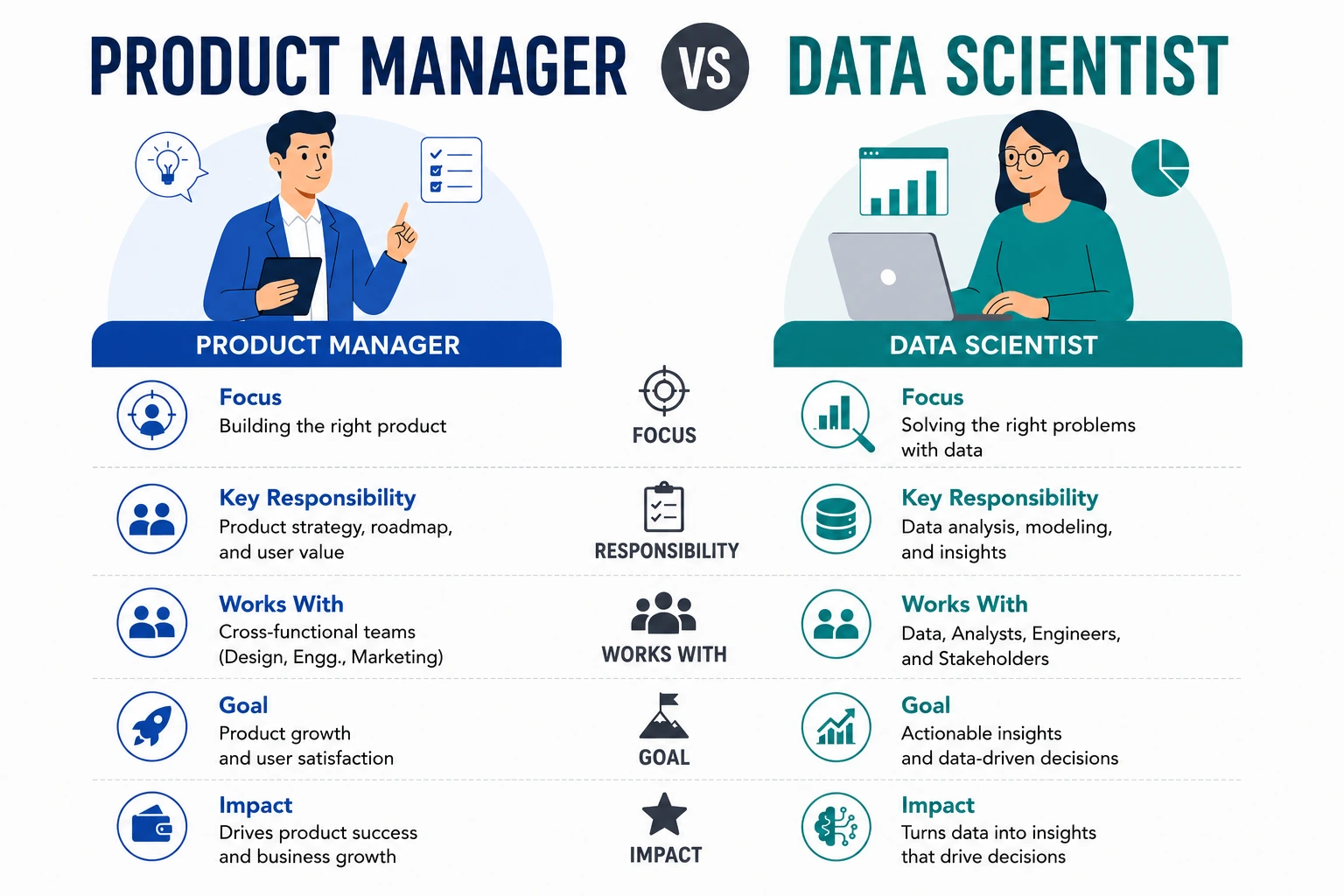












 ROI Calculator