Big data analytics is not a background technology. It is the foundation on which AI diagnostic systems, predictive clinical tools, population health management, and operational efficiency programmes are built. Understanding it is not optional for healthcare professionals working in Industry 5.0 environments.
The term ‘big data‘ is often used loosely. In healthcare specifically, big data refers to datasets with four characteristics — the traditional 4Vs:
Volume: A single large hospital generates terabytes of data daily — Electronic Health Records (EHRs), medical imaging files, laboratory results, pharmacy records, insurance claims, IoT sensor streams from monitoring equipment. India’s national ABDM system, when fully operational, will be one of the largest health databases in the world.
Variety: Healthcare data is highly heterogeneous — structured data (lab values, vital signs, diagnosis codes), semi-structured data (HL7 FHIR messages, ICD-10 codes), and unstructured data (clinical notes, radiology reports, discharge summaries, ECG waveforms, medical images).
Velocity: ICU monitoring generates continuous real-time streams of vital sign data. Emergency departments generate high-velocity event data. Claims processing generates batch data. Each requires different analytical approaches .
Veracity: Healthcare data is notoriously messy — missing values, inconsistent coding, transcription errors, variable data entry quality across providers. Data quality management is one of the most significant practical challenges in healthcare analytics.
5 Major Application Areas of Big Data Analytics in Healthcare
1. Clinical Decision Support and Predictive Modelling
Predictive models built on large patient datasets can identify patients at risk of clinical deterioration before symptoms become obvious. This is the most direct application of big data to patient outcomes:
Sepsis prediction: Models trained on thousands of sepsis cases identify the early pattern of vital signs, lab values, and clinical notes that precede septic shock by 6–12 hours. Early intervention reduces mortality significantly.
Readmission prediction: Identifying patients at high risk of readmission within 30 days of discharge — enabling targeted care transition support. CMS in the US has made this a reimbursement metric; India’s insurance-driven quality reporting is moving in the same direction.
Deterioration alerts: Real-time algorithms (like the NEWS score, enhanced by ML) that continuously monitor inpatient vital signs and alert nursing staff before a patient deteriorates to the point of needing ICU transfer.
Chronic disease progression: Predicting which diabetic patients will develop nephropathy, which hypertensive patients are at high risk of stroke, enabling preventive intervention at the primary care level — critical for India’s chronic disease burden management.
2. Population Health Management
Population health management uses analytics on aggregated patient data to understand disease burden, identify high-risk groups, and design targeted interventions at the population level. This is the analytical backbone of public health programmes:
Disease surveillance: Analysing real-time data from hospitals, pharmacies, and laboratories to detect emerging infectious disease outbreaks. India’s IDSP (Integrated Disease Surveillance Programme) is a national example; COVID-19 response data analytics drove many of the containment decisions.
High-risk population identification: Using claims data, EHR data, and social determinants of health data to identify populations at highest risk — enabling insurance companies, government schemes (Ayushman Bharat PM-JAY), and hospital networks to target preventive care resources.
Health equity analytics: Identifying disparities in care access and outcomes across geographic, demographic, and socioeconomic groups — informing health policy and resource allocation decisions.
3. Genomics and Precision Medicine
Genomic datasets are among the largest in healthcare — a single whole genome sequence is 200GB of raw data. Big data analytics applied to genomics enables:
Cancer genomics: Identifying tumour-specific mutations that predict response to targeted therapies — enabling oncologists to select treatments based on the molecular profile of a specific patient’s cancer rather than cancer type alone.
Pharmacogenomics: Using genetic data to predict how individual patients will respond to specific drugs — reducing adverse drug reactions and improving treatment efficacy.
Population genomics: India’s IndiGen programme has built a genomic database of Indian populations — creating the reference data needed to develop precision medicine approaches calibrated to India’s genetic diversity.
4. Operational and Financial Analytics
Big data analyticsin hospital operations translates directly into cost reduction and efficiency gains — areas of direct interest to healthcare administrators and managers:
Bed management and capacity planning: Predictive models that forecast admission volumes by day, week, and season — enabling hospitals to plan staffing, bed allocation, and theatre scheduling proactively rather than reactively.
Supply chain optimisation: Analysing consumption patterns for pharmaceuticals, blood products, and consumables to reduce stockouts and minimise wastage. In large hospital groups, this alone can represent savings of ₹2–5 crore annually.
Denial management and revenue cycle analytics: Analysing insurance claims denial patterns to identify systemic coding or documentation issues — reducing revenue leakage.
Surgical theatre utilisation: Analytics on theatre scheduling, turnover times, and case duration to maximise utilisation of one of the most expensive resources in a hospital.
5. Drug Discovery and Clinical Trial Analytics
Big data analytics is transforming pharmaceutical R&D — though this application is more relevant to pharma and biotech professionals than to most hospital-based healthcare administrators:
Target identification: Analysing large genomic, proteomic, and clinical datasets to identify disease targets for new drugs
Clinical trial design: Adaptive trial designs that use interim analysis of accumulating trial data to modify dosing, patient selection, or endpoints in real time
Real-world evidence (RWE): Using post-marketing data from EHRs and insurance claims to assess drug safety and effectiveness in real patient populations — supplementing randomised controlled trial evidence
Key Analytical Methods Used in Healthcare Big Data
Healthcare professionals working with data teams or evaluating analytical systems benefit from understanding the methods being used:
Method
What it does
Healthcare Application
Logistic Regression
Predicts binary outcomes (event/no event)
Readmission risk, disease diagnosis (yes/no)
Random Forests / XGBoost
Ensemble ML — high accuracy on tabular data
Sepsis prediction, length of stay prediction
Deep Learning (CNN)
Image pattern recognition
Radiology AI, pathology slide analysis
Natural Language Processing
Extracts meaning from unstructured text
Clinical note mining, medical coding, evidence synthesis
Time Series Analysis (LSTM)
Analyses sequential/temporal data
ICU vital sign monitoring, epidemic forecasting
Survival Analysis
Models time-to-event outcomes
Disease progression, treatment effectiveness
Network Analysis
Maps relationships between entities
Disease comorbidity networks, drug interaction mapping
Federated Learning
Trains models across distributed data without sharing raw data
Multi-hospital AI model development with privacy preservation
India-Specific Context: Big Data in Healthcare 2026
Several India-specific developments make big data analytics in healthcare particularly important in 2026:
ABDM Health Data Management Policy: The Ayushman Bharat Digital Mission’s data policy framework governs how health data can be collected, stored, and used — creating compliance requirements for every healthcare organisation deploying analytics.
DPDP Act 2023: India’s Digital Personal Data Protection Act places explicit obligations on organisations processing personal health data — consent management, data localisation, and breach notification requirements directly affect analytics programmes.
PM-JAY claims data: The Ayushman Bharat PM-JAY insurance scheme generates the largest standardised health claims dataset in India — being used for fraud detection, hospital quality assessment, and population health research.
NHA’s Health Analytics Unit: The National Health Authority has invested in analytics capabilities to monitor PM-JAY implementation, assess hospital performance, and inform policy — creating demand for health analytics professionals at the national level.
Healthtech analytics platforms: Companies like Innovaccer, HealthPlix, and Qure.ai have built India-specific healthcare analytics platforms — representing both employers and ecosystem partners for healthcare data professionals.
The Governance Challenge: Why Analytics Alone Is Not Enough
Healthcare big data analytics programmes fail not because of technical limitations but because of governance failures:
Data quality: An analytics programme built on poor-quality data produces poor-quality insights. Data governance — defining data standards, managing data entry quality, and resolving inconsistencies — is the unglamorous foundation on which all analytics rests.
Clinical adoption: A predictive model that clinicians do not trust or use has zero impact. Translating analytics outputs into clinical workflow change requires change management skills that are distinct from the technical analytics capabilities.
Ethical use: Healthcare analytics raises significant ethical questions — who has access to patient data, how is consent managed, what happens when an algorithm produces biased outputs for marginalised populations. Healthcare professionals need frameworks for thinking through these questions.
Privacy and security: Patient data breaches are among the most serious cybersecurity incidents an organisation can experience. Analytics infrastructure must be designed with security controls from the ground up — relevant to the cybersecurity knowledge discussed in the IIM Nagpur Cyber Security blog.
Not necessarily — many healthcare analytics roles require domain expertise (clinical, administrative, or operational knowledge) combined with data literacy, rather than full data science skills. Healthcare professionals who can interpret analytics, ask the right questions of data teams, and make evidence-based decisions are in strong demand. The IIT Delhi Healthcare Industry 5.0 programme is designed for this profile — not to produce data scientists, but to produce healthcare leaders who can effectively govern and use analytics.
Python and R are the dominant languages for healthcare data science. SQL is essential for working with healthcare databases. For clinical informatics roles, knowledge of HL7 FHIR APIs and standards is important. For hospital operations analytics, business intelligence tools like Power BI, Tableau, or Qlik are widely used.
The Digital Personal Data Protection Act 2023 requires healthcare organisations to obtain explicit consent for processing personal health data, implement appropriate security measures, notify authorities and affected individuals of breaches, and respond to data principal rights requests. Analytics programmes that process patient data must be designed with DPDP compliance built in from the start — not retrofitted.
Federated learning allows AI models to be trained across multiple hospitals’ datasets without the raw patient data leaving each institution. This is significant for India where patients often visit multiple providers in different hospital networks — federated learning enables comprehensive model training on this distributed data without creating a centralised patient database that raises privacy concerns.
The programme covers healthcare analytics as part of its broader Healthcare Industry 5.0 curriculum — including data governance, predictive modelling applications, AI deployment in clinical settings, and the regulatory and ethical frameworks for data use. It is designed for healthcare professionals and managers, not data engineers. See Blog 6 for the full programme details, or apply directly at Executive Programme in Healthcare for Industry 5.0 Programme by CEP, IIT Delhi
Nuthana Reddy
Nuthana Reddy is a Senior Manager at Procter & Gamble, specializing in operations, digitization, and cross-functional leadership. She has driven multimillion-dollar impact through innovation, process optimization, and strategic execution across global markets.
Get Free Upskilling Guidance
Fill in the details for a free consultation
Related Courses
Explore our programs
Executive Programme in Healthcare for Industry 5.0
 HOME > BLOG > Healthcare Management > Big Data Analytics in Healthcare: Applications, Predictive Modelling & What It Means for India
 July 28, 2026
 7 min read




 ChatGPT
 Perplexity
 Claude
 Grok
Grok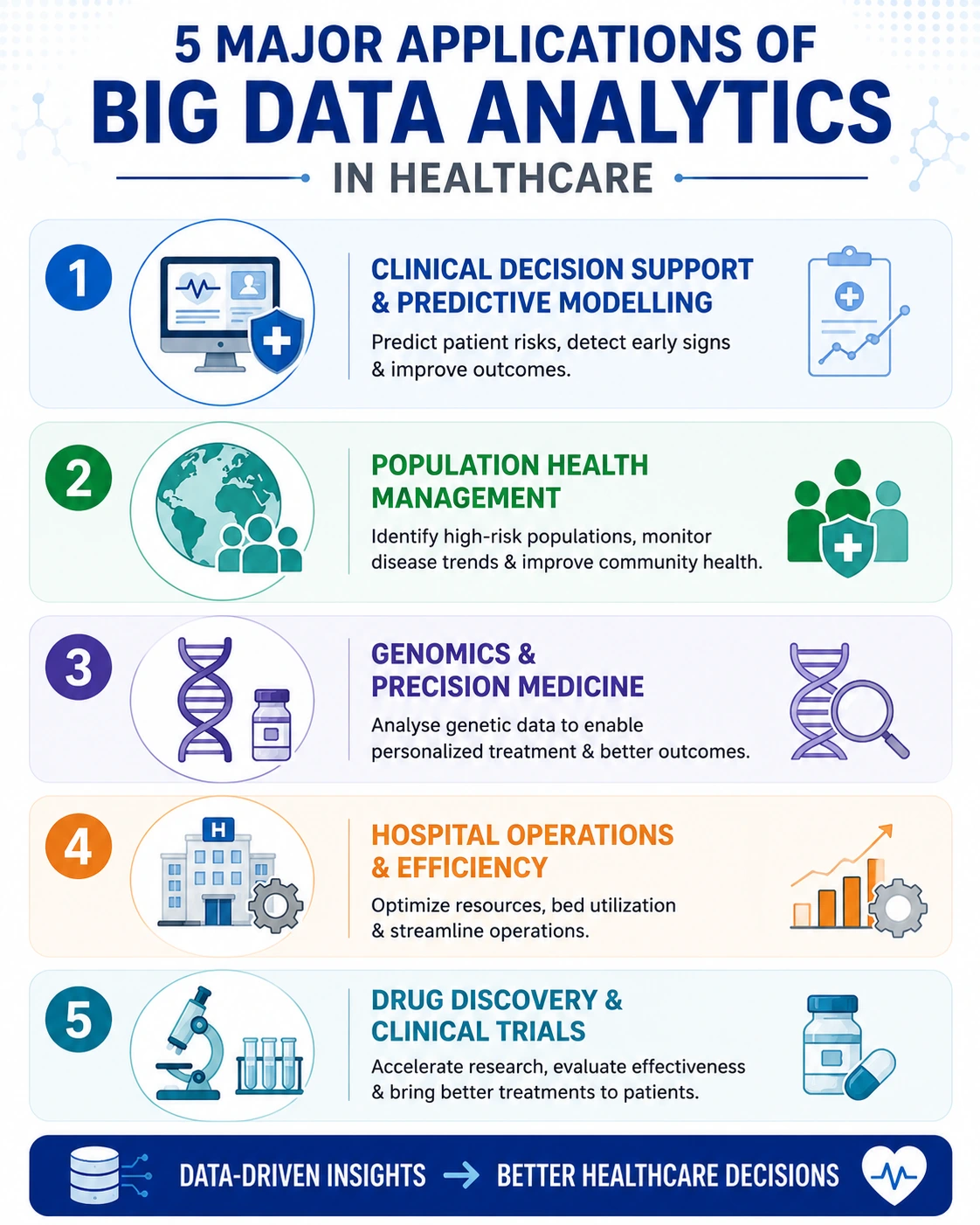








 ROI Calculator