AI automation combines artificial intelligence with automated workflows to handle tasks such as email classification, invoice processing, lead research, and content creation, allowing people to focus on work that requires human judgment and creativity.
Beginners can follow a five stage roadmap by learning AI fundamentals, understanding workflows, practicing with no code or low code tools like Zapier, Make, and n8n, exploring Python and APIs, and building real projects.
Choosing the right AI automation courses involves matching them to your skill level, from AI fundamentals and workflow automation to prompt engineering, Python, AI agents, and advanced systems. Hands on practice, error handling, and project based learning are important considerations.
AI automation jobs include AI Automation Specialist, Workflow Automation Consultant, AI Engineer, Prompt Engineer, Business Process Analyst, RPA Developer, and AI Operations professional. Building a portfolio with documented projects can help demonstrate practical skills to employers.
In this blog, you'll learn about AI automation, the step by step learning roadmap, recommended AI automation courses, career opportunities, portfolio building strategies, and how to develop skills for AI automation jobs.
Think about the last time you did something boring and repetitive at work. Maybe you copied data from one sheet to another, sorted a messy inbox, or wrote the same type of report for the tenth time. Now imagine a system doing all of that for you, quietly, in the background, while you focus on real thinking.
That's the promise of AI automation, and it's one of the fastest-growing skill areas in the job market right now. Companies of every size want people who can build smart workflows that save time, cut costs, and reduce errors. The good news? You don't need a PhD to get started.
In this blog, we'll lay out a clear roadmap: what AI automation actually is, which AI automation courses are worth your time, and which AI automation jobs you can aim for. Let's dive in.
Traditional automation follows fixed rules. “If this happens, do that.” It’s useful, but it breaks the moment something unexpected shows up.
AI automation adds intelligence to those workflows. Instead of only following rules, the system can read text, understand intent, make decisions, summarize documents, classify requests, and even write responses. It can handle messy, real-world information, not just neat spreadsheets.
Here are a few everyday examples:
A support system that reads incoming emails, understands the problem, and drafts a reply for a human to approve
A sales workflow that researches a lead, scores it, and updates the CRM automatically
A finance process that reads invoices, extracts the details, and flags anything unusual
A content pipeline that turns one long video into a blog post, social posts, and a newsletter
An HR workflow that screens applications and schedules interviews
In short, AI automation is about giving routine work to machines so people can do the work that needs judgment, creativity, and empathy.
Tools that once needed a team of engineers can now be built by one curious person with the right knowledge. That shift is creating a huge gap between demand and supply. Businesses want faster operations, but few people know how to design, build, and manage these systems well.
Here’s why learning AI automation is a smart move:
Every industry needs it.Marketing, healthcare, banking, retail, logistics, and education are all adopting it.
It rewards problem-solvers. You don’t have to be the best coder. You need to spot inefficiencies and fix them.
It’s beginner-friendly. Many modern tools are low-code or no-code, so you can start small and grow.
It boosts your value. Even in a non-technical role, knowing how to automate your own work makes you stand out.
Now let’s build your roadmap.
Step-by-Step AI Automation Roadmap for Beginners
Think of this as a journey with five stages. You don’t have to rush. Spend as long as you need on each one.
Stage 1: Understand the basics of AI
Before you automate anything, get comfortable with the vocabulary. Learn what machine learning, large language models, prompts, and AI agents mean. You don’t need deep math here. You just need a clear mental picture of what AI can and can’t do.
Stage 2: Learn how workflows work
Automation is really about processes. Learn to map a task into steps: what triggers it, what data goes in, what decisions are made, and what comes out. Practice by drawing your own daily tasks as simple flowcharts. This habit will serve you throughout your career.
Stage 3: Pick up a no-code or low-code tool
This is where things get fun. Platforms like Zapier, Make, and n8n let you connect apps and add AI steps without writing much code. Start with a simple project, like automatically saving email attachments to a folder and summarizing them with AI.
Stage 4: Add a little Python and APIs
You can go far without code, but a basic understanding of Python and APIs opens many doors. APIs are how different software talks to each other, and they’re the glue of every serious automation. Even beginner-level Python helps you handle data, build custom steps, and fix things when no-code tools hit their limits.
Stage 5: Build, publish, and improve
Create three to five real projects and document them. Show the problem, your solution, and the time it saved. This portfolio matters more than any certificate when you apply for roles.
Now for the part everyone asks about. Instead of listing dozens of random links, here’s a smart way to think about AI automation courses: choose by skill area and level. Course catalogs change often, so always check current content and reviews before enrolling.
Beginner: AI fundamentals and literacy
Start with a concept-first course that explains how AI works in everyday terms. Good options include DeepLearning.AI’s AI For Everyone, the free Elements of AI, and Google’s AI Essentials. These take only a few weeks and give you the confidence to talk about AI clearly.
Look for: simple explanations, real business examples, and zero coding requirements.
Courses and websites to try:
AI For Everyone by DeepLearning.AI on Coursera
Elements of AI on elementsofai.com (free)
Google AI Essentials on Coursera and Grow with Google
Generative AI for Everyone by DeepLearning.AI on Coursera
Beginner to intermediate: no-code workflow automation
This is the heart of practical AI automation. Search for courses and official tutorials on Zapier, Make, and n8n, many of which are free through the platforms’ own academies and communities. You’ll learn triggers, actions, filters, data mapping, and how to plug AI models into your flows.
Look for: hands-on projects, templates you can reuse, and lessons on error handling.
Courses and websites to try:
Zapier Learn Center guides and tutorials on zapier.com/learn
Make Academy on academy.make.com (free)
n8n Course (Level 1 and Level 2) in the n8n documentation (free)
Microsoft Power Automate learning paths on Microsoft Learn (free)
Intermediate: prompt engineering and working with LLMs
A workflow is only as good as the instructions you give the AI inside it. Take a course that teaches prompt design, structured outputs, context handling, and evaluating results. Short courses from DeepLearning.AI and OpenAI-style developer guides are popular here.
Look for: practice with real prompts, testing methods, and ways to reduce wrong or made-up answers.
Courses and websites to try:
ChatGPT Prompt Engineering for Developers on DeepLearning.AI (short course, free to start)
Building Systems with the ChatGPT API on DeepLearning.AI
Prompt Engineering for ChatGPT by Vanderbilt University on Coursera
Intermediate: Python and API basics for automation
Choose a beginner-friendly Python course that includes working with data, JSON, and APIs. Platforms like Coursera, edX, freeCodeCamp, and Kaggle Learn all have good starting points. Focus on practical use, such as pulling data from an app, processing it, and sending it somewhere else.
Look for: small, project-based lessons rather than heavy theory.
Courses and websites to try:
Python for Everybody by the University of Michigan on Coursera and py4e.com
Automate the Boring Stuff with Python on automatetheboringstuff.com (free to read online)
Python and Intro to Programming micro-courses on Kaggle Learn (free)
Scientific Computing with Python on freeCodeCamp (free)
Advanced: AI agents, RAG and production systems
Once you’re comfortable, step into more powerful territory. Learn how AI agents use tools, how retrieval-augmented generation (RAG) lets AI answer from your own documents, and how to monitor and secure automations in real use. Courses on LangChain, LlamaIndex, agent frameworks, and cloud AI services are a good fit.
Look for: capstone projects, deployment lessons, and coverage of safety, privacy, and reliability.
Courses and websites to try:
LangChain for LLM Application Development on DeepLearning.AI
Building and Evaluating Advanced RAG Applications on DeepLearning.AI
AI Agents Course on Hugging Face (free)
Microsoft Azure AI Fundamentals (AI-900) learning path on Microsoft Learn (free)
Structured certificate programmes
If you prefer mentor-led learning, deadlines, and a recognized credential, a university-backed certificate in machine learning, generative AI, or data andanalytics can add depth. These suit professionals who want guided learning rather than going solo. Compare duration, schedule, fees, and eligibility carefully, and pick one that matches your career goal.
Programmes and websites to try:
IBM Generative AI Engineering Professional Certificate on Coursera
Machine Learning Specialization by DeepLearning.AI and Stanford Online on Coursera
UiPath Academy automation developer training on academy.uipath.com (free), useful for RPA-focused jobs
Google Cloud learning paths on Google Cloud Skills Boost
A quick tip on choosing AI automation courses
Don’t collect courses like trading cards. Finish one, build something with it, then move on. A single completed project teaches you more than five half-watched playlists.
Best AI Automation Jobs to Aim For
So where can all this learning take you? The market for AI automation jobs is growing, and the roles are more varied than most people expect. Here are some of the best paths.
1. AI Automation Specialist
This is the most direct role. You design and build automated workflows that connect business tools and AI models. You’ll work closely with teams to find repetitive tasks and replace them with smart systems.
Core skills: no-code tools, APIs, prompt design, process mapping.
2. Workflow Automation Consultant or Freelancer
Many small businesses don’t have in-house experts, so they hire freelancers or consultants to set up automations. If you enjoy variety and independence, this path can be rewarding. A strong portfolio and clear communication matter a lot here.
Core skills: client communication, project scoping, a wide tool stack.
3. AI Engineer or LLM Application Developer
This role is more technical. You build applications powered by large language models, including chatbots, agents, and document-processing systems. You’ll often use Python, APIs, vector databases, and cloud platforms.
Prompt engineers craft and test the instructions that make AI behave reliably. In many companies, this skill is blended into other roles rather than being a standalone title, but it remains very valuable.
If you like understanding how organizations run, this is a great fit. You study processes, find bottlenecks, and recommend where AI automation can help. Your edge is business thinking combined with tool knowledge.
Core skills: process mapping, analytics, communication.
6. RPA and Intelligent Automation Developer
Robotic process automation has been around for years, and it’s now blending with AI to handle documents, emails, and decisions. Companies with large back-office operations hire for this often.
Once automations go live, someone has to keep them running smoothly. These roles focus on monitoring, testing, cost control, and reliability.
Core skills: cloud basics, monitoring, version control, security.
8. Automation-Focused Roles in Marketing, Sales, and HR
Not every opportunity carries an “AI” title. Marketing operations, sales operations, customer success, and HR operations teams all want people who can automate reporting, outreach, onboarding, and screening. If you’re already in one of these fields, adding automation skills can quickly set you apart.
Core skills: domain knowledge plus automation tools.
A note on salaries and demand
Pay for AI automation jobs varies widely based on country, company size, role, and experience. Rather than trusting a single number you saw online, check current listings on job portals for your city and target role. It’s the most honest way to see what employers are actually offering.
How to Build a Portfolio That Gets You Hired
Employers in this space care about what you can do. So give them proof. Here are a few project ideas:
An email triage system that categorizes messages and drafts replies
A lead research workflow that gathers company info and updates a spreadsheet or CRM
A meeting notes automation that turns recordings into summaries and action items
A document processing flow that extracts key details from invoices or contracts
A content repurposing pipeline for blogs, videos, and social media
For each project, write a short case study: the problem, your approach, the tools used, and the result, such as hours saved per week. Share it on LinkedIn or a simple personal website. Recruiters love clear, measurable stories.
AI automation isn’t about replacing people. It’s about removing the dull parts of work so humans can do more of what they’re good at. The roadmap is simple: learn the basics, understand workflows, practice with no-code tools, add a bit of Python, and build real projects. Along the way, choose AI automation courses that match your level and turn what you learn into a portfolio.
The demand for AI automation jobs will keep growing as more businesses rethink how work gets done. Start small this week. Automate one tiny task. Then another. Before long, you’ll have both the skills and the proof to back them up.
Frequently Asked Questions
No, not at the beginning. Many AI automation tools are no-code or low-code, so you can build useful workflows by connecting apps visually. That said, learning basic Python and how APIs work will give you more flexibility and open up more advanced AI automation jobs.
It depends on your starting point and the time you can give. Many beginners build their first working automations within a few weeks. Becoming job-ready usually takes a few months of consistent practice, including a handful of portfolio projects.
Start with a concept-first course like AI For Everyone or Elements of AI, then move to hands-on lessons on tools such as Zapier, Make, or n8n. After that, add a beginner Python course and a prompt engineering short course. Choose based on your goals and always check recent reviews.
It will change many jobs, and some repetitive tasks will disappear. But it’s also creating new roles and making people who can use these tools more valuable. Learning AI automation now is one of the best ways to stay relevant and future-ready.
Dr. Sanjay Kulkarni
Data & AI Transformation Leader
Dr. Sanjay Kulkarni is a Data & AI Transformation Leader with over 25 years of industry experience. He helps organizations adopt data-driven and responsible AI practices through strategic guidance and education. With experience across startups and global enterprises, he bridges the gap between theory and real-world application. His work empowers teams to innovate and thrive in AI-driven environments.
Get Free Upskilling Guidance
Fill in the details for a free consultation
Related Courses
Explore our programs
Advanced Certificate Programme in Machine Learning, Gen AI & LLMs for Business Applications

 October 16, 2026
 10 min read





 Key Insights
 ChatGPT
 Perplexity
 Claude
 Grok
Grok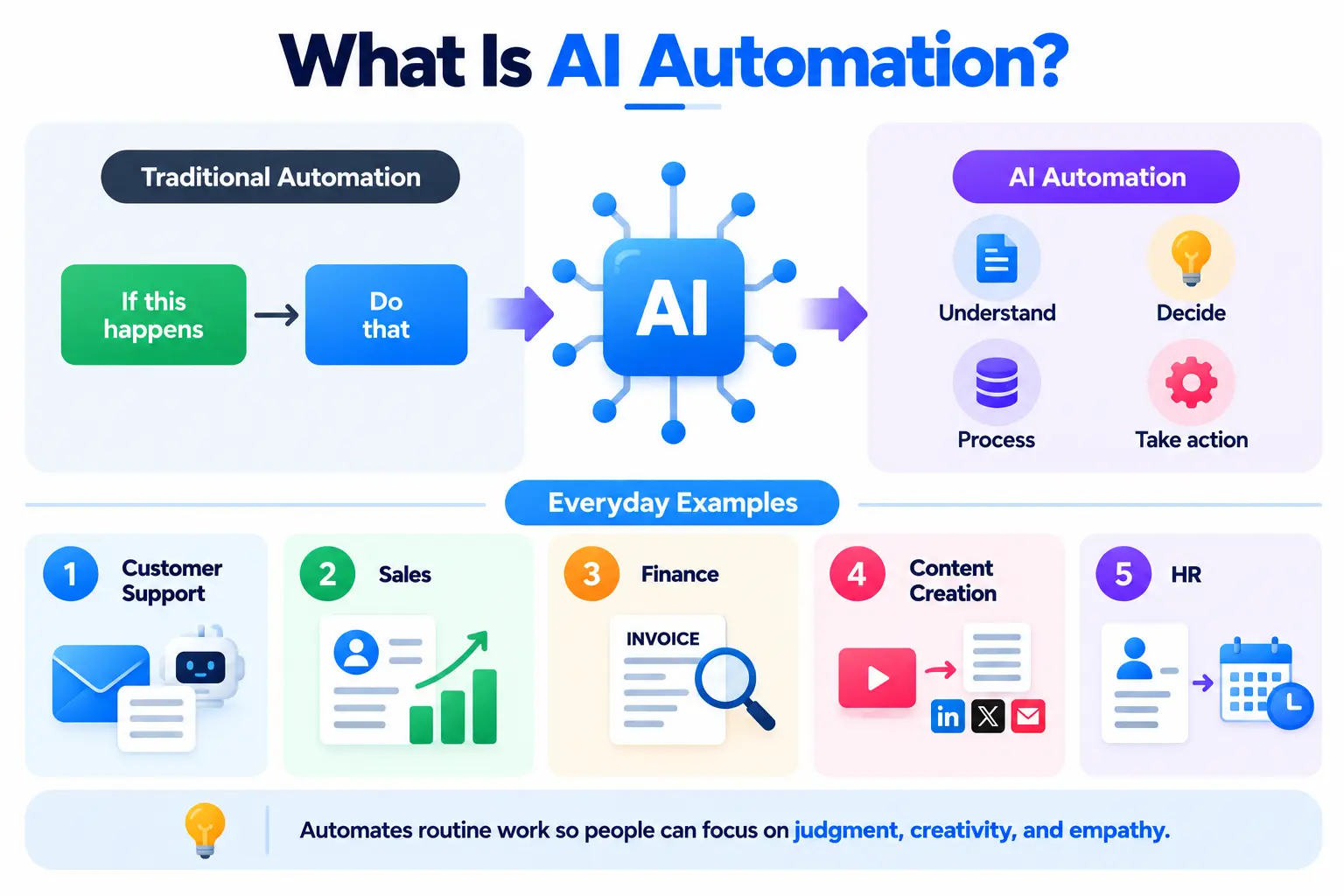











 ROI Calculator



