Project Risk Analytics: Frameworks Every Manager Should Know
J
By Nuthana Reddy
September 9, 20266 min read
Published on September 9, 2026
SHARE THIS ARTICLE
Table Of Content
What Is Project Risk Analytics, Exactly?
Core Risk Management Frameworks Every Manager Should Understand
Effective Project Risk Analysis: Qualitative and Quantitative Approaches
Building Organizational Maturity in Project Risk Analytics
Key Insights
Project risk analytics uses data and analysis to identify, assess, and manage uncertainty, helping managers make evidence based project decisions.
PMBOK, ISO 31000, COSO ERM, and PRINCE2 provide different approaches to risk management and can be used together based on an organization's needs.
Qualitative and quantitative risk analysis help managers assess risks at different levels, with quantitative methods providing numerical insights for important decisions involving cost, schedules, and contingency planning.
Organizations can improve their risk management maturity from a reactive approach to a predictive approach by using quantitative techniques, historical data, and AI-assisted analytics.
In this blog, you'll learn about project risk analytics, key risk management frameworks, qualitative and quantitative risk analysis, risk management maturity stages, and common pitfalls managers should avoid.
Project management rarely goes exactly as planned. Budgets change, timelines extend, vendors may fall short, and market conditions can shift during execution. What helps organizations respond effectively is not luck but a structured approach to project risk analytics. It involves identifying, assessing, and analyzing uncertainty so that project decisions are based on data and evidence rather than assumptions.
This blog explores the key frameworks used in modern project risk analytics and explains how qualitative assessment can be combined with quantitative techniques. It also looks at how to choose the right framework, apply risk analytics across different stages of the project lifecycle, and build a more mature risk management approach over time.
Typical risk management is generally limited to the completion of an introductory checklist or color-coded matrix that categorizes risks as either low, medium, or high. Project risk analytics pushes this one step further through the use of data and statistical models to turn uncertainty into measurable insight.
For project leaders, this completely changes the conversation with stakeholders. Rather than relying on gut feelings and broad estimates, you can back up your warnings with hard numbers. Instead of telling leadership, “This risk is high,” you can say, “There is a 68% chance this delay will push our timeline back by three weeks and cost us around $120,000.” That kind of clarity gets attention, speeds up decision-making, and ensures resources go where they are needed most.
Core Risk Management Frameworks Every Manager Should Understand
Several established risk management frameworks are used by organizations to identify, assess, and manage risks. Each framework has a different purpose, so managers should understand their differences before choosing one.
PMBOK Risk Management Framework (PMI)
The Project Management Institute’s PMBOK framework provides a structured approach to managing risks throughout a project. It covers risk planning, identification, qualitative and quantitative risk analysis, response planning, and monitoring. Since it is designed specifically for projects, it is useful for managers dealing with schedules, budgets, resources, and project deliverables.
ISO 31000
ISO 31000 is a general risk management standard that can be used across different types of organizations and industries. It focuses on making risk management part of everyday decision-making and organizational governance. While PMBOK focuses mainly on managing risks within a project, ISO 31000 encourages organizations to build risk management into their overall culture and operations.
COSO Enterprise Risk Management (ERM) Framework
The COSO ERM framework focuses on managing risks across an entire organization. It connects risk management withbusiness strategy, performance, and decision-making. This makes it useful for large projects and programmes where risks can affect the organization’s finances, reputation, compliance, or long-term goals.
PRINCE2 Risk Approach
The PRINCE2 risk approach is designed for organizations that use the PRINCE2 project management methodology. It integrates risk management into project governance and defines responsibilities such as the risk owner and risk actionee. Risks are reviewed regularly throughout the different stages of a project.
Choosing the Right Framework
Managers do not always have to choose just one framework. Different frameworks can be used together based on the organization’s needs.
PMBOK or PRINCE2 can be used for managing risks at the project level.
ISO 31000 can help align project risk management with the organization’s overall risk practices.
COSO ERM is useful when project risks could have a major impact on the wider organization, such as in large investments, mergers, or highly regulated projects.
In practice, many organizations combine these approaches. Project-level frameworks can manage risks within individual projects, while broader frameworks such as ISO 31000 or COSO ERM can support organization-wide risk management.
Effective Project Risk Analysis: Qualitative and Quantitative Approaches
Project risk analysis usually has two main approaches: qualitative and quantitative. Understanding when to use each approach helps managers assess risks and make better project decisions.
Qualitative Risk Analysis
Qualitative analysis is usually the first step in risk management. Teams identify risks using workshops, expert opinions, and past project information. They then rate each risk based on its probability and potential impact, often using a probability impact matrix.
This approach is simple and quick. It helps managers identify the most important risks that may need further analysis. However, ratings such as “high,” “medium,” and “low” do not provide exact numbers. For major decisions involving budgets or project schedules, quantitative analysismay be more useful.
Quantitative Risk Analysis
Quantitative analysis uses numbers and data to study the risks identified during qualitative analysis. Instead of simply calling a risk “high impact,” managers estimate how likely it is to affect project costs, timelines, or other outcomes. This helps them make more informed decisions and plan suitable contingency budgets.
The Decision Rule Managers Should Apply
Not every project risk needs detailed quantitative analysis. Managers should consider it when:
The risk could have a major impact on project cost or schedule.
Enough historical or relevant data is available to analyze the risk.
The decision is important enough to justify detailed analysis, such as approving a project, setting a contingency budget, or selecting a vendor.
Using complex analysis for a simple and low-risk task can waste time and resources. At the same time, relying only on basic judgement for a high-impact and uncertain risk can lead to poor decisions.
Building Organizational Maturity in Project Risk Analytics
Rather than treating risk analytics as something an organization either has or lacks, it is more useful to think in terms of maturity stages:
Stage 1 – Reactive: Risks are addressed only after they materialize; no formal register or process exists.
Stage 2 – Defined: A basic risk register and qualitative scoring process is in place, typically aligned loosely with PMBOK.
Stage 3 – Managed: Quantitative techniques such as sensitivity analysis and Monte Carlo simulation are applied consistently to high-priority risks, with results feeding into contingency planninng.
Stage 4 – Integrated: Project-level risk analytics is connected to enterprise risk frameworks such as ISO 31000 or COSO ERM, giving leadership portfolio-wide visibility rather than isolated project views.
Stage 5 – Predictive: The organization uses historical project data and increasingly AI-assisted analytics to forecast risk before it manifests, continuously recalibrating models based on real outcomes.
Most organizations sit between Stage 2 and Stage 3. Progressing to Stage 4 or 5 does not require abandoning existing frameworks, rather it requires connecting them and investing in the data discipline that quantitative analytics depends on.
Advance Your Project Management Career with IIM Mumbai
Take your project management expertise to the next level with the Executive Certificate Programme in Advanced Project Management & Analytics from IIM Mumbai. Designed for experienced professionals, the programme combines advanced project management, project analytics, risk analytics, AI and Generative AI, portfolio governance, Agile practices, and leadership skills. Delivered in a blended format with live online sessions and campus immersion, it also includes real-world case studies, a capstone project, and hands-on learning with project management tools. The programme is ideal for professionals looking to strengthen their decision-making skills and manage complex projects more effectively.
Common Pitfalls Managers Should Avoid
Treating risk analysis as a one-time exercise. Risk registers created at project kickoff and never revisited quickly become disconnected from reality.
Over-relying on qualitative scoring for high-stakes decisions. A “high” label does not tellleadership how much contingency budget is actually required.
Ignoring data quality. Quantitative models are only as reliable as the historical data feeding them; poor data discipline undermines even well-chosen frameworks.
Choosing a framework based on familiarity rather than fit. A framework that works well for a small internal project may be entirely inadequate for a regulated, enterprise-scale programme.
Failing to review actual outcomes. If organizations do not compare predictions with actual results, they cannot improve their risk analysis over time.
Conclusion
Project risk analytics is not about using one framework and considering the work complete. It is about understanding how frameworks such as PMBOK, ISO 31000, COSO ERM, and PRINCE2 support different areas of risk management. It also involves knowing when to use qualitative judgement and when to use quantitative analysis during a project. By applying the right risk analytics techniques at the right stage, managers can make better decisions, communicate risks clearly, and prepare for potential challenges. As uncertainty continues to be a part of every project, strong risk management has become an important skill for effective project leadership.
Frequently Asked Questions
Project risk analytics is the process of using data, analysis, and risk management techniques to identify, assess, and manage risks that may affect a project’s cost, schedule, resources, or outcomes.
PMBOK and PRINCE2 are useful for managing risks at the project level. The right framework depends on the project methodology, organizational structure, and risk management needs.
Quantitative risk analysis is useful when a project has complex or high impact risks and managers need numerical estimates to understand their possible effect on cost, schedule, or other project outcomes.
ISO 31000 provides general principles for managing risk across an organization, while PMBOK provides a more project focused approach to identifying, analyzing, responding to, and monitoring project risks.
Risk analytics helps managers make informed decisions, identify potential problems early, communicate risks clearly, and improve their ability to prepare for uncertainty throughout the project lifecycle.
Nuthana Reddy
Nuthana Reddy is a Senior Manager at Procter & Gamble, specializing in operations, digitization, and cross-functional leadership. She has driven multimillion-dollar impact through innovation, process optimization, and strategic execution across global markets.
Get Free Upskilling Guidance
Fill in the details for a free consultation
Related Courses
Explore our programs
Executive Certificate Programme in Advanced Project Management and Analytics

 September 9, 2026
 6 min read




 Key Insights
 ChatGPT
 Perplexity
 Claude
 Grok
Grok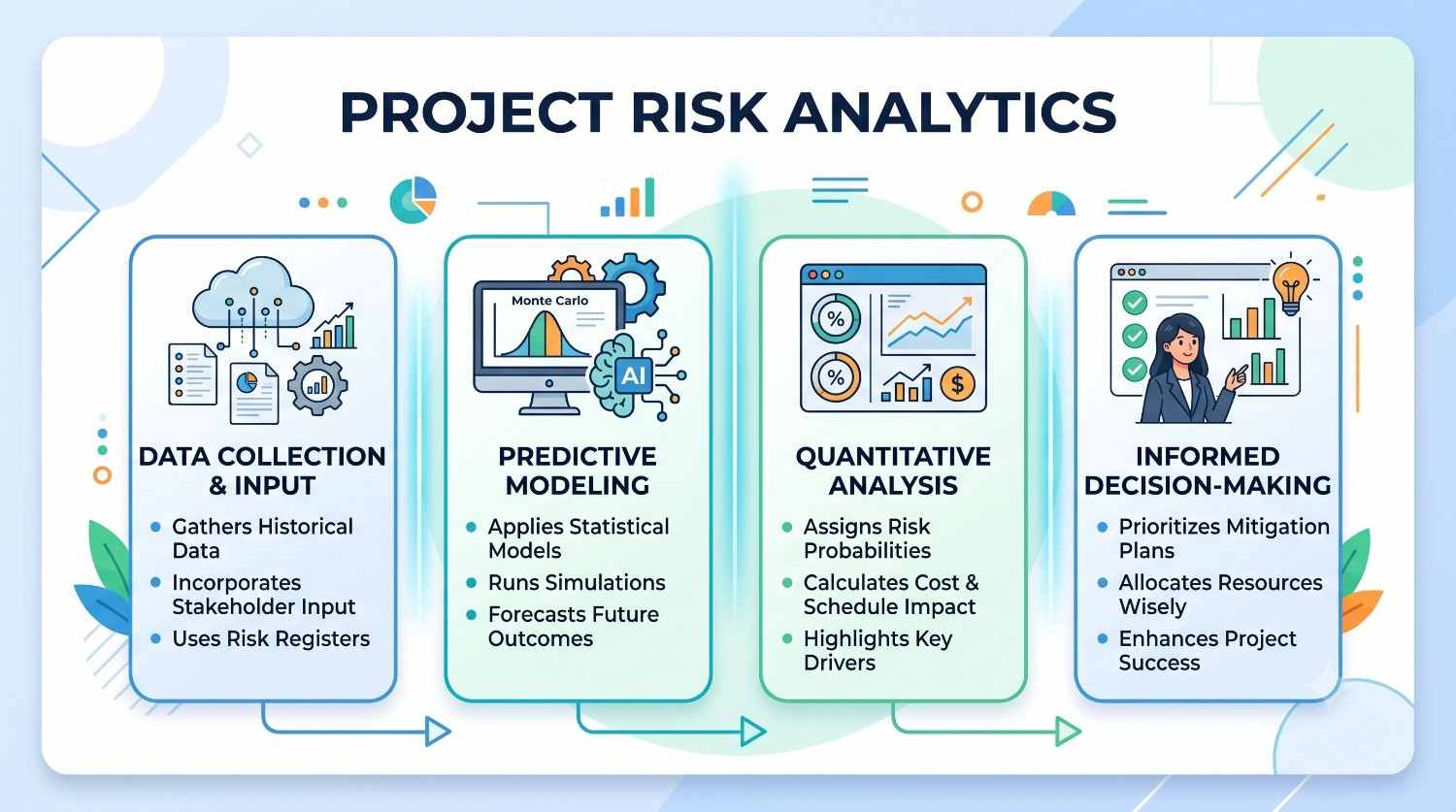












 ROI Calculator