The 'Worth It' Framework: How We Ranked the Top 15 Tools
The 15 Best AI Workflow Automation Tools for 2026
The Career ROI: Why AI Certification is the New Salary Floor
Conclusion: Choosing Your 2026 Stack
In 2026, the best workflow automation tools are redefining the industry landscape. These tools include n8n, Make, Zapier, Lindy.ai, Gumloop, Agentforce, Workato, Vellum, Parabola, and Taskade. They are evolving from simple triggers to intelligent agents capable of autonomous decision-making, marking a significant shift in how businesses operate.
Workflow automation was traditionally based on "if this, then that" logic. For instance, a form submission might trigger an email, or a Slack message could create a Trello card. While these rules-based triggers were useful, they are no longer sufficient to meet the demands of today's complex, dynamic, and interconnected business environments. This is why the top workflow automation tools of 2026 differ significantly from those that led the market five years ago.
This shift is about moving from automation that executes tasks to automation that makes decisions.
Research from leading automation platforms shows that agentic AI—systems that plan, adapt, and act across multi-step processes without continuous human input—is becoming the enterprise norm. This isn't just an incremental improvement; it's a fundamental change in architecture.
Several factors converge in 2026: large language models have matured, enterprise security standards have improved, and deployment costs have decreased. Among the AI productivity tools 2026, those delivering real ROI are not just faster but also serve as autonomous decision-makers.
This raises the question: how do you evaluate which tools are worth the investment? The answer lies in a structured framework, which is detailed next.
The 'Worth It' Framework: How We Ranked the Top 15 Tools
Not every tool labeled as an “AI automation platform” truly deserves that title. Many solutions simply add a chatbot to basic trigger-action logic and market it as intelligent. Before diving into the top 10 workflow automation tools worth your budget in 2026, here’s the exact framework used to distinguish genuinely transformative tools from mere integrations.
Agentic Capability The first criterion is whether a tool supports multi-step decision-making. Can it evaluate conditions, adjust its path, and take autonomous actions, or does it merely execute a pre-set script? Genuine agentic behavior is essential in 2026.
Cross-Departmental Orchestration Siloed automation creates new bottlenecks. The ranked tools prioritize cross-departmental workflows, connecting sales, marketing, operations, and support without needing separate platforms for each team.
Deployment Flexibility A tool’s value depends on its accessibility. The ranking considers no-code to low-code to fully technical environments, as accessibility directly impacts adoption rates.
Enterprise Security Role-based access control (RBAC), audit logs, and compliance certifications are crucial for scaling teams. Any tool lacking enterprise-grade security was rated lower.
With this framework established, let’s explore the tools themselves—ranked, contextualized, and evaluated honestly.
With the ranking framework in place, it’s time to examine the tools themselves. The landscape divides into four categories based on use case and technical depth—knowing which category fits your team can save months of trial-and-error switching costs.
1. Technical & Scalable: Built for Teams That Want Control
n8n and Make lead this category for good reason. Both are prominent in thetop AI workflows discussion when technical flexibility is a priority, but they cater to different audiences.
n8n is ideal for teams needing genuine customization, allowing custom JavaScript or Python steps directly in workflows, self-hosting options, and a rapidly growing node library through an active open-source community. It’s particularly strong for engineering-adjacent teams comfortable with writing some code to unlock edge-case logic.
Make (formerly Integromat) takes a different approach. Its visual scenario builder excels in complex data transformation—mapping, filtering, and restructuring information between apps without needing code. While n8n rewards technical depth, Make rewards visual thinking. Teams handling intricate API payloads or multi-step data pipelines often find Make’s interface faster than writing transformation logic from scratch.
“The most durable automation stacks in 2026 aren’t the most complex—they’re built on tools that match a team’s actual technical capacity.”
2. The No-Code Giants: Volume and Simplicity at Scale
Zapier remains the central hub of no-code automation, and its longevity is well-earned. With thousands of app integrations and a straightforward “Zap” structure, it handles high-volume, repeatable tasks that keep operations running—form-to-CRM routing, notification triggers, and cross-platform data syncing. The platform has further embraced AI with features suggesting automations based on natural language descriptions, as noted inZapier’s own breakdown of AI automation tools.
Lindy.ai occupies a newer but rapidly growing niche. Built around AI agents rather than traditional triggers, Lindy manages scheduling, email management, and routine decision-making through conversational setup. It’s approachable—users describe workflows in plain language rather than mapping nodes—making it a strong fit for small teams needing automation without a dedicated operations hire.
3. The Agent Builders: Orchestrating Intelligent Action
Gumloop focuses on niche AI workflows, particularly for content operations and research-heavy processes. Its strength lies in chaining AI steps—summarization, classification, extraction—into repeatable pipelines that would otherwise require custom development. It’s a specialized layer for teams whose core bottleneck is AI-assisted content work.
Agentforce, built within the Salesforce ecosystem, targets enterprise sales and service teams already invested in that platform. Instead of standalone automation, it serves as an agent layer on top of CRM data—triggering outreach, summarizing account history, and routing leads based on real-time signals. For Salesforce shops, the native integration eliminates the data-syncing friction that plagues third-party tools.
4. Enterprise Orchestrators: Connecting the Whole Stack
Workato positions itself as an enterprise integration platform with a strong presence in marketing and sales operations. Its “recipes” manage cross-departmental workflows touching multiple systems simultaneously—syncing campaign data, updating customer records, and triggering internal notifications in a single flow. It’s priced for enterprise budgets and built for enterprise complexity.
Vellum takes a low-code approach specifically designed for AI application development, as detailed inVellum’s roundup of low-code AI workflow tools. Teams building LLM-powered products use Vellum to test prompts, evaluate model outputs, and deploy AI workflows with version control included—a gap most general-purpose automation tools don’t address.
5. Productivity Specialists: Focused on Team Output
Parabola structures messy data workflows, particularly for operations teams processing reports, spreadsheets, and e-commerce data. Its drag-and-drop pipeline builder makes data transformation accessible without SQL knowledge, according toParabola’s own analysis of AI automation tools.
Taskade rounds out this tier with AI-powered team orchestration—combining project management, document creation, and automated task assignment in one workspace. It’s less about connecting external apps and more about structuring how a team operates daily.
These tools represent the accessible end of the spectrum. For teams willing to engage with more technical configurations, comparing the two leading open platforms reveals sharper trade-offs worth examining closely.
6. The Technical Powerhouses: n8n vs. Make
Among the top automation trends in 2026 reshaping how engineering teams build internal tools, one pattern stands out: technical teams are moving away from closed-ecosystem platforms in favor of tools that don’t penalize complexity.
n8n and Make are the top choices for teams needing real power under the hood.
n8n’s core advantage is flexibility. Custom JavaScript and Python steps can be integrated into any workflow, and theself-hosting option keeps sensitive data fully within your infrastructure—a crucial requirement for finance, healthcare, and enterprise teams.
Make, in contrast, excels in visual complexity. Its scenario builder manages intricate data mapping with clarity rivaling purpose-built ETL tools, making it the better choice for operations teams who think in flowcharts rather than code.
The deeper reason technical teams are abandoning closed ecosystems? Vendor lock-in has a real cost. When your logic is confined to a proprietary, click-only interface, switching tools means starting from scratch. Open, developer-friendly platforms convert automation logic into transferable assets.
Both tools handle multi-step workflows well, but neither fully crosses into autonomous, decision-making territory. That gap is exactly where the next category operates.
7. The Agentic Revolution: Gumloop and Lindy.ai
While most of the top 10 workflow automation tools focus on connecting apps, two platforms are pushing toward something fundamentally different: autonomous agents that make decisions, not just execute them.
Gumloop carves out a distinct niche with deeply configurable, multi-step AI workflows built around content-heavy use cases—think automated research pipelines, SEO content production, and lead enrichment sequences. Rather than offering broad generalist automation, Gumloop focuses on precision. Each workflow node can invoke a language model, process its output, and feed results downstream with minimal human input.
Lindy.ai takes an even bolder stance. Its framing is deliberate: you’re not building a workflow, you’re hiring an AI employee. Lindy manages tasks like inbox triage, meeting scheduling, and CRM updates by operating with contextual judgment—not just rule-following.
That distinction matters. A tool waits for instructions. An agent pursues a goal.
In practice, this shift changes how teams think about delegation entirely. Mastering these platforms isn’t just a productivity upgrade—it’s a career-defining skill that’s rapidly reshaping what employers expect from operations and leadership roles.
The Career ROI: Why AI Certification is the New Salary Floor
Knowing which tools to use is only half the equation. The other half—the part that directly affects your paycheck—is demonstrating mastery of them. As organizations race to operationalize the 15 best AI workflow automation tools for 2026, professionals who can implement, manage, and scale these systems are commanding significant salary premiums over peers who can’t.
Automation Fluency Is Now a Leadership Prerequisite
Chief AI Officer and VP of Operations roles have quietly rewritten their job descriptions. Where these positions once prioritized strategic vision and stakeholder management, they now explicitly require hands-on fluency with automation platforms. According tosamueljwoods.com’s analysis of AI workflow tools, organizations no longer treat automation knowledge as a technical nice-to-have—it’s a baseline expectation at the director level and above.
Automation fluency has become what spreadsheet proficiency was in 2005: the minimum viable skill for a credible operations role.
From Doer to Orchestrator
The most important career shift happening right now isn’t about learning to code. It’s about learning to orchestrate. This means transitioning from executing tasks manually to designing the agent workflows that handle those tasks at scale.
Typically, individual contributors who master this transition get promoted faster—because they stop trading time for output and start multiplying team capacity instead.
This shift in how work gets done is why choosing the right tools matters so much. With your stack clarified, the next step is building a concrete plan for putting it all together in 2026.
The verdict is clear: the best AI workflow automation tools aren’t just productivity enhancements—they’re competitive infrastructure. Whether you’re routing data with a visual builder or deploying agentic AI workflows that reason and act autonomously, the right stack pays for itself quickly.
Key takeaways:
Match the tool to the use case—not the hype
Agentic platforms represent the highest ROI ceiling
Certification validates your investment to employers and clients
Don’t try to adopt everything at once. Pick one agentic tool this week, run a real workflow, and measure the output. That single experiment will teach you more than hours of research.
Ready to build smarter? Subscribe to our AI Strategy newsletter for weekly tool comparisons, workflow templates, and certification guides delivered straight to your inbox.
Dr. Sanjay Kulkarni
Data & AI Transformation Leader
Dr. Sanjay Kulkarni is a Data & AI Transformation Leader with over 25 years of industry experience. He helps organizations adopt data-driven and responsible AI practices through strategic guidance and education. With experience across startups and global enterprises, he bridges the gap between theory and real-world application. His work empowers teams to innovate and thrive in AI-driven environments.
 HOME > BLOG > AI and Machine Learning > Beyond Zapier: The 15 Best AI Workflow Automation Tools Actually Worth the ROI in 2026
 April 16, 2026
 8 min read




 ChatGPT
 Perplexity
 Claude
 Grok
Grok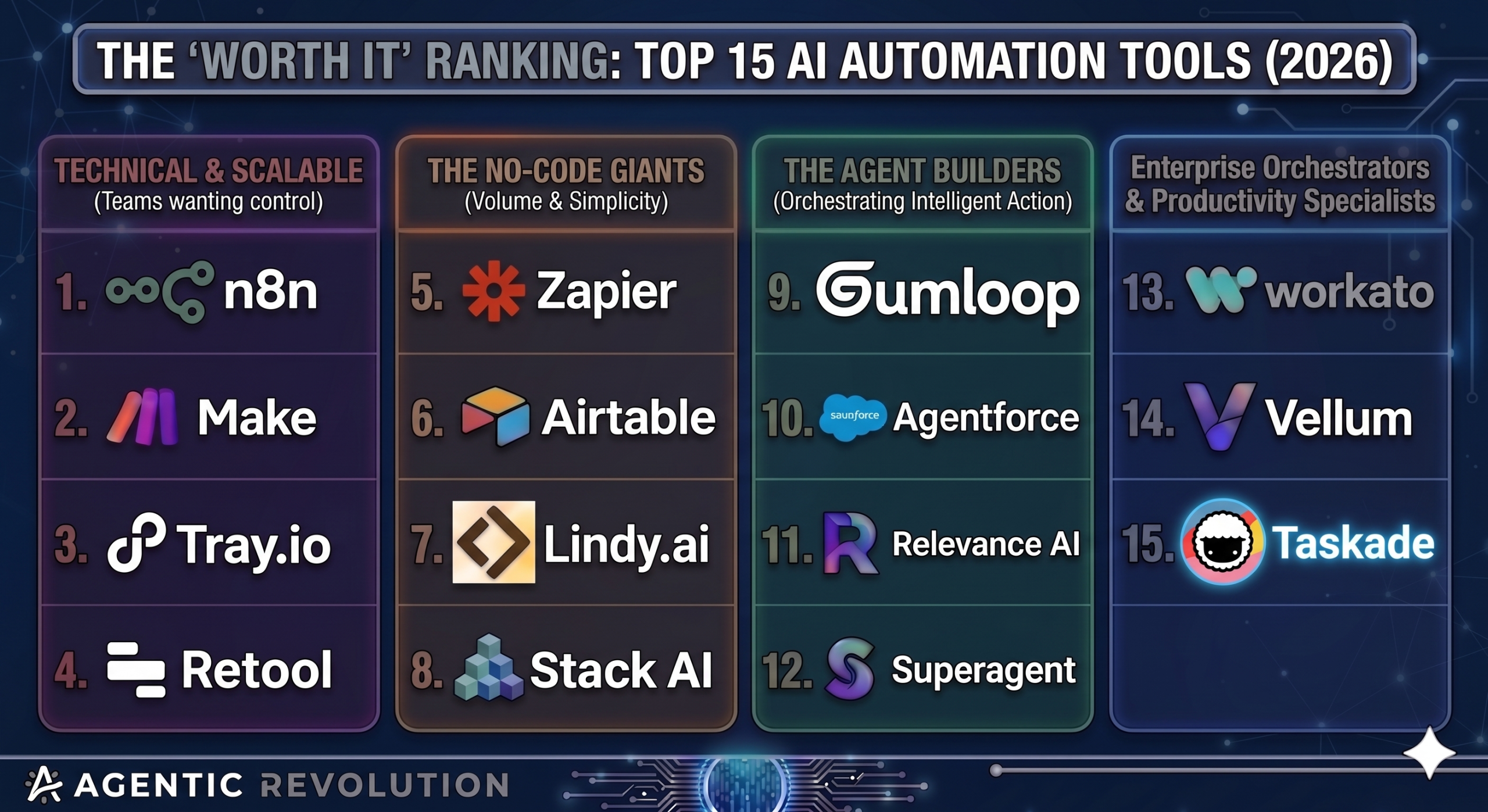





 Admission Open
 Admission Open

 Admission Open
 Admission Closed

 ROI Calculator



