HOME > BLOG > AI and Machine Learning > AI Prompt Engineering for Business Professionals 2026: A Practical Guide for MBA Students and Managers
AI and Machine Learning
AI Prompt Engineering for Business Professionals 2026: A Practical Guide for MBA Students and Managers
J
By Dr. Sanjay Kulkarni
July 30, 202611 min read
Last updated on July 31, 2026
SHARE THIS ARTICLE
Table Of Content
What is AI Prompt Engineering?
Why Prompt Engineering Matters in 2026
The Growing Demand for Prompt Engineering Skills
How Generative AI Understands Prompts
Learn how AI prompt engineering is transforming the way MBA students and business professionals work with generative AI. This guide covers practical prompting techniques, real-world business applications, ethical considerations, and best practices to improve productivity, decision-making, and workplace efficiency in 2026.
Artificial Intelligence has rapidly evolved from being a futuristic concept to an everyday business tool. In 2026, organizations across industries are using AI to automate repetitive tasks, improve decision-making, analyze large datasets, generate reports, createmarketing campaigns, develop business strategies, and enhance customer experiences. At the center of this transformation lies one skill that has become increasingly valuable across professions—AI Prompt Engineering.
Contrary to popular belief, prompt engineering is not just for software developers or AI specialists. Today, MBA students, business managers, consultants, marketers, finance professionals, HR leaders, and entrepreneurs are using AI-powered tools to improve productivity and solve complex business problems. However, the quality of AI-generated output depends significantly on the quality of the instructions provided to the model. This is where prompt engineering plays a crucial role.
Prompt engineering refers to the practice of designing clear, structured, and context-rich prompts that enable AI models to generate accurate, relevant, and actionable responses. A well-written prompt can transform a generic AI response into a comprehensive business report, strategic recommendation, market analysis, or executive presentation.
As organizations increasingly integrate AI into their workflows, professionals who know how to communicate effectively with AI systems will enjoy a significant competitive advantage. Understanding prompt engineering is no longer a technical niche—it is becoming a core business skill.
This guide explores the fundamentals of AI prompt engineering, explains why it matters for business professionals in 2026, and provides practical techniques that MBA students and managers can immediately apply in their academic and professional lives.
AI Prompt Engineering is the process of crafting effective instructions that guide artificial intelligence models toward producing useful, accurate, and contextually appropriate responses.
A prompt can be as simple as a question or as detailed as a multi-step instruction containing objectives, context, constraints, expected output format, audience, tone, and examples.
Consider two different prompts:
Prompt A
“Write about digital marketing.”
The AI may produce a broad and generic response.
Now consider:
“You are a marketing consultant. Explain the latest digital marketing trends in 2026 for MBA students. Include real business examples, practical applications, challenges, and future trends in approximately 800 words using simple language.”
The second prompt provides significantly more context, enabling the AI to generate a more focused and relevant response.
Prompt engineering is therefore less about asking AI questions and more about communicating with AI strategically.
AI tools have become deeply integrated into business operations. Organizations now expect employees to use AI responsibly to improve efficiency rather than replace human expertise.
Professionals spend considerable time preparing reports, presentations, business proposals, emails, meeting summaries, research documents, and financial analyses. AI can significantly reduce the time required for these activities—but only when guided with effective prompts.
Prompt engineering helps professionals:
Generate better-quality outputs.
Save time on repetitive work.
Improve creativity and idea generation.
Enhance decision-making with structured analysis.
Increase productivity across multiple business functions.
For MBA students, prompt engineering also improves learning. Instead of simply asking AI for answers, students can use structured prompts to understand concepts, compare theories, analyze case studies, prepare interview responses, or practice strategic thinking.
Managers benefit by using AI as a collaborative assistant rather than a simple search tool.
Just a few years ago, AI expertise was primarily associated with data scientists and machine learning engineers. Today, businesses are hiring professionals who understand how to use AI effectively regardless of their technical background.
Companies increasingly value employees who can:
Communicate effectively with AI systems.
Improve workflow efficiency.
Analyze AI-generated insights critically.
Create high-quality business content.
Make informed decisions using AI-assisted research.
Prompt engineering has therefore become a complementary skill alongside business strategy, leadership, communication, and analytical thinking.
Rather than replacing professional expertise, it amplifies it by enabling individuals to complete complex tasks faster and with greater confidence.
How Generative AI Understands Prompts
Generative AI models do not think like humans. They predict the most appropriate response based on patterns learned from vast amounts of data.
The quality of their output depends largely on the information provided in the prompt.
A vague prompt leaves the AI guessing.
A detailed prompt reduces ambiguity and increases accuracy.
For example, instead of requesting:
“Prepare a sales report.”
A better prompt would be:
“Prepare a quarterly sales report for a retail company. Include revenue trends, customer acquisition, regional performance, challenges, opportunities, and strategic recommendations. Present the report using executive-level language with headings and tables where appropriate.”
The second prompt defines:
Context
Objective
Audience
Structure
Expected output
These elements significantly improve the usefulness of the response.
Core Components of an Effective Prompt
Effective prompts usually contain several essential elements that help AI understand the task clearly.
Clear Objective
Every prompt should define exactly what the AI needs to accomplish.
Instead of asking:
“Explain leadership.”
Specify:
“Explain transformational leadership for first-year MBA students with practical corporate examples.”
The clearer the objective, the more focused the response.
Relevant Context
Context provides background information that allows AI to tailor its response.
For example, if you are writing a report for senior executives, mention the audience.
If you’re preparing an assignment, specify the academic level.
Providing context reduces irrelevant information and improves overall quality.
Defined Role
Assigning AI a role often improves responses.
For example:
“You are an HR consultant.”
“You are a CFO.”
“You are a product manager.“
“You are a strategy professor.”
Role-based prompting encourages AI to adopt an appropriate perspective and terminology.
Output Format
Always specify how you want the information presented.
You may request:
Executive summary
Business report
SWOT analysis
Case study
Email
Presentation outline
Table
Step-by-step guide
Structured outputs are generally easier to review and edit.
Constraints
Good prompts also define limitations.
Examples include:
Maximum word count.
Professional tone.
Simple language.
Avoid technical jargon.
Include examples.
Cite assumptions.
These constraints help produce outputs that better meet specific business needs.
Practical Prompting Techniques Every Business Professional Should Know
Although prompt engineering is a broad field, a few foundational techniques can dramatically improve results.
The first is instruction-based prompting, where the AI receives direct and specific instructions. Rather than asking broad questions, the user clearly explains the task, desired audience, tone, and format. This approach is particularly useful for preparing reports, drafting emails, writing proposals, or creating presentations.
Another useful technique is role prompting. Asking the AI to respond as a business consultant, financial analyst, HR manager, or strategy expert often results in more relevant and professionally structured outputs. By assigning a role, users encourage the AI to adopt the perspective and communication style associated with that profession.
Business professionals also benefit from context-first prompting. Instead of immediately requesting an output, they begin by providing background information about the company, project, industry, or objective. The richer the context, the better the AI can tailor its response.
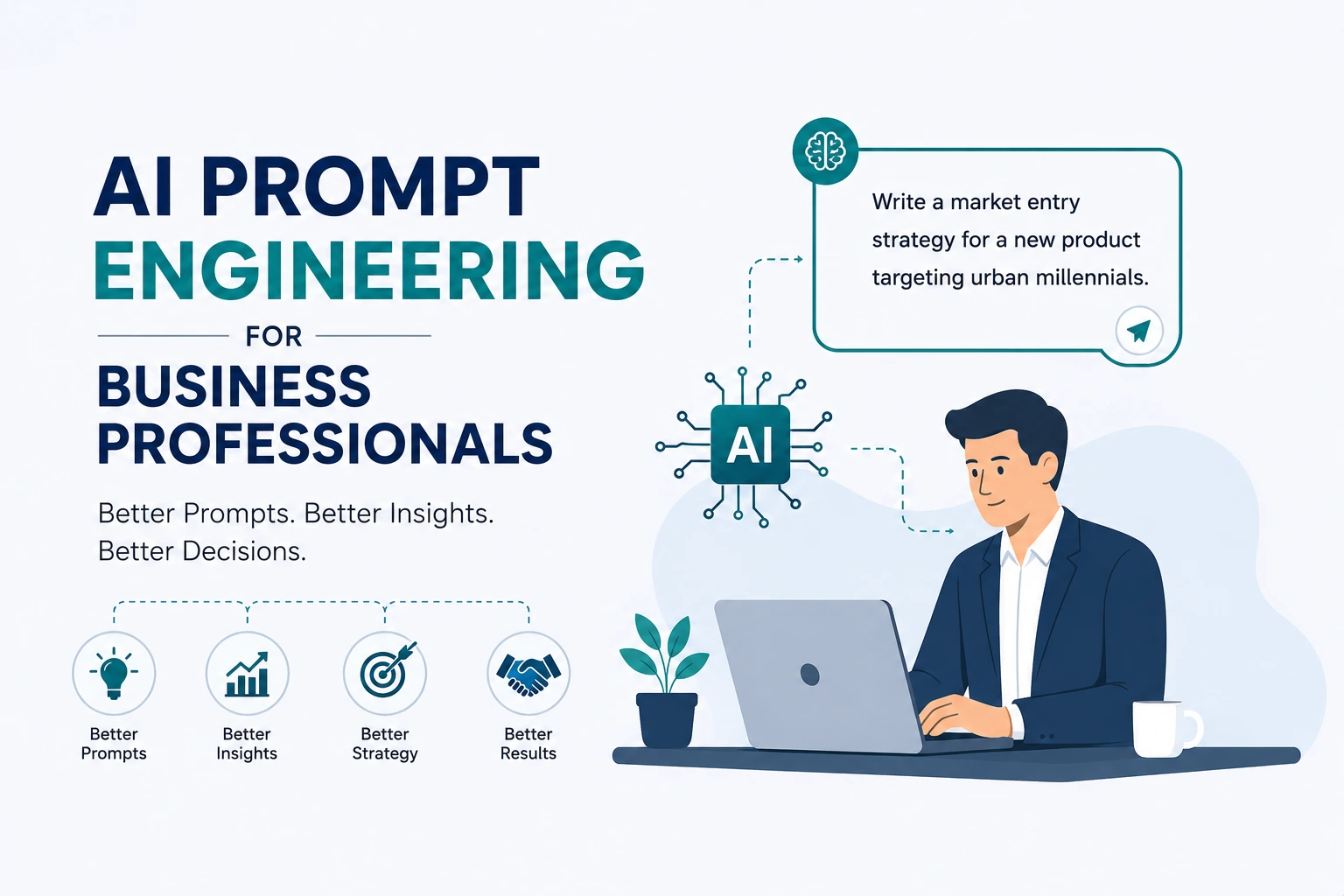
For complex tasks, step-by-step prompting is particularly effective. Breaking large problems into smaller stages allows AI to produce more organized and accurate results. For example, instead of requesting a complete market-entry strategy in a single prompt, users can first ask for market analysis, followed by competitor evaluation, customer segmentation, and finally strategic recommendations.
Prompt Engineering in MBA Education
Business schools are increasingly incorporating AI into learning activities. MBA students now use AI to assist with research, case study analysis, project planning, and presentation development.
However, AI should be viewed as a learning partner rather than a shortcut for completing assignments.
For example, students can ask AI to explain complex frameworks such as Porter’s Five Forces or the Balanced Scorecard using real-world examples. They can request feedback on business presentations, generate practice interview questions, or compare different strategic models.
Prompt engineering also helps students improve critical thinking. Instead of accepting AI-generated responses at face value, they should evaluate the information, verify facts, and refine prompts iteratively to obtain more nuanced insights.
Developing this habit not only strengthens academic performance but also prepares students for AI-enabled workplaces where the ability to ask the right questions is as important as finding the right answers.
Practical Business Applications of Prompt Engineering
Prompt engineering has evolved beyond content generation and is now being used across nearly every business function. Organizations increasingly rely on AI to accelerate decision-making, improve productivity, and reduce the time spent on routine tasks. Professionals who know how to frame effective prompts are better positioned to leverage AI as a strategic assistant rather than just an information retrieval tool.
For managers, prompt engineering can streamline report preparation, meeting documentation, strategic planning, customer communication, andproject management. Instead of spending hours gathering information from multiple sources, they can use AI to prepare first drafts, summarize research, identify trends, and generate actionable recommendations.
MBA students can similarly benefit by using AI to understand academic concepts, prepare case studies, brainstorm business ideas, and practice analytical thinking. Rather than replacing learning, AI becomes a tool that supports deeper understanding when guided with thoughtful prompts.
The key is to view prompt engineering as a communication skill. Just as effective communication improves collaboration between people, well-designed prompts improve collaboration between humans and AI.
Prompt Engineering Across Business Functions
Marketing and Brand Management
Marketing professionals work with large volumes of content, campaign planning, customer insights, and market research. Prompt engineering enables marketers to create high-quality outputs more efficiently while maintaining consistency in messaging.
AI can assist with campaign ideation, audience segmentation, competitor analysis, social media planning, SEO content outlines, email marketing drafts, customer personas, and advertising copy.
For example, instead of asking AI to “write an advertisement,” a marketer could provide details about the product, target audience, communication objective, preferred tone, and platform. The result is significantly more tailored and relevant.
Prompt engineering also supports A/B testingby generating multiple versions of headlines, email subject lines, and promotional messages for comparison.
Finance and Accounting
Finance professionals increasingly use AI for analytical rather than purely creative tasks.
Prompt engineering can help generate financial summaries, explain accounting standards, prepare variance analyses, identify business risks, summarize annual reports, and interpret financial ratios.
For example, a Finance Manager reviewing quarterly performance can ask AI to analyze revenue trends, highlight unusual variances, compare results with previous quarters, and suggest possible business explanations.
However, professionals should always validate AI-generated financial analysis using official financial statements and organizational data before making decisions.
Human Resources
Human resource teams manage recruitment, employee engagement, learning and development, performance management, and internal communication.
Managers can also use AI to prepare constructive performance feedback while maintaining professionalism and empathy.
Since HR often deals with confidential information, organizations should ensure that sensitive employee data is not unnecessarily shared with public AI platforms.
AI can assist in documenting standard operating procedures, identifying operational bottlenecks, preparing risk assessments, and generating improvement recommendations.
Prompt engineering also helps managers simulate different operational scenarios by asking AI to evaluate potential outcomes under changing business conditions.
Although AI cannot replace operational expertise, it can significantly accelerate brainstorming and preliminary analysis.
Product Management
Product Managers frequently coordinate with engineering, marketing, sales, customer support, and leadership teams.
Prompt engineering supports product professionals by helping generate user stories, product requirement documents, feature prioritization frameworks, customer journey maps, competitive analyses, and launch plans.
Managers can also ask AI to summarize customer feedback collected from surveys or reviews, enabling faster identification of recurring issues and improvement opportunities.
This allows product teams to spend more time validating ideas with customers instead of manually organizing information.
Business Strategy and Consulting
Strategic planning often requires evaluating complex business environments, industry trends, competitor behavior, customer expectations, and organizational capabilities.
AI can support strategy professionals by summarizing market reports, identifying emerging opportunities, generating SWOT analyses, comparing strategic frameworks, and suggesting possible business scenarios.
Consultants can use prompt engineering to prepare structured presentations, executive summaries, workshop agendas, and strategic recommendations.
Nevertheless, strategic decisions should always combine AI-generated insights with human judgment, organizational knowledge, and market realities.
Practical Prompt Templates for Business Professionals
While every business situation is unique, certain prompt structures consistently produce high-quality outputs.
Business Report Prompt
“Act as a business consultant. Prepare a report on the impact of AI adoption in retail businesses. Include market trends, challenges, opportunities, business recommendations, and future outlook. Write in a professional tone suitable for senior management.”
Meeting Summary Prompt
“Summarize the following meeting notes into key decisions, action items, responsible stakeholders, and next steps. Present the information in a concise executive format.”
Case Study Prompt
“Analyze this business case using Porter’s Five Forces, SWOT Analysis, and value chain concepts. Conclude with strategic recommendations supported by business reasoning.”
Presentation Prompt
“Create an outline for a 10-slide presentation explaining digital transformation in banking. Include slide titles, key discussion points, and speaker notes.”
These structured prompts provide AI with sufficient direction while allowing room for meaningful analysis.
One of the biggest misconceptions about prompt engineering is that the first prompt must produce the perfect response.
In reality, effective prompt engineering is an iterative process.
Professionals often begin with a broad prompt before gradually refining it through follow-up questions. They may ask AI to simplify explanations, add examples, expand specific sections, compare alternatives, or tailor the content for a different audience.
For example, after generating a market analysis, a manager might ask AI to identify investment risks, compare competitors, estimate future demand, or explain assumptions behind the analysis.
Each refinement improves the usefulness of the final output.
This collaborative process mirrors how professionals work with colleagues—asking clarifying questions, requesting revisions, and building upon earlier ideas.
Conclusion
AI prompt engineering has become one of the most practical and valuable skills for business professionals in 2026. It enables MBA students, managers, consultants, marketers, finance professionals, HR leaders, and entrepreneurs to communicate effectively with AI systems and obtain more relevant, accurate, and actionable outputs.
Rather than being a technical discipline reserved for AI experts, prompt engineering is fundamentally about structured communication. Professionals who define objectives clearly, provide meaningful context, specify the desired output, and refine their prompts iteratively can significantly improve productivity and decision-making across a wide range of business activities.
However, successful AI adoption also requires critical thinking and ethical responsibility. AI should support human expertise rather than replace it. By combining domain knowledge with effective prompt engineering techniques, business professionals can leverage AI as a trusted collaborator while maintaining accountability for the final decisions.
As AI continues to reshape the modern workplace, mastering prompt engineering will not only enhance individual performance but also prepare organizations for a future where human intelligence and artificial intelligence work together to drive innovation and business success.
Frequently Asked Questions
AI prompt engineering is the practice of designing clear, structured instructions that help AI models generate accurate, relevant, and useful responses for specific tasks.
Yes. Prompt engineering helps MBA students conduct research, analyze case studies, prepare presentations, understand business frameworks, and improve learning efficiency while using AI responsibly.
Absolutely. Marketing managers, HR professionals, finance managers, consultants, sales leaders, and entrepreneurs can all use prompt engineering to improve productivity and decision-making without needing programming skills.
Yes. Although AI interfaces are becoming more intuitive, the ability to communicate objectives clearly, provide context, and evaluate AI-generated outputs will remain an essential business skill.
Dr. Sanjay Kulkarni
Data & AI Transformation Leader
Dr. Sanjay Kulkarni is a Data & AI Transformation Leader with over 25 years of industry experience. He helps organizations adopt data-driven and responsible AI practices through strategic guidance and education. With experience across startups and global enterprises, he bridges the gap between theory and real-world application. His work empowers teams to innovate and thrive in AI-driven environments.
Get Free Upskilling Guidance
Fill in the details for a free consultation
Related Courses
Explore our programs
Online BCA Course – Bachelor of Computer Applications
 HOME > BLOG > AI and Machine Learning > AI Prompt Engineering for Business Professionals 2026: A Practical Guide for MBA Students and Managers
 July 30, 2026
 11 min read




 ChatGPT
 Perplexity
 Claude
 Grok
Grok







 ROI Calculator