Penetration Testing: How It Works, Types, Tools & Career Scope
J
By Shubham Lal
October 4, 20267 min read
Published on October 4, 2026
SHARE THIS ARTICLE
Table Of Content
What Is Penetration Testing?
Why Penetration Testing Matters
How Penetration Testing Works: The Phases
Types of Penetration Testing
Key Insights
Penetration testing is an authorised, simulated attack on a system to find weaknesses before real attackers do, and to show how far an attacker could get.
Established guidance such as NIST SP 800-115 describes four phases: planning, discovery, attack and reporting, with the attack phase looping back to discovery.
Tests are classified by knowledge level (black, white and grey box) and by target, such as network, web application, wireless, cloud and social engineering.
Pen testing is different from vulnerability scanning: scanners list possible weaknesses, while testers try to exploit them safely and prove the impact.
Penetration testing must always be authorised in writing. Unauthorised "penetration hacking" is a crime, not a career.
In this blog, you'll learn how penetration testing works, its types, common tools, certifications, legal basics and career scope.
Every organisation that stores customer data, runs a website or uses cloud services is a potential target. Firewalls and antivirus tools help, but the only way to know whether your defences hold up against a determined attacker is to test them. That is what penetration testing does.
This guide explains what penetration testing is, how a pen test unfolds phase by phase, the main types and tools, the certifications that matter and what a career in the field looks like in India.
Penetration testing, often called pen testing, is an authorised and controlled attempt to break into a system, network or application in order to find security weaknesses. Skilled testers use the same techniques as real attackers, but they work with permission, follow agreed rules and report everything they find so it can be fixed.
A good penetration test does more than list problems. It shows how several small weaknesses can be chained together, for example a misconfigured server plus a weak password leading to access to sensitive data. If you are new to the field, start with our overview of what cyber security is.
Penetration Testing vs Vulnerability Scanning
The two are related but not the same.
Aspect
Vulnerability scan
Penetration test
Approach
Automated checks against known issues
Human-led, with exploitation attempts
Output
List of potential weaknesses
Proof of what is actually exploitable and its impact
Depth
Broad
Deep and targeted
Frequency
Often continuous or monthly
Usually periodic, such as annually or after major changes
What Is “Penetration Hacking”?
People sometimes search for “penetration hacking” to mean pen testing. The activities can look alike, but the difference is permission. Penetration testing is ethical hacking carried out with written authorisation and defined scope. Hacking into systems without permission is illegal. In India, the Information Technology Act, 2000 contains provisions, including Sections 43 and 66, that deal with unauthorised access to computer systems, and similar laws exist worldwide. For the concept of offence and defence, see our guide to defensive and offensive cybersecurity.
According to NIST Special Publication 800-115, penetration testing has four phases: planning, discovery, attack and reporting. The attack phase can loop back to discovery when new information is found, and reporting runs alongside the other phases.
1. Planning
The testers and the organisation agree on scope, goals, timing, rules of engagement and written authorisation. This is where you decide which systems are in scope, what is off limits and how emergencies are handled.
2. Discovery
Testers gather information about the target, such as exposed services, technologies and users, and run vulnerability analysis to identify likely weak points. Discovery can be passive, using public information, or active, such as scanning.
3. Attack
The testers attempt to exploit the weaknesses they found, to gain access, move further into the environment and see what data or systems they can reach. Good testers do this carefully, to avoid disrupting business operations, and document every step.
4. Reporting
The final report describes what was found, the severity of each issue, evidence, the potential impact and clear recommendations for fixing it. A strong report speaks to two audiences: an executive summary for leadership and technical details for engineers.
Many practitioners describe the process in more steps, such as reconnaissance, scanning, exploitation, post-exploitation and reporting. These are refinements of the same flow.
Black box: the tester starts with no inside information, like an outside attacker.
White box: the tester has full information, such as architecture and source code, for a deep review.
Grey box: the tester has partial information, such as a user account, which is common and efficient.
By Target
Type
What it tests
Network (external and internal)
Firewalls, servers, open ports, segmentation
Web application
Login, input handling, sessions, access control
API
Authentication, authorisation, data exposure
Wireless
Wi-Fi configuration and encryption
Cloud
Misconfigurations, identity and access, storage
Mobile
App security, data storage, communication
Social engineering
Human responses to phishing and pretexting
Physical
Access to buildings, devices and hardware
For cloud-focused testing, it helps to understand the shared responsibility model and security strategy covered in our guide to multi and hybrid cloud security. For network-level work, see the basics of network security.
Common Penetration Testing Tools
Professionals use a mix of tools, and no tool replaces judgement. Common examples include:
Nmap: discovers hosts and services on a network.
Metasploit Framework: a platform for testing known vulnerabilities in controlled settings.
Burp Suite and OWASP ZAP: intercept and test web application traffic.
Wireshark: analyses network traffic.
Hashcat and John the Ripper: test the strength of password hashes in authorised audits.
Kali Linux: a Linux distribution that bundles many security tools.
Because most tools run on Linux, learning the command line is a smart first step, and our guide to standard Linux commands is a good place to start. For a wider list, see our overview of top cybersecurity tools.
Where to Practise Safely
Never practise on systems you do not own or have permission to test. Instead, build your own lab with virtual machines, use intentionally vulnerable applications such as DVWA, or use legal training platforms such as TryHackMe and Hack The Box. Malware analysis is another useful skill, which our guide on malware analysis in ethical hacking introduces.
Methodologies and Standards
Professional testers do not improvise. They follow recognised guidance such as NIST SP 800-115, the PTES (Penetration Testing Execution Standard) and OSSTMM. For web applications, the OWASP Web Security Testing Guide is a widely used reference that lays out what to test and how. These sit alongside broader security frameworks, which our guide to the top cybersecurity frameworks covers.
What a Penetration Test Report Should Contain
The report is the main deliverable. Look for:
An executive summary in plain language.
The scope, dates and methodology used.
Each finding with a severity rating, evidence and affected assets.
Business impact, not just technical detail.
Specific, prioritised remediation steps.
A retest plan to confirm fixes.
Skills You Need for Penetration Testing
Networking: TCP/IP, DNS, HTTP and common protocols.
Operating systems: Linux and Windows administration.
Scripting: Python and Bash to automate tasks.
Web technologies: how applications handle sessions, input and authentication.
Security fundamentals: encryption, access control and common vulnerability classes.
Communication: clear writing and the ability to explain risk to non-technical people.
Penetration Testing Certifications
Certifications can help you stand out, especially early in your career. Popular options include CEH (Certified Ethical Hacker), CompTIA PenTest+, OSCP (Offensive Security Certified Professional), GIAC GPEN and eJPT. Entry-level credentials show knowledge, while practical exams such as OSCP are valued for proving hands-on skill. Check the current prerequisites and costs on each provider’s website, and read our guide on how to certify your cyber security skills.
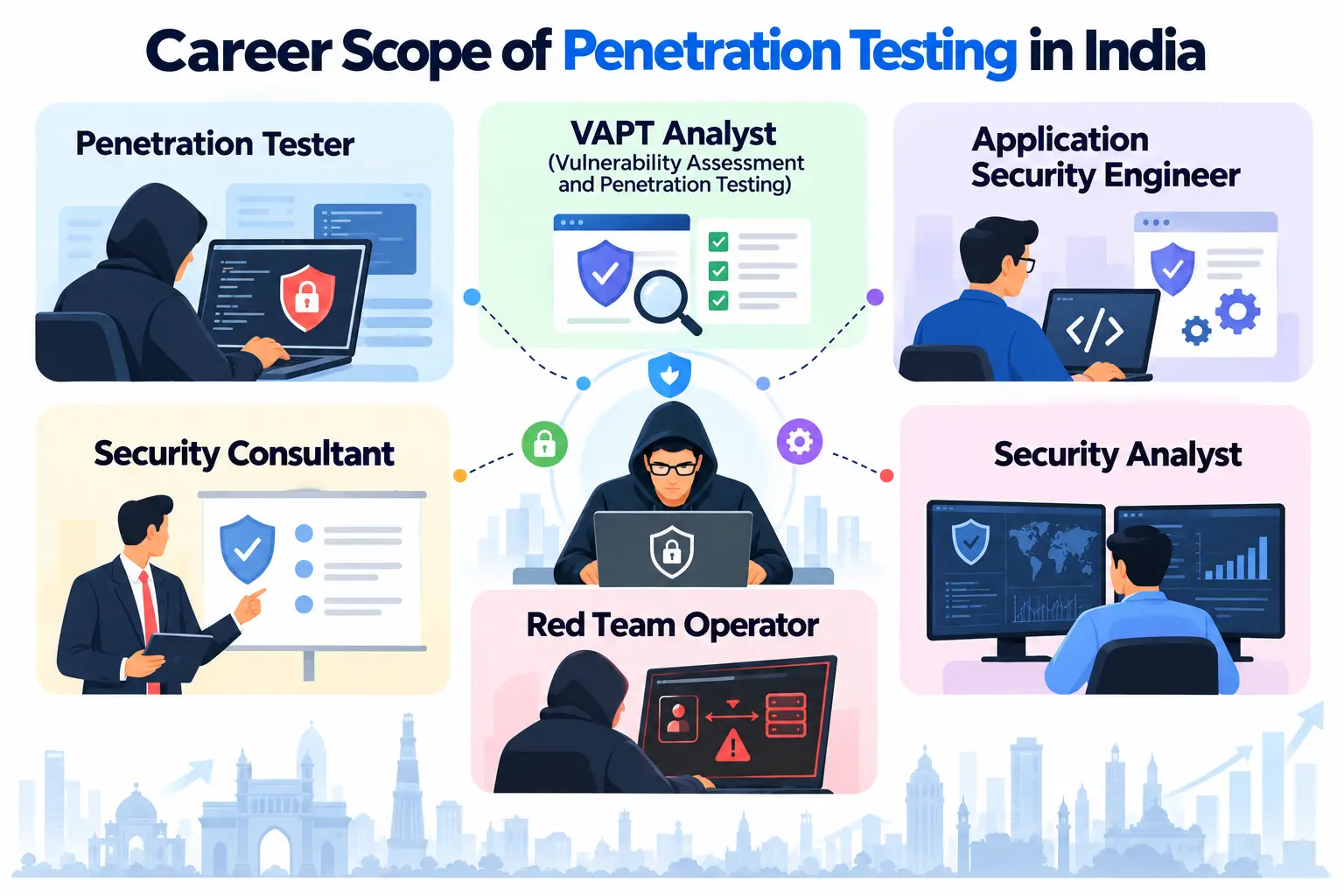
Demand for security testing is driven by regulation, digital banking, cloud adoption and a steady stream of attacks. Common roles include:
Penetration Tester
VAPT (Vulnerability Assessment and Penetration Testing) Analyst
Application Security Engineer
Security Consultant
Red Team Operator
Security Analyst
Salary varies widely by employer, city, skills and certifications. Published salary trackers commonly show fresher ethical hacking and pen testing roles in roughly the ₹3 to ₹6 lakh per year range, with experienced specialists earning considerably more. Figures differ across sources and samples are often small, so treat them as rough guides. Our guides to cybersecurity careers in India and the best cybersecurity courses can help you plan your path.
How to Start a Career in Penetration Testing
Learn the fundamentals: networking, Linux and one scripting language.
Understand security basics: common vulnerabilities and defences.
Build a home lab: practise legally on your own virtual machines and training platforms.
Follow a methodology: practise the planning, discovery, attack and reporting flow, and write reports.
Earn a certification: start with a foundation credential and aim for a practical one.
Show your work: publish write-ups of labs and capture-the-flag challenges.
Apply for entry-level roles: security analyst, SOC analyst or junior tester positions are common entry points.
Legal and Ethical Rules You Must Follow
Get written authorisation before testing anything, including the exact scope and timeframe.
Stay in scope: do not touch systems that were not agreed.
Protect data: handle any sensitive information found with care and follow the agreed retention rules.
Report responsibly: share findings only with the right people.
Know the law: unauthorised access is an offence, so seek legal advice if unsure.
Common Mistakes in Penetration Testing
Treating a scan as a pen test: automated output without validation can mislead.
Poor scoping: unclear boundaries cause missed risks or accidental disruption.
Ignoring business context: the most severe technical issue may not be the most important risk.
Weak reporting: a report that engineers cannot act on wastes the test.
Testing once and forgetting: systems change, so testing needs to be repeated.
Conclusion
Penetration testing helps organisations find and fix security weaknesses before attackers exploit them. It follows a disciplined process of planning, discovery, attack and reporting, draws on a range of tools and standards and always depends on authorisation and ethics.
For learners, the path is clear: build networking and Linux skills, practise legally in labs, earn recognised certifications and show your work. Done well, pen testing is one of the most hands-on and in-demand careers in cyber security.
Frequently Asked Questions
Penetration testing is an authorised, simulated attack on a system, network or application to find security weaknesses and show how they could be exploited, so they can be fixed.
A vulnerability scan automatically lists potential weaknesses. Pen testing is human-led and tries to exploit weaknesses to prove real impact.
NIST SP 800-115 describes four phases: planning, discovery, attack and reporting. The attack phase can loop back to discovery when new information appears.
By knowledge level: black box, white box and grey box. By target: network, web application, API, wireless, cloud, mobile, social engineering and physical testing.
It is a loose term for pen testing. Testing is legal only with written permission. Accessing systems without authorisation is illegal.
Common tools include Nmap, Metasploit, Burp Suite, OWASP ZAP, Wireshark, Hashcat and the Kali Linux distribution. Tools must only be used on authorised systems.
CEH, CompTIA PenTest+, OSCP, GIAC GPEN and eJPT are popular. OSCP is valued for its hands-on exam, while others suit beginners.
Yes, demand is growing across banking, IT services and cloud-driven businesses. Pay varies widely by skills and experience, and practical proof of ability matters most.
Shubham Lal
Lead Software Developer
Shubham Lal joined Microsoft in 2017 and brings 8 years of experience across Windows, Office 365, and Teams. He has mentored 5,000+ students, supported 15+ ed-techs, delivered 60+ keynotes including TEDx, and founded AI Linc, transforming learning in colleges and companies.
Get Free Upskilling Guidance
Fill in the details for a free consultation
Related Courses
Explore our programs
Advanced Professional Certification Programme in Cybersecurity and Ethical hacking
 HOME > BLOG > Cloud Computing and Cyber Security > Penetration Testing: How It Works, Types, Tools & Career Scope
 October 4, 2026
 7 min read





 Key Insights
 ChatGPT
 Perplexity
 Claude
 Grok
Grok











 ROI Calculator