
Advanced Certificate Programme in Machine Learning, Gen AI & LLMs for Business Applications
IITM Pravartak Technology Innovation Hub of IIT Madras

- Course Duration
10-11 Months
- Batch
04
- Commencement Date
12th December, 2026
- Application Closure Date
Closing Soon
- Delivery Mode
Hybrid
(Online with an optional 1-day campus immersion for the valedictory session towards the end) - Class Schedule
Saturday,
8 PM to 10 PM (2nd and 4th)
Sunday,
10 AM to 1 PM (All)
Programme Overview
Admission Criteria

Eligibility Criteria
- Graduate/4-year Engineering/Tech Degree/B.Sc./BCA/M.Sc./MCA from a recognized university (UGC/AICTE/DEC/AIU/State Government/recognized international universities).
- Minimum 50% and above is required for qualification.
- Industry Targeting (Preference): IT, Tech, Software, Engineering Research, Business Analytics, etc.
- Professionals from a tech background must have a minimum of 1 year of work experience.
Assessment
- Homework, Final exam, project
- Final Certifying examination with grades ranging from A to F, with A as the highest grade, and F indicating Failure.
- 50% weightage to homework/case studies and 50% to the final exam.
- Attendance: 70% attendance is mandatory.
This Programme is Curated For
⭐ Individuals with backgrounds in Science, Technology, Engineering, and Mathematics, including fields such as computer science, physics, mathematics, statistics, and engineering.
⭐ Professionals working in the IT industry, software development, programming, and related fields who want to specialize in data science and AI.
⭐Professionals involved in business analysis, market research, and strategic planning who wish to develop expertise in data-driven decision-making.
⭐ Tech professionals with a minimum of 1 year of work experience.
About IITM Pravartak
IITM Pravartak Technologies Foundation is a section 08 Company housing the Technology Innovation Hub on Sensors, Networking, Actuators, and Control Systems (SNACS). IITM Pravartak is funded by the Department of Science and Technology, Government of India, under its National Mission on Interdisciplinary Cyber-Physical Systems and hosted as a Technology Innovation Hub (TIH) by IIT Madras. The IITM Pravartak Technology Innovation Hub aims to focus on new knowledge in the SNACS area through extensive and application-oriented research. IITM-PTF gladly takes the role of preparing young India for the next generation of world-class technologies. The NM-ICPS is a comprehensive Mission aimed at complete convergence with all stakeholders by establishing strong linkages between academia, industry, Government, and International Organizations.
Cutting-Edge Tools and Technologies
Pedagogical Methodology
Leaders
Learning Outcomes
Jaro Expedite - Career Booster
Note: IITM Pravartak or Jaro Education do not guarantee or promise you a job or advancement in your existing position. Career services are simply provided as a service to help you manage your career in a proactive manner. Jaro Education provides the career services described here. IITM Pravartak is not involved in any way with the career services described above and offers no commitments.
Admission Process
- 1
Eligibility of Applicant
- 2
Application Submission
- 3
Screening & Shortlisting
- 4
Admission & Fee Payment
- 5
Book your Seat
Unleash the benefits that await you with Jaro Value adds.
%
higher employee retention rate
%
increase in employee productivity
%
businesses achieved measurable growth
Companies that already trust us!


















Syllabus Breakdown
1. Introduction to Machine Learning
1.1 Overview of Machine Learning Concepts
- Supervised, Unsupervised, and Reinforcement Learning
- Common Machine Learning Algorithms
1.2 Machine Learning Workflow
- Problem Definition and Data Collection
- Data Preprocessing and Feature Engineering
- Model Selection and Training
- Model Evaluation and Tuning
2. Python Tools for Machine Learning
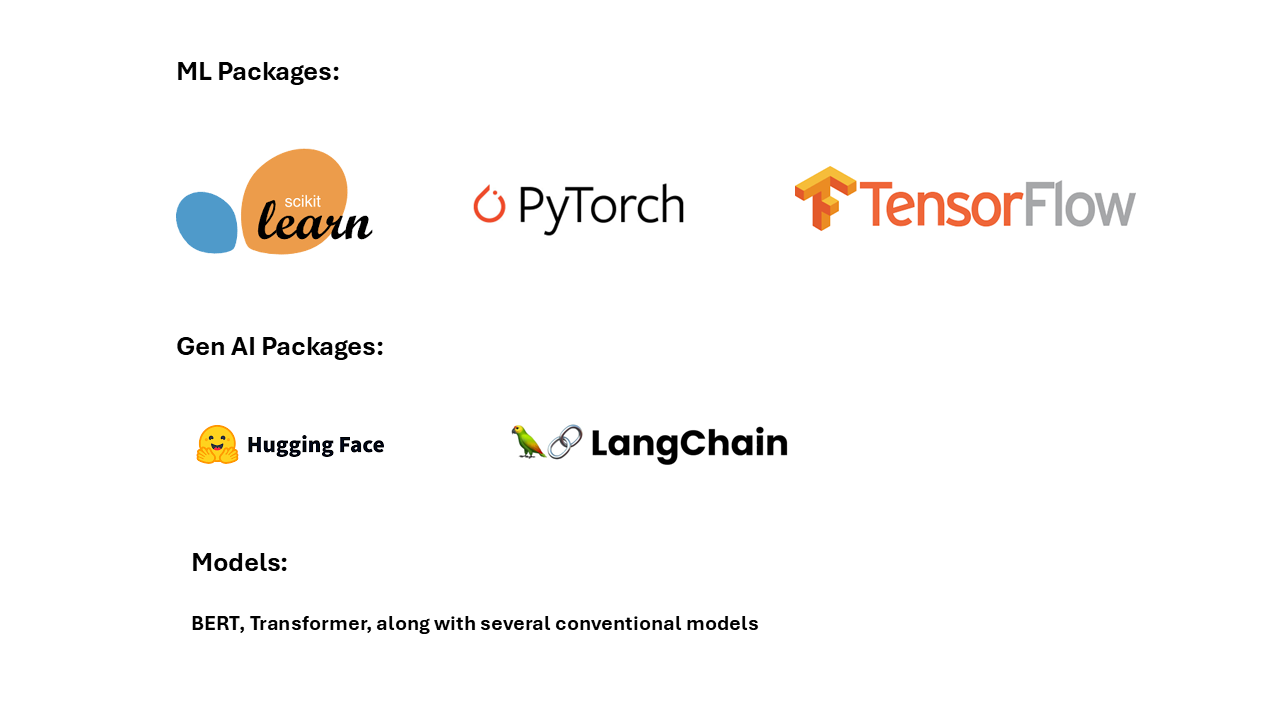
2.1 Introduction to Scikit-Learn
- Data Preprocessing with Scikit-Learn
- Implementing Classification and Regression Models
- Model Evaluation Metrics and Cross-Validation
2.2 Advanced Machine Learning Techniques
- Ensemble Methods: Random Forests, Gradient Boosting
- Dimensionality Reduction: PCA, LDA
- Clustering Techniques: K-Means, Hierarchical Clustering
3. Practical Applications of Machine Learning
- Predictive Modeling with Real-World Datasets
- Implementing Recommendation Systems
- Time Series Forecasting with Machine Learning Models
4. Capstone Project: Machine Learning Application
- Problem Statement and Data Exploration
- Model Development and Evaluation
- Optimization and Final Presentation
5. Introduction to Deep Learning
5.1 Fundamentals of Neural Networks
- Neurons, Layers, and Activation Functions
- Loss Functions and Optimization
5.2 Deep Learning Architectures
- Convolutional Neural Networks (CNNs)
- Recurrent Neural Networks (RNNs)
- Advanced Architectures: LSTMs, GRUs, Attention Mechanisms
6. Python Tools for Deep Learning
6.1 Introduction to TensorFlow and Keras
- Building Neural Networks with Keras
- Training and Evaluating Deep Learning Models
- Visualizing Model Performance
6.2 PyTorch for Deep Learning
- Understanding Tensors and Autograd
- Implementing CNNs and RNNs with PyTorch
- Transfer Learning and Fine-Tuning Pre-Trained Models
7. Practical Applications of Deep Learning
- Image Classification and Object Detection with CNNs
- Sequence Modeling for NLP Tasks with RNNs
- Advanced Topics: GANs, Autoencoders, and Attention Models
8. Capstone Project: Deep Learning Application
- Problem Statement and Data Preparation
- Model Development and Tuning
- Final Model Evaluation and Presentation
9. Introduction to Generative AI
9.1 Overview of Generative Models
- GANs, VAEs, and Diffusion Models
- Applications of Generative AI
9.2 Generative Adversarial Networks (GANs)
- GAN Architecture and Training Process
- Implementing GANs with TensorFlow/PyTorch
- Applications of GANs: Image Synthesis, Style Transfer
10. Variational Autoencoders (VAEs) and Diffusion Models
10.1 Understanding VAEs
- Encoder-Decoder Architecture
- Latent Space Representation and Sampling
10.2 Diffusion Models for Generative AI
- Basics of Diffusion Processes
- Implementing Diffusion Models in Python
11. Practical Applications of Generative AI
- Creative AI: Art and Music Generation
- Data Augmentation with Generative Models
- Ethical Considerations in Generative AI
12. Capstone Project: Generative AI Application
- Project Setup and Data Collection
- Model Development and Fine-Tuning
- Final Model Deployment and Presentation
13. Introduction to Large Language Models (LLMs)
- Evolution of LLMs: From GPT to GPT-4 and Beyond
- Transformer Architecture and Attention Mechanism
- Pre-trained vs. Fine-Tuned LLMs: Differences and Use Cases
14. Fine-Tuning LLMs
- Data Preparation for Fine-Tuning
- Fine-Tuning LLMs with Hugging Face Transformers
- Evaluating and Optimizing Fine-Tuned Models
15. Building Custom AI Agents with LangChain
- Introduction to LangChain for Building AI Agents
- Creating Custom Chains and Workflow Automation
- Integrating LLMs with External APIs
16. Retrieval-Augmented Generation (RAG)
- Understanding RAG Concepts and Architecture
- Implementing RAG with Hugging Face Transformers
- Practical Applications of RAG in QA and Search Systems
17. Capstone Project: LLM and RAG Application
- Project Setup and Data Collection
- Model Development and Fine-Tuning
- Final Model Evaluation and Presentation
18. Text-Based Applications of LLMs
- Automated Content Creation and Summarization
- Building Conversational Agents and Chatbots
- Sentiment Analysis and Text Classification
19. Image and Video Applications with LLMs
- Text-to-Image Generation with DALL-E and CLIP
- Video Synthesis and Editing with Generative Models
- Combining LLMs with Computer Vision Tasks
20. Audio Applications of LLMs
- Text-to-Speech (TTS) Systems with LLMs
- Music and Sound Generation
- Voice Cloning and Audio Enhancement
21. Capstone Project: Multimodal LLM Application
- Project Proposal and Planning
- Data Collection and Model Development
- Final Integration and Presentation
22. Multimodal Generative AI Systems
- Integrating Text, Image, and Audio Models
- Case Studies: AI Art, Music Videos, Virtual Worlds
- Developing Cross-Modal Retrieval Systems
23. Customizing and Extending Generative AI Models
- Fine-Tuning LLMs for Multimodal Tasks
- Building End-to-End Multimodal Pipelines
- Deployment Strategies for Multimodal Applications
24. Capstone Project: Integrated Generative AI Application
- Project Planning and Data Collection
- Model Integration and Workflow Design
- Final Testing, Optimization, and Presentation
25. Introduction to Productionizing AI Models
- Overview of MLOps and Best Practices
- Setting Up CI/CD Pipelines for AI Applications
- Monitoring and Maintaining AI Models in Production
26. Deploying AI Models with Python Tools
- Model Deployment with TensorFlow Serving and TorchServe
- Scaling Applications with Docker and Kubernetes
27. End-to-End Pipeline for LLM and Generative AI Applications
- Text-to-Speech (TTS) Systems with LLMs
- Music and Sound Generation
- Voice Cloning and Audio Enhancement
Programme Fee Details

- Easy EMI Options Available*

Application Fee
INR 1500 + GSTTotal Programme Fee
INR 1,30,000 + GSTInstalment Pattern

Instalment I
INR 60,000 + GST(As mentioned in the offer letter)
Instalment II
INR 40,000 + GST(05th February, 2027)
Instalment III
INR 30,000 + GST(05th April, 2027)
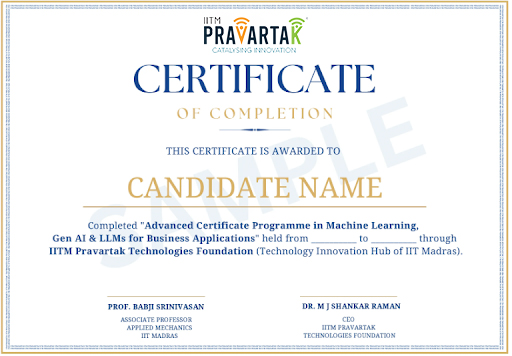
Programme Certification
- Participants who successfully meet the evaluation criteria and satisfy the requisite attendance criteria will be awarded a ‘Certification of Completion’ – Advanced Certificate Programme in Machine Learning, Gen AI & LLMs for Business Applications.
Note: The above certificate is for illustrative purposes only.
Know the Facilitators


The Jaro Advantage

Learning Support

Doubt Resolution
Networking
Unlock Your Path to Success
Unsure about which course to choose? We understand—selecting the right programme can feel overwhelming. That’s why our intuitive Course Finder is here to help you discover the perfect match based on your skills, goals, and interests. Let us guide you toward your next career milestone with confidence.
Find My Ideal Course Find My Ideal Course

Refer & Earn – Amazing Rewards Await!
Share the gift of education—refer your friends and colleagues now! Earn fantastic rewards for every successful referral and empower others to advance their careers while you benefit.
Start Referring Today! Start Referring Today!Frequently Asked Questions
The duration of the programme is 10-11 months.
- To qualify, candidates should possess a Graduate or 4-year Engineering/Technical Degree, B.Sc, BCA, M.Sc, or MCA from a recognized university, such as those accredited by UGC, AICTE, DEC, AIU, State Government, or other recognized international institutions.
- Plus a minimum score of 50% or above is required for qualification.
- The candidates are from diverse industries: IT, Technology, Software, Engineering Research, Business Analytics, and related fields are ideal to apply for this intake.
- Additionally, professionals from a tech background must possess at least 1 year of work experience.
The programme is designed for participants to gain clarity and hands-on experience in concepts related to data science and AI, analytics workflow including data management, model building, and reporting results, handling and processing big datasets, several in-demand software related to data science, and ,applications of data science and AI in different real-world contexts.
The primary goal of this programme is to equip working professionals with knowledge about state-of-the-art techniques such as Generative AI, GPTs, and text generation. Also, the programme will focus on developing the skills of participants in this field using various pedagogy techniques such as online classes, tutorial sessions on Python, projects and mini quizzes while providing relevant reference materials.
IITM Pravartak does not provide any career support related services including interviews, placements, etc. Jaro Education provides certain services that are mentioned on the programme webpage. Neither IITM Pravartak nor Jaro Education can guarantee you a fresh job or promotion in your current job.
