
Executive Programme in Artificial Intelligence and Cyber Security for Organizations
Programme Offered by IIM Indore

- Batch
04
- Course Duration
10 months
- Commencement Date
19th December 2026
- Application Closure Date
Closing Soon
- Session Timings
Saturday,
1st Session:
5.30PM-6.45PM
2nd Session:
7.00PM-8.15PM
Programme Overview
The Executive Programme in Artificial Intelligence & Cyber Security for Organizations is a comprehensive, industry-oriented programme designed for non-technical professionals, engineers, IT project managers, functional managers, and early-career IT professionals seeking to build future-ready capabilities in AI and cybersecurity.
As organizations rapidly adopt AI-driven technologies, cyber risk has become a business challenge—not just an IT concern. This multidisciplinary programme equips participants with the knowledge to understand digital transformation, leverage AI responsibly, identify cyber threats, manage organizational risk, and contribute to secure business decision-making.
The programme is ideal for professionals looking to enhance cross-functional technology leadership, transition into cybersecurity roles, or strengthen their ability to navigate today’s evolving digital landscape.
Assessment & Evaluation

Eligibility Criteria
- Diploma (10+2+3)/ Graduate / Post Graduate from Universities recognised by the Association of Indian Universities with minimum 50% marks in either Diploma or graduation or post-graduation (or its equivalent) with at least two years of work experience.
*Internships and Trainee experiences are not considered Full-time work experience
Attendance Criteria
Participants are expected to attend all sessions of a given course. However, Participants may take leave on account of emergencies, subject to the approval of the Programme Coordinator. However, 75% minimum attendance requirement would be considered for the final grading. For less than 75% attendance, a grade cut as per the norms will be applied.
Evaluation Methodology
The performance of participants will be monitored on a continuous evaluation basis through quizzes, assignments, tests and examinations. The participant is required to score minimum of marks/grades as decided by the Institute from time to time to complete the course
On-Campus Module: 3 Days Duration (12 Sessions)
One or two sessions from some courses will become part of the on-campus orientation module. In case the on-campus module is not conducted due to the COVID situation, the same will be included in the total number of sessions.
Who Should Enrol?
This programme is designed for professionals looking to build strategic capabilities in Artificial Intelligence and Cyber Security, regardless of their technical background.
- Graduates with a minimum of 2 years of post-qualification work experience.
- Non-engineers and non-technical professionals seeking to develop AI and cybersecurity literacy for business and leadership roles.
- Managers and functional leaders responsible for technology, digital transformation, governance, risk, or business operations.
- Technology leaders and IT managers looking to strengthen their understanding of cyber risk, AI adoption, and organizational resilience.
- Engineers, IT professionals, and project managers seeking to upskill in AI, cybersecurity, and emerging technologies.
- Cybersecurity aspirants looking to build expertise in threat management, cyber risk, governance, and security operations to accelerate their careers.
- Career switchers from business, operations, finance, consulting, or other domains who wish to transition into AI, cybersecurity, or digital risk management.
- Professionals involved in digital transformation initiatives who need to make informed decisions on AI adoption, cybersecurity, governance, and enterprise risk.
The programme follows a multidisciplinary, business-focused approach and is equally valuable for technical and non-technical professionals aspiring to lead AI-enabled, secure organizations.
About IIM Indore
Established in 1996, the Indian Institute of Management Indore is among the leading business schools in India and globally, and the second IIM in India to receive the prestigious Triple Crown accreditation (EQUIS, AACSB, and AMBA).
IIM Indore has consistently been ranked among the leading institutions by national and international ranking bodies, including the QS and Financial Times Executive Education rankings, where it ranks 62nd globally in Open Executive Education and 2nd among Indian business schools. The institute offers a diverse portfolio of executive education programmes across long-term and short-term formats.
With over 200 executive education programmes, including specialized offerings designed for professionals from the UAE, GCC countries, and the Middle East, IIM Indore equips participants with globally relevant knowledge, skills, and leadership capabilities.

Pedagogical Methodology
Learning Outcomes
Artificial Intelligence
Cyber Security
Hear from the Facilitator
Career Assistance by Jaro Education
Executive Education Alumni Status
Benefits include:
- Subscription to brochures and newsletters from IIM Indore
- Access to the IIM Indore Learning Centre (on-campus access only)
- An official email ID from the institute
- Executive Education Alumni Status is granted upon request and subject to completion of the application process and verification by the Alumni Office.
Please note that successful completion of the programme and payment of the fee do not automatically guarantee alumni status. The Institute reserves the right to approve or decline applications for Executive Education Alumni Status.IIM Indore also reserves the right to modify these terms at its discretion without prior notice. Any disputes arising shall fall under the exclusive jurisdiction of the courts at Indore.
Admission Process
- 1
Eligibility of Applicant
- 2
Application Submission
- 3
Screening & Shortlisting
- 4
Admission & Fee Payment
- 5
Book your Seat
Unleash the benefits that await you with Jaro Value adds.
%
higher employee retention rate
%
increase in employee productivity
%
businesses achieved measurable growth
Companies that already trust us!




















Syllabus Breakdown
Module A1 — Introduction to Artificial Intelligence & Digital Transformation
- What is AI? History, evolution, and the current state of the field
- Types of AI: Narrow AI, General AI, and the emerging AI Agent paradigm
- Digital transformation frameworks and AI’s role in organizational change
- AI adoption maturity models for enterprises
- IAI in Indian and global industry contexts
Industry Case Study: How companies leverage AI-driven automation to transform service delivery models — and what it means for enterprise clients.
Module A2 — Machine Learning and AI
- Supervised, unsupervised, and reinforcement learning fundamentals
- Key algorithms: Decision Trees, Random Forests, SVMs, Neural Networks
- Model training, validation, and evaluation frameworks
- Feature engineering and data preprocessing pipelines
- Practical ML with Python (scikit-learn, Pandas, NumPy)
- Introduction to deep learning and computer vision
- Natural Language Processing (NLP) fundamentals
Learning Outcomes:
- Build and evaluate basic ML models using Python
- Understand the lifecycle of an AI/ML project
- Critically assess AI model outputs and their business implications
Tools Exposure: Python, Jupyter Notebooks, Google Colab, scikit-learn
Industry Case Study: How Bank uses ML models for credit scoring and fraud detection — including model governance challenges.
Module A3 — Big Data and Analytics
- The 4Vs of Big Data: Volume, Velocity, Variety, Veracity
- Hadoop ecosystem: HDFS, MapReduce, Hive, HBase
- Apache Spark and PySpark for large-scale data processing
- Data lakes vs. data warehouses: architectural decisions
- Real-time streaming analytics (using PySpark)
- Data-driven decision making for managers
Learning Outcomes:
- Understand how organizations store, process, and derive insight from large datasets
- Use PySpark for basic data transformations and analysis
- Evaluate big data infrastructure options for organizational contexts
Tools Exposure: Apache Spark, PySpark, Hadoop (conceptual), Hive
Industry Case Study: How food aggregators use real-time big data pipelines to optimize delivery and demand forecasting.
Module A4 — Data Visualization
- Principles of effective data visualization for executive audiences
- Dashboard design: what to show vs. what to hide
- Hands-on with Power BI: building dashboards and reports
- Hands-on with Tableau: storytelling with data
- KPIs and metrics design for cybersecurity and AI operations
Learning Outcomes:
- Build interactive dashboards using Power BI or Tableau
- Design visualizations that drive business decisions
- Communicate data insights to non-technical stakeholders
Tools Exposure: Power BI, Tableau
Industry Case Study: How a leading BFSI firm uses Power BI dashboards for real-time cybersecurity risk monitoring at the board level.
Module A5 — Generative AI including Prompt Engineering (Enhanced)
- How generative AI works: LLMs, diffusion models, transformers
- Key platforms: ChatGPT, Claude, Gemini, Copilot — capabilities and limitations
- Prompt engineering techniques: zero-shot, few-shot, chain-of-thought
- Enterprise use cases: content generation, code assistance, document automation
- Risks of generative AI: hallucinations, data leakage, IP concerns
- Integrating GenAI into organizational workflows responsibly
- GenAI for cybersecurity: threat report generation, policy drafting, alert summarization
Learning Outcomes:
- Design effective prompts for business and technical use cases
- Evaluate GenAI tools for enterprise readiness and risk
- Identify security and compliance risks in GenAI deployment
Tools Exposure: ChatGPT (API), Claude, Microsoft Copilot, Google Gemini
Industry Case Study: How a global law firm piloted GenAI for contract review — and the governance framework they built to manage risk.
Module A6 — Agentic AI and Autonomous Systems (New Module)
Why this matters: Agentic AI is the fastest-growing area of enterprise AI adoption in 2025-26. Organizations are deploying autonomous AI systems without adequate governance — creating both opportunity and serious risk. Professionals who understand this space will be indispensable.
- What is Agentic AI? From chatbots to autonomous AI agents, difference between AI agents and Agentic AI
- Architecture of AI agents: perception, reasoning, memory, action
- Multi-agent systems and orchestration frameworks
- Agentic AI in enterprise: automated workflows, decision pipelines, AI assistants
- Security risks of agentic systems: prompt injection, agent manipulation, unintended actions
- Governance and human-in-the-loop design for autonomous AI
- Real-world deployments: AI agents in customer service, IT operations, finance
Learning Outcomes:
- Understand how autonomous AI agents are architected and deployed
- Evaluate organizational readiness and risk for agentic AI adoption
- Design governance guardrails for AI agent deployment in their organization
Tools Exposure: Microsoft Copilot Studio, Zapier, n8n
Industry Case Study: How a global bank is deploying AI agents for reconciliation and compliance checks — and the oversight framework that keeps humans in control.
Module A7 — Emerging Technologies: Blockchain & Quantum Computing
- Blockchain fundamentals: distributed ledgers, consensus mechanisms, smart contracts
- Enterprise blockchain use cases: supply chain, identity, finance
- Quantum computing basics: qubits, superposition, entanglement
- Quantum’s threat to current encryption (post-quantum cryptography)
- NIST post-quantum cryptographic standards overview
- Strategic implications for organizational IT roadmaps
Learning Outcomes:
- Understand how blockchain and quantum computing will reshape security and data management
- Assess organizational exposure to quantum-era cryptographic vulnerabilities
- Evaluate blockchain applicability to specific business contexts
Industry Case Study: India’s Central Bank Digital Currency (CBDC) pilot — blockchain design choices and security considerations.
Module B1 — Introduction to Cybersecurity: Issues and Challenges
- The current global cybersecurity threat landscape and sector-specific cyber threat landscape
- Foundational understanding of cybersecurity concepts
- Types of threats: malware, ransomware, phishing, insider threats, APTs
- AI enabled tech challenges
- Leadership role in cybersecurity implementation
Learning Outcomes:
- Describe the global and sector-specific cyber threat landscape and AI-related risks
- Understand core cybersecurity concepts to assess risks and recommend basic technical and organizational controls
- Lead and justify cybersecurity policies and implementation plans to reduce risk and ensure accountability
Industry Case Study: The AIIMS Delhi ransomware attack (2022)
Module B2 — Defensive and Offensive Cybersecurity Landscape
- Understanding network fundamentals and reference models
- Secure design principles and models
- Offensive and defensive security
- Penetration testing methodology and scope
- Vulnerability scanning and assessment fundamentals
- Social engineering and human-factor attacks
Learning Outcomes:
- Explain network fundamentals, reference models, and secure design principles to evaluate system architectures for security
- Understand offensive techniques and recommend defensive measures—detection, prevention, containment—and mitigate human-factor risks including social engineering
- Penetration testing and vulnerability assessment fundamentals and methodologies
Module B3 — Security in the Interconnected World: Cloud, Mobile & IoT
- Cloud security fundamentals and modern architecture
- IoT security risks: device management, firmware vulnerabilities, network segmentation
- Sector specific IoT and automation
- IoT strategic insights and business challenges for an organization
Learning Outcomes:
- Explain cloud security fundamentals and architectures
- Identify IoT security risks and sector-specific automation challenges
- Assess strategic and business implications of IoT adoption and apply case-study insights to recommend governance, business cost of failures and risk mitigation
Industry Case Study: Samsung: The Internet of Things
Module B4 — Governance, Risk Management & Compliance [ENHANCED]
Risk Management:
- Cybersecurity risk management frameworks: NIST CSF, ISO 27001, COBIT
- Risk registers, risk appetite, and risk treatment strategies
Compliance & Regulations:
- India: IT Act 2000, DPDP Act 2023, CERT-In Directions, RBI Cyber Security Framework
- Global: GDPR, HIPAA, SOC 2, PCI-DSS
- EU AI Act: implications for organizations using or developing AI
- Compliance audit processes and documentation requirements
- Building a compliance calendar and reporting cadence
Governance:
- Cybersecurity governance structures: CISO role, Security Committees, Board reporting
- Developing an Information Security Management System (ISMS)
- Security policy lifecycle: creation, approval, enforcement, review
- Security metrics and KPIs for board-level reporting
- AI governance frameworks: responsible AI policies, model risk management
Learning Outcomes:
- Build and present a risk register for a real organizational scenario
- Map organizational practices against NIST CSF or ISO 27001 controls
- Draft a compliance roadmap for DPDP Act and CERT-In requirements
- Understand board-level cybersecurity governance responsibilities
Industry Case Study:
GDPR vs. DPDP Act: A side-by-side comparison and what Indian organizations operating globally must address.
Why this depth matters: This programme targets managers and technology leaders who are accountable for organizational risk. Superficial compliance knowledge is insufficient — professionals need to operationalize governance frameworks, present to boards, and make risk-informed decisions.
Module B5 — Cybersecurity Technologies (Tool-Enhanced)
SIEM platforms: architecture, log management, correlation rules
Learning Outcomes:
Design a layered cybersecurity technology stack for an organization
Industry Case Study: How a global manufacturing company deployed CrowdStrike to detect and contain a nation-state intrusion within 4 hours — compared to their previous 3-week mean time to detect.
Module B6 — Incident Response and Digital Forensics
- Business Continuity and Disaster Recovery Planning
- Risk Assessment and Management
- The incident response lifecycle: Preparation, Detection, Containment, Eradication, Recovery
- Digital forensics fundamentals: chain of custody, digital evidence, investigation and evidence preservation
- Tools and Techniques in Forensic Analysis (Conceptual)Post-incident analysis
- Crisis communication during a cyber incident
Learning Outcomes:
- Understand the incident response lifecycle for an organisation
- Identify and preserve digital evidence to meet legal and evidentiary standards
- Understand risk assessments and post-incident analysis, leveraging digital forensics fundamentals and conceptual forensic tools/techniques
- Coordinate crisis communication and strengthen organisational resilience
Tools Exposure: Nmap, Wireshark, Metasploit (conceptual)
Module B7 — Ethical Hacking
- Ethical hacking methodology and legal boundaries
- Reconnaissance techniques and ethical considerations
- Scanning and enumeration
- Ethical hacking, compliance and best practices
Learning Outcomes:
- Explore ethical hacking methodologies within legal and regulatory boundaries to assess system security
- Understand reconnaissance, scanning, and enumeration techniques to identify vulnerabilities responsibly
- Adhere to compliance requirements and best practices for reporting, remediation, and safe exploitation
Module B8 — Identity and Access Management (IAM)
- Identity as the new security perimeter
- Authentication mechanisms and challenges
- Role-Based Access Control (RBAC) and Attribute-Based Access Control (ABAC)
- Zero Trust and IAM
- Integration issues and connectivity
- Identity governance and access reviews
Learning Outcomes:
- Explain identity as the security perimeter and evaluate authentication mechanisms and common challenges
- Understand access control and Zero Trust principles to manage access and integration across systems
- Lead identity governance, conduct access reviews, and address connectivity and compliance issues
Module B9 — Data Privacy and Data Protection
- Data privacy principles: purpose limitation, data minimization, consent
- India’s Digital Personal Data Protection (DPDP) Act 2023: detailed walkthrough
- GDPR essentials for organizations with global operations
- HIPPA
- Data classification frameworks and data inventory
- Privacy by Design: embedding privacy into product and system development
- Data breach notification requirements and timelines
- AI and data privacy: handling personal data in ML models
Learning Outcomes:
- Conduct a basic data inventory and classification exercise
- Map organizational practices to DPDP Act compliance requirements
- Draft a data breach response procedure aligned with regulatory timelines
Industry Case Study: The WhatsApp GDPR fine (2021) — what went wrong with privacy notices and how organizations can avoid similar penalties.
Module B10 — Overview of Cybercrime and Cyber Law
- Typology of cybercrime and classification
- Motivations and planning behind cyber attack
- India’s IT Act 2000 and amendments and legal gap
- IT Guidelines and rules
- Digital Personal Data Protection Act, 2023
- Cyber law and evidence admissibility – Indian Evidence Act
- International regulation and enforcement challenges
Learning Outcomes:
- Describe cybercrime typologies, attacker motivations, planning, and classifications
- Explain key Indian cyber laws and regulations (IT Act 2000, its amendments, Digital Personal Data Protection Act 2023), evidence admissibility under the Indian Evidence Act, and identify legal gaps.
- Assess international regulatory frameworks and enforcement challenges
Industry Case Study: Legal case of large-scale data breach and exposure of user records and privacy failures
Module B11 — Information Security: Strategy and Policy [ENHANCED]
- Aligning cybersecurity strategy with organizational business objectives
- Security budgeting: building a business case for security investments
- Security program maturity models (CMMI for Security)
- Developing and communicating a multi-year cybersecurity roadmap
- Security culture and behaviour change programs
- Vendor and procurement security assessment frameworks
- M&A cybersecurity due diligence
- Communicating cyber risk to boards and audit committees (using language executives understand)
Learning Outcomes:
- Develop a 3-year cybersecurity strategic roadmap for a sample organization
- Build a board-level cybersecurity risk briefing (non-technical language)
- Evaluate security investment decisions using risk-adjusted ROI frameworks
Industry Case Study: How the CISO of a Fortune 500 company restructured the security budget from reactive to proactive — and the metrics they used to justify it to the CFO.
Module B12 — AI Security Operations (AI SecOps) [NEW]
- Securing the AI/ML lifecycle: data pipelines, model training, deployment
- Adversarial machine learning: model poisoning, evasion attacks, model inversion
- AI-powered threat detection: behavioral analytics, anomaly detection at scale
- Securing LLMs and generative AI deployments (prompt injection, data leakage)
- AI governance for security tools: bias in automated decision-making
- Evaluating AI-powered security products critically
Learning Outcomes:
- Identify security risks in AI system deployment within their organization
- Evaluate AI-powered cybersecurity tools with appropriate critical judgment
- Understand how attackers are using AI to enhance attacks
Industry Case Study: How attackers used AI-generated deepfake audio to impersonate a CEO and authorize a $25M wire transfer — and the detection controls that could have stopped it.
Programme Fee Details

- *The above fee does not include the Executive Education Alumni fee.

- *GST will be charged extra on these components; at present it is @18%.
Registration Fee
(while applying)
Total Programme Fee
(inclusive of application fee)
(excluding GST @18%)
Overall Fees
(including GST @18%)
Instalment Pattern

Instalment 1
INR 70,000(At the time of Admission)
Instalment 2
INR 70,000(15th February, 2027)
Instalment 3
INR 57,500(15th May, 2027)
Faculty Coordinators


Programme Certification
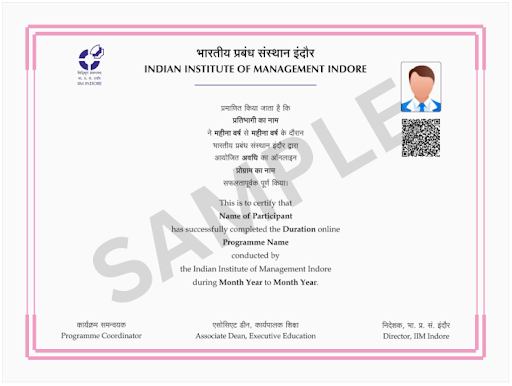
Participants who successfully meet the evaluation criteria and satisfy the requisite attendance criteria will be awarded a ‘Certification of Completion’ from IIM Indore.
The Jaro Advantage

Personalized Learning Support
- Career Acceleration: Get unmatched career guidance, resume-building workshops, and 1:1 mentorship to fast-track your professional growth.
- 24/7 Student Support: Dedicated assistance at every step—from enrollment to graduation.
- Future-Ready Learning: Engage in immersive, industry-aligned programs designed for lifelong career relevance.

Expert-Led Doubt Resolution
- Learn from the Best: Access mentorship from top-tier faculty and industry leaders.
- Collaborative Learning: Join dynamic discussion forums and peer-to-peer networks for deeper insights.
- Real-World Problem Solving: Apply knowledge through case studies and interactive sessions.

Powerful Global Networking
- Elite Alumni Community: Connect with 350,000+ professionals worldwide for career opportunities and collaborations.
- Exclusive Events: Attend global webinars, networking meetups, and industry talks.
- Lifelong Access: Stay updated with cutting-edge trends and alumni benefits long after graduation.
Unlock Your Path to Success
Unsure about which course to choose? We understand—selecting the right programme can feel overwhelming. That’s why our intuitive Course Finder is here to help you discover the perfect match based on your skills, goals, and interests. Let us guide you toward your next career milestone with confidence.
Find My Ideal Course Find My Ideal Course

Refer & Earn – Amazing Rewards Await!
Share the gift of education—refer your friends and colleagues now! Earn fantastic rewards for every successful referral and empower others to advance their careers while you benefit.
Start Referring Today! Start Referring Today!Frequently Asked Questions
The pedagogy has been meticulously curated with a judicious blend of lectures, case studies, project work, term papers, and assignments, among other things.
- This multi-disciplinary course is designed to equip non-engineers/non-tech graduates, managers, Engineers, and Cybersecurity Career aspirants: Early-career IT professionals, IT project managers and engineers wanting to gain the ability to think critically about the threat landscape, including vulnerabilities in cyber security for career advancement.
- Managers who lead technology functions.
- Participants are expected to attend all sessions of a given course. However, Participants may take leave on account of emergencies, subject to the approval of the Programme Coordinator. However, a 75% minimum attendance requirement would be considered for the final grading. For less than 75% attendance, a grade cut as per the norms will be applied.
Participants will be introduced to:
-
AI/ML tools: Python, Scikit-Learn, Jupyter Notebooks
-
Data tools: Tableau, Power BI, Hadoop
-
Cybersecurity tools: Wireshark, Metasploit, Nmap
-
Generative AI platforms: ChatGPT, GitHub Copilot