History of AI: Key Milestones and Evolution of Artificial Intelligence
J
By Dr. Sanjay Kulkarni
September 20, 20268 min read
Published on September 20, 2026
SHARE THIS ARTICLE
Table Of Content
Artificial Intelligence Background: Where Did the Idea Begin?
Origin of Artificial Intelligence: The Foundations in the 1940s and 1950s
1956: The Birth of AI as a Field
The 1960s: Early AI Programs and Growing Expectations
Key Insights
AI has evolved from early ideas about machine reasoning into technology used for search, recommendations, chatbots, image generation, and other everyday applications.
The 1956 Dartmouth workshop marked an important milestone in the history of AI, helping establish artificial intelligence as a formal academic research field.
AI development faced major challenges, including limited computing power, insufficient data, and difficulties in handling real-world complexity, leading to periods known as AI winters.
Machine learning, deep learning, and technologies such as neural networks and Transformers significantly changed the evolution of artificial intelligence, enabling systems to learn patterns from large datasets.
Generative AI has brought AI into mainstream use, with systems capable of creating text, images, audio, video, and computer code.
In this blog, you'll learn about the artificial intelligence background, origin of artificial intelligence, major milestones from the 1940s to the rise of generative AI, and the brief history of artificial intelligence and its evolution into everyday technology.
The idea of artificial intelligence is much older than modern computers. Ancient Greek myths even described artificial beings created to serve humans. Thousands of years later, that idea evolved into the AI systems we use today for search, recommendations, chatbots, image generation, and much more.
The history of AI is quite interesting which includes a combination of mathematics, computer science, neuroscience, and human imagination. What started as a question about whether machines could think has grown into one of the most influential fields in technology.
The evolution of artificial intelligence has not happened overnight. It includes decades of ambitious ideas, breakthroughs, setbacks, and renewed interest. From early theoretical work in the 1940s to generative AI in the 2020s, each stage has shaped how we understand and build intelligent machines.
This brief history of artificial intelligence explores the major milestones that explain how AI moved from an academic idea to a technology used across industries and everyday life.
Artificial Intelligence Background: Where Did the Idea Begin?
The artificial intelligence background can be traced to a simple but challenging question: Can machines imitate human intelligence?
Before electronic computers existed, philosophers and mathematicians were already exploring logic, reasoning, and mechanical calculation. The development of formal logic and early calculating machines created the foundation for thinking about whether human reasoning could be represented using rules.
In the 19th century, Charles Babbage designed the Analytical Engine, a mechanical computing machine. Ada Lovelace, who worked on ideas related to the machine, recognized that such machines could potentially manipulate symbols beyond simple numerical calculations.
Although these inventions were not AI systems, they contributed to an important idea: machines could follow structured instructions to process information.
Origin of Artificial Intelligence: The Foundations in the 1940s and 1950s
The origin of artificial intelligence as a formal scientific field is generally associated with developments in the mid 20th century.
In 1943, researchers Warren McCulloch and Walter Pitts published a mathematical model of artificial neurons. Their work helped establish a connection between biological neurons and computational systems.
Another major milestone came in 1950, when British mathematician and computer scientist Alan Turing published his influential paper Computing Machinery and Intelligence. Instead of asking whether machines could literally think, Turing proposed a practical way to consider machine intelligence.
He introduced what later became known as the Turing Test, which considers whether a machine can produce responses that are difficult to distinguish from those of a human in a conversation.
These developments helped move the discussion about machine intelligence from science fiction toward scientific research.
1956: The Birth of AI as a Field
One of the most important moments in the history of AI came in 1956 at the Dartmouth Summer Research Project on Artificial Intelligence.
The workshop was organized by John McCarthy, Marvin Minsky, Nathaniel Rochester, and Claude Shannon. John McCarthy is widely associated with introducing the term artificial intelligence.
The researchers proposed that aspects of learning and intelligence could potentially be described precisely enough for machines to simulate them.
This event is often considered the formal beginning of AI as an academic research field.
Early researchers were highly optimistic about what machines could accomplish. They explored areas such asproblem solving, language processing, game playing, and symbolic reasoning.
The 1960s: Early AI Programs and Growing Expectations
During the 1960s, AI research began producing some of its earliest working programs.
Researchers developed systems that could solve mathematical problems, prove logical statements, play games, and manipulate language.
One notable example was ELIZA, developed by Joseph Weizenbaum at MIT in the 1960s. ELIZA could simulate a conversation by identifying keywords and responding using predefined patterns.
Although ELIZA was not actually understanding language in the human sense, many users found its responses surprisingly convincing.
Another important development was Shakey the Robot, created at Stanford Research Institute. Shakey could perceive its surroundings, plan actions, and move around an environment. It represented an early attempt to combine reasoning, perception, and physical action in one system.
These projects demonstrated the potential of AI while also revealing how difficult human-like intelligence could be.
The 1970s and 1980s: AI Winters and Expert Systems
The evolution of artificial intelligence was not a smooth upward journey. AI research experienced periods when expectations were much higher than what available technology could deliver.
These periods are often referred to as AI winters.
During the 1970s, researchers faced limitations in computing power, available data, and the ability of AI systems to handle real-world complexity. Funding and interest declined in some areas.
However, AI research continued.
During the 1980s, expert systems became particularly important. These systems were designed to reproduce the decision-making process of human specialists within specific domains.
Expert systems used knowledge bases and rules to make recommendations or solve particular problems. They were used in areas such as medical diagnosis,finance, manufacturing, and technical support.
However, maintaining large rule-based systems was difficult. As their limitations became more apparent, enthusiasm again declined, contributing to another AI winter.
The 1990s: Machine Learning Gains Momentum
The 1990s brought an important change in the history of AI. Instead of relying entirely on humans to program every rule, researchers increasingly focused on machine learning.
Machine learning allows computers to identify patterns in data and improve their performance through experience.
This shift became possible because computers were becoming more powerful and larger datasets were becoming available.
A famous milestone occurred in 1997 when IBM’s Deep Blue defeated world chess champion Garry Kasparov in a match. Deep Blue relied heavily on computational power and sophisticated search techniques to analyze chess positions.
The victory attracted worldwide attention because chess had long been viewed as a significant test of machine intelligence.
It also demonstrated an important lesson in AI: machines do not necessarily need to think like humans to outperform humans at particular tasks.
The 2000s: More Data, Better Computers, and Practical AI
By the 2000s, the artificial intelligence background had changed significantly.
The internet was generating large amounts of digital information. Computing hardware was becoming more powerful, and businesses were collecting more data than ever.
These changes created favorable conditions for machine learning.
AI began becoming increasingly useful in practical applications such as:
Search engines
Recommendation systems
Fraud detection
Speech recognition
Image classification
Email spam filtering
Customer service
AI was becoming less about experimental demonstrations and more about solving everyday business and consumer problems.
A major turning point in the evolution of artificial intelligence came in 2012.
A deep neural network known as AlexNet achieved a major improvement in image recognition performance at the ImageNet competition. The system was developed by Alex Krizhevsky, Ilya Sutskever, and Geoffrey Hinton.
The success highlighted the potential of deep learning, a form of machine learning that uses neural networks with multiple layers.
Deep learning benefited from three major developments:
More powerful computing hardware
Large amounts of training data
Improved neural network techniques
Graphics processing units, or GPUs, also became increasingly important for training large neural networks.
After 2012, deep learning research accelerated rapidly, influencing computer vision, speech recognition, natural language processing, and other areas.
2016: AI Defeats a Go Champion
Another significant milestone came in 2016 when DeepMind’s AlphaGo defeated professional Go player Lee Sedol.
Go is considerably more complex than chess in terms of the number of possible moves and positions. AlphaGo combined deep neural networks with search techniques to make its decisions.
The achievement attracted global attention and demonstrated how AI systems could tackle problems that were difficult to solve using traditional rule-based approaches.
It also showed the growing importance of combining different AI techniques rather than relying on a single method.
2020 and Beyond: The Rise of Generative AI
The modern chapter in the history of AI is strongly connected to generative AI.
Generative AI systems can create new content such as text, images, audio, video, and computer code based on patterns learned from large datasets.
A major development behind modern generative AI was the introduction of the Transformer architecture in 2017. Transformers became particularly important for natural language processing because they could process relationships between words and other elements of language efficiently.
Large language models then grew rapidly in scale and capability.
The public launch of ChatGPT in 2022 brought generative AI into mainstream conversation. People began using AI tools for writing, brainstorming, coding, learning, research, customer support, and many other tasks.
Image generation systems also became increasingly accessible, allowing users to create images from natural language prompts.
The Evolution of Artificial Intelligence in Everyday Life
The evolution of artificial intelligence can now be seen in many parts of everyday life.
AI helps power recommendation systems on streaming and shopping platforms, voice assistants, navigation tools,search engines, fraud detection systems, and personalized digital experiences.
Businesses use AI for areas such as customer service, marketing, software development, cybersecurity, data analysis, and operations.
Healthcare organizations use AI based tools to assist with areas such as medical imaging and research. Financial institutions use machine learning for tasks including fraud detection and risk analysis.
At the same time, the rapid growth of AI has created important conversations around privacy, bias, copyright, misinformation, employment, transparency, and responsible development.
This means the future of AI is not only a technical question. It also involves decisions about how these systems should be designed, deployed, and governed.
History of AI: Key Milestones at a Glance
Year
Key Milestone
1943
McCulloch and Pitts proposed a mathematical model of artificial neurons
1950
Alan Turing published work that introduced the idea behind the Turing Test
1956
Dartmouth workshop helped establish AI as a formal research field
1960s
Early systems such as ELIZA and Shakey demonstrated AI capabilities
1970s
AI research faced limitations that contributed to an AI winter
1980s
Expert systems became an important area of AI development
1997
IBM Deep Blue defeated chess champion Garry Kasparov
2012
AlexNet demonstrated the power of deep learning for image recognition
2016
AlphaGo defeated Go champion Lee Sedol
2017
Transformer architecture was introduced
2022
ChatGPT helped bring generative AI into mainstream use
What Does the Future of AI Look Like?
Looking at the origin of artificial intelligence and its development shows how dramatically the field has changed.
Early AI systems depended heavily on predefined rules. Modern systems can learn complex patterns from enormous datasets and generate new content.
The next stages of AI development are likely to involve continued advances in areas such as multimodal systems, AI agents, robotics, reasoning, scientific research, and human AI collaboration. However, the direction of these developments will depend on technical progress, research, business adoption, regulation, and society’s approach to responsible AI.
The most important lesson from the brief history of artificial intelligence is that progress has rarely been linear. AI has gone through periods of excitement, disappointment, experimentation, and breakthroughs. Each stage has contributed to the technology we see today.
From theoretical questions about machine thinking to systems that can understand language, analyze images, generate content, and assist with complex tasks, the history of AI reflects one of technology’s most remarkable journeys.
Frequently Asked Questions
The origin of artificial intelligence as a formal research field is generally linked to the Dartmouth workshop in 1956. However, its foundations came from earlier work in mathematics, logic, computing, and artificial neural networks.
Major milestones include Alan Turing’s 1950 work on machine intelligence, the 1956 Dartmouth workshop, early expert systems, IBM Deep Blue’s 1997 chess victory, the rise of deep learning, AlphaGo’s 2016 victory, Transformers, and the growth of generative AI.
The evolution of artificial intelligence has moved from rule based systems toward machine learning, deep learning, and generative AI. Modern systems can learn patterns from large datasets and perform increasingly complex tasks.
Understanding the brief history of artificial intelligence helps explain how today’s AI systems developed. It also shows why progress has involved both major breakthroughs and periods of limited progress.
Dr. Sanjay Kulkarni
Data & AI Transformation Leader
Dr. Sanjay Kulkarni is a Data & AI Transformation Leader with over 25 years of industry experience. He helps organizations adopt data-driven and responsible AI practices through strategic guidance and education. With experience across startups and global enterprises, he bridges the gap between theory and real-world application. His work empowers teams to innovate and thrive in AI-driven environments.
Get Free Upskilling Guidance
Fill in the details for a free consultation
Related Courses
Explore our programs
Executive Programme in Artificial Intelligence and Cyber Security for Organizations
 HOME > BLOG > AI and Machine Learning > History of AI: Key Milestones and Evolution of Artificial Intelligence
 September 20, 2026
 8 min read





 Key Insights
 ChatGPT
 Perplexity
 Claude
 Grok
Grok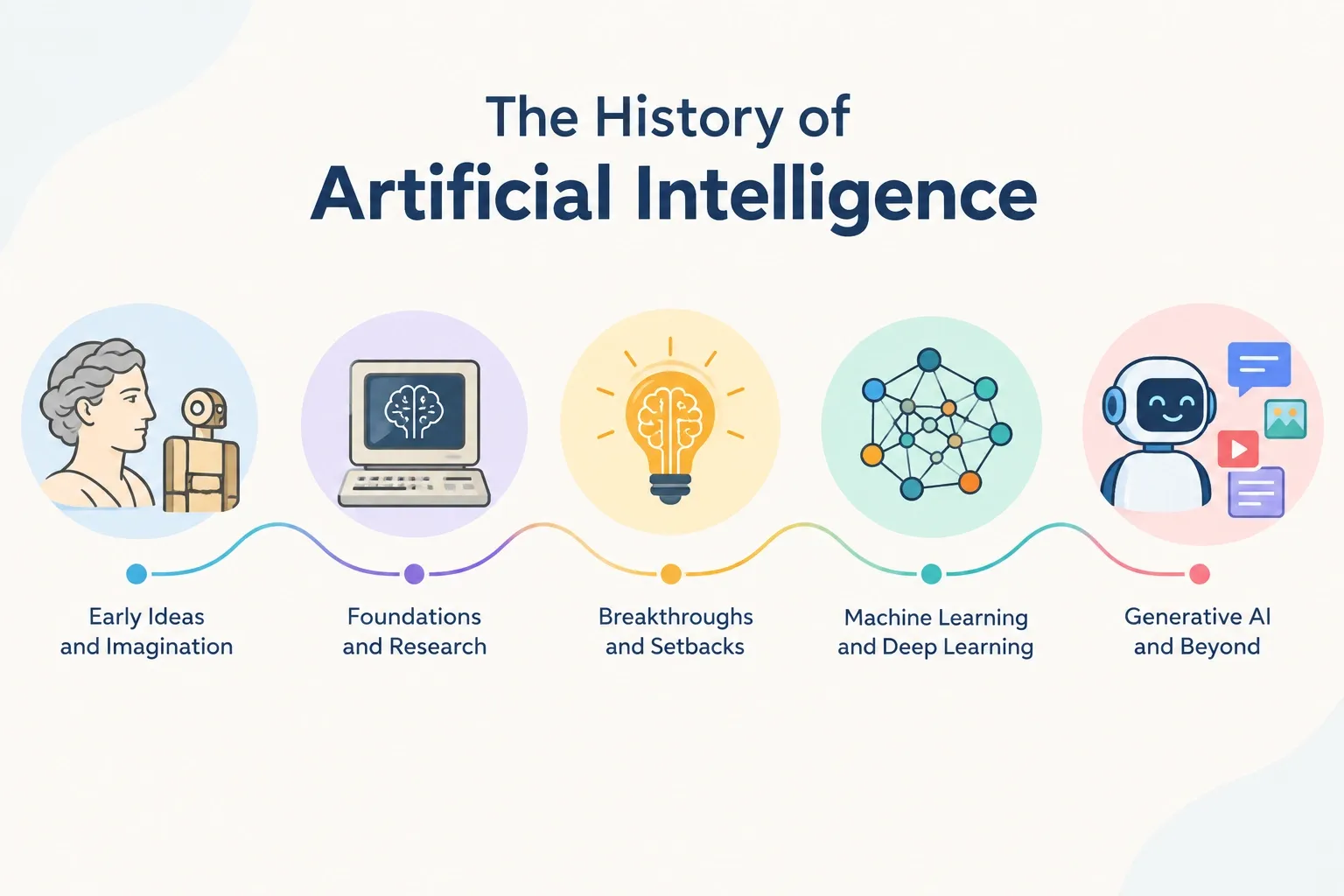











 ROI Calculator




