Interaction Design Specialization: Choosing Your Focus
Key Insights
Interaction design focuses on how users interact with digital products through buttons, screens, commands, and notifications to create clear and user-friendly experiences.
Interaction design courses in India include full-time master's degrees, specialised diplomas, and flexible certificate programmes for students and working professionals.
Popular specializations include research-driven design, interactive products, emerging technologies, human factors, and data visualization.
Choosing the right course involves evaluating eligibility, curriculum, learning format, practical projects, fees, and career goals. Hands-on experience and a strong portfolio are also important for building a career in this field.
In this blog, you'll learn about the top interaction design courses in India, including master's degrees, specializations, diplomas, and certificates, along with their eligibility, fees, duration, benefits, and how to choose the right programme.
Every time you book a cab, pay a bill through a mobile app, or order groceries online, you rely on an interface that someone designed carefully. The person behind that experience is often an interaction designer. As more services in India move onto screens, voice assistants, and connected devices, the demand for professionals who understand how people use technology keeps growing.
If you want to enter this field or move up in it, you have many options. They include full-time degrees, flexible diplomas for working professionals, and short certificate programs. This blog explains the main types of interaction design courses in India, how they differ, and which programs are worth considering.
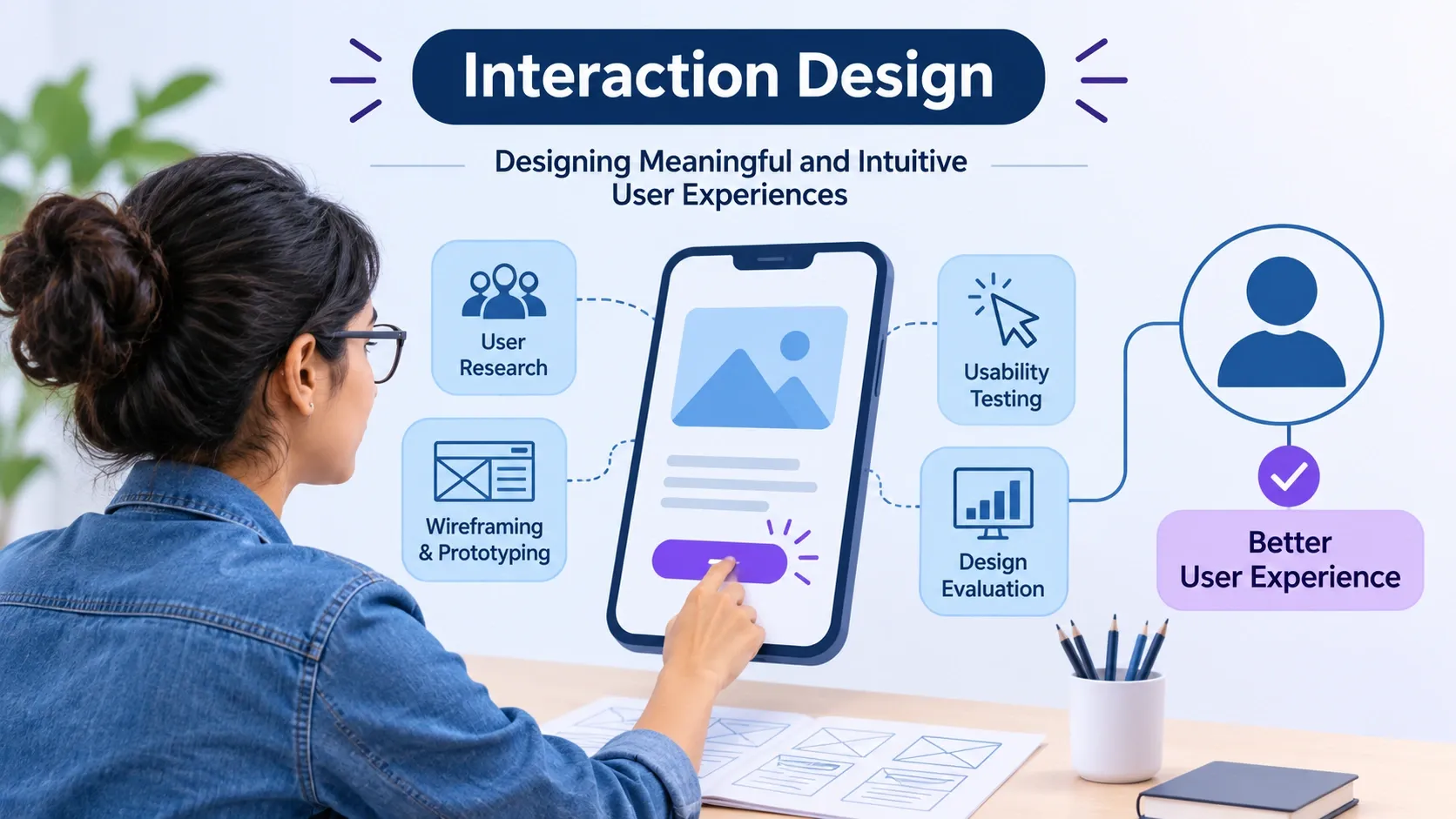
Interaction design focuses on how people and digital products communicate with each other. It looks at the moment a user taps a button, swipes a screen, speaks a command, or reads a notification, and asks whether that moment feels clear, useful, and pleasant.
It is closely related to user experience (UX) design, but it is more specific. UX design covers the entire journey a person has with a product. Interaction design concentrates on behavior: how the product responds, how feedback appears, and how users move from one step to the next.
Core topics include:
User research and usability testing
Information architecture and user flows
Wireframing and prototyping
Human factors and human-computer interaction (HCI)
Design evaluation and iteration
Why Interaction Design Courses Are in Demand
Banks, e-commerce firms, health-tech startups, software companies, and government platforms all need products that ordinary people can use without confusion. A poor interface costs money through abandoned carts, support calls, and lost trust. Companies are therefore willing to hire people who can research users, test ideas, and improve products.
The field also welcomes people from varied backgrounds. Engineers, architects, graphic designers, writers, and product managersall move into interaction design. This is one reason the range of interaction design courses is so broad.
Master’s degrees. These are full-time, in-depth programs, usually two to two and a half years long. They suit students who want a formal design education and research exposure.
Specializations. Some programs let you choose an interaction design specialization within a broader design degree or diploma. You study general design principles and then focus on interaction topics.
Certificates and diplomas. These are shorter or more flexible programs, often delivered online, designed for working professionals who want to build skills without leaving their jobs.
Interaction Design Specialization: Choosing Your Focus
An interaction design specialization lets you go deeper into one area instead of studying design in general. Some programs offer it as a stream, while others allow you to select electives that match your goals.
Popular areas of focus include:
Research-driven design: qualitative and quantitative research methods
Interactive products: designing complete digital products from idea to launch
Emerging technology: virtual reality, augmented reality, and game design
Human factors: usability, safety, and user satisfaction
Data visualization: presenting complex information in clear visual forms
The right specialization depends on your background. A software developer may want stronger design research skills. A graphic designer may want to learn prototyping and usability evaluation. Reviewing the course list before applying helps you confirm that the electives match your career plan.
Interaction Design Certificate: A Flexible Option
An interaction design certificate is a practical choice if you are working full time, switching careers, or testing your interest before committing to a longer program. Certificates are usually delivered online, often in the evening or on weekends, and take about six months to a year.
Their main benefits are flexibility, lower time commitment, and focused skill-building. Their limitation is depth. A certificate will not replace a master’s degree, but it can give you a recognized credential and a portfolio to show employers. When comparing options, check who awards the certificate, how many live hours are included, and whether you will complete real projects.
Top Interaction Design Courses in India
The following programs cover degrees, a diploma, and certificates. Fees, dates, and seat numbers can change with each batch, so it is advised to confirm them on the official page before applying.
1. e-Postgraduate Diploma in Interaction Design (ePGD IxD), IDC School of Design, IIT Bombay (offered through Jaro Education)
Structure: A 36-credit program. Learners choose 5 to 6 courses from a set of 8, with each course carrying 6 to 12 credits.
Duration: Students must complete the 36 credits within 3 years.
Mode: A mix of online courses (live weekend sessions) and in-person studio sessions at IIT Bombay. Even online courses require an in-person presentation, exam, or assessment on the IIT Bombay campus.
Courses offered: Design of Interactive Products (12 credits), Data Visualization, Quantitative Research Methods in Design, Qualitative Research Methods in Design, Theoretical Perspectives in Design, Game Design: Principles and Practice, Introduction to Virtual and Augmented Reality, and Human Factors in Interaction Design (6 credits each).
Eligibility: An undergraduate degree in design, engineering, architecture, fine arts, applied arts, information architecture, ergonomics/human factors, or writing and communication. Candidates with a degree in another field can apply with 3 or more years of relevant industry experience (such as UI/UX designer, web developer, product manager, or copywriter) or a qualifying CEED score.
Assessment: Learners must score at least 50% overall and 40% in the final assessment of each course.
Fees: Application fee of INR 2,500 plus GST. Total program fee of INR 3,00,000 plus GST, inclusive of the application fee.
Next start: The course calendar lists Data Visualization beginning on January 9, 2027.
Credential: A diploma issued by IIT Bombay on completing 36 credits.
2. M.Des in Interaction Design, National Institute of Design, Bengaluru
The Master of Design (M.Des) in Interaction Design at the National Institute of Design (NID), Bengaluru, is a full-time postgraduate programme spanning two and a half years, with 19 seats available in this discipline. The programme focuses on understanding how people interact with different products, digital platforms, services, and emerging technologies. It prepares students to develop design concepts and solutions that improve the way users engage with technology. The curriculum also explores areas such as artificial intelligence, machine learning, and the Internet of Things(IoT), helping students understand how technological developments influence interaction design. Admission is through the NID Design Aptitude Test (DAT), which includes preliminary and main examination stages.
This programme is particularly suitable for students who want to build careers in interaction design, digital product development, and technology-led experience design
3. M.Des in Human Centered Design, Srishti Manipal Institute of Art, Design and Technology, Bengaluru
The M.Des in Human Centered Design at Srishti Manipal Institute of Art, Design and Technology, Bengaluru, is a two-year, full-time postgraduate programme divided into four semesters. It focuses on understanding human experiences with existing and emerging digital technologies. The programme encourages students to examine how people interact with digital products, services and systems while considering their social, cultural, and environmental contexts. The programme is suitable for graduates and professionals from different academic backgrounds who want to build expertise in human-centred and interdisciplinary design practices.
The curriculum follows an inquiry-based learning approach that combines studio-based learning, workshops, theoretical discussions, fieldwork, and collaborative projects. Graduates can explore opportunities in UX research, interaction design, product development, service design and design consulting after the completion of this course.
4. Certificate Programme in Design Thinking for User Experience, IIT Delhi (Continuing Education Programme)
The Certificate Programme in Design Thinking for User Experience offered by IIT Delhi’s Continuing Education Programme (CEP) is a six-month online programme conducted by the Department of Design in collaboration with TimesPro. It is designed for graduates and working professionals who want to understand the complete UX design process and apply design thinking principles to digital product development. The programme covers the fundamentals of user experience, interaction design, and human-centred design. It helps learners understand how to identify user requirements, analyze problems, develop creative solutions, and create digital experiences that are intuitive and accessible. The programme also includes live online sessions and a campus immersion component, providing opportunities to engage with faculty and gain exposure to design learning at IIT Delhi.
The curriculum is structured around different stages of the UX design process, including introduction to UX design, user research, UX analysis, ideation, execution, and usability testing. It is a suitable option for aspiring UX designers, product designers, and professionals who want to strengthen their design thinking and user research skills.
5. Post Graduate Certificate in UX Design and HCI, IIT Guwahati (with Coursera)
The Post Graduate Certificate in UX Design and Human-Computer Interaction (HCI), offered by IIT Guwahati in collaboration with Coursera, is a six-month online programme designed for learners who want to develop practical knowledge of user experience design and human-computer interaction. The programme comprises four courses and three projects, with an expected learning commitment of approximately seven hours per week. It combines online learning, live faculty sessions, recorded lectures, case studies, and practical assignments. Students are introduced to the fundamentals of UX design, user-centred design principles, and the processes involved in developing digital products and services. The programme is suitable for beginners as well as professionals who want to understand how users interact with digital interfaces and how design decisions can improve usability.
The curriculum covers four major areas: Introduction to UX Design and HCI, User Research Methods and Practices, Designing User Interfaces and User Interactions, and Usability Evaluation. This programme can be a suitable choice for learners looking for structured online training in UX design and HCI with academic input from IIT Guwahati.
With so many choices, a simple checklist can help.
Define your goal. Do you want to change careers, grow in your current role, or move into research? Degrees suit career changers and researchers. Diplomas and certificates suit working professionals.
Check eligibility early. Master’s programs often need an entrance exam such as CEED or NID DAT. Diplomas and certificates usually have more flexible entry rules.
Consider your schedule. Full-time degrees need you to step away from work. Online or hybrid programs let you continue earning.
Review the curriculum. Look for hands-on projects, research methods, and prototyping, not just theory.
Look at the format. Check whether any in-person visits are required, as some online programs include campus assessments.
Compare total cost. Include application fees, GST, travel, and the cost of any extra courses.
Skills You Can Expect to Build
Whichever route you choose, a good interaction design course should help you build:
A repeatable design process, from research to testing
The ability to translate user needs into clear flows and interfaces
Comfort with prototyping and evaluation methods
Research skills, both qualitative and quantitative
A portfolio that shows real projects
Employers in design and technology value portfolios and demonstrated thinking as much as certificates, so hands-on work should be a priority.
Interaction design is an evolving field that combines creativity, technology, and an understanding of human behaviour. As businesses continue to develop digital products and services, the need for professionals who can create intuitive and user-friendly experiences is growing. Choosing the right learning path depends on your career goals, experience, and available time. An interaction design master’s degree offers in-depth academic learning, an interaction design specialization helps you focus on specific areas, while an interaction design certificate or diploma provides a flexible way to develop practical skills.
For working professionals looking to advance their design careers, the e-Postgraduate Diploma in Interaction Design from IDC School of Design, IIT Bombay, offered through Jaro Education, is worth exploring. With its flexible learning structure and range of specialized courses, it offers an opportunity to build relevant interaction design skills while continuing to work. Evaluate the curriculum, eligibility, fees, and learning format to choose an interaction design course that best aligns with your professional goals.
Frequently Asked Questions
Yes. Companies across banking, e-commerce, health-tech, and software need people who can make digital products easy to use. The field also welcomes professionals from design, engineering, and product backgrounds, which makes it accessible to career changers.
In many cases, yes. For the IIT Bombay ePGD in Interaction Design, applicants with a non-design degree can qualify with 3 or more years of relevant work experience or a valid CEED score. Master’s programs generally require an entrance exam such as CEED or NID DAT, so check each program’s eligibility rules.
UX design covers the full experience a person has with a product or service, including research, content, and visuals. Interaction design focuses on how users and products respond to each other, such as the flow of steps, feedback, and controls. The two overlap heavily, and many courses teach both.
It depends on your goals. A master’s degree offers deeper study, research exposure, and a full-time academic environment, but it needs more time and an entrance exam. A certificate or diploma is more flexible and suits working professionals who want to build skills quickly. Many people start with a certificate and move to a longer program later.
Shubham Lal
Lead Software Developer
Shubham Lal joined Microsoft in 2017 and brings 8 years of experience across Windows, Office 365, and Teams. He has mentored 5,000+ students, supported 15+ ed-techs, delivered 60+ keynotes including TEDx, and founded AI Linc, transforming learning in colleges and companies.
Get Free Upskilling Guidance
Fill in the details for a free consultation
Related Courses
Explore our programs
e-Postgraduate Diploma in Interaction Design (ePGD IxD)
 HOME > BLOG > Design Thinking > Interaction Design Courses in India: Master’s Degrees, Specializations & Certificates
 November 15, 2026
 9 min read




 Key Insights
 ChatGPT
 Perplexity
 Claude
 Grok






 ROI Calculator