
Interaction Design Career: Scope, Skills & Job Roles
 October 9, 2026
 9 min read




Table Of Content
- What Is Interaction Design?
- Why Choose an Interaction Design Career?
- Interaction Design Scope: How Wide Is the Field?
- Interaction Design Skills You Need to Succeed
 Key Insights
- Interaction design focuses on how people interact with digital products, including their actions, product responses, behaviors, and overall experience.
- The interaction design scope spans mobile and web applications, wearables, smart devices, voice interfaces, AR/VR, automotive, healthcare, and AI-powered products.
- Key interaction design skills include user research, wireframing, prototyping, information architecture, visual design, motion and micro-interactions, usability, accessibility, and effective collaboration.
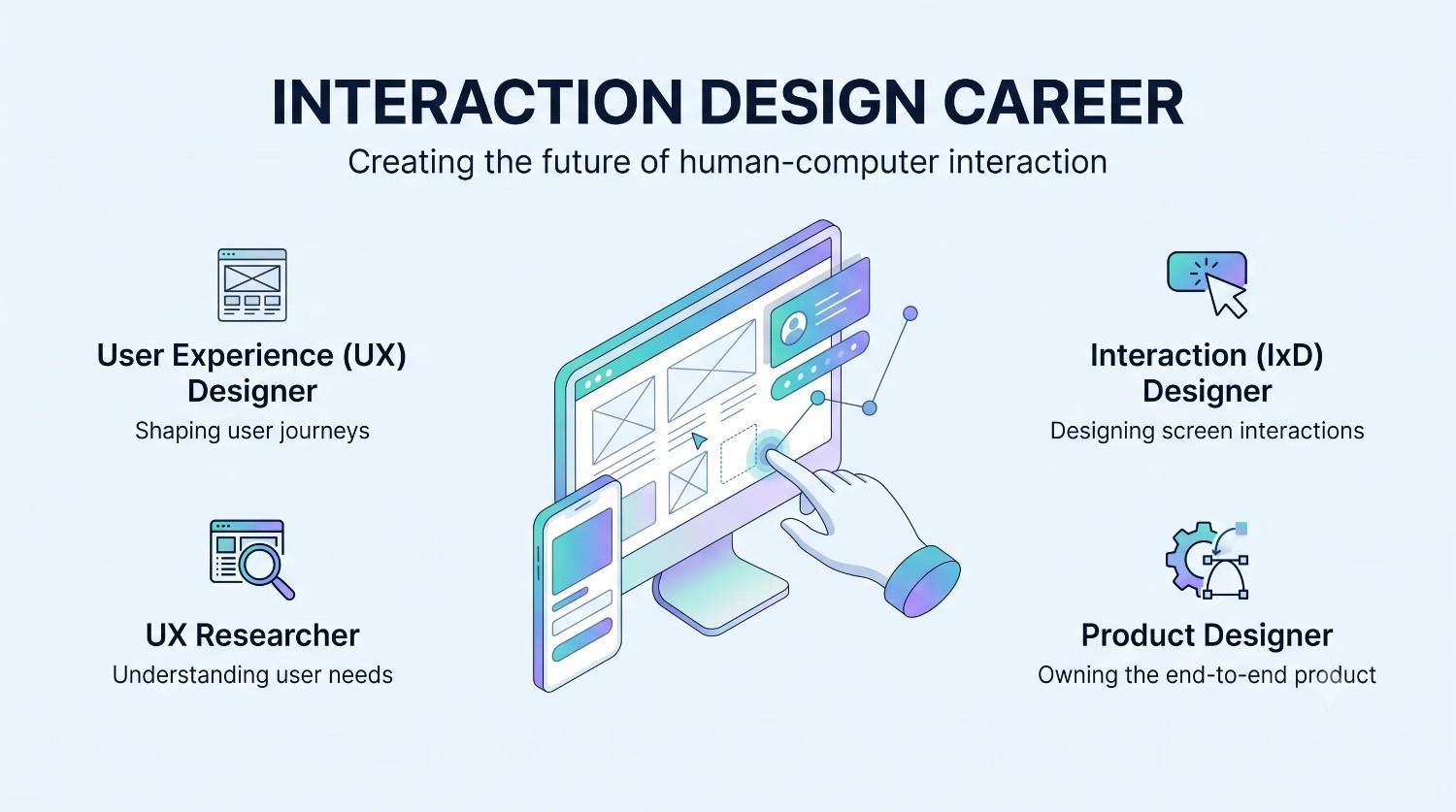
- Interaction designer roles include Interaction Designer, UX Designer, UI/UX Designer, Product Designer, UX Researcher, Motion Designer, Voice UI Designer, Service Designer, Design Lead, and Design Systems Designer.
- Building a strong portfolio with well-explained case studies, gaining practical experience, seeking feedback, and continuously learning can help professionals start and grow their interaction design career.
- In this blog, you'll learn about interaction design career scope, essential skills, job roles, industries, salary ranges in India and the US, and the steps to start a career in interaction design.
Think about the last time you swiped through an app, paid a bill online, or unlocked your phone with your face. It probably felt effortless. That ease isn't an accident. Someone designed every tap, animation, and button response so you wouldn't have to think about it.
That someone is often an interaction designer.
If you enjoy solving problems, understanding people, and making technology feel friendly, an interaction design career could be a great fit. This blog covers what interaction design is, its scope, the skills you need, the roles on offer, and what you can earn.
 ChatGPT
 Perplexity
 Claude
 Grok
GrokWhat Is Interaction Design?
Interaction design (often shortened to IxD) is the practice of designing how people interact with digital products and services. It focuses on the conversation between a person and a system: what they do, what the product does in response, and how that exchange feels.
Interaction designers think about questions like:
- What happens when a user taps this button?
- How do we show that a file is uploading?
- How can we stop someone from making a costly mistake?
- Does this screen make the next step obvious?
It’s closely related to UX (user experience) and UI (user interface) design, but it has its own focus. UI is how a product looks, and UX is the overall experience. Interaction design is the behavior: how things move, respond, and guide the user from one step to the next.
A simple example is the “pull to refresh” gesture on your phone. Nobody told you to do it, yet it feels natural. That’s good interaction design.
Why Choose an Interaction Design Career?
There are plenty of reasons people are drawn to this field:
- High demand: Every company with an app, website, or smart device needs people who can make it usable.
- Creative and logical: You get to be creative and analytical in the same job.
- Varied work: You might design a banking app one year and a smart home device the next.
- Good growth: The path from junior designer to design leader is well established.
- Flexibility: Many interaction design jobs offer remote or hybrid options.
Most importantly, the work has real impact. A well-designed interaction can save someone time, reduce frustration, or make a service accessible to people who struggled with it before.
Interaction Design Scope: How Wide Is the Field?
The interaction design scope is much bigger than it was a decade ago. It used to mean websites and desktop software. Today it covers almost every screen and many things without screens.
Mobile and Web Applications
This is the most common area. Designers shape the flow of shopping apps, food delivery platforms, social media, banking tools, and education portals.
Wearables and Smart Devices
Smartwatches, fitness bands, smart TVs, and home assistants all need thoughtful interaction design. With small screens or voice commands, every decision matters even more.
Voice and Conversational Interfaces
Chatbots and voice assistants are growing fast. Designers decide how a bot should respond, what happens when it doesn’t understand, and how to keep the conversation feeling human.
AR, VR, and Immersive Experiences
Augmented and virtual reality open up new questions: How does a person “click” in 3D space? How do you prevent motion discomfort? Interaction designers are helping answer these.
Automotive and Healthcare
Car dashboards, touchscreens, and medical devices are high-stakes. A confusing interface isn’t just annoying. It can be dangerous. That’s why these industries invest heavily in interaction design.
AI-Powered Products
As AI tools become part of everyday software, designers are shaping how people prompt, review, correct, and trust them. This is one of the fastest-growing parts of the field.
In short, as long as people use technology, the scope of interaction design will keep expanding.




Interaction Design Skills You Need to Succeed
The good news is that you don’t need a rare talent. Most interaction design skills can be learned with practice. They fall into two groups.
Core Technical Skills
- User research
You can’t design for people you don’t understand. This means running interviews, surveys, and usability tests, then turning what you learn into useful insights. - Wireframing and prototyping
Wireframes are simple layouts of a screen. Prototypes are clickable versions that show how a product behaves. Tools like Figma, Adobe XD, and Sketch are industry standards, and Figma is especially popular right now. - Information architecture
This is organizing content so people can find things. Good structure, such as clear menus and logical grouping, is the backbone of a usable product. - Visual design basics
You don’t need to be an illustrator, but understanding spacing, typography, color, and hierarchy helps you communicate your ideas clearly. - Motion and micro-interactions
Small animations, like a heart icon that pops when you like a post, give users feedback and add personality. Tools like After Effects, Principle, or Figma’s built-in animations help here. - Usability and accessibility
Designing for everyone, including people with visual, hearing, motor, or cognitive differences, is both good practice and often a legal requirement. Knowing the basics of accessibility guidelines (like WCAG) makes you a stronger candidate. - Basic coding knowledge (optional but helpful)
You don’t have to be a developer, but understanding HTML, CSS, and how developers work helps you design things that can actually be built.
Soft Skills That Matter Just as Much
- Empathy: Seeing the product through the user’s eyes.
- Communication: Explaining your design decisions to developers, managers, and clients.
- Collaboration: Interaction designers work closely with product managers, engineers, researchers, and other designers.
- Curiosity: The best designers constantly ask “why?” and “what if?”
- Open mind: Your first idea is rarely the best one. You’ll get feedback, and you need to be comfortable with it.
If you’re just starting out, don’t try to learn everything at once. Pick one tool, one project, and build from there.
Interaction Designer Roles: Who Does What?
The phrase “interaction designer” isn’t always used the same way. Depending on the company, the work might sit under several titles. Here are the most common interaction designer roles.
1. Interaction Designer
The classic role. You design the flows, behaviors, and responses within a product. You create wireframes, prototypes, and interaction specifications that developers can follow.
2. UX Designer
A broader role that includes research, strategy, structure, and testing. Many companies use “UX designer” to include interaction design work.
3. UI/UX Designer
A hybrid role common in smaller companies and startups, where one person handles both how the product works and how it looks.
4. Product Designer
Product designers think about the entire product, from user needs to business goals. They often work across research, interaction, and visual design.
5. UX Researcher
This role focuses on understanding users through studies, interviews, and data. Interaction designers often move into research if they love the “why” behind behavior.
6. Motion Designer
Specialists who create animations and transitions, helping products feel alive and responsive.
7. Voice UI / Conversation Designer
These designers write and structure the dialogue for chatbots and voice assistants.
8. Service Designer
Instead of focusing on a single screen, service designers map the whole customer journey, including offline touchpoints like a call center or a store visit.
9. Design Lead or Design Manager
With experience, many designers grow into leadership, guiding teams, setting the design vision, and mentoring juniors.
10. Design Systems Designer
These designers build and maintain the shared library of components and rules that keep a product consistent across teams.
You don’t have to choose one forever. Many professionals start as generalists and specialize as they find what they enjoy most.
Interaction Design Jobs: Where Can You Work?
The range of interaction design jobs is wide, and they exist in nearly every industry.
Where designers are hired:
- Tech companies and startups: Software, SaaS, and app-based businesses
- E-commerce and retail: Online stores and marketplaces
- Banking and fintech: Payment apps, trading platforms, insurance tools
- Healthcare and health-tech: Patient portals, wellness apps, medical devices
- Education and ed-tech: Online learning platforms
- Automotive and manufacturing: In-car systems and smart machinery
- Design agencies and consultancies: Working on many clients and projects
- Freelancing: Building your own client base and setting your own schedule
Where to look:
Job platforms like LinkedIn, Indeed, and Naukri are good starting points. Design-specific communities such as Behance, Dribbble, and ADPList are useful for networking, getting feedback, and spotting openings. Many companies also post jobs directly on their career pages.
What employers look for:
Most care less about degrees and more about your portfolio. A strong portfolio shows your thinking, not just your final screens. Include the problem, your process, the mistakes you made, and what you learned. Three to five well-explained case studies are better than a dozen shallow ones.
Interaction Designer Salary: What Can You Earn?
Naturally, one of the most common questions is about the interaction designer salary. Pay varies by country, city, company size, and your experience, so treat the numbers below as rough ranges rather than guarantees. Check current listings for the most accurate picture.
| Experience Level | India: Approx. Annual Salary | United States: Approx. Annual Salary |
| Entry-level (0–2 years) | ₹3–6 lakh | $65,000–85,000 |
| Mid-level (3–6 years) | ₹8–18 lakh | $90,000–120,000 |
| Senior-level (7+ years) | ₹20–40 lakh or more | $130,000 and above |
What Affects Your Pay?
- Portfolio quality: Strong, thoughtful case studies can push your offers higher.
- Industry: Fintech, big tech, and product-based companies often pay more than agencies.
- Specialization: Skills in areas like AI product design, accessibility, or design systems are in demand.
- Location: Big metro cities and tech hubs typically pay more, though remote work is narrowing the gap.
- Communication and leadership: Designers who can influence decisions move up faster.
Freelancers can earn well too, but income is less predictable, especially in the beginning.
How to Start Your Interaction Design Career
You don’t need a perfect plan, just a clear first step. Here’s a simple path:
Step 1: Learn the fundamentals.
Start with the basics of UX, usability, and design thinking. Free resources, YouTube channels, and beginner courses are plenty to get you going.
Step 2: Pick a tool and practice.
Download Figma and recreate screens from apps you use daily. Ask yourself why each button is where it is.
Step 3: Work on real problems.
Redesign a clunky local website, an app you find confusing, or a college portal. Document your thinking from research through to final prototype.
Step 4: Build a portfolio.
Create a simple site or use a platform like Behance. Show your process clearly. Hiring managers want to see how you think.
Step 5: Get feedback and keep improving.
Share your work in design communities. Feedback can sting, but it’s the fastest way to grow.
Step 6: Apply for internships or junior roles.
Real-world experience teaches you things no course can, like working with developers and handling tight deadlines.
Step 7: Keep learning.
Tools and trends change quickly. Stay curious about accessibility, AI, and new interaction patterns.
A formal degree in design, HCI (human-computer interaction), or a related area can help, but plenty of successful designers are self-taught or switched from other fields like psychology, engineering, or art.
Advance Your Design Career with IIT Bombay’s ePGD in Interaction Design
Take your design career to the next level with the ePGD in Interaction Design from IDC School of Design, IIT Bombay. Designed for working professionals, the programme covers human-centered design, user research, interaction design, digital product design, data visualization, and emerging areas such as VR and AR. With online and in-person learning, hands-on projects, research-driven techniques, and practical portfolio development, the programme helps professionals build relevant skills for digital product and design innovation.
Final Thoughts
An interaction design career offers a rare mix of creativity, problem-solving, and impact. The scope keeps growing, from mobile apps to AI tools and immersive tech. The skills can be learned step by step. The roles range from hands-on designer to researcher to design leader. And with solid experience and a strong portfolio, the earning potential is healthy.
If you’re curious about how people and technology connect, this could be a very rewarding path. Start small, stay curious, build real projects, and let your work speak for itself.
Frequently Asked Questions
Yes. Demand for designers who can make digital products easy and enjoyable to use is strong across industries. It also offers good growth, flexible work options, and a chance to do creative work with real impact.
Not necessarily. Most roles don’t require you to code. However, knowing the basics of HTML and CSS helps you collaborate with developers and design things that are practical to build.
It depends on the country and company. In India, fresher salaries typically fall in the range of ₹3–6 lakh per year, while in the US, entry-level roles often start around $65,000–85,000. A strong portfolio can help you negotiate better.






Find a Program made just for YOU
We'll help you find the right fit for your solution. Let's get you connected with the perfect solution.

Is Your Upskilling Effort worth it?
 ROI Calculator

Are Your Skills Meeting Job Demands?
Try our Skill Gap tool
Experience Lifelong Learning and Connect with Like-minded Professionals
Explore Jaro Connect
