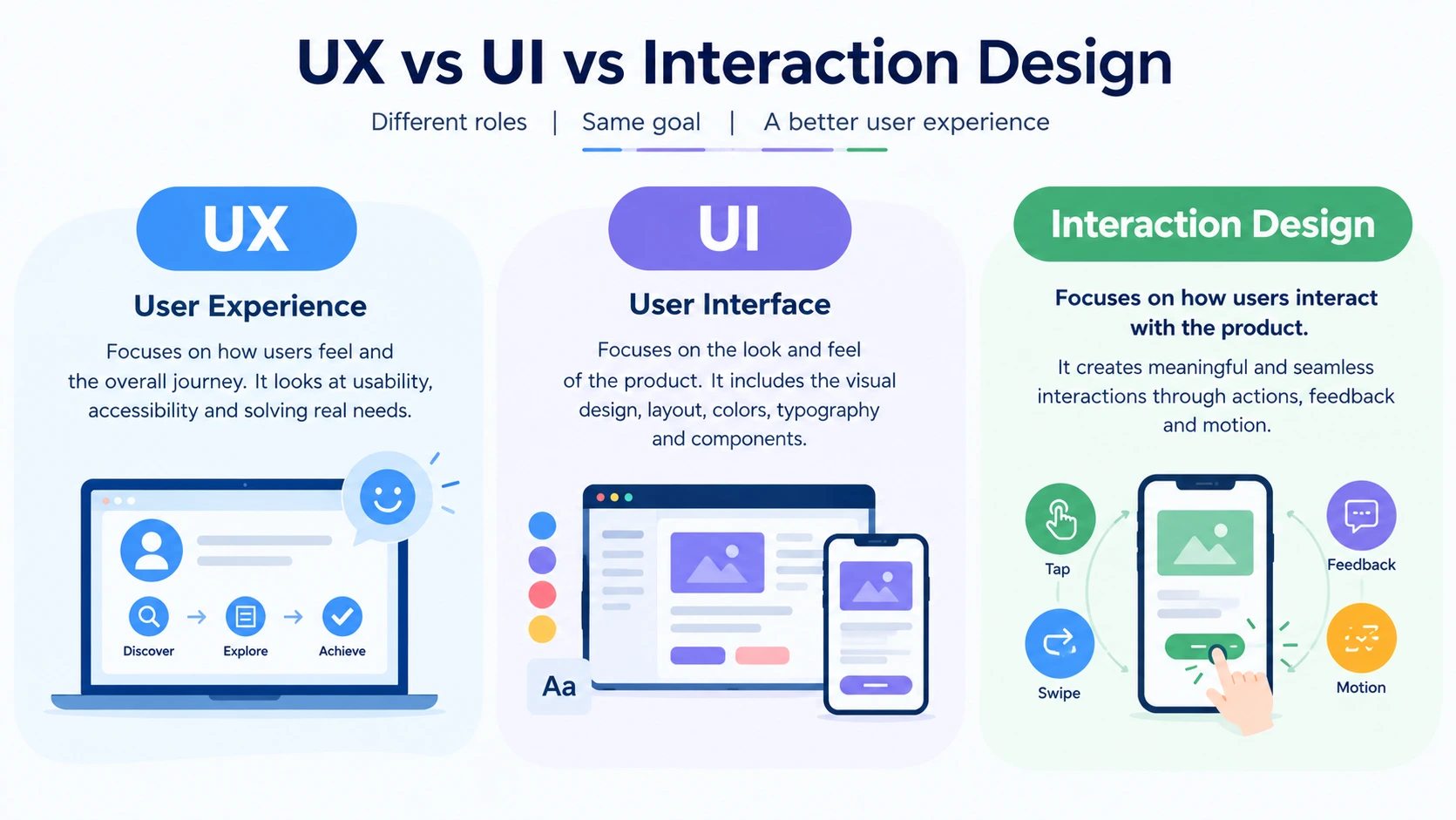
UX, UI, and interaction design share one goal, which is making products useful and easy to use, but each approaches it from a different angle: the overall journey, the visual look, and the product's response to user actions.
UX design is research-driven and covers user interviews, journey maps, wireframes, and usability testing, while UI design focuses on layouts, colors, typography, and design systems.
Interaction design defines how a product behaves and gives feedback when people tap, swipe, click, or speak to it, and it extends to wearables, AR/VR, voice, and connected devices.
In real projects, these roles work as a team across research, structure, behavior, visual design, and testing, and one designer may cover several stages in smaller companies.
Your choice of path can follow your strengths: UX suits people who enjoy solving problems, UI suits those with an eye for aesthetics, and interaction design suits those curious about behavior and technology.
In this blog, you'll learn the key differences between UX, UI, and interaction design, the skills each role needs, how they work together, and the career scope and job titles open to you in each field.
Every app you open, website you browse, or smart device you touch has been shaped by designers. Yet when people try to understand who does what, the terms often blur together. UX designer, UI designer, and interaction designer are frequently used as if they mean the same thing, but each role has its own focus, skills, and career path.
If you are planning a career in design or want to hire the right professional, understanding UX vs UI vs interaction design is a good first step. This blog explains each field in simple terms, compares them side by side, and outlines the skills and career opportunities that come with each one.
The easiest way to separate these three fields is to think about the questions each one answers.
UX (user experience) design asks: Does this product solve the user’s problem, and is the overall journey smooth and satisfying?
UI (user interface) design asks: How should this product look, and are the visual elements clear and consistent?
Interaction design asks: How should the product respond when a person taps, swipes, clicks, or speaks to it?
All three work toward the same goal, which is a product that people find useful and easy to use. They simply approach it from different angles. In many companies, one person may handle more than one of these areas, especially in small teams. In larger organizations, the roles are usually separate and highly specialized.
User experience design looks at the complete relationship between a person and a product. It covers everything from the moment someone discovers a service to the moment they finish using it, and even what happens afterward.
A UX designer studies users to understand their needs, goals, and frustrations. Common activities include:
Conducting user interviews and surveys
Creating user personas and journey maps
Defining information architecture and user flows
Building wireframes and low-fidelity prototypes
Running usability tests and analyzing the results
For example, when a banking app makes it easy to transfer money in three steps instead of eight, that is the result of good UX design. The designer researched what users struggled with, simplified the process, and tested the new version before launch.
UX is strategic and research-driven. It is less about decoration and more about solving the right problem in the right way.
User interface design focuses on the visual and tactile parts of a product. It deals with everything the user sees and touches on a screen, such as buttons, icons, colors, typography, spacing, and layout.
A UI designer takes the structure created during the UX process and gives it a clear, attractive, and consistent look. Their typical tasks include:
Designing screens and page layouts
Choosing color palettes and typefaces
Creating icons, buttons, and other interface elements
Building design systems and style guides
Making sure designs work across devices and screen sizes
Following accessibility standards, such as color contrast and readable text
UI design is about visual communication. A well-designed interface builds trust, guides attention, and makes the product feel polished. If UX is the blueprint of a house, UI is the interior design that makes the space comfortable and appealing.
What Is Interaction Design?
Interaction design, often shortened to IxD, concentrates on the dialogue between a person and a product. It defines how a system behaves in response to user actions and how that behavior feels.
An interaction designer thinks about questions such as:
What happens when a user taps this button?
How should the screen transition from one state to another?
What feedback tells the user that an action worked or failed?
How can a gesture, voice command, or sensor make the task easier?
Examples include the swipe motion used to delete an email, the loading animation that reassures users while data loads, or the way a smart speaker confirms a command. These small moments may seem minor, but together they shape how natural a product feels.
Interaction design also extends beyond screens. It applies to wearables, games, virtual and augmented reality, connected devices, and physical products with digital features. It draws from human-computer interaction, psychology, and human factors, which is why it is often considered the most behavior-focused of the three fields.
How UI vs UX Design and UX vs Interaction Design Work Together
In real projects, these roles rarely work in isolation. A successful product comes from close teamwork between researchers, designers, developers, and product managers. Understanding UI vs UX design and UX vs interaction design is useful mainly because it shows how each specialty adds value at a different stage of the process.
A typical product design workflow looks like this:
Research and discovery: UX designers interview users, study their problems, and define what the product needs to achieve.
Structure and flows: UX and interaction designers map user journeys and create wireframes that show how people move through the product.
Behavior and prototyping: Interaction designers define how screens respond to taps, swipes, and gestures and build prototypes to test those ideas.
Visual design: UI designers apply color, typography, and imagery, and build a design system so every screen feels consistent.
Testing and refinement: The team tests the design with real users, gathers feedback, and improves it before and after launch.
Communication is the thread that connects these steps. Shared tools such as Figma allow designers to review each other’s work, leave comments, and keep files up to date. Developers join early so that designs are realistic to build, and product managers help balance user needs with business goals.
In startups and smaller companies, one designer may cover several of these steps. In larger organizations, separate specialists handle each stage. Either way, the strongest results come from teams that treat UX, UI, and interaction design as parts of one connected effort.
UI UX Interaction Design Differences at a Glance
Here is a short summary of the UI UX interaction design differences to help you compare the three fields quickly:
Aspect
UX Design
UI Design
Interaction Design
Core question
Does the product solve the user’s problem?
How should the product look?
How should the product respond to user actions?
Focus
The entire user journey
The visual layer
Behavior, feedback, and motion
Main goal
Make the product useful, efficient, and enjoyable
Make the product clear, consistent, and attractive
User research, information architecture, usability testing
Typography, color theory, layout, accessibility
Human factors, state design, animation, AR/VR and voice
Typical roles
UX Designer, UX Researcher
UI Designer, Visual Designer
Interaction Designer, Product Designer
Food delivery app example
Figures out how users want to browse and order
Designs the screens, buttons, and images
Decides how the cart updates and how order tracking animates
Think of a food delivery app. The UX designer figures out how users want to browse restaurants and place orders. The UI designer designs the screens, buttons, and images. The interaction designer decides how the cart updates when an item is added and how the order tracking animation behaves.
Skills Needed for UX, UI, and Interaction Design
There is a lot of shared ground among these careers, but each one also needs its own set of strengths.
Familiarity with emerging technologies such as AR, VR, voice, and wearables
Collaboration with developers to bring behavior to life
Soft skills matter in all three roles. Good designers listen well, accept feedback, explain their decisions clearly, and work comfortably with product managers, engineers, and researchers.
Demand for design professionals has grown as more businesses move their services online. Banks, healthcare providers, e-commercecompanies, education platforms, gaming studios, and software firms all rely on thoughtful design to attract and retain users.
Common job titles include:
UX Designer, UX Researcher, or UX Writer
UI Designer or Visual Designer
Interaction Designer
Product Designer
Information Architect
Usability Analyst
Design Lead or Design Manager
Product Manager with a design focus
Career paths often start with junior or associate roles and progress to senior designer, lead, and eventually head of design or chief design officer. Some professionals move into product management, while others become consultants or start their own studios.
Interaction designers are increasingly valuable as technology expands into new areas, including mobile apps, smart devices, immersive media, and AI-driven products. Because these products rely on intuitive behavior and feedback, professionals who understand how people interact with technology are in strong demand. Design professionals with a mix of research, visual, and interaction skills, often called product designers, tend to have the widest range of opportunities.
How to Choose the Right Path for Your Career
If you are unsure where to begin, consider your natural strengths and interests.
If you enjoy understanding people, asking questions, and solving problems, UX design may suit you.
If you have a strong eye for aesthetics, branding, and layout, UI design may be a better match.
If you are curious about behavior, motion, and how technology responds to people, interaction design could be your calling.
You do not have to stay in one lane forever. Many designers begin in one area and gradually build skills in the others. What matters most is a solid foundation in design thinking, a portfolio of real projects, and a willingness to keep learning.
Build Your Design Career with the ePGD in Interaction Design from IIT Bombay
If you want to deepen your expertise in interaction design, the e-Postgraduate Diploma in Interaction Design (ePGD IxD)from the IDC School of Design, IIT Bombay, offered in association with Jaro Education, is worth considering. Designed for working professionals, this 36-credit program covers the digital product design process, user research, data visualization, human factors, and emerging areas such as game design and virtual and augmented reality. It blends online courses with in-person studio sessions on the IIT Bombay campus and can be completed within 12 to 36 months. Designers, developers, product managers, and graduates from design, engineering, and related fields can apply, subject to the eligibility criteria.
Conclusion
UX, UI, and interaction design are closely connected, but they are not identical. UX design shapes the full experience, UI design creates the visual interface, and interaction design defines how the product behaves when people use it. Understanding the differences helps you choose a career path, build the right skills, and communicate more clearly with other professionals in the field.
As digital products continue to grow in number and complexity, designers who can combine research, visual thinking, and interaction expertise will remain highly valuable. A structured education, hands-on practice, and a strong portfolio can help you move forward with confidence.
Frequently Asked Questions
UX design focuses on the overall experience and how well a product solves user problems, while UI design focuses on the visual appearance of the product, including layouts, colors, and typography. UX shapes how the product works, and UI shapes how it looks.
Interaction design is often considered a specialized area within the broader UX field. It focuses on how a product responds to user actions, including feedback, transitions, and gestures, while UX design covers the entire journey, including research and strategy.
None is better in every case. The right choice depends on your interests and strengths. UX suits research-minded problem solvers, UI suits visually creative people, and interaction design suits those interested in behavior and emerging technology. Many designers combine these skills over time.
Yes, in many cases. Professionals with backgrounds in engineering, software development, product management, writing, or related fields can move into interaction design by learning design fundamentals, building a portfolio, and completing a structured program or diploma.
Shubham Lal
Lead Software Developer
Shubham Lal joined Microsoft in 2017 and brings 8 years of experience across Windows, Office 365, and Teams. He has mentored 5,000+ students, supported 15+ ed-techs, delivered 60+ keynotes including TEDx, and founded AI Linc, transforming learning in colleges and companies.
Get Free Upskilling Guidance
Fill in the details for a free consultation
Related Courses
Explore our programs
e-Postgraduate Diploma in Interaction Design (ePGD IxD)

 November 1, 2026
 9 min read





 Key Insights
 ChatGPT
 Perplexity
 Claude
 Grok








 ROI Calculator