HOME > BLOG > Career Guidance > How to Successfully Switch Careers at 35 in India: A Practical Step-by-Step Guide (2026)
Career Guidance
How to Successfully Switch Careers at 35 in India: A Practical Step-by-Step Guide (2026)
J
By Prerna Singh
August 10, 20266 min read
Published on August 10, 2026
SHARE THIS ARTICLE
Table Of Content
Is 35 Too Late to Change Careers?
Why More Professionals Are Switching Careers in 2026
Signs You May Be Ready for a Career Change
Challenges You May Face During a Career Change
For many professionals, turning 35 brings a mix of confidence and uncertainty. By this stage, you've likely built years of experience, achieved financial stability, and established yourself in your industry. Yet, it's also the age when many people begin to question whether they're truly satisfied with their careers.
Perhaps your industry is evolving rapidly, your current role no longer excites you, or you've discovered a new passion that offersbetter growth opportunities. Whatever the reason, making a career switch at 35 in India is no longer unusual. In fact, it has become increasingly common as professionals seek meaningful work, higher salaries, greater flexibility, and future-ready careers.
The good news is that changing careers at 35 is entirely possible. With careful planning, the right skills, and a strategic approach, you can successfully transition into a new field without starting from scratch.
This guide explains how to change career at 35 in India, the challenges you may encounter, and practical steps to make your transition smoother in 2026.
One of the biggest misconceptions is that career changes are only for people in their twenties.
Today’s job market tells a different story.
Companies increasingly value professionals who bring industry experience, business maturity, leadership capabilities, and problem-solving skills. These qualities often outweigh age, especially when combined with relevant new skills.
Many professionals successfully make a career change at 35 in India by leveraging transferable skills rather than completely restarting their careers.
Instead of viewing your experience as a limitation, consider it one of your strongest advantages.
Why More Professionals Are Switching Careers in 2026
Several workplace trends have made career transitions more common than ever.
Artificial intelligence and automation are transforming traditional job roles. Digital transformation is creating demand for new skills across industries. Remote work has expanded employment opportunities beyond geographical boundaries, while executive education and online learning have made upskilling significantly more accessible.
At the same time, professionals increasingly prioritise work-life balance, meaningful work, and long-term career growth over staying in the same organisation for decades.
These factors have encouraged many professionals to consider a career pivot in India instead of remaining in roles with limited future potential.
Signs You May Be Ready for a Career Change
Not every difficult workday means you should switch careers. However, consistent patterns often indicate that it may be time for change.
If you no longer feel challenged by your work, struggle to stay motivated, or see limited opportunities for growth, it may be worth reassessing your career direction.
Similarly, if your industry is shrinking, your skills are becoming outdated, or you frequently find yourself interested in opportunities outside your current profession, these could be indicators that a transition is worth exploring.
Recognising these signs early allows you to plan thoughtfully rather than making impulsive career decisions.
Step 1: Identify Why You Want to Change Careers
Before making any decisions, clearly define your motivation.
Are you seeking higher salaries? Better work-life balance? Greater job security? Leadership opportunities? A passion-driven profession? Or a future-proof industry?
Your reason for changing careers will influence every decision you make—from selecting courses to choosing target industries.
Without a clear objective, even a successful transition may leave you feeling unfulfilled.
Step 2: Identify Your Transferable Skills
One of the biggest mistakes professionals make is assuming they have to begin from zero.
In reality, most professionals already possess valuable transferable skills.
Choose industries that align with both your interests and existing experience whenever possible.
This reduces the learning curve while increasing your employability.
Step 4: Upskill Before You Transition
Upskilling is one of the most important aspects of a successful career transition.
Fortunately, professionals today have access to executive education, online certifications, Executive MBA programmes, and specialised industry courses that allow them to continue working while learning.
Rather than enrolling in every available programme, choose learning paths that directly support your target role.
For example, someone moving from operations into product management should focus on product strategy, customer research, Agile methodologies, and business analytics.
Similarly, finance professionals entering analytics may prioritise data visualisation, business intelligence, and AI-powered decision-making.
Purposeful learning delivers far better outcomes than collecting certificates.
Step 5: Build Relevant Experience Before Switching
Many professionals hesitate because they believe employers only hire candidates with direct experience.
Fortunately, there are several ways to bridge this gap.
Volunteer for cross-functional projects within your current organisation. Take on freelance assignments, consulting opportunities, internships, or portfolio projects related to your target field.
Even personal projects can demonstrate practical knowledge during interviews.
Building evidence of your capabilities significantly strengthens your credibility during a career change for a 35-year-old professional in India.
Step 6: Update Your Resume and LinkedIn Profile
Your resume should reflect your future career rather than simply documenting your past.
Highlight transferable achievements, measurable business outcomes, certifications, leadership experience, and relevant projects.
Similarly, optimise your LinkedIn profile with industry-specific keywords, updated skills, and a compelling professional summary aligned with your new career direction.
Recruiters increasingly search for candidates through professional networking platforms, making your online presence equally important.
Step 7: Expand Your Professional Network
Networking often plays a crucial role in career transitions.
Connect with professionals already working in your target industry. Attend webinars, conferences, alumni events, and industry meetups.
Speaking with professionals who have already completed a career pivot in India can provide valuable insights into hiring trends, required skills, and common challenges.
Strong professional relationships frequently lead to referrals, mentorship opportunities, and hidden job openings.
Step 8: Prepare for Career Transition Interviews
Career transition interviews differ from traditional interviews.
Recruiters will naturally ask why you are changing careers.
Prepare a confident, positive explanation that focuses on growth rather than dissatisfaction.
Demonstrate how your previous experience complements your new role instead of apologising for changing industries.
Employers appreciate candidates who make thoughtful career decisions supported by continuous learning and practical preparation.
Free Courses
Stakeholder Communication & Negotiation Skill Sets
You may initially receive fewer interview calls while building credibility in your new field.
Some professionals accept lateral roles before progressing into leadership positions. Others invest time in acquiring certifications or practical experience before receiving their ideal opportunity.
Financial planning is equally important, especially if your transition involves temporary salary adjustments.
Patience, persistence, and realistic expectations make the process significantly smoother.
Mistakes to Avoid During a Mid-Career Career Switch
Many professionals delay action because they wait for the “perfect” opportunity.
Others resign before developing the necessary skills or financial backup.
Some focus entirely on technical certifications while neglecting networking, communication, and leadership development.
Another common mistake is applying to every available role without tailoring resumes or understanding industry expectations.
Successful switching careers mid-career in India requires strategic planning rather than impulsive decision-making.
Changing careers at 35 may seem intimidating, but it is increasingly becoming a smart and strategic decision for professionals seeking long-term growth.
The modern workplace values adaptability, continuous learning, and transferable skills more than ever before. With thoughtful planning, relevant upskilling, and practical experience, a career switch at 35 in India can open doors to more fulfilling, future-ready opportunities.
If you’re wondering how to change career at 35 in India, start by defining your goals, identifying your transferable strengths, researching high-growth industries, and investing in targeted learning. Remember that your experience is an asset, not a limitation.
Whether you’re planning a complete career change at 35 in India or a gradual career pivot in India, consistent action and a long-term perspective will help you navigate the transition successfully. For any 35-year-old professional in India considering a career change, 2026 offers more opportunities than ever to build a rewarding second chapter in your professional journey.
Frequently Asked Questions
No. A career switch at 35 in India is increasingly common as organisations value experienced professionals with transferable skills, leadership potential, and a willingness to learn new technologies and business practices.
If you’re wondering how to change career at 35 in India, begin by identifying transferable skills, upskilling in your target field, building relevant experience through projects, and networking with professionals in your desired industry.
High-growth fields such as AI, data analytics, product management, digital marketing, cybersecurity, FinTech, healthcare management, consulting, and sustainability are popular choices for a career change for a 35-year-old professional in India.
Yes. Switching careers mid-career in India often requires learning new tools, technologies, or business concepts. Executive education, certifications, and specialised online programmes can significantly improve your chances of a successful transition.
The most common challenges during a career pivot in India include gaining relevant experience, adapting to a new industry, addressing interview questions about the career change, and managing expectations around salary and career progression during the initial transition.
Prerna Singh
Talent Acquisition Manager - India
Prerna Singh is a results-driven Talent Acquisition Manager with expertise in end-to-end HR management. She has a strong background in recruitment, employee engagement, and HR operations across IT domains. Skilled in ATS/HRIS platforms and vendor management, she is passionate about building productive workplaces. She is committed to aligning talent strategies with business growth.
 HOME > BLOG > Career Guidance > How to Successfully Switch Careers at 35 in India: A Practical Step-by-Step Guide (2026)
 August 10, 2026
 6 min read





 ChatGPT
 Perplexity
 Claude
 Grok
Grok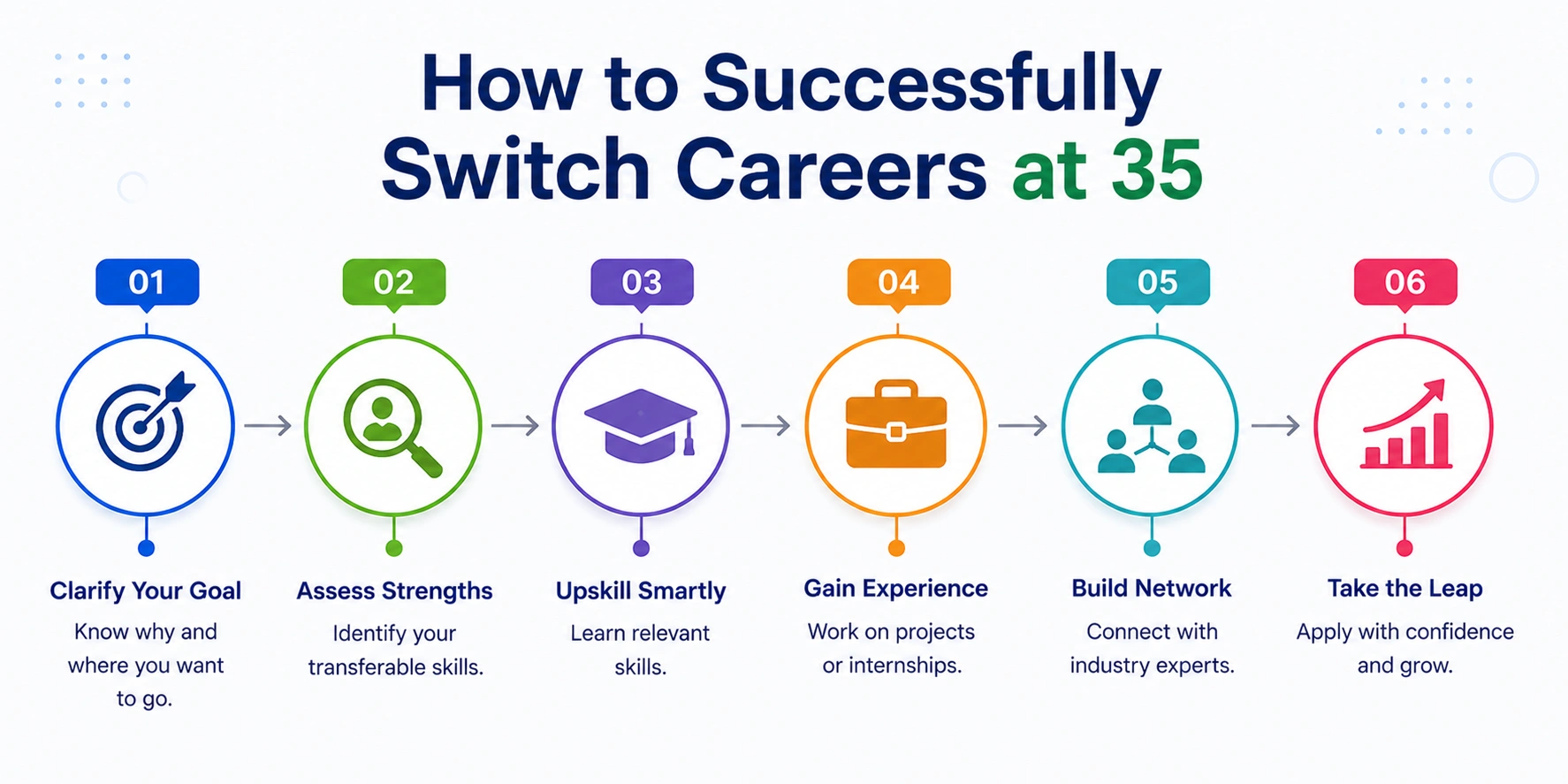








 ROI Calculator