Professional Communication Skills: The Foundation of Every Career
Critical Thinking and Problem-Solving
Emotional Intelligence and Teamwork
Key Insights
Professional skills complement technical knowledge by helping employees communicate effectively, solve problems, build trust, and take on greater responsibilities.
Strong professional communication, critical thinking, emotional intelligence, and teamwork help improve workplace relationships and decision-making.
Time management, adaptability, and continuous learning help professionals manage priorities, respond to workplace changes, and stay relevant in evolving industries.
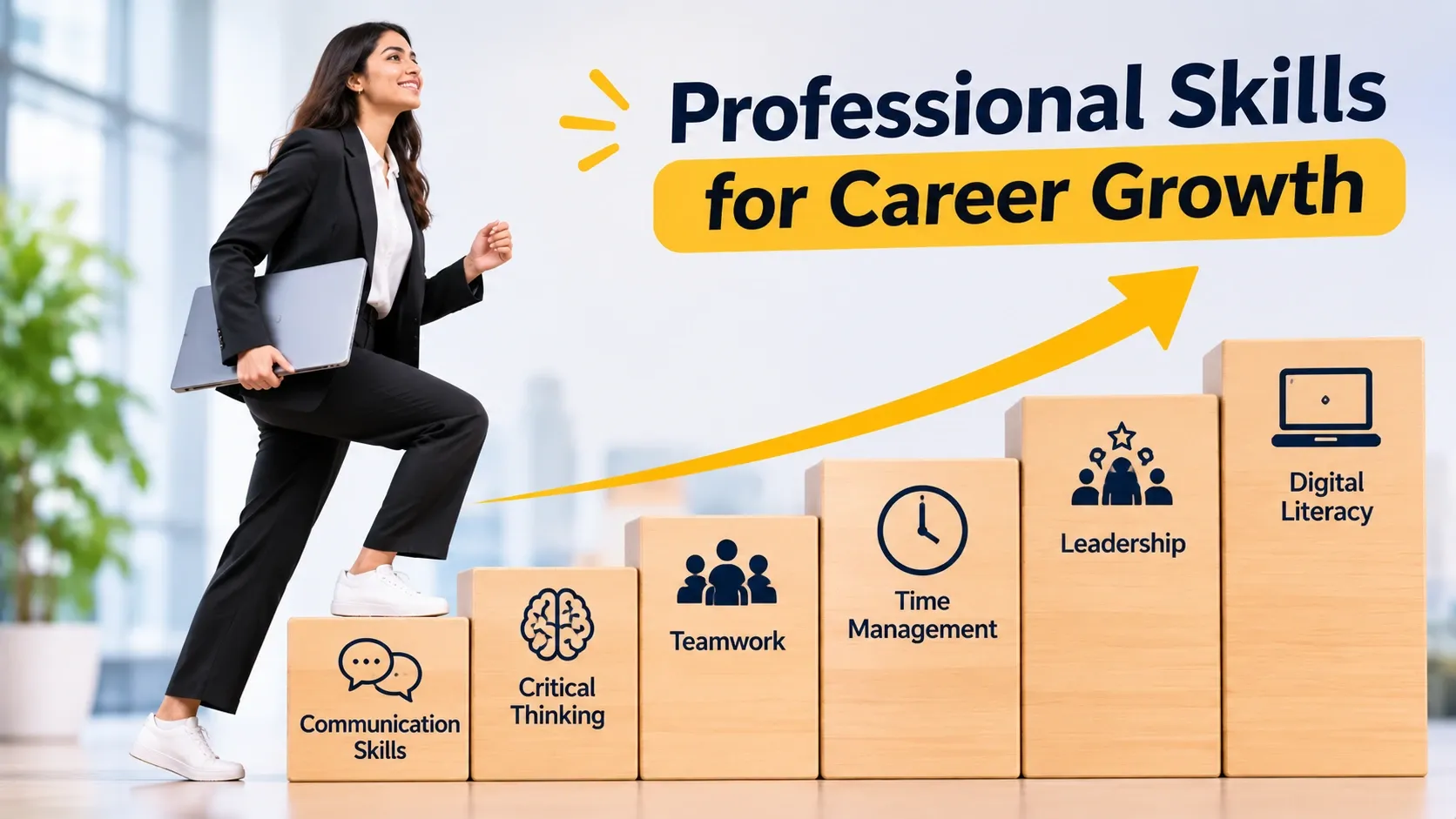
Developing leadership abilities, digital literacy, and data awareness prepares professionals for bigger roles, while showcasing relevant skills with real examples strengthens their resumes.
In this blog, you'll learn about the top professional skills for career growth, ways to improve communication and problem-solving, leadership training, essential digital skills, resume-building tips, and practical steps to develop these abilities.
Career growth rarely happens by chance. While experience and qualifications open doors, it is the right set of professional skills that helps people move forward, take on bigger responsibilities, and earn the trust of their organizations. Employers today look beyond degrees and job titles. They want people who can communicate clearly, solve problems, work well with others, and keep learning as industries change. Whether you are starting your first job or planning your next promotion, building these abilities with intention can make a real difference. This guide explains the most valuable skills, why they matter, and how you can develop them step by step.
Technical knowledge helps you do a job, but professional skills help you grow in it. Two employees with the same qualifications may have very different career paths, and the difference often lies in how they communicate, manage their time, handle pressure, and work with colleagues.
These abilities are often called transferable skills because they apply across roles, industries, and even career changes. A project manager, a software engineer, and a marketing executive may use very different tools, yet all of them rely on clear communication, sound judgment, and teamwork. As workplaces become more digital and more collaborative, these skills are becoming even more important. Organizations also tend to promote people who show maturity, reliability, and the ability to guide others, not only those who complete tasks accurately.
Professional Communication Skills: The Foundation of Every Career
Among all workplace abilities, professional communication skills are usually the first to be noticed. Clear communication builds trust, prevents misunderstandings, and helps your ideas gain support.
Strong communication includes several parts:
Written communication: Emails, reports, and messages should be clear, concise, and polite. A well-structured email with a specific subject line saves time for everyone.
Verbal communication: Speaking confidently in meetings, presentations, and one-to-one discussions helps you share ideas and answer questions with ease.
Active listening: Listening carefully, without interrupting, shows respect and helps you understand the real needs behind a request.
Non-verbal communication: Eye contact, posture, and tone of voice all influence how your message is received, especially in video meetings.
Adaptability: Explaining the same idea differently to a senior leader, a client, and a new team member is a sign of real skill.
To improve, practice summarizing your points in two or three sentences before a meeting. Ask for feedback on your presentations, and read well-written documents to learn from their structure. Over time, these habits make your message more persuasive and professional.
Critical Thinking and Problem-Solving
Employers value people who do not only point out problems but also suggest solutions. Critical thinking means analyzing information, questioning assumptions, and reaching logical conclusions. Problem-solvingbuilds on this by turning conclusions into action.
A simple approach can help. First, define the problem clearly. Next, gather facts from reliable sources. Then, consider more than one possible solution and weigh the benefits and risks of each. Finally, act, review the results, and learn from them. When you follow this process consistently, your decisions become more thoughtful, and your manager sees you as someone who can be trusted with complex responsibilities.
Emotional Intelligence and Teamwork
Most modern work is collaborative, which makes emotional intelligence a key part of workplace success. It refers to the ability to understand your own emotions, manage them well, and respond with empathy to others.
People with strong emotional intelligence stay calm during disagreements, accept feedback without becoming defensive, and notice when a colleague needs support. They also build better relationships, which leads to smoother projects and stronger networks. To develop this skill, pause before reacting in stressful moments, ask questions to understand different viewpoints, and acknowledge the contributions of others. Small, respectful actions repeated daily create a reputation for professionalism.
As responsibilities increase, managing time well becomes essential. Professionals who deliver work on schedule and handle several priorities without losing quality stand out quickly.
Some practical methods include:
Prioritizing tasks: Separate what is urgent from what is truly important, and begin with work that has the highest impact.
Planning your day: Spend ten minutes each morning listing the key tasks you must complete.
Setting realistic deadlines: Be honest about how long tasks will take and communicate early if timelines change.
Reducing distractions: Silence unnecessary notifications and set aside focused blocks of time for demanding work.
Good time managementalso protects your well-being. When you plan well, you avoid last-minute stress and maintain a healthier balance between work and personal life.
Adaptability and Continuous Learning
Industries are changing quickly due to new technologies, shifting markets, and evolving customer expectations. Professionals who adapt to these changes remain valuable, while those who resist them risk falling behind.
Adaptability means staying open to new ideas, learning new tools, and adjusting your approach when circumstances change. Continuous learningsupports this mindset. You can build it through online courses, workshops, industry reading, professional certifications, and mentorship. Even setting aside thirty minutes a few times each week for learning can lead to significant progress over a year. Employers notice this effort, and it often leads to new opportunities.
Training for Leadership: Preparing for Bigger Roles
Leadership is not limited to people with management titles. Anyone can show leadership by taking initiative, supporting teammates, and guiding projects toward success. This is why structured training for leadershipis valuable even early in your career. Preparing before you step into a leadership role helps you handle it with greater confidence.
Effective training for leadership usually focuses on these areas:
Decision-making: Learning to evaluate options and make timely, balanced decisions, even with limited information.
Delegation: Trusting team members with responsibility while providing clear direction and support.
Coaching and feedback: Guiding others to improve through constructive, respectful conversations.
Conflict resolution: Addressing disagreements early and fairly to protect team morale.
Strategic thinking: Connecting daily work to long-term organizational goals.
You can begin developing these qualities through leadership workshops, mentoring programs, executive education courses, and by volunteering to lead small projects. Observing leaders you admire and reflecting on what makes them effective is another useful practice. Over time, consistent training for leadership turns potential into proven capability.
Digital Literacy and Data Awareness
Nearly every role now involves digital tools, from collaboration platforms and spreadsheets to data dashboards and automation software. Being comfortable with technology saves time and allows you to contribute more effectively.
Data awareness is also growing in importance. Even if you are not a data analyst, being able to read charts, interpret basic metrics, and use numbers to support your ideas makes your arguments stronger. Start by learning the tools used in your own field, and gradually explore areas such as data visualizationand basic analytics. A willingness to learn digital skills signals that you are ready for the future of work.
Professional Skills for Resume: What Recruiters Notice
A strong resume does more than list your job duties. It shows the abilities that make you effective. When choosing professional skills for resume writing, aim for relevance, clarity, and proof.
Here are some practical tips:
Match the job description: Read the posting carefully and include the skills that the employer mentions, provided they truly reflect your experience.
Combine hard and soft skills: Pair technical strengths, such as data analysis or project management, with abilities like communication and teamwork.
Show evidence: Instead of writing “good communicator,” add a result, such as “presented quarterly updates to senior management, which improved cross-team coordination.”
Keep it concise: Select six to ten of your strongest skills rather than long, generic lists.
Use clear headings: A dedicated skills section helps recruiters and applicant tracking systems find the information quickly.
Well-chosen professional skills for resume writing also help you in interviews. When you can support each skill with a real example, you appear credible and prepared. This is far more convincing than a list of general claims.
How to Build Your Professional Skills Step by Step
Knowing which abilities matter is only the first step. The next is to build them with a clear plan.
Assess yourself honestly. Identify your current strengths and the areas that need improvement. Feedback from colleagues and managers can offer a useful outside view.
Set specific goals. Instead of saying “improve communication,” aim to “deliver one team presentation each month with written feedback.”
Learn through practice. Apply new ideas at work as soon as possible, because skills grow faster through use than through theory alone.
Find a mentor. An experienced guide can offer advice, share lessons, and help you avoid common mistakes.
Review your progress. Every few months, reflect on what has improved and adjust your plan.
Consistency matters more than speed. Small improvements repeated over time lead to lasting career growth.
Career advancement depends on more than technical ability. Strong communication, critical thinking, emotional intelligence, time management, adaptability, digital awareness, and leadership readiness all work together to build a successful professional journey. The encouraging part is that every one of these abilities can be learned and improved with practice. Begin by choosing two or three areas that matter most for your current goals, make a simple plan, and review your progress regularly. As you invest in your professional skills, you will find that new opportunities, greater responsibility, and stronger confidence follow naturally.
Frequently Asked Questions
Employers consistently look for communication, problem-solving, adaptability, collaboration, time management, digital literacy, and leadership potential. These abilities are useful across industries and help professionals stay relevant as technology and job roles change.
Practice writing clear and concise emails, listen carefully in meetings, and ask for feedback on your presentations. Joining a public speaking group or taking a communication workshop can also build confidence over time.
It is not mandatory, but it is highly beneficial. Early training helps you develop decision-making, delegation, and coaching abilities before you take on a team, which makes the transition smoother and reduces common mistakes.
Choose skills that match the job description and that you can support with examples. A balanced mix of technical skills and abilities such as communication, teamwork, and problem-solving usually works best. Keep the list focused, and avoid generic phrases without evidence.
Bhargavi R
HR Professional
Bhargavi Reddy is an HR professional with over 6 years of experience in IT recruitment and talent acquisition. She specializes in hiring across technologies like Java, DevOps, Python, and Data Engineering. With strong expertise in full-cycle recruitment and stakeholder management, she focuses on building high-performing teams. Currently, she works as an HR Manager driving strategic hiring initiatives.
Get Free Upskilling Guidance
Fill in the details for a free consultation
Related Courses
Explore our programs
Blended Post Graduate Program in Management MBA (MBA - BPGP)

 November 6, 2026
 7 min read





 Key Insights
 ChatGPT
 Perplexity
 Claude
 Grok









 ROI Calculator