A Quick Look at the IIT Bombay ePGD in Interaction Design
How the Programme Is Structured
IIT Bombay ePGD Interaction Design Skills: The Big Picture
The Soft Skills You Pick Up Along the Way
Key Insights
Flexible Upskilling for Working Professionals: The IIT Bombay ePGD in Interaction Design allows professionals to gain advanced design skills through a flexible 36-credit, 12 to 36-month program combining online sessions and mandatory in-person campus evaluations.
Comprehensive Multi-Disciplinary Approach: The curriculum covers qualitative and quantitative research, human factors, data visualization, design theory, and emerging technology concepts like VR/AR and game design.
Balancing Work Commitments with Quality Design Education: Working professionals often cannot pause their careers for a two-year full-time degree; this program solves that challenge by offering weekend sessions and a pay-per-course structure spanning up to 3 years.
Practical Portfolio and Soft Skills Growth: Learners develop hands-on projects while naturally strengthening cross-functional collaboration, design communication, self-discipline, and critical thinking skills.
In this blog, you'll learn about the structure, eligibility, fee details, core course modules, and specific skills offered through IIT Bombay’s ePGD Interaction Design program.
Let's be honest: most working professionals who think about upskilling hit the same wall. You can't pause your job for two years, and a full-time design degree just isn't realistic. That's exactly the gap that the IIT Bombay ePGD in Interaction Design tries to fill.
Offered by the IDC School of Design at IIT Bombay, the ePostgraduate Diploma in Interaction Design (ePGD IxD) is built for people who are already working and want to grow in the field of interaction design. It's a 36-credit programme that you can complete in 12 to 36 months, which makes it a lot easier to balance with a full-time role.
But the big question is always the same: what will you actually walk away with? In this blog, we'll break down the IIT Bombay ePGD Interaction Design skills in plain language, course by course, so you can decide if it's the right move for you.
A Quick Look at the IIT Bombay ePGD in Interaction Design
Before we get into the skills, here’s the basic picture.
The programme was launched by IIT Bombay’s IDC School of Design for working professionals. It’s designed for interaction designers, UI/UX professionals, software developers, IT quality professionals,product managers, and faculty members who want to teach interaction design and related subjects.
This course is offered in both online and in-person formats, and the programme also includes seven additional courses covering research, human factors, emerging technology, and design theory.
The application fee for the programme is ₹2,500 + GST, while the total programme fee is ₹3,00,000 + GST.
The diploma is a 36-credit programme. You choose 5 or 6 courses from a pool of 8, each worth 6 or 12 credits, and you have up to 3 years to finish. Courses run either online through live weekend sessions or in person at IIT Bombay. Even online courses end with an in-person presentation or exam on campus, and attendance is mandatory. To pass a course, you need at least 50% overall and 40% in the final assessment.
On eligibility, you can apply with a degree in design, engineering, architecture, fine arts, applied arts or a related field. Candidates with any other degree can apply with 3 or more years of experience in roles such as UX designer, web developer, product manager, or copywriter, or with a qualifying CEED score.
IIT Bombay ePGD Interaction Design Skills: The Big Picture
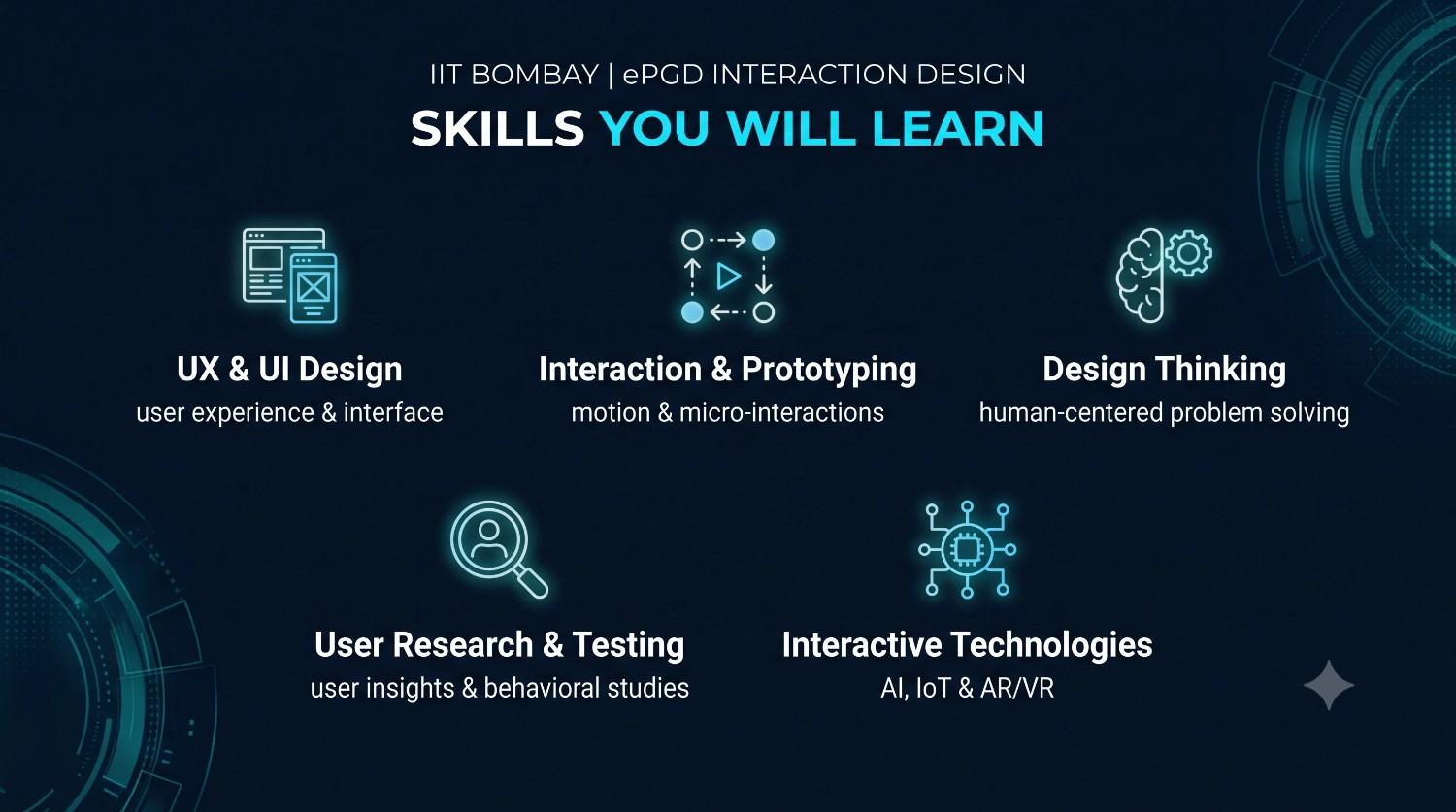
Overall, the IIT Bombay ePGD Interaction Design skills fall into five broad groups:
Designing interactive products from scratch
Understanding users through research
Understanding human behaviour and limitations
Working with emerging technologies and play
Thinking critically about design
The nice part is that the programme doesn’t treat design as only “making screens look good”. It treats it as a mix of research, psychology,technology, and thinking, which is how real products actually get built. Let’s go through each one.
Skill 1: Designing Interactive Products (Design of Interactive Products)
This is the heart of the IIT Bombay interaction design course skills. The “Design of Interactive Products” course takes you through how interactive products are conceived, designed, and evaluated, with a hands-on course project covering user studies, interaction design and evaluation, drawing from IIT Bombay’s long-running HCI course.
In practical terms, this is where you build skills like:
Understanding how people interact with apps, websites, and digital tools
Turning a vague problem into a clear design brief
Sketching and prototyping ideas before investing in development
Testing your designs with real users, aligning them with business goals, and building a portfolio of hands-on projects
For a UI/UX designer, this sharpens the “why” behind your design decisions. For a developer or product manager, it gives you a structured way to think about users instead of relying on gut feeling.
Skill 2: Qualitative Research Methods in Design
Good design starts with listening. The qualitative research methods course focuses on understanding people through observation, interviews, and conversations rather than numbers. It’s an advanced course meant to take your qualitative research skills to the next level.
This is one of the most valuable IIT Bombay ePGD skills for anyone working in product teams. It helps you:
Plan and run user interviews that actually reveal insights
Observe how people use products in real situations
Spot patterns in what users say and do
Turn messy notes into clear findings the team can act on
If you’ve ever sat in a meeting where everyone argued over opinions, you’ll appreciate how powerful solid research can be.
Skill 3: Quantitative Research Methods in Design
Qualitative research tells you the “why”. Quantitative research tells you the “how many” and “how much”. The quantitative research methods course adds the numbers side to your toolkit.
With this skill, you can:
Form a research hypothesis, identify variables, and design experiments that give reliable results
Collect and analyze data, applying statistical methods and avoiding common mistakes in research design
Back up your design choices with evidence stakeholders trust
Combined with the qualitative course, you get a balanced research mindset. That mix is rare and really useful, especially if you want to move into senior design or research roles.
Skill 4: Human Factors in Interaction Design
This course looks at the human side of the equation: how people see, think, remember, make mistakes, and get tired. It’s the kind of knowledge that quietly separates a usable product from a frustrating one.
Among the IIT Bombay ePGD Interaction Design skills, this one helps you:
Design interfaces that fit how people naturally perceive and process information
Focus on usability, safety, and user satisfaction by reducing errors and confusion
Think about accessibility and diverse users from the start
It’s especially handy if you work on products for large or varied audiences, which is pretty much every product in India today.
Skill 5: Virtual and Augmented Reality Basics
The introduction to virtual and augmented reality course opens the door to immersive experiences. You won’t become a VR engineer overnight, but you’ll understand how interaction works when screens are replaced by spaces.
You can expect to build skills like:
Understanding Extended Reality (XR) domains and VR technology
Following a design process made for immersive, interactive experiences
Spotting where immersive tech actually adds value (and where it’s just a gimmick)
For designers who want to stay ahead of the curve, this is an exciting addition to the IIT Bombay interaction design course skills list.
Skill 6: Game Design Principles and Practice
Games are some of the most carefully designed interactive systems around. The game design course teaches you what keeps people motivated, curious, and coming back. It’s an intensive, in-person course in which you design real, innovative games.
The lessons travel well beyond gaming. You can use them to:
Build engaging learning apps, fitness tools, and rewards systems
Understand feedback loops, challenge, and motivation
Design experiences that feel playful without being childish
If you work in edtech,fintech, or any product where user engagement matters, this is a surprisingly practical skill.
Skill 7: Data Visualization
Data is everywhere, but data that people can’t read is useless. The data visualization course teaches you how to turn complex information into clear, meaningful visuals, with practical experience in building and evaluating them.
This is one of the more job-ready IIT Bombay ePGD skills, because it helps you:
Choose the right chart or visual for the story you want to tell
Design dashboards that people actually understand
Present insights in a way that helps decision-makers act quickly
Product managers, analysts, and designers all benefit from this one.
Skill 8: Theoretical Perspectives in Design
This course might sound heavy, but it’s where you build long-term thinking. Theory gives you language and frameworks to explain your work, question assumptions, and make smarter design choices. The course also offers critical perspectives on technology and design, including how ideologies shape technology and society.
The skills you build here include:
Critically examining why designs work or fail
Communicating your design reasoning clearly and confidently
Connecting practice with research, which is especially useful if you’re interested in teaching or academic work
This is also why the programme suits faculty members who want to teach interaction design with a stronger foundation.
The IIT Bombay ePGD Interaction Design skills go well beyond learning a few tools. You get a well-rounded foundation: designing interactive products, researching users, understanding human behaviour, exploring emerging tech, and thinking critically about design. And because it’s built for working professionals, you can learn while you keep earning and keep growing in your current role.
If you’re serious about moving ahead in UX, product, or design-led roles, this programme is worth a close look. Before applying, check the latest course schedule, eligibility, and fees on the official IDC School of Design website, as details can change.
Frequently Asked Questions
It’s the ePostgraduate Diploma in Interaction Design (ePGD IxD) offered by IIT Bombay’s IDC School of Design for working professionals. It’s a 36-credit programme that blends online and in-person courses and can be completed in 12 to 36 months.
The programme is designed for interaction designers, UI/UX professionals, software developers, IT quality professionals, product managers, and faculty members interested in teaching interaction design. Formally, you need a degree in design, engineering, architecture, fine arts, or a related field, or any degree plus 3 or more years of relevant industry experience, or a qualifying CEED score.
You’ll build skills in interactive product design, qualitative and quantitative research, human factors, VR and AR basics, game design, data visualization, and design theory.
Fees are paid per course rather than as one payment for the whole programme. A 6-credit course costs ₹59,000 and the 12-credit course ₹1,18,000 including GST, and the total programme fee is ₹3,00,000 + GST. Amounts can change, so confirm them on the official website.
Shubham Lal
Lead Software Developer
Shubham Lal joined Microsoft in 2017 and brings 8 years of experience across Windows, Office 365, and Teams. He has mentored 5,000+ students, supported 15+ ed-techs, delivered 60+ keynotes including TEDx, and founded AI Linc, transforming learning in colleges and companies.
Get Free Upskilling Guidance
Fill in the details for a free consultation
Related Courses
Explore our programs
e-Postgraduate Diploma in Innovation & Entrepreneurship

 October 12, 2026
 8 min read




 Key Insights
 ChatGPT
 Perplexity
 Claude
 Grok
Grok








 ROI Calculator



