Product Development Process: Stages, Strategy & Real-World Examples
J
By Shubham Lal
February 10, 202611 min read
Last updated on June 29, 2026
SHARE THIS ARTICLE
Table Of Content
What is Product Development?
Why Should Businesses Care about Product Development?
Stages of Product Development
Product Development Process Examples
How exactly does an idea turn into something we use in our daily lives? How can some products succeed in the marketplace while others fail miserably? Product development is an exciting yet difficult endeavour. It is not just the way to build something new, but building products that people actually want and are curious to use. From ideation to execution, products go through many stages, helping you deliver high-quality, desirable products.
Thus, whether you’re a marketing head, an entrepreneur, or a student who is just curious to learn more about product development, this blog is for you. Here we will outline everything you need to know, including the stages of product development, what it is, and how to develop the best plan. Stay tuned with this blog only to get real insights.
Product development is an umbrella term that describes the entire process from the conception of an idea for a product until it is ready to be put on the market.
In the past, many people viewed product development as simply the “building” or “engineering” aspect; however, this view has changed dramatically over the years. Today, product development encompasses every phase of the life cycle of a product. Therefore, product development begins with the idea of creating a new item and includes all necessary steps preceding its creation, such as research, planning, design, development, testing, marketing, and launch.
In simple terms, product development is about more than creating something new; it is about building the best item for the intended audience and at the appropriate point in time.
The creation of new products generally starts when someone notices a problem or sees a business opportunity. After the customer has successfully received the product, the journey ends. During this period, various teams work collaboratively on different parts of product development. The following is a list of the most common roles.
Product Manager(s)
Research and Development (R&D) Team(s)
Designers/Engineers
Marketing/Sales Team(s)
Senior Management
At every stage of product development, various established deliverables are generated. Examples of deliverables include: product concepts, prototypes, product roadmaps, and launch plans.
Why Should Businesses Care about Product Development?
Product Development isn’t Just an Imagination Game; It is an Investment in Business Strategy. According to international consulting firm McKinsey & Company, over a quarter of the total revenues and profits for industries around the world are generated from new products. This statistic alone should motivate companies to invest in their product development processes.
While companies may see this statistic and believe they can reverse this trend, they shouldn’t get too excited. Research shows:
Of the 7 product ideas, only one-and-a-half of them will reach the launch phase, and
Out of 7, only 1 will become a success.
This further emphasizes the importance of having a strategically focused product development strategy and a systematic approach to product development. When companies follow a systematic product development process, it can:
Increase company profits by up to 34.2% if the product is developed properly.
Reduce time, money, and resources wasted on unproductive solutions for product launch.
Provide greater organisation of the entire development process by all parties involved (i.e., marketing, sales, production, etc.)
Speed up the time-to-market for new products.
Stages of Product Development
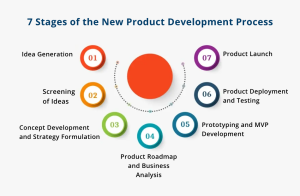
*appventurez.com
The product development process plays a critical role in simplifying complex product launches while encouraging strong cross-functional collaboration. From ideation to commercialization, each stage ensures that teams work in alignment, risks are minimized, and the final product meets both business objectives and customer expectations. Clear communication, structured decision-making, and teamwork remain central to the success of every stage.
Let’s explore the six widely recognized product development stages in detail.
1. Idea generation (Ideation)
Generating ideas is the starting stage for the product development process. In this phase, teams collect opportunities based on their customers, customer issues, market holes and anticipated future trends. The ideas generated may come from within the company, from customer comments, from evaluating the competition, from technology or from the changing behaviours of consumers.
Target market
One must have a clear understanding of the target market. The team will need to identify the market in which the product will be sold, including the typical demographic, behaviour, problems, and expectations of customers.
Existing products
Evaluating existing products, both within the organization and in the competitive landscape, helps to understand whether the new idea is unique and viable. Teams also assess whether similar solutions already exist, how competitors address the problem, and where current offerings fall short.
Functionality
While detailed specifications are not required yet, having a clear understanding of the product’s purpose helps keep ideation focused and realistic.
SWOT analysis
SWOT analysis is an important method of examining an idea from internal and external perspectives. Strengths and Weaknesses show the internal capabilities of an organization, while Opportunities and Threats highlight market conditions, risks, and competition.
SCAMPER method
The SCAMPER method is a structured brainstorming technique used to improve or innovate ideas. It encourages teams to:
Substitute products or processes
Combine different products or processes
Adapt an old or existing product or process into a new context
Modify or enhance an existing product or process
Use an existing product or process in a different way
Remove anything unnecessary
Rearrange or reverse the order of a process.
2. Product Definition
Once an idea has been selected, the product definition stage focuses on refining and shaping it into a clearly defined concept. This stage bridges creativity and execution by aligning the product idea with business goals and strategic priorities.
Business analysis
Business analysis evaluates the commercial viability of the product. This includes assessing distribution channels, ecommerce strategies, pricing considerations, revenue potential, cost structures, and competitive positioning.
Value proposition
It highlights the product’s unique benefits, differentiators, and relevance to the target market. A strong value proposition guides product design, marketing messaging, and customer communication.
Success metrics
Defining success metrics early allows teams to measure performance after launch. These metrics may include revenue targets, customer adoption rates, retention, engagement, conversion rates, or operational efficiency indicators.
Marketing strategy
Early marketing planning ensures that product development aligns with how the product will be positioned and promoted. While the strategy may evolve later, early alignment prevents mismatches between product features and market expectations.
3. Prototyping
Prototyping is a critical aspect of developing a new product. It establishes a tangible representation of an abstract concept, allowing for an early prototype to be tested. This helps to determine whether the assumptions used to create the prototype(s) are valid and whether there will be any problems or obstacles to successful project execution, as well as the potential time frame and budget for project completion.
Feasibility analysis
It assesses if it is possible and practical to create a proposed product within the specific time period, budget, and technical capabilities of the organisation. There may be some instances where difficulties arise, which means that the timeline or scope will have to be adjusted accordingly.
Market risk research
When assessing market risk, organisations examine all potential barriers to the successful launch of their product, including low demand, regulatory restrictions, pricing sensitivity, and the presence of strong competition. All risks are documented and shared with all stakeholders to ensure they can make an informed decision and establish a proactive plan to mitigate these risks.
Development strategy
It provides a clear outline of the way in which tasks are to be assigned, sequenced, and tracked. Project planning is usually conducted using a combination of project management techniques, such as sprint planning, critical path analysis, and agile methodologies, to enable effective and efficient execution of the task, as well as appropriate accountability.
MVP
The MVP is the most important output of the prototyping stage. It includes only the essential features required for the product to function and deliver value.
4. Initial design
The initial design stage focuses on refining the product’s appearance, usability, and structure based on the MVP. Stakeholders collaborate closely to ensure that the design aligns with both user expectations and technical requirements.
Source materials
For physical products, sourcing materials involves identifying suppliers, evaluating quality, and documenting material specifications. For digital products, this may involve selecting software frameworks, tools, or platforms. Proper documentation ensures consistency and scalability.
Connect with stakeholders
Regular communication with stakeholders, including designers, engineers, suppliers, and leadership, is critical during this stage. Progress updates, design reviews, and approval checkpoints help prevent misalignment and delays.
Receive initial feedback
Once the design is ready, initial feedback is gathered from senior management and key stakeholders. This feedback helps identify improvements, address concerns, and finalize the design before moving into validation.
5. Validation and Testing
Validation and testing ensure that the product is reliable, functional, and market-ready. This stage helps identify issues before launch, reducing the risk of costly post-launch fixes.
Concept development and testing
Teams test the product’s core functionality to ensure it performs as intended. This may include usability testing, performance testing, security checks, or stress testing, depending on the product type.
Front-end testing
Front-end testing focuses on user-facing components. This includes testing interfaces, navigation, responsiveness, and overall user experience. For digital products, e-commerce functionality and system stability are also tested.
Test marketing
Marketing materials, campaigns, and messaging are reviewed and tested to ensure consistency and effectiveness. This may involve A/B testing, pilot campaigns, or internal reviews.
6. Commercialisation
Commercialization is the final stage of the product development process, where the product is officially launched into the market.
Product development
Final production or development is completed according to approved specifications. This may involve manufacturing, software deployment, packaging, or logistics preparation.
Ecommerce implementation
For digital and retail products, ecommerce platforms are transitioned to a live environment. Final checks ensure that payment systems, order processing, and customer support channels function smoothly.
Apple uses a highly structured and disciplined product development process. Apple emphasizes in-depth user research as opposed to in-house ideation, iterative prototyping; and extensive testing. Apple puts in a large amount of time on refining products before launching them, and aligning their marketing strategy with the design of their product at launch time, to allow for consistent delivery of innovative user-centric products.
Example 2: Tesla Inc.
Tesla’s product development process is driven by innovation, sustainability and advanced engineering. Tesla combines in-house research and development with real-world testing, continuous software updates and enables faster feedback cycles by selling directly to consumers contributing to rapid innovation.
How to Write a Product Development Plan
A good product development plan ensures that you know where you are heading before you build, it guides your product development team through each step of the product development life cycle and ensures that everyone has a similar understanding of the product’s objectives, priorities, and direction.
Step 1: Develop Your Goals
Defining your goals is the first step in writing a product development plan. Your goals serve as the primary bases for all critical decisions made about your product. Your goals will also ensure that the focus of your product development team is on creating a minimum viable product (MVP) that addresses a significant market need.
Your goals should be consistent with your business analysis and value proposition. This will ensure that your product meets the needs of the target audience and provides the right value to potential customers. Additionally, clearly defined goals will help to assess the success of the product at various stages of product development.
Example: A new startup that has developed a mobile application to manage time wants to build a user-friendly solution that will enable busy individuals to schedule their lives more efficiently and reduce their daily time spent planning by twenty percent.
Step 2: Plan the strategy
Once your goals are set, the next step is to plan how you will achieve them. It includes developing a well-defined plan for development that contains specific time frames, milestones, and the necessary resources needed to complete your project successfully. Using a product road map gives all of your team’s members a common reference point throughout the entire development process.
When developing your marketing strategy, you also need to closely evaluate such things as pricing structures, test marketing plans, and product messaging. By creating a product strategy template, you can easily connect your development activities with your actual company’s performance goals.
Example: An e-commerce company launching a subscription-based meal kit service structures its strategy in phases. It begins with a three-week prototype phase to test packaging designs, followed by a two-month user experience trial with selected customers. The strategy concludes with a regional market test to evaluate pricing and demand before expanding nationwide.
Step 3: Track and adjust
A product development plan should never be static. Once execution begins, it’s essential to track progress using key performance indicators (KPIs) and other relevant metrics. Constantly measuring and monitoring performance enables teams to quickly discover potential problems and react accordingly, using data based on evidence.
Continuously reviewing performance allows teams to improve their products, their ability to deliver products and increase the overall user experience. Regular review intervals ensure that the product strategy remains in alignment with changing market conditions, customer demands, and the product’s original vision.
Example: A SaaS company monitors metrics such as daily active users, session duration, and customer churn during its beta launch. After noticing lower engagement with certain features, the team redesigns the user interface and improves onboarding, leading to higher retention and increased feature adoption.
Wrap Up
The product development process is a structured yet flexible approach that helps businesses turn ideas into successful products. By following clearly defined product development stages, from ideation and research to testing and commercialization, companies can reduce risk, improve efficiency, and create products that truly resonate with customers.
A strong product development strategy not only improves launch success but also ensures long-term growth and competitive advantage. In today’s market, businesses that invest in thoughtful, customer-focused product development are the ones that stand out, and succeed.
For learners and professionals looking to build expertise in this domain, Jaro Education offers industry-relevant online degree programs that provide in-depth exposure to product development concepts, real-world case studies, and practical frameworks. Through flexible learning models and expert-led curriculum, Jaro helps you gain the strategic and analytical skills required to excel in modern product development roles.
Frequently Asked Questions
The main goal of the product development process is to turn an idea into a successful, market-ready product while minimizing risk, cost, and time. It ensures the product meets customer needs and business objectives.
The timeline varies depending on the product type, industry, and complexity. Some products may take a few months, while others, like technology or manufacturing products, can take several years.
Product development includes improving or modifying existing products, while new product development focuses on creating entirely new products that do not yet exist in the market.
An MVP (Minimum Viable Product) allows companies to launch quickly with essential features, gather real user feedback, and improve the product without investing heavily in full-scale development early on.
Shubham Lal
Lead Software Developer
Shubham Lal joined Microsoft in 2017 and brings 8 years of experience across Windows, Office 365, and Teams. He has mentored 5,000+ students, supported 15+ ed-techs, delivered 60+ keynotes including TEDx, and founded AI Linc, transforming learning in colleges and companies.
Get Free Upskilling Guidance
Fill in the details for a free consultation
Related Courses
Explore our programs
Admission Open
Post Graduate Certificate Programme in Strategic Product Management
 HOME > BLOG > IT/Software Development > Product Development Process: Stages, Strategy & Real-World Examples
 February 10, 2026
 11 min read




 ChatGPT
 Perplexity
 Claude
 Grok
Grok





 Admission Open
 Admission Closed
 Admission Closed
 Admission Closed
 ROI Calculator