What Makes the Capstone Different From a Regular Assignment?
Key Insights
BYOP (Build Your Own Product) provides a hands-on opportunity to apply Product Management methodologies to a product concept with guided mentor support.
The capstone follows a problem-first approach, using user research, personas, Jobs-to-be-Done, the 5 Whys, and MVP fundamentals to identify and validate product opportunities.
Participants learn to define an MVP and prioritise features, focusing on solving the core user problem instead of trying to build everything at once.
The project connects product decisions with analytics, roadmapping, business models, and go-to-market strategy, helping participants understand how different product decisions work together.
BYOP is not simply about coding or creating a final presentation; it focuses on thinking like a Product Manager and applying frameworks to make structured product decisions.
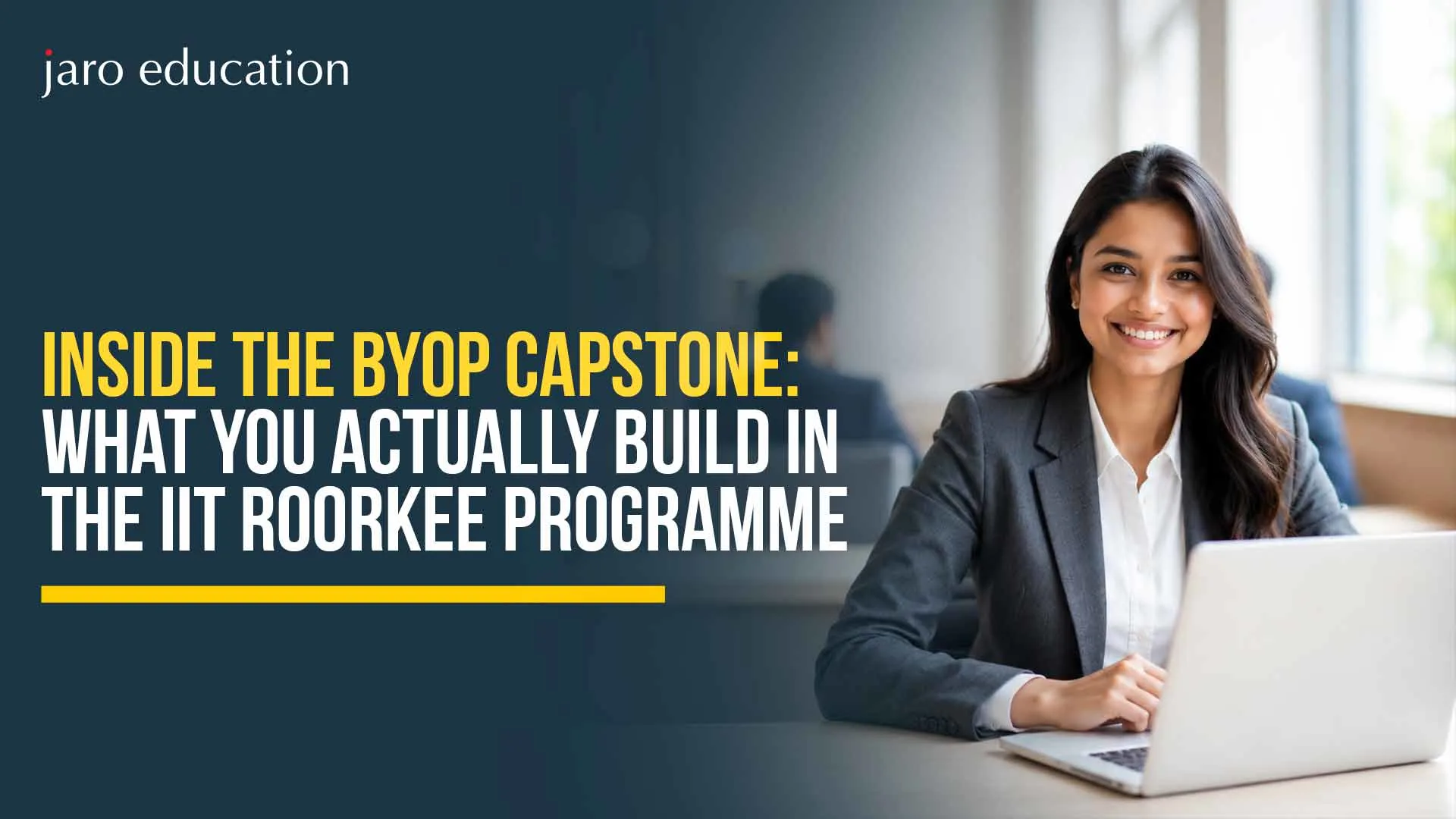
In this blog, you'll learn what the IIT Roorkee BYOP capstone involves, how participants identify problems, define users and MVPs, use analytics and roadmaps, develop business and GTM strategies, and apply these skills to Product Management.
Product Management is often described as the function that connects customers, business strategy, technology, design, and execution. But learning these concepts theoretically is very different from actually applying them to a product idea. This is where the Build Your Own Product (BYOP) component of the IIT Roorkee Strategic Product Management Programme becomes particularly relevant.
The Post Graduate Certificate Programme in Strategic Product Management at IIT Roorkee is structured around end-to-end product management, covering areas such as user research, product strategy, analytics, business models, AI integration, product roadmaps, and go-to-market planning. The programme specifically includes a BYOP project, supported through guided mentor sessions, giving participants an opportunity to apply concepts learned throughout the programme to a product-building exercise.
So, what do you actually build during the BYOP capstone? Is it just a presentation? Do you need to be a programmer? What kind of product can you develop? And, most importantly, how can the experience help you demonstrate practical Product Management skills?
Let us look inside the BYOP journey and understand what participants can expect.
BYOP stands for Build Your Own Product. Instead of limiting learning to lectures, case studies, frameworks, and theoretical exercises, the initiative gives participants an opportunity to work on a product concept and apply Product Management methodologies to it.
The IIT Roorkee programme describes BYOP as a hands-on component in which learners develop real-world solutions under expert mentorship. The syllabus places the BYOP execution module after foundational topics such as user research, product thinking, product sense, personas, Jobs-to-be-Done, and Minimum Viable Products.
This sequence is important. You are not simply asked to invent an idea and prepare slides. The learning journey first introduces the frameworks required to understand a problem, identify users, validate opportunities, define an MVP, and make product decisions. BYOP then gives you a context in which these skills can be brought together.
In other words, the capstone is designed to simulate the way a Product Manager thinks about a product—from identifying a problem to determining what should be built and how it can create value.
What Do You Actually Build?
The exact product idea can depend on the project and participant or group. However, the objective of BYOP is to take a product concept through the major stages of Product Management.
Think of it as building the product strategy and product blueprint, rather than simply writing code.
A typical journey starts with identifying a meaningful customer problem. For example, you may identify a problem faced by working professionals, students, small businesses, consumers, healthcare users, financial customers, or another clearly defined audience.
The next step is understanding whether the problem is significant enough to solv.
This requires moving beyond assumptions. Product Managers need to understand who the user is, what they struggle with, how they currently solve the problem, and why existing alternatives may not be sufficient.
The programme’s user research curriculum includes concepts such as the DVA framework, the 5 Whys, Jobs-to-be-Done, user personas, and MVP fundamentals. These frameworks provide a structured way to move from a broad problem statement toward a more clearly defined product opportunity.
Step 1: Start With a Problem, Not a Feature
One of the most important lessons in Product Management is that products should solve problems rather than simply add features.
Suppose you want to build an application for working professionals. Saying, “I want to build an AI-powered career app” is a product idea, but it is not yet a strong product definition.
A stronger approach would be to identify a specific problem.
Perhaps professionals find it difficult to understand which skills they need to progress into a particular role. Research can then help determine whether this is a genuine pain point, which users experience it most strongly, what solutions already exist, and what gaps remain.
The BYOP process allows participants to approach their product from this problem-first perspective.
This is valuable because it teaches one of the fundamental differences between Product Management and simply building software: the Product Manager must establish why something should be built before deciding what should be built.
Step 2: Define Your Target User
Once a problem has been identified, the next question is: Who exactly are you solving it for?
A product intended for everyone usually struggles to address anyone particularly well.
The programme introduces participants to user personas and customer-centric frameworks that can help define the target audience. A persona may capture factors such as the user’s background, goals, pain points, behaviours, and motivations.
For the capstone, this means your product begins to have a specific audience rather than an abstract customer.
For example, instead of targeting “professionals,” your product might focus on early-career professionals switching into technology roles. This narrower definition can influence the features, messaging, user experience, pricing, and go-to-market strategy.
Step 3: Define the MVP
A common mistake among aspiring Product Managers is trying to build everything at once.
BYOP introduces the idea of an Minimum Viable Product (MVP), helping participants think about what the first version of a product genuinely needs.
An MVP is not simply a product with fewer features. It is an approach totesting whether the core value proposition can solve an important user problem without unnecessarily investing resources in features that have not yet been validated.
For the capstone, this means participants have to make prioritisation decisions.
What should be included in Version 1?
What can wait?
Which feature directly addresses the user’s primary pain point?
Which features are useful but not essential?
These questions mirror real-world Product Management decisions.
Step 4: Think About Product Analytics
Building a product is only one part of the journey. Product Managers also need to understand whether the product is actually working.
The IIT Roorkee syllabus includes an introduction to Product Analytics, covering the difference between product and business analytics, types of data companies can capture, different product metrics, and how to select appropriate metrics.
In the context of BYOP, this encourages participants to think beyond “we launched the product.”
Instead, they can consider what success should look like.
For example, depending on the product, relevant metrics could include activation rate, user engagement, retention, conversion, customer acquisition, or feature adoption.
The objective is to develop the habit of connecting product decisions with measurable outcomes.
Step 6: Understand the Business Model
A good product also needs a sustainable business logic.
The IIT Roorkee programme coversbusiness model fundamentals and the Business Model Canvas, including key elements and different types of business models.
During a product-building exercise, this helps participants look beyond the customer experience.
Who pays for the product?
What value does the customer receive?
How does the company generate revenue?
What are the important resources and activities?
Who are the key partners?
What costs could affect profitability?
These questions help transform an interesting product concept into a more commercially realistic proposition.
Step 7: Plan How the Product Reaches Customers
Even a well-designed product can fail if customers do not know about it or cannot access it effectively.
That is why the BYOP journey also connects with go-to-market thinking.
The IIT Roorkee syllabus covers GTM strategy, the 3C/4P framework, acquiring the first 1,000 users, product launches, and the factors involved in successful launches.
This means participants can think about their product beyond development.
They can consider positioning, target customers, launch strategy, channels, messaging, and early adoption.
For aspiring Product Managers, this is particularly useful because modern product roles increasingly require collaboration withmarketing, sales, growth, design, technology, and business teams.
This is perhaps one of the biggest questions professionals have.
Not necessarily.
Product Management is not the same as software development. A Product Manager is responsible for defining the problem, understanding users, shaping product strategy, prioritising requirements, coordinating stakeholders, and measuring outcomes.
The IIT Roorkee programme does introduce technical concepts such as product architecture, technology stacks, APIs, andSQL basics. It also addresses AI in Product Management.
The purpose is to develop technical understanding for better product decisions, rather than turning every participant into a software engineer.
This distinction is important for professionals from business, marketing, consulting, operations, analytics, finance, or other backgrounds who want to move toward Product Management.
What Makes the Capstone Different From a Regular Assignment?
A regular academic assignment may ask you to explain a framework, analyse a case, or answer a specific question.
A product capstone is different because multiple decisions are connected.
Your user research influences your problem statement.
Your problem statement influences your MVP.
Your MVP influences your roadmap.
Your business model influences your positioning.
Your positioning influences your GTM strategy.
Your metrics influence how you evaluate success.
That interconnected thinking is at the heart of Product Management.
The IIT Roorkee programme combines BYOP assignments with hands-on sessions, live interactive classes, industry-expert sessions, and case-based learning. The BYOP component itself includes guided mentor sessions.
Therefore, the value is not only in the final product concept but also in the decision-making process used to arrive at it.
What Can You Take Away From the BYOP Experience?
The biggest advantage of a capstone is that it gives participants something more concrete to discuss when demonstrating their Product Management capabilities.
Instead of saying, “I know what a product roadmap is,” you can explain how you created one.
Instead of simply stating that you understand user research, you can discuss how research shaped your product problem.
Instead of only learning prioritisation frameworks, you can demonstrate how you used prioritisation to decide which features belonged in the MVP.
This can make the learning experience more practical and portfolio-oriented.
The programme itself lists hands-on BYOP experience among its learning outcomes, alongside product lifecycle management, analytics, product launches, AI-driven solutions, roadmapping, and GTM strategies.
BYOP can be particularly useful for professionals who want to understand how Product Managers operate in real business environments.
Aspiring Product Managers can use it to practise the complete product development thought process. Existing Product Managers can use the frameworks to structure their approach more systematically. Professionals from technology, consulting, marketing, analytics, operations, or entrepreneurship can use the experience to understand how different functions come together around a product.
It can also be valuable for professionals preparing for product-focused interviews, where interviewers often assess problem-solving, prioritisation, customer understanding, analytical thinking, and product sense.
Final Thoughts
The most important thing to understand about the BYOP capstone in the IIT Roorkee Strategic Product Management Programme is that it is not simply about producing a final presentation.
It is about learning to think like a Product Manager.
You start with a customer problem, investigate the user, define the opportunity, identify the MVP, consider product metrics, build a roadmap, evaluate the business model, and think about how the product can reach its target market.
That makes the capstone a practical bridge between Product Management theory and application.
The IIT Roorkee programme is currently structured as a five-month live-online programme and includes a campus visit of three to four days. Its curriculum combines product strategy, user research, analytics, business models, GTM, branding, technology fundamentals, and AI-related product management concepts.
For professionals considering a move into Product Management, the BYOP experience can therefore provide something that traditional classroom learning often lacks: an opportunity to apply product frameworks to a product of your own and understand how individual product decisions connect to the larger business strategy.
Frequently Asked Questions
BYOP stands for Build Your Own Product. It is a hands-on component of the programme where participants work on product-building exercises with guided mentor support and apply Product Management concepts learned during the course.
Not necessarily. Product Management focuses on product strategy, customer needs, prioritisation, business objectives, and execution. The programme does cover technical concepts such as APIs, product architecture, technology stacks, and SQL basics, helping participants collaborate more effectively with technical teams.
Yes. A hands-on product project can help aspiring Product Managers understand how different Product Management frameworks work together. It can also give them practical examples to discuss during interviews and career conversations.
The programme is delivered live online over five months, with weekend sessions, and includes a three-to-four-day campus visit. The structure is designed to combine professional learning with practical product-building exposure.
The capstone can help you apply skills related to user research, problem identification, MVP definition, product analytics, prioritisation, roadmapping, business models, GTM strategy, and product decision-making.
Nuthana Reddy
Nuthana Reddy is a Senior Manager at Procter & Gamble, specializing in operations, digitization, and cross-functional leadership. She has driven multimillion-dollar impact through innovation, process optimization, and strategic execution across global markets.
Get Free Upskilling Guidance
Fill in the details for a free consultation
Related Courses
Explore our programs
Post Graduate Certificate Programme in Strategic Product Management
 HOME > BLOG > Business Management > Inside the BYOP Capstone: What You Actually Build in the IIT Roorkee Programme
 August 17, 2026
 9 min read




 Key Insights
 ChatGPT
 Perplexity
 Claude
 Grok
Grok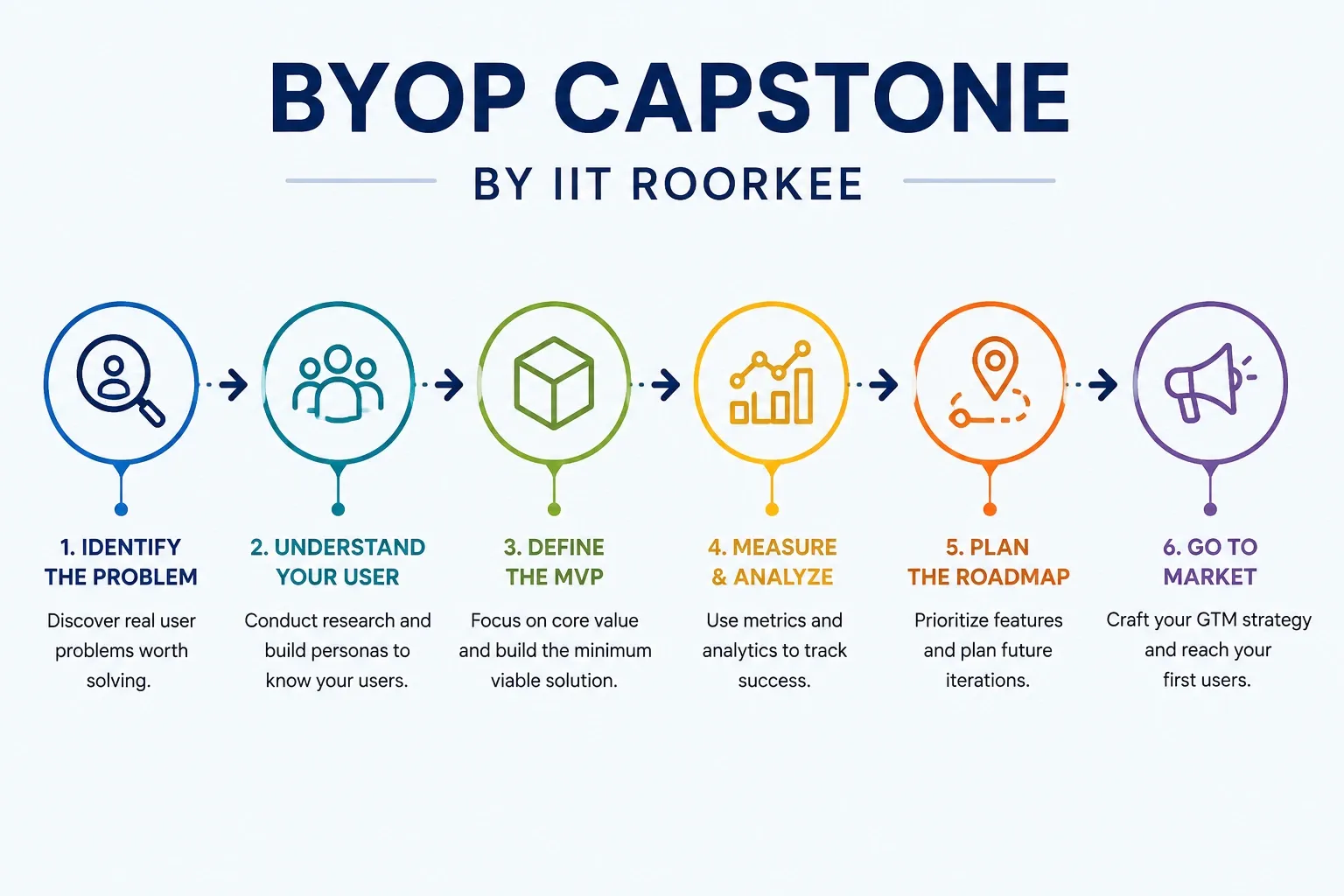








 ROI Calculator