HOME > BLOG > Business Management > Product Management Certification ROI: Fees, EMI Options and Payback Period
Business Management
Product Management Certification ROI: Fees, EMI Options and Payback Period
J
By Nuthana Reddy
August 6, 20268 min read
Published on August 6, 2026
SHARE THIS ARTICLE
Table Of Content
Understanding ROI in a Product Management Certification
Looking Beyond the Programme Fee
What Determines the ROI of a Product Management Certification?
Calculating Your Certification ROI
The demand for product managers has grown significantly over the last few years as organisations across industries embrace digital transformation, artificial intelligence, and customer-centric innovation. From technology startups to global enterprises, companies are actively hiring professionals who can bridge the gap betweenbusiness strategy, customer needs, and product execution. As a result, many working professionals are exploring product management certifications to transition into this high-growth field or accelerate their existing careers.
However, before investing in any certification programme, one question naturally comes to mind: Is it worth the money? While product management certifications can open doors to better opportunities, the real value lies in understanding the return on investment (ROI). Beyond the programme fee, learners should evaluate the skills they gain, potential salary growth, career advancement opportunities, networking benefits, and the time it takes to recover their investment.
With flexible learning models and convenient EMI options now available, pursuing a premium certification has become more accessible than ever. Instead of delaying career growth due to financial concerns, professionals can spread the cost over manageable monthly instalments while continuing to work full-time.
This blog explores how to evaluate the ROI of a product management certification, understand programme costs, compare financing options, and estimate the payback period so that you can make an informed career investment.
Understanding ROI in a Product Management Certification
Return on Investment (ROI) is not just about earning a higher salary after completing a certification. It is a broader measure of the value you receive compared to the amount you invest.
When evaluating a product management certification, ROI includes several factors. These include acquiring industry-relevant skills, improvingleadership capabilities, expanding your professional network, gaining access to experienced faculty, learning practical frameworks, and increasing employability in competitive job markets.
Unlike many short-term online courses that focus only on theoretical concepts, high-quality certification programmes provide practical exposure through case studies, live projects, product strategy frameworks, and industry mentorship. These experiences contribute directly to long-term career growth.
The true ROI of a certification is realised when the knowledge gained translates into promotions, salary hikes, successful career transitions, or greater confidence in handling strategic product responsibilities.
Looking Beyond the Programme Fee
Many professionals evaluate certifications solely on their tuition fees. While cost is an important consideration, it should never be the only deciding factor.
Think of a certification as an investment rather than an expense. A lower-priced programme may seem attractive initially but might lack industry recognition, faculty expertise, practical learning opportunities, or placement support. On the other hand, a premium certification offered by a reputed institution often provides significantly higher long-term value.
The overall investment includes:
Programme fee
Learning resources
Time commitment
Networking opportunities
Access to alumni communities
Industry exposure
Career services and mentorship
When these factors contribute to faster career growth, the overall return often outweighs the initial investment.
What Determines the ROI of a Product Management Certification?
Several elements influence how quickly you recover your investment and begin seeing career benefits.
The reputation of the institution plays a major role. Certifications offered by prestigious institutions carry stronger recognition among employers and often enhance professional credibility.
The curriculum is equally important. Modern product management extends beyond traditional product lifecycle management. Today’s professionals must understand AI-driven product development, customer analytics,digital transformation, agile methodologies, user experience, pricing strategies, product roadmaps, and stakeholder management.
Faculty quality also impacts learning outcomes. Experienced industry practitioners provide practical insights that are difficult to gain through self-paced courses alone.
Networking opportunities further increase ROI. Interacting with peers from diverse industries allows professionals to exchange ideas, build meaningful relationships, and discover new career opportunities.
Finally, flexibility matters.Programmes designed for working professionals minimise career disruption while allowing learners to apply classroom concepts immediately in their workplace
Calculating Your Certification ROI
Although every professional’s journey is different, a simple ROI calculation can provide a realistic estimate.
Suppose a certification costs ₹2.5 lakh.
After completing the programme, you secure a role with an annual salary increase of ₹5 lakh.
Your additional earnings recover the certification cost within the first year.
Even if your salary increase is more gradual, the long-term financial impact can be substantial. Over five years, the cumulative increase in earnings may significantly exceed the original programme fee.
However, salary should not be the only measurable outcome.
These career advantages often create exponential returns over time.
Why Product Management Salaries Continue to Rise
One of the strongest reasons professionals invest in product management certifications is the attractive salary potential.
Companies today require professionals who understand customer behaviour, data-driven decision-making, technology trends, and business strategy simultaneously. This rare combination of skills has created strong demand for experienced product managers.
Professionals with certifications often find it easier to demonstrate structured knowledge during interviews, especially when supported by practical projects and real-world case studies.
As organisations increasingly adopt AI, cloud computing, SaaS platforms, fintech, healthcare technology, and digital commerce, skilled product managers continue to remain among the most sought-after professionals.
Instead of performing operational tasks, product managers directly influence business growth, customer experience, innovation, and profitability. Their strategic contribution naturally leads to stronger compensation packages.
Free Courses
Mastering Product Management: Roadmap,Vision, and Strategy
One of the biggest barriers professionals face is affordability.
Many hesitate to pursue executive education because they assume they must pay the entire programme fee upfront.
Fortunately, this is no longer the case.
Today, many premium certification programmesoffer flexible EMI options that significantly reduce the financial burden. Instead of postponing career growth for several years, professionals can begin learning immediately while distributing payments across manageable monthly instalments.
This approach offers several advantages.
First, professionals continue earning their regular salary while studying.
Second, monthly payments are often easier to manage than a large one-time investment.
Third, learners begin applying newly acquired knowledge at work even before completing the programme, increasing the chances of promotions or better job opportunities during or shortly after the certification.
Viewed this way, EMI financing becomes a strategic career investment rather than a financial burden.
Estimating the Payback Period
The payback period refers to the amount of time required to recover your educational investment through increased earnings.
For example, if your certification costs ₹3 lakh and your annual salary increases by ₹6 lakh after completing the programme, your payback period is approximately six months.
If the salary increase is ₹3 lakh annually, the investment is recovered in about one year.
Even professionals who experience gradual career progressiontypically recover their investment within a few years through cumulative salary hikes, promotions, bonuses, and better job opportunities.
Importantly, the payback period becomes shorter when professionals actively apply their new skills, pursue strategic projects, and leverage alumni networks to explore new roles.
Career Growth Beyond Salary
Although compensation remains a primary motivation, the value of a product management certification extends far beyond financial returns.
Professionals often experience a noticeable shift in the quality of work they handle. They become involved in strategic decision-making, cross-functional leadership, product vision development, customer research, innovation initiatives, and executive presentations.
Many professionals also transition from purely technical or operational roles into business-focused leadership positions. This career shift often creates opportunities that would otherwise require years of traditional experience.
Another overlooked advantage is confidence. Structured learning helps professionals communicate product strategies more effectively, manage stakeholders with greater clarity, and make informed business decisions backed by proven frameworks.
These intangible benefits often become the foundation for sustained career success.
Who Should Invest in a Product Management Certification?
Product management certifications are valuable for professionals from diverse educational and professional backgrounds. Software engineers looking to transition into business roles often benefit by learning product strategy, customer-centric thinking, and market analysis. Similarly, business analysts can expand their responsibilities by understanding product lifecycle management and stakeholder collaboration.
Marketing professionals, consultants, project managers, UX designers, and entrepreneurs can also strengthen their strategic decision-making capabilities through structured product management education. Even experienced managers seeking leadership positions can gain valuable insights into innovation, digital transformation, and product growth strategies.
Fresh graduates interested in building a career in product management may also consider certifications that combine theoretical concepts with practical exposure. However, working professionals generally derive higher ROI because they can immediately implement new knowledge within their organisations.
The role of product managers is changing rapidly. Organisations are no longer looking for professionals who simply coordinate product development. They need leaders who can leverage artificial intelligence, interpret customer insights, drive innovation, and align business objectives with technology.
As AI-powered products, SaaS platforms, fintech solutions, health-tech innovations, and digital commerce continue to grow, the demand for skilled product managers is expected to remain strong. Companies increasingly value professionals who possess strategic thinking, analytical skills, and the ability to collaborate across engineering, design, marketing, and business teams.
At the same time, executive education has become more flexible than ever. Weekend live classes, online learning, recorded sessions, and EMI payment options make it possible for working professionals to upskill without taking a career break. This combination of industry demand and accessible learning makes 2026 an excellent time to invest in a recognised product management certification.
Advance Your Product Management Career with IIT Roorkee
If you’re looking for a programme that combines academic excellence with practical industry learning, the Post Graduate Certificate Programme in Strategic Product Management by Continuing Education Centre (CEC), IIT Roorkee, offered through Jaro Education, is a strong choice. Designed for working professionals, this 5-month live online programme equips learners with in-demand product management skills, including product strategy, AI-driven product development, product lifecycle management, customer-centric innovation, agile methodologies, and go-to-market planning.
The programme features live interactive weekend classes, expert faculty from IIT Roorkee and industry leaders, real-world case studies, a Bring Your Own Product (BYOP) capstone project, and a one-day campus immersion at IIT Roorkee. Participants also gain exposure to modern product management tools and frameworks that can be immediately applied in the workplace. With flexible EMI options, professionals can pursuepremium executive education without disrupting their careers or finances. Whether you are planning to transition into product management or accelerate your growth in your current role, this programme provides the knowledge, credibility, and practical exposure needed to stay competitive in today’s evolving business landscape.
Conclusion
A product management certification should not be viewed merely as an educational expense—it is a long-term investment in your professional growth. While programme fees and financing options are important considerations, the true ROI lies in the opportunities the certification creates. Higher salaries, leadership roles, stronger strategic thinking, industry recognition, and an expanded professional network all contribute to long-term career success.
When evaluating different programmes, look beyond the price tag. Consider the institution’s reputation, curriculum relevance, faculty expertise, learning methodology, industry exposure, and networking opportunities. A well-designed programme can significantly shorten your payback period by equipping you with the skills employers actively seek.
As businesses continue to innovate and compete in an increasingly digital world, professionals with strong product management capabilities will remain in high demand. Investing in the right certification today can position you for sustained career growth in the years ahead.
Frequently Asked Questions
Yes. A recognised certification can enhance your strategic skills, improve employability, support career transitions, and increase earning potential, especially when combined with practical project experience.
The payback period varies based on salary growth and career progression. Many professionals recover their investment within one to two years through promotions, new job opportunities, or salary hikes.
Yes. Many executive education providers offer flexible EMI plans, allowing working professionals to spread programme fees over manageable monthly instalments while continuing their careers.
Software engineers, business analysts, consultants, project managers, marketing professionals, entrepreneurs, and aspiring product managers can all benefit from a structured certification programme.
Successful product managers require strategic thinking, customer research, data analysis, product roadmap planning, stakeholder management, agile methodologies, AI awareness, communication, and leadership skills.
Nuthana Reddy
Nuthana Reddy is a Senior Manager at Procter & Gamble, specializing in operations, digitization, and cross-functional leadership. She has driven multimillion-dollar impact through innovation, process optimization, and strategic execution across global markets.
Get Free Upskilling Guidance
Fill in the details for a free consultation
Related Courses
Explore our programs
Post Graduate Certificate Programme in Strategic Product Management
 HOME > BLOG > Business Management > Product Management Certification ROI: Fees, EMI Options and Payback Period
 August 6, 2026
 8 min read




 ChatGPT
 Perplexity
 Claude
 Grok
Grok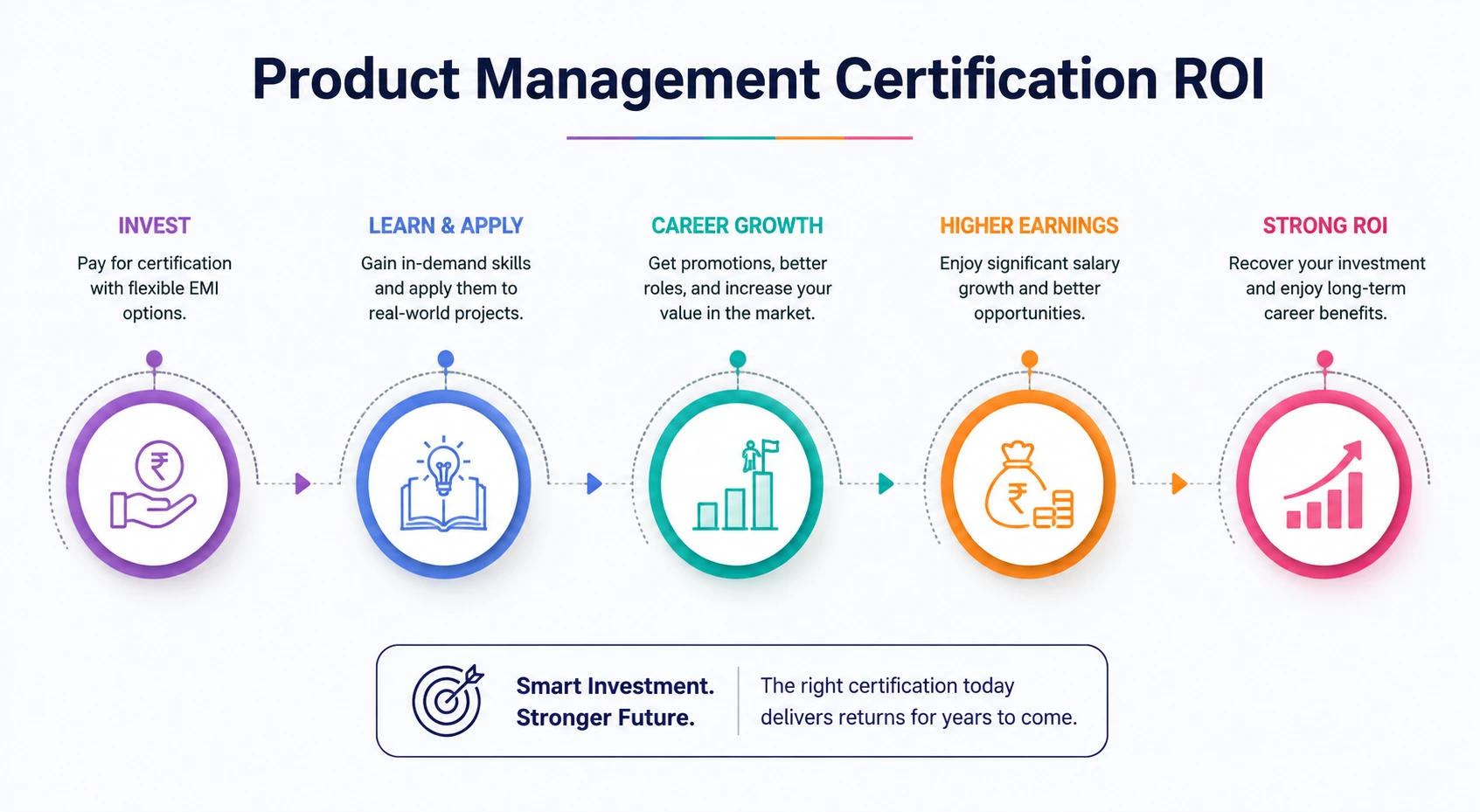









 ROI Calculator