Artificial Intelligence Syllabus: What You'll Actually Study
AI and ML Projects: What Can You Build?
Artificial Intelligence Project Topics for Students
Key Insights
AI and ML curricula cover more than machine learning algorithms, combining programming, mathematics, statistics, data handling, deep learning, NLP, generative AI, computer vision, and cloud technologies.
The artificial intelligence syllabus typically progresses from foundational concepts such as Python, data structures, databases, and statistics to advanced areas including machine learning, deep learning, MLOps, and generative AI.
Practical ai and ml projects help learners apply theoretical concepts through applications such as recommendation systems, sentiment analysis, fraud detection, chatbots, and image classification.
When selecting artificial intelligence project topics, learners should consider their skill level, career interests, available data, development time, and ability to create a well-executed solution.
In this blog, you'll learn about artificial intelligence subjects, the artificial intelligence syllabus, key AI and ML concepts, practical project ideas, and how to choose suitable AI and ML learning paths.
Artificial Intelligence (AI) and Machine Learning (ML) are among the most widely explored areas in technology today. From predictive analytics and recommendation systems to generative AI and intelligent automation, these technologies are changing how organizations use data and build digital solutions. For students and working professionals considering a career in this field, understanding the curriculum is just as important as knowing the career opportunities.
But what do you actually study in an AI and ML program? The answer goes beyond machine learning algorithms. A well-structured curriculum typically combines programming, mathematics, statistics, data handling, artificial intelligence, machine learning, deep learning, natural language processing, data visualization, and practical projects.
This guide explores the major artificial intelligence subjects, explains what you can expect from an artificial intelligence syllabus, and discusses practical AI and ml projects, artificial intelligence project ideas, and artificial intelligence project topics that can help turn theoretical knowledge into practical skills.
AI and ML subjects cover the concepts and techniques used to build systems that can analyze data, identify patterns, generate predictions, and support intelligent decision-making.
Artificial Intelligence is the broader field. It includes areas such as reasoning, problem-solving, natural language processing, computer vision, intelligent systems, and automation. Machine Learning is a major part of AI that focuses on developing systems capable of learning patterns from data.
As a result, an AI and ML curriculum usually combines several areas, including:
Artificial Intelligence Syllabus: What You'll Actually Study
The artificial intelligence syllabus is generally designed to take learners from foundational concepts to advanced applications. Students first develop programming and mathematical skills before moving into machine learning and advanced AI techniques.
Here are some of the major subjects you may encounter.
1. Programming for AI and ML
Programming is one of the most important foundations of AI and ML. Python is particularly popular because it is widely used for data analysis, machine learning, automation, and AI application development.
A programming component may cover:
Python fundamentals
Variables and data types
Conditional statements
Loops and functions
Object-oriented programming
File handling
Data structures
Libraries and packages
Data processing
Depending on the program, learners may also encounter R, Java, or C++.
The goal is not simply to learn programming syntax. You need to understand how to write structured code, manipulate data, implement algorithms, and build applications around AI models.
2. Mathematics and Statistics
Mathematics is an important part of the syllabus artificial intelligence learners encounter because many machine learning concepts are based on mathematical and statistical principles.
Statistics helps learners understand data distributions, relationships, uncertainty, and model performance. Linear algebra helps explain how data is represented and processed, while optimization concepts are important for understanding how models learn from data.
You do not need to become a mathematician to study AI, but understanding the fundamentals can make advanced concepts much easier to grasp.
3. Data Structures and Algorithms
AI systems need to process information efficiently. Data structures and algorithms help learners understand how data can be stored, accessed, searched, and manipulated.
Typical topics include:
Arrays
Linked lists
Stacks and queues
Trees
Graphs
Hashing
Searching
Sorting
Algorithm complexity
This foundation is particularly useful when working with large datasets or developing applications where computational efficiency matters.
4. Database Management and Data Handling
AI and ML depend heavily on data, making databases another important area of study.
The focus gradually moves from simply storing data to preparing and organizing it for analysis.
Learners also need to understand that poor-quality data can affect the results of an AI model. Data preparation is therefore an important part of the overall AI workflow.
5. Data Analytics and Visualization
Before developing a machine learning model, it is important to understand the dataset.
These methods can help identify hidden patterns or groups within datasets.
Reinforcement Learning
Reinforcement learning focuses on how an agent can learn through interaction with an environment using rewards and penalties.
Advanced programs may introduce states, actions, policies, rewards, and value functions.
8. Machine Learning Model Evaluation
Developing a model is only one part of the machine learning process. You also need to determine whether the model performs effectively.
This part of the curriculum can include:
Training and testing datasets
Validation
Cross-validation
Overfitting
Underfitting
Bias and variance
Feature selection
Hyperparameter tuning
Students may also learn evaluation metrics such as accuracy, precision, recall, F1-score, and error-based metrics.
Understanding evaluation is important because a model should not be considered successful simply because it produces predictions. Its performance needs to be tested against appropriate criteria.
9. Deep Learning
Deep learning introduces neural networks that can learn complex patterns from data.
Deep learning can be applied to areas such as image analysis, language processing, speech-related applications, and other complex data problems.
10. Natural Language Processing
Natural Language Processing, or NLP, focuses on enabling computers to process and work with human language.
An NLP component may include:
Text preprocessing
Tokenization
Text classification
Sentiment analysis
Named entity recognition
Language modeling
Text generation
Information extraction
Students can use these concepts to develop applications such as chatbots, document classification systems, sentiment analysis tools, and text processing applications.
11. Generative AI
Generative AI is increasingly becoming part of modern AI curricula.
Learning generative AI should involve more than simply using AI tools. Students need to understand how these systems can be applied, evaluated, integrated into applications, and used responsibly.
12. Computer Vision
Computer vision focuses on helping computers interpret visual information.
Topics may include:
Image processing
Image classification
Object detection
Image segmentation
Feature extraction
Convolutional neural networks
Video analysis
Computer vision can be used for applications involving image recognition, document processing, visual inspection, and other image-based tasks.
13. Big Data and Cloud Technologies
As datasets become larger, AI professionals need to understand how data can be stored and processed efficiently.
Students may also learn how AI and analytics applications can be deployed through cloud environments.
14. MLOps and AI Application Deployment
Some advanced programs also introduce the operational side of machine learning.
MLOps connects machine learning with software developmentand operational practices. Topics can include:
Model deployment
Model monitoring
Version control
Data pipelines
Model versioning
Application deployment
Performance monitoring
This helps learners understand that creating a machine learning model is not necessarily the final step. Models need to be integrated into applications and monitored after deployment.
Practical projects are one of the best ways to apply concepts learned in an AI and ML curriculum. Projects allow students to combine programming, data preparation, algorithms, visualization, and model evaluation.
Some useful artificial intelligence project ideas include:
Student Performance Prediction System
Develop a system that analyzes student-related data and generates performance predictions. The project can demonstrate data preprocessing, visualization, machine learning, and model evaluation.
Recommendation System
Build a recommendation engine that suggests products, courses, movies, or other items based on available user or item data.
This can help learners understand data patterns and recommendation techniques.
Sentiment Analysis Application
Create an NLP application that analyzes text and identifies sentiment. This can be applied to customer feedback, reviews, or social media content.
Fraud Detection System
Develop a machine learning model that identifies potentially unusual or suspicious transactions. The project can provide practical exposure to classification, data preprocessing, and model evaluation.
AI-Powered Chatbot
Create a chatbot that answers frequently asked questions using predefined information or a knowledge base. Advanced versions can incorporate NLP and generative AI techniques.
Image Classification Application
Build an application that classifies images into predefined categories. This can introduce students to image data, neural networks, and computer vision.
Artificial Intelligence Project Topics for Students
When selecting artificial intelligence project topics, students should consider their skill level, available data, development time, and career interests.
Beginner-Level Topics
Beginners can start with relatively focused applications such as:
Personal expense prediction
Basic recommendation systems
Sentiment analysis
Simple chatbot
Student performance analysis
Email classification
These projects can help learners understand data preparation and basic machine learning concepts.
Intermediate-Level Topics
Students with some programming and machine learning experience can explore:
These projects typically require more data preparation and model evaluation.
Advanced-Level Topics
Advanced learners can consider:
Generative AI applications
Intelligent recommendation platforms
Computer vision systems
NLP-based information extraction
AI-powered business analytics
Real-time AI applications
The goal should not be to select the most complicated title. A well-executed project with clear requirements, appropriate data, testing, documentation, and measurable results can be more valuable than a project that uses many technologies without a clear purpose.
IIT Roorkee Applied Data Science & AI Certificate Program
For working professionals looking to develop practical knowledge in data science and AI, the Post Graduate Certificate Programme in Applied Data Science & AI offered by CEC, IIT Roorkee provides a structured learning path. The 6–8 month program is delivered through live online learning with campus immersion and covers areas such as Python and R, SQL and NoSQL, statistics, visualization, machine learning, deep learning, generative AI, NLP, time series, network analysis, big data, web dashboards, AI-based web applications, and cloud analytics. The curriculum also includes industry use cases and real-world datasets, helping learners connect AI and data science concepts with practical applications. The program is designed primarily for working professionals and accepts graduates from recognized universities with at least 50% aggregate marks, with one year of work experience preferred. Participants who meet the specified assessment and attendance criteria receive a certificate of completion from IIT Roorkee.
Conclusion
Understanding artificial intelligence subjects and the artificial intelligence syllabus can help you make a more informed decision about your education and career path. AI and ML are not limited to machine learning algorithms. A comprehensive curriculum can take you through programming, mathematics, statistics, data management, machine learning, deep learning, NLP, generative AI, computer vision, big data, cloud technologies, and application development.
The practical side is equally important. Working on ai and ml projects, exploring different artificial intelligence project ideas, and selecting relevant artificial intelligence project topics can help you apply what you learn to real-world problems.
Whether you are a student planning your specialization or a working professional looking to build AI and data science capabilities, focus on a curriculum that balances foundational knowledge with practical exposure. The right learning path can help you move from understanding AI concepts to applying them to meaningful business and technology problems.
Frequently Asked Questions
The major artificial intelligence subjects can include programming, mathematics, statistics, data structures, databases, machine learning, deep learning, NLP, generative AI, computer vision, data visualization, big data, and cloud technologies.
Yes. Mathematics and statistics provide the foundation for understanding several AI and ML concepts. Topics such as probability, statistics, linear algebra, calculus, and optimization can be particularly useful.
Students can explore projects such as recommendation systems, sentiment analysis applications, student performance prediction, fraud detection, chatbots, image classification, and demand forecasting.
Choose a topic based on your skill level, career interests, available data, project duration, and the complexity you can realistically manage. A clear problem statement and measurable outcome are more important than simply selecting a complex-sounding topic.
Many modern AI and ML programs now include generative AI as an advanced topic. Depending on the curriculum, learners may explore generative models, large language models, transformers, prompt engineering, and practical generative AI applications.
Dr. Sanjay Kulkarni
Data & AI Transformation Leader
Dr. Sanjay Kulkarni is a Data & AI Transformation Leader with over 25 years of industry experience. He helps organizations adopt data-driven and responsible AI practices through strategic guidance and education. With experience across startups and global enterprises, he bridges the gap between theory and real-world application. His work empowers teams to innovate and thrive in AI-driven environments.
Get Free Upskilling Guidance
Fill in the details for a free consultation
Related Courses
Explore our programs
Advanced Certificate Programme in Machine Learning, Gen AI & LLMs for Business Applications

 September 7, 2026
 9 min read




 Key Insights
 ChatGPT
 Perplexity
 Claude
 Grok
Grok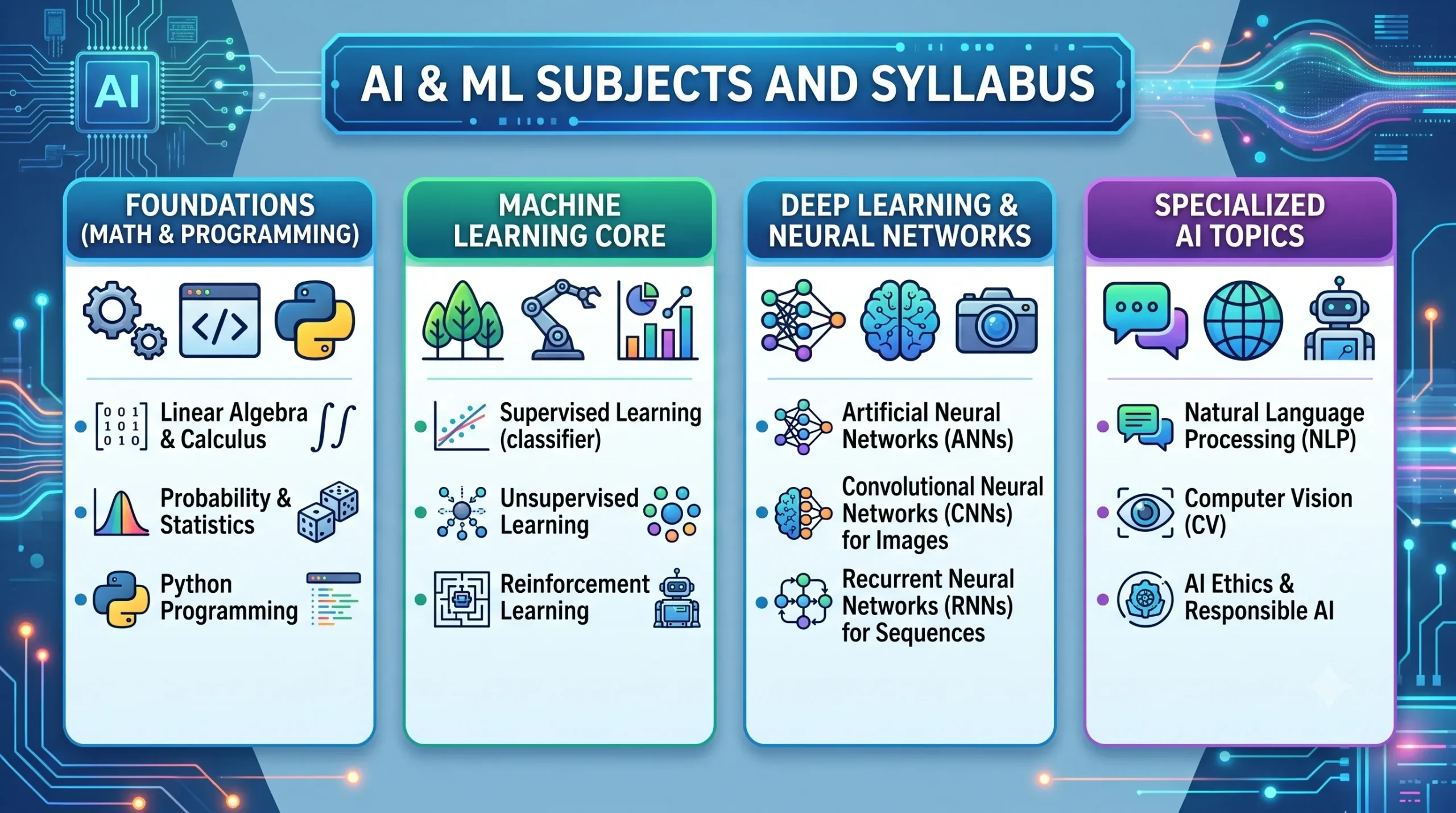











 ROI Calculator