Machine learning has brought about a dramatic shift in the way individuals, as well as organizations and developers, prefer to deal with a large amount of information for deriving key results. Among the various processes used in machine learning, the role played by clustering is very important for handling unknown trends. The most common and popular form of clustering used in machine learning is k-means clustering.
In essence, k-means clustering in machine learning is an unsupervised learning algorithm whose primary job is to cluster similar data points based on their similarity. Unlike most supervised algorithms, the process doesn’t utilize labeled datasets. Its primary objective is to divide a given dataset into k non-overlapping clusters and assign each datapoint to the cluster closest to the mean.
It is vital for anyone pursuing or already pursuing a career in the domain of data science or machine learning to understand how the k-means clustering works. Customer segmentation, image compression, and anomaly detection are some of the numerous applications of the k-means clustering. This blog aims to give you an insightful knowledge of the k-means algorithm, how it works, its advantages, disadvantages, and applications.
Clustering is a method of bringing similar data points or observations together on the basis of some characteristics. This is an essential concept in unsupervised machine learning. Among the several methods available in clustering, k-means clustering in machine learning is much appreciated for its simplicity and scalability.The basic purpose of the clustering process is the maximization of similarity for the elements in the cluster as well as the minimization of similarity among the different clusters. The k means similarity measurement is performed with the use of distance measures such as Euclidean distance.
Unlike the hierarchical and density-based clustering techniques, k means clustering demands prior knowledge of the number of clusters. This known number is denoted by k and plays an important role in determining the resultant output. In spite of this constraint, k means clustering is widely preferred because of its efficiency.
K-Means Clustering Algorithm Explained
The k-means algorithm is an iterative method of clustering that splits a dataset into k clusters, each being defined by a centroid. A centroid is the average location of all points in a given cluster. This algorithm is an optimization method that tries to minimize the sum of squares of the points in each cluster, also known as the inertia of a cluster. A univariate convolution operation takes an input vector and convolves it element-wise with a set of kernels, where each kernel covers a different set of dimensions. The output is a vector where each element corresponds to a kernel, and each element of the vector is calculated using a univariate convolution operation.
One of the key characteristics of the k-means clustering technique is that it relies on numerical data. The fact that it is based on distance means that the use of numerical data is often required when the data is categorical.
The operation of the k means clustering process in machine learning can be explained with a sequence of well-articulated steps. These steps are extremely imperative in the process of optimizing the formed clusters.
Step 1: Choosing the Number of Clusters (k)
The first step of the k-means algorithm is determining the number of clusters, k. The selection of k is a human choice task that depends on the type of data and the problem that is being attempted to be solved. Determining the appropriate k is important because there is a possibility of underfitting/oversimplification and overfitting due to inappropriate selection.
Step 2: Initialize the centroids
Once a value for k is determined, k centroids are randomly initialized. The centroids are considered initial reference points for forming a cluster. In k-means clustering, it can be considered that a better initial centroids value affects the final clustering result.
Step 3: Assign Data Points to the Nearest centroid
Each observation is assigned to the closest centroid using a distance criterion, usually Euclidean distance. This step creates temporary clusters and is a main step in k-means clustering in machine learning.
Step 4: Recalculate the centroids
With the assignment of all data points done, the next task for the algorithm is to calculate the centroid for each cluster by finding the average of the points in the cluster.
Step 5: Repeat Until Convergence
It is worth pointing out that the assignment and recalculation phases are continued until the centroids have stopped changing noticeably or a fixed number of iterations have been reached. At this point, the k means process has converged.
Mathematical Intuition Behind K-Means Clustering
The goal of k-means clustering is to reduce the total variance within clusters. Mathematically, this is shown as the sum of squared distances between data points and their centroids. The k-means algorithm improves this goal through repeated adjustments. This process makes k-means clustering very effective for datasets with clear, round cluster shapes. However, it can face challenges with complex forms or overlapping clusters, which is something to keep in mind when selecting clustering methods.
Choosing the Right Value of k
Finding the best number of clusters is one of the hardest parts of k-means clustering. Several methods can help you identify the right value of k.
Elbow Method
The elbow method involves graphing the within-cluster sum of squares for various values of k. The point where the graph bends, resembling an elbow, shows the optimal value. This method is often used in k-means clustering.
Silhouette Score
The silhouette score shows how similar a data point is to its own cluster compared to other clusters. A higher silhouette score means better clustering performance for the k-means algorithm.
Advantages of K-Means Clustering
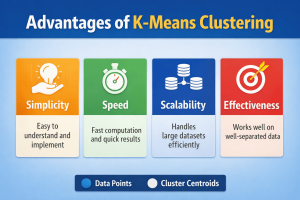
K-means clustering is popular in machine learning mainly because of its many advantages. One key benefit is simplicity. The k-means algorithm is easy to understand, implement, and interpret, even for beginners. It also works well with large datasets, making it suitable for big data tasks.
Another benefit is speed. Compared to many other clustering methods, k-means clustering is efficient and quickly reaches a solution when clusters are well separated.
Despite its benefits, k-means clustering has some limitations that users should know about.The algorithm is sensitive to where centroids start, which can cause different results on different runs. Additionally, k-means clustering assumes that clusters are roughly the same size and density, which might not hold true for real-world data.
Outliers can also greatly impact the k-means algorithm’s performance, as extreme values can distort centroids and affect clusters.
Applications of K-Means Clustering
K-means clustering is used widely across various industries and fields due to its flexibility.
In marketing, it helps with customer segmentation based on buying habits and demographics. In image processing, k-means clustering is useful for image compression by cutting down the number of colors used.
The k-means algorithm is also used for document clustering, recommendation systems, fraud detection, and bioinformatics, highlighting its wide-ranging applications.
K-Means Clustering vs Other Clustering Algorithms
When compared to hierarchical or DBSCAN clustering, k-means clustering performs faster but is less flexible in dealing with complex cluster shapes. The k-means algorithm works best when clusters are compact and well separated. Understanding these differences helps users choose the right clustering method based on data characteristics and project needs.
Best Practices for Using K-Means Clustering
To achieve the best results with k-means clustering in machine learning, it is important to prepare data properly. Feature scaling, normalization, and removing outliers can significantly boost performance. Running the k-means algorithm multiple times with different initial centroids and picking the best outcome can also improve cluster quality.
The k-means clustering algorithm in machine learning remains one of the most powerful and accessible tools for unsupervised data analysis. Its ability to group data efficiently and uncover hidden patterns makes it invaluable across industries.
While the k-means algorithm has limitations, understanding how it works, along with its strengths and weaknesses, allows users to apply it effectively. With proper data preparation and careful parameter selection, k-means clustering can yield meaningful and actionable insights from complex datasets.
As machine learning continues to grow, k-means clustering will stay a key technique, especially for those starting their journey in data science and artificial intelligence.
Frequently Asked Questions
K-means clustering is an unsupervised learning technique used for this purpose, dividing similar data points into a fixed number of clusters. In k-means clustering in machine learning, there is a central point for each cluster called the centroid, and assignment is done by keeping a point’s distance in mind. Centroids are continuously updated by the k-means algorithm to optimize the clusters and pattern discovery.
The important difference will be that KNN is supervised, whereas k means clustering is unsupervised. In k means clustering in machine learning, the k means algorithm will group the unlabeled data, whereas KNN predicts labels using labeled data and nearest neighbors. Their use cases differ based on prediction versus pattern identification.
A practical example of k-means clustering is the segmentation of customers in marketing. Companies apply k-means clustering in machine learning to segment customers according to their purchase habits, preferences, and expenditure. In such cases, the k-means algorithm assists an organization in developing focused marketing campaigns for each category.
These include customer segmentation, image compression, document clustering, and fraud detection. K-means clustering in machine learning identifies hidden patterns and structure in large datasets. Because of this, k-means algorithms are in high demand and widely used in industries like finance, healthcare, and e-commerce.
Dr. Sanjay Kulkarni
Data & AI Transformation Leader
Dr. Sanjay Kulkarni is a Data & AI Transformation Leader with over 25 years of industry experience. He helps organizations adopt data-driven and responsible AI practices through strategic guidance and education. With experience across startups and global enterprises, he bridges the gap between theory and real-world application. His work empowers teams to innovate and thrive in AI-driven environments.
Get Free Upskilling Guidance
Fill in the details for a free consultation
Related Courses
Explore our programs
Advanced Certificate Programme in Machine Learning, Gen AI & LLMs for Business Applications
 HOME > BLOG > Data Science and BI Analytics > What is K-Means Clustering Algorithm In Machine Learning?
 January 7, 2026
 6 min read




 ChatGPT
 Perplexity
 Claude
 Grok
Grok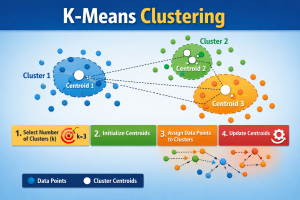











 ROI Calculator