HOME > BLOG > Career Development > Data Science vs MBA 2026: Which Career Path Pays More in India Right Now?
Career Development
Data Science vs MBA 2026: Which Career Path Pays More in India Right Now?
J
By Dr. Sanjay Kulkarni
July 27, 20269 min read
Published on July 27, 2026
SHARE THIS ARTICLE
Table Of Content
Why Are Data Science and MBA the Most Popular Career Choices in 2026?
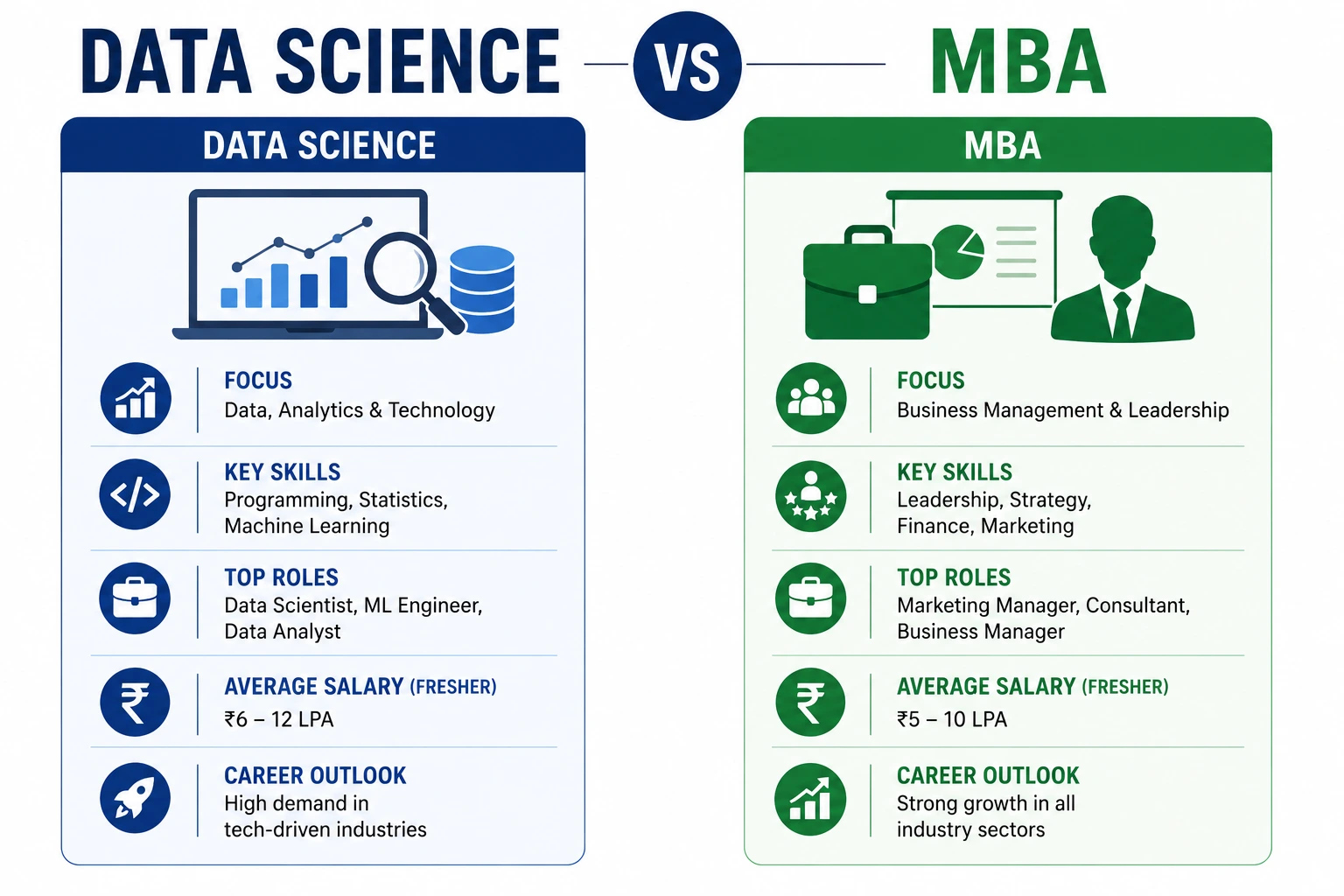
Data Science vs MBA: At a Glance
Understanding Data Science
Popular Data Science Job Roles
The demand for future-ready professionals in India has never been higher. As businesses embrace artificial intelligence (AI), automation, cloud computing, and digital transformation, students and working professionals are increasingly confused between two highly rewarding career paths—Data Science and an MBA. Both fields promise attractive salaries, rapid career growth, and global opportunities, but they cater to different skill sets and professional aspirations.
If you're planning your career in 2026, understanding the differences between these two paths is essential. While Data Science focuses on technical expertise and data-driven decision-making, an MBA develops leadership, strategic thinking, and business management capabilities. The real question isn't just which course is better—it is which career path offers better earning potential, long-term growth, and job security in India today.
In this comprehensive guide, we'll compare Data Science vs MBA based on salary, skills, career prospects, return on investment (ROI), job demand, and future opportunities to help you make an informed decision.
Why Are Data Science and MBA the Most Popular Career Choices in 2026?
India’s digital economy continues to expand rapidly. Organizations across sectors are investing heavily in AI, analytics, digital marketing, fintech,healthcare technology, and business transformation. This shift has created two distinct types of high-value professionals:
Data experts who can analyze large datasets and build intelligent solutions.
Business leaders who can manage teams, make strategic decisions, and drive organizational growth.
According to industry reports, India will continue witnessing strong demand for both technical and managerial talent over the coming years. However, the nature of these roles, required qualifications, and salary trajectories differ significantly.
Data Science combines statistics, programming, artificial intelligence, machine learning, and business intelligence to solve complex problems using data. Organizations generate massive volumes of information every day, and data scientists help transform this information into actionable business insights.
Instead of relying on intuition, companies today make decisions based on predictive models, customer behavior analysis, sales forecasting, fraud detection, and operational optimization. This growing dependence on data has made Data Science one of the fastest-growing careers globally.
Professionals in this domain typically work with technologies such as Python, SQL, R, Tableau, Power BI, TensorFlow, cloud platforms, and machine learning frameworks.
Popular Data Science Job Roles
The field offers multiple specialization opportunities depending on experience and interests.
Some of the most sought-after roles include:
Data Scientist
Machine Learning Engineer
AI Engineer
Business Intelligence Analyst
Data Analyst
Data Engineer
Analytics Consultant
Decision Scientist
AI Product Analyst
Research Scientist
As professionals gain experience, they often move into leadership roles such as Head of Analytics, Director of AI, or Chief Data Officer.
Understanding an MBA
An MBA (Master of Business Administration)is designed to develop managerial and leadership capabilities across multiple business functions. Unlike technical programs, MBA education focuses on decision-making, finance, marketing, operations, human resources, business strategy, entrepreneurship, and organizational leadership.
Modern MBA programs also include subjects such as digital transformation, AI for business, business analytics, innovation management, sustainability, and global strategy.
The biggest advantage of an MBA is its versatility. Graduates can transition across industries and departments throughout their careers.
Popular MBA Specializations in 2026
Business schools now offer highly specialized MBA programs to align with evolving industry demands.
Professionals can also pursueOnline MBA programsthat provide flexibility while continuing full-time employment.
Data Science vs MBA: Skills You Need
One of the biggest differences between these two career paths lies in the type of skills required.
Data Science Skills
Success in Data Science requires a strong technical foundation. Professionals must be comfortable working with numbers, programming languages, algorithms, and statistical models.
Analytical thinking and curiosity are equally important because professionals constantly work with business problems that require innovative solutions.
MBA Skills
MBA professionals focus more on business decision-making and people management.
An MBA develops professionals who can lead organizations rather than build technical solutions.
Salary Comparison: Data Science vs MBA in India (2026
Salary is one of the biggest deciding factors for students choosing between these career paths.
Although both fields offer attractive compensation, salary depends on multiple factors such as institute reputation, work experience, specialization, technical expertise, and industry.
Experience
Data Science Salary
MBA Salary
Freshers
₹6–12 LPA
₹5–10 LPA
3–5 Years
₹12–22 LPA
₹10–20 LPA
5–10 Years
₹20–40 LPA
₹18–35 LPA
Senior Leadership
₹40–80+ LPA
₹35 LPA–1 Crore+
Data Science Salary
Data Science professionals often experience faster salary growth during the initial years because of the industry’s talent shortage. Skilled AI and Machine Learning professionals working for global technology companies frequently earn packages exceeding ₹30–50 LPA within a few years of experience.
MBA Salary
MBA salaries vary significantly depending on the business school and specialization. Graduates from premier institutions often receive exceptional placement packages, especially in consulting, investment banking, product management, and strategy roles. Over the long term, MBA professionals who move into senior leadership positions may earn higher compensation than purely technical professionals.
The demand for Data Science is no longer limited to technology companies. Today, organizations across sectors are actively recruiting skilled data professionals to improve decision-making, automate processes, and enhance customer experiences.
Major hiring industries include:
Information Technology
Banking and Financial Services
Healthcare
E-commerce
Manufacturing
Telecommunications
Retail
Logistics
Insurance
Consulting
EdTech
FinTech
Government and Public Sector
Media and Entertainment
Global companies such as Amazon, Microsoft, Google, Accenture, Deloitte, TCS, Infosys, Wipro, HCLTech, and Flipkart continue to invest heavily in AI and analytics talent.
Industries Hiring MBA Graduates
MBA graduates enjoy one of the broadest employment landscapes because every organization requires professionals who can manage teams, operations, finance, marketing, and business growth.
Popular hiring sectors include:
Consulting
Banking
FMCG
Healthcare
Manufacturing
IT Services
Retail
E-commerce
Pharmaceuticals
Logistics
Real Estate
Hospitality
Media
Telecommunications
Leading recruiters include Deloitte, EY, PwC, KPMG, Accenture, Amazon, Reliance Industries, Tata Group, Aditya Birla Group, ICICI Bank, HDFC Bank, Asian Paints, Hindustan Unilever, and many multinational corporations.
Data Science vs MBA: Return on Investment (ROI)
When choosing between Data Science and an MBA, salary alone should not be the deciding factor. You should also evaluate the return on investment (ROI) by comparing the cost of the program with the career opportunities and salary growth it offers.
A Data Science course is generally more affordable than a full-time MBA. Certificate programs and postgraduate courses in Data Science usually range from a few months to one year and equip learners with industry-relevant technical skills. Since the demand for data professionals is high, many candidates recover their investment within the first few years of employment.
An MBA, particularly from a reputed institution, often requires a higher financial investment. However, it opens doors to leadership positions, consulting, finance, product management, and executive roles. Professionals from top B-schools often witness substantial salary growth over time, making the long-term ROI highly attractive.
Ultimately, the better ROI depends on your career aspirations. If your goal is to enter a technical role quickly with a lower investment, Data Science may be the better option. If you aspire to lead teams, manage businesses, or move into senior management, an MBA can provide greater long-term value.
Job Demand and Future Scope in India
Both Data Science and MBA graduates are expected to remain in high demand over the coming years, but the reasons behind this demand differ.
The rapid adoption of AI, automation, cloud computing, and digital transformation has made data professionals indispensable. Organizations rely on analytics to improve customer experiences, optimize operations, detect fraud, and make informed business decisions. As a result, Data Science professionals continue to be among the most sought-after technology experts in India.
MBA graduates, on the other hand, are required to manage these technological transformations effectively. Companies need business leaders who can formulate strategies, oversee cross-functional teams, improve profitability, and drive organizational growth. Every industry—from banking and consulting to healthcare and manufacturing—requires skilled managers.
Future Outlook Comparison
Factor
Data Science
MBA
Industry Demand
Very High
Very High
AI Impact
Creates more opportunities
Changes managerial responsibilities
Global Opportunities
Excellent
Excellent
Remote Work Availability
High
Moderate
Career Stability
Strong
Strong
Leadership Opportunities
Moderate to High
Very High
Which Career Is Easier to Enter?
The answer depends entirely on your educational background and interests.
If you enjoy mathematics, coding, statistics, and solving analytical problems, Data Science offers a more natural career path. However, candidates without programming knowledge should be prepared to invest time in learning technical skills.
An MBA is generally more accessible to students from diverse academic backgrounds, including engineering, commerce, arts, science, pharmacy, law, and medicine. Strong communication, leadership, and problem-solving abilities are more important than technical expertise.
Data Science vs MBA for Freshers
Fresh graduates often struggle to decide between developing technical expertise and acquiring management skills.
Choose Data Science if you:
Enjoy programming and analytical thinking.
Have a background in engineering, mathematics, computer science, statistics, or IT.
Want to work on AI, machine learning, or advanced analytics.
Prefer solving technical business problems.
Aim for rapid salary growth in technology-driven roles.
Aspire to work in consulting, finance, marketing, or operations.
Enjoy interacting with people and leading teams.
Plan to start your own business in the future.
Want flexibility to switch industries throughout your career.
Data Science vs MBA for Working Professionals
Working professionals often pursue higher education to accelerate career growth, transition into new roles, or increase earning potential.
Professionals with technical experience in software development, engineering, analytics, or IT can significantly benefit from advanced Data Science programs, especially if they wish to specialize in AI and machine learning.
On the other hand, professionals with several years of work experience who aspire to managerial or leadership roles may find an MBA more beneficial. An MBA enhances strategic thinking, decision-making, and business acumen, making it easier to move into senior positions.
For many professionals, an Online MBA has become the preferred choice because it offers flexibility without requiring a career break.
Can You Combine Data Science and an MBA?
Absolutely. In fact, professionals who possess both technical and managerial expertise are among the highest-paid talent in today’s job market.
Many organizations seek leaders who understand analytics while also being capable of managing teams, budgets, and business strategy. This has led to the growing popularity of specialized programs such as:
Combining both domains enables professionals to bridge the gap between technical teams and business stakeholders, making them valuable assets across industries.
Data Science vs MBA: Pros and Cons
Aspect
Data Science
MBA
Major Strength
High technical demand
Leadership and business expertise
Learning Curve
Steeper due to programming
Easier for non-technical learners
Career Flexibility
Mostly technical roles
Diverse industries and functions
Salary Growth
Excellent in the early years
Excellent in senior leadership roles
Entrepreneurship
Moderate
High
Future Readiness
Excellent with AI adoption
Excellent with strategic business roles
Which Career Path Pays More in India Right Now?
The answer depends on your career stage.
During the early years, Data Science professionals often enjoy higher salaries because organizations actively compete for skilled AI and analytics talent. Freshers and mid-level professionals with expertise in machine learning, cloud computing, and data engineeringfrequently receive lucrative compensation packages.
However, as careers progress, MBA graduates who transition into leadership positions such as Business Head, Vice President, Director, or Chief Executive Officer often surpass technical professionals in terms of overall compensation. These roles also come with performance bonuses, stock options, and broader responsibilities.
Therefore:
If your goal is immediate earning potential and technical specialization, Data Science currently has an edge.
If your goal is long-term leadership, strategic decision-making, and executive-level compensation, an MBA offers greater growth potential.
Final Verdict
Choosing between Data Science and an MBA in 2026 is not about determining which career is universally better—it is about identifying the path that aligns with your strengths, interests, and long-term aspirations.
If you enjoy coding, working with data, and solving technical challenges, Data Science offers excellent salary prospects and a future-proof career. The increasing adoption of AI and analytics across industries ensures sustained demand for skilled professionals.
If you aspire to lead teams, manage businesses, influence organizational strategy, or build your own venture, an MBA provides broader career flexibility and greater opportunities for leadership roles.
Ultimately, both career paths are highly rewarding in India. By evaluating your skills, career goals, and preferred work environment, you can confidently choose the option that positions you for long-term success in the evolving job market.
Frequently Asked Questions
In the early stages of a career, Data Science professionals often earn higher salaries due to the growing demand for AI and analytics expertise. However, experienced MBA graduates in leadership roles can eventually earn significantly higher compensation packages.
It depends on your interests and background. Data Science is ideal for those with strong analytical and technical skills, while an MBA is better suited for individuals interested in management, leadership, and business strategy.
Yes. Many professionals gain technical experience in Data Science and later pursue an MBA to transition into managerial, consulting, or leadership roles.
Both fields have excellent future prospects. Data Science benefits from the rapid growth of AI and automation, while MBA graduates continue to be in demand for leadership, strategy, and business management roles across industries.
Yes. An Online MBA is an excellent option for Data Science professionals who want to enhance their leadership, business, and strategic management skills without taking a career break.
Dr. Sanjay Kulkarni
Data & AI Transformation Leader
Dr. Sanjay Kulkarni is a Data & AI Transformation Leader with over 25 years of industry experience. He helps organizations adopt data-driven and responsible AI practices through strategic guidance and education. With experience across startups and global enterprises, he bridges the gap between theory and real-world application. His work empowers teams to innovate and thrive in AI-driven environments.
Get Free Upskilling Guidance
Fill in the details for a free consultation
Related Courses
Explore our programs
Post Graduate Certificate Programme in Applied Data Science & AI
 HOME > BLOG > Career Development > Data Science vs MBA 2026: Which Career Path Pays More in India Right Now?
 July 27, 2026
 9 min read





 ChatGPT
 Perplexity
 Claude
 Grok
Grok









 ROI Calculator