AI has become one of the most talked-about technologies in this 21st century. But when people refer to ai vs machine learning, or machine learning vs deep learning, or even machine learning vs artificial intelligence, it's not always clear what the differences are. In this guide, we will break down what AI is, how machine learning fits into it, and where deep learning comes in using simple, non-technical language.
First, let’s begin with ai vs machine learning by defining the broadest concept: Artificial Intelligence. The term AI, in its most basic definition, covers any technique that allows machines to think like humans, including reasoning, planning, learning, and reaching decisions. When we compare machine learning vs artificial intelligence, you can simply think of AI as the big umbrella: it would cover any system that tries to behave intelligently, whether with rules, logic, or learning from data.Over time, AI has evolved from simple rule-based systems-like early expert systems-to much more sophisticated systems that learn from data, adapt, and improve. So, perhaps, the idea of ai vs machine learning comes when you understand that all AI is not machine learning-some AI systems rely on hand-crafted rules rather than data-driven learning.
More practically, AI is used in many places such as virtual assistants Siri and Alexa, recommendation systems that support online streaming services, and even robotics. But these aren’t always powered by learning algorithms-sometimes simpler pattern-matching or rule-based logic can suffice.
What Is Machine Learning?
Now, let’s dive into machine learning versus artificial intelligence. Machine Learning, or ML, is a subset of AI, and it’s arguably the most powerful and widely used subset in modern AI. The key idea in ML is that, instead of writing explicit rules for every decision, you train a model: you feed it data, and it learns patterns, makes predictions, or decisions based on that data.When you discuss ai vs machine learning, ML is the bridge between basic AI and more advanced learning paradigms. Machine learning algorithms can be supervised-learning from labeled data-unsupervised-finding patterns in unlabeled data-or reinforcement-based-learning through trial and error with rewards. Importantly, in comparing machine learning vs artificial intelligence, ML brings in the concept of improvement: over time, as the ML model sees more data, it can get better at its task. Examples of ML in real life include filtering e-mail spam, where the system learns what it looks like, fraud detection in banks, and recommendation systems, such as suggesting products or movies. These are clear demonstrations of machine learning vs artificial intelligence at work; ML is what makes AI adaptive and data-driven.
When people mention machine learning versus deep learning, they refer to a powerful, specialized sub-field of ML: Deep Learning or DL is a subset of machine learning that utilizes neural networks with many layers (or what people call “deep” neural networks), in order to learn complex patterns in data. Where traditional machine learning might rely on human feature engineering-you define which aspects of the data are important-deep learning lets the model discover features on its own. The difference between machine learning vs deep learning mainly lies in how the learning happens. Deep learning models, like convolutional neural networks or recurrent neural networks, can take raw, unstructured data-inputs like images, texts, or audio-and learn hierarchical representations. That is due to the many layers within the neural networks, which actually is the reason why most of the discussion around machine learning vs deep learning points out that DL is much stronger but also more resource-intensive.
Deep learning has allowed major leaps forward in AI. For example, image recognition systems used in self-driving cars or facial recognition, voice assistants, and natural language processing are all subfields of deep learning. Deep learning, due to its power and flexibility, is considered the “next level” in the AI vs. machine learning vs. deep learning hierarchy.
Key differences between AI and Machine Learning:
Let’s do a side-by-side comparison of ai vs machine learning, drawing on some significant differences between them: With this comparison, it’s easy to see how machine learning vs artificial intelligence works: ML is one way to realize AI, but AI can also exist without ML-in older or simpler systems.
Aspect
Artificial Intelliegence (AI)
Machine Learning (ML)
Definition
The broad field of creating “intelligent” machines
A subset of AI focused on models that learn from data
Approach
Can use rule-based systems, logic, heuristics
Uses statistical methods to learn patterns automatically
Flexibility
Very flexible — can be symbolic, rule-based, or learning-based
Machine Learning vs Deep Learning: How They Differ
Next, let’s take a closer look at machine learning vs deep learning:
1. Learning Process
In machine learning, you very often need to define features; for instance, in a tabular dataset, you would decide what columns count.
Large neural networks learn their own features from raw data in deep learning, especially in a model involving many layers.
2. Data Requirements
Smaller to medium-sized datasets can work with machine learning algorithms.
Deep learning usually requires very large amounts of data to shine, especially for tasks such as image recognition or natural language processing.
3. Computational Power
Often, machine learning can run on standard CPUs.
As a rule, deep learning requires GPUs or TPUs because training of deep neural nets involves heavy computation.
4. Training Time
Traditional ML models tend to train faster.
Deep learning models may take a much longer time to train due to their depth and complexity.
5. Performance & Accuracy
For structured, tabular data, ML may be enough and efficient.
Deep learning outperforms classical ML for unstructured data such as images, audio, and video.
6. Interpretability
Machine learning models – such as decision trees, linear regression – are more interpretable.
Deep learning models are generally “black boxes” in that they are more complex; therefore, knowing why they make specific decisions is very hard.
AI vs Machine Learning vs Deep Learning: How They Work Together
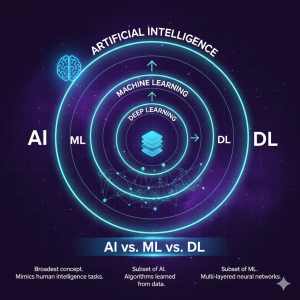
To understand the concept of ai vs machine learning vs deep learning, consider three concentric circles:
The outermost circle is AI: all systems that attempt to carry out intelligent tasks.
Inside that sits machine learning, a powerful subset of AI that learns from data.
Deep learning represents the most advanced and specialized form of learning by means of deep neural networks inside ML. In this hierarchy, every discussion of machine learning vs artificial intelligence reminds us: ML is a part of AI. And every time we talk about machine learning vs deep learning, we realize that DL is a specialized technique within ML. Not all AI is ML, and not all ML is deep learning.
Why Does This Distinction Matter?
You may wonder, why is it important to understand ai vs machine learning, or machine learning vs deep learning, or even machine learning vs artificial intelligence in daily conversation or in a business setting? Here are a few reasons:
1. Choosing the Right Tool for the Job
Knowing whether to choose a simple AI approach, a machine learning model, or a deep learning architecture makes all the difference when you are building an application. For example, if you have a small dataset, you probably don’t need deep learning at all. Understanding machine learning vs deep learning helps you make cost-effective and efficient decisions.
2. Resource Management
Deep learning models require more computational power and also more data. By understanding ai vs machine learning vs deep learning, you’d be able to budget correctly for infrastructure, data collection, and training time.
3. Talent and Skills
Hiring for an AI project means you need to know what kind of expertise to look for. Someone who can build a classical ML model may not be the same person who can architect a deep neural network. Recognizing machine learning vs artificial intelligence helps you to define roles clearly.
4. Explainability & Trust
In a lot of real-world applications, such as healthcare, finance, or autonomous driving, interpretability plays an important role. If you’re interested in a model whose decisions can be explained, then you’re likely to lean more on traditional machine learning rather than deep learning. For this reason, understanding machine learning vs deep learning becomes key in ethical and regulatory contexts.
5. Future Learning Path
Differentiating between ai vs machine learning, machine learning vs deep learning, and machine learning vs artificial intelligence helps students or professionals entering the field of AI to chart a clear career path. You may then make a decision to start with either ML, then move to DL, or to focus on other areas of AI.
Real-World Examples: AI vs. Machine Learning vs. Deep Learning
Let’s take a look at some concrete examples to show ai vs machine learning vs deep learning in action:
AI Example, Not Necessarily ML: A rule-based expert system does medical diagnosis: The doctors feed in symptoms and the system applies a rule set to suggest possible diseases. This is AI, but not necessarily ML because it may not learn from data.
Machine Learning Example: A bank utilizes an ML model, such as logistic regression or decision trees, to identify fraud on credit cards. The model is first trained on labeled data of transactions either as “fraud” or “not fraud” and learns patterns to make predictions on new transactions.
Deep Learning Example: An autonomous car utilizes deep learning-a convolutional neural network processing real-time camera images-to recognize pedestrians, traffic signs, and obstacles. Based on the recognitions, the AI system then makes decisions on what to do with the vehicle.
These examples clearly illustrate the difference in sophistication, complexity, and application between ai vs machine learning and machine learning vs deep learning.
Since the terms AI vs Machine Learning and Machine Learning vs Deep Learning are used very loosely, there are several common misconceptions that exist:
AI always means deep learning. Not true. AI can be simple rule-based systems, and deep learning is only one way to achieve AI; the confusion comes when people equate all smart systems with deep neural networks.
Machine learning and AI are the same. While closely related, they are not identical. More correct would be to say machine learning vs. artificial intelligence: ML is a subset of AI, not the same as AI.
Deep learning is always better. While powerful, DL is not always the best choice. For small and structured datasets, classical ML models often perform just as well or even outperform, and are more interpretable.
You don’t need to understand the difference. Understanding these distinctions is important in strategy, implementation, and resource planning, if one is dealing with AI professionally-be it as a developer, business leader, or a student.
How to Get Started with AI, ML, and DL
If you are excited about exploring ai vs machine learning or machine learning vs deep learning in a practical way, here are a few things you can do:
Learn the Basics of AI
Start with an introductory course on AI. Understand the broad goals, history, and types of AI: rule-based, symbolic, and data-driven.
Pick up Machine Learning Foundations
The student should learn about supervised and unsupervised learning, including reinforcement learning. Work on small projects using scikit-learn or similar libraries to understand how models are trained and evaluated.
Dive into Deep Learning
Once comfortable with ML, move to neural networks. Use frameworks such as TensorFlow, PyTorch, or Keras. Try to build simple deep learning models-for image classification or text-and then increase the complexity of those models.
Work on Projects
Apply to real-world problems with your knowledge, either in building small apps or data analysis projects or even mini AI products. This will help you have a deep understanding of ai vs machine learning vs deep learning.
Stay Current
AI, ML, and DL are continuously emerging fields. Reading blogs like Edureka, Global AI Vision, Coursera; attending webinars; and participating in AI communities keep you posted on latest developments and how the domain of machine learning vs artificial intelligence is shifting.
Conclusion: Why AI vs. Machine Learning vs. Deep Learning Matters
The terms ai vs machine learning, machine learning vs deep learning, and machine learning vs artificial intelligence might sound like interchangeable buzzwords. They are very different things, though, and understanding these differences is more than merely academic. AI is the broadest concept: machines behaving intelligently. Machine Learning is a potent subset of AI that learns from data rather than relying exclusively on hand-coded rules. Deep Learning is a subset of machine learning that leverages multi-layered neural networks to handle complex and high-dimensional data. Knowing what makes AI versus machine learning, or machine learning versus deep learning, different will help you choose the right technology, manage resources, and build smarter systems. Whether you are a student, developer, or business leader, this clarity will empower better decisions.
Frequently Asked Questions
AI is a general area of research in constructing intelligent systems, ML is a subfield of AI that learns itself from data, and DL is a deeper level form of ML that uses neural networks. This explanation clearly highlights the distinction between ai vs machine learning, machine learning vs deep learning, and the full machine learning vs artificial intelligence hierarchy.
AI creates intelligent behavior, while ML helps machines learn; deep neural networks are used by DL, and DS analyzes data to find insights. Understanding AI vs ML vs DL vs DS gives clarity on ai vs machine learning, machine learning vs deep learning, and also how machine learning vs artificial intelligence fits into the bigger picture.
ChatGPT represents an intersection of both AI and ML. It is an AI system because it performs tasks requiring human-like intelligence, such as understanding natural language and generating coherent responses. At its core, it uses a specific subset of ML called Deep Learning, which is designed to process vast amounts of data and improve over time.
ChatGPT is based on a neural network architecture called the Transformer, which excels at handling sequential data like text. This enables the model to generate human-like responses and engage in dynamic conversations. In essence, ChatGPT’s intelligence is derived from AI principles, while its ability to learn and adapt comes from ML technologies.
No, AI is the general term for intelligent machines, but ML is a subset that gives systems the ability to learn from data. This difference explains the core idea behind ai vs machine learning, highlights machine learning vs deep learning, and reinforces why machine learning vs artificial intelligence is not the same.
Dr. Sanjay Kulkarni
Data & AI Transformation Leader
Dr. Sanjay Kulkarni is a Data & AI Transformation Leader with over 25 years of industry experience. He helps organizations adopt data-driven and responsible AI practices through strategic guidance and education. With experience across startups and global enterprises, he bridges the gap between theory and real-world application. His work empowers teams to innovate and thrive in AI-driven environments.
Get Free Upskilling Guidance
Fill in the details for a free consultation
Related Courses
Explore our programs
Advanced Certificate Programme in Machine Learning, Gen AI & LLMs for Business Applications

 December 11, 2025
 11 min read




 ChatGPT
 Perplexity
 Claude
 Grok
Grok










 ROI Calculator