You Will Learn
Course Overview
In today’s data-driven world, SQL (Structured Query Language) is the universal language of data. From analysts and engineers to product managers and business leaders, the ability to query, manipulate, and interpret data is no longer optional — it is a fundamental professional skill.
This free, self-paced SQL course is designed to build proficiency from the ground up. Starting with core database concepts and progressing through advanced functions, window analytics, performance tuning, and interview-ready theory, learners gain both the technical depth and practical fluency that employers demand.
Built around PostgreSQL — one of the most widely adopted open-source databases — the course uses real-world case studies, step-by-step demonstrations, and curated exercises to ensure every concept is understood and applied, not just memorised.
Course Highlights
6 comprehensive modules covering beginner to advanced SQL
Hands-on installation, setup, and case study walkthroughs
Full coverage of Joins, Subqueries, Views, and Indexes
String, Mathematical, Date-Time, and Window Functions
Interview-ready topics: Normalisation, ACID compliance, Primary & Foreign Keys
8 performance optimisation tips for real-world query efficiency
100% free — no payment, no barrier to entry
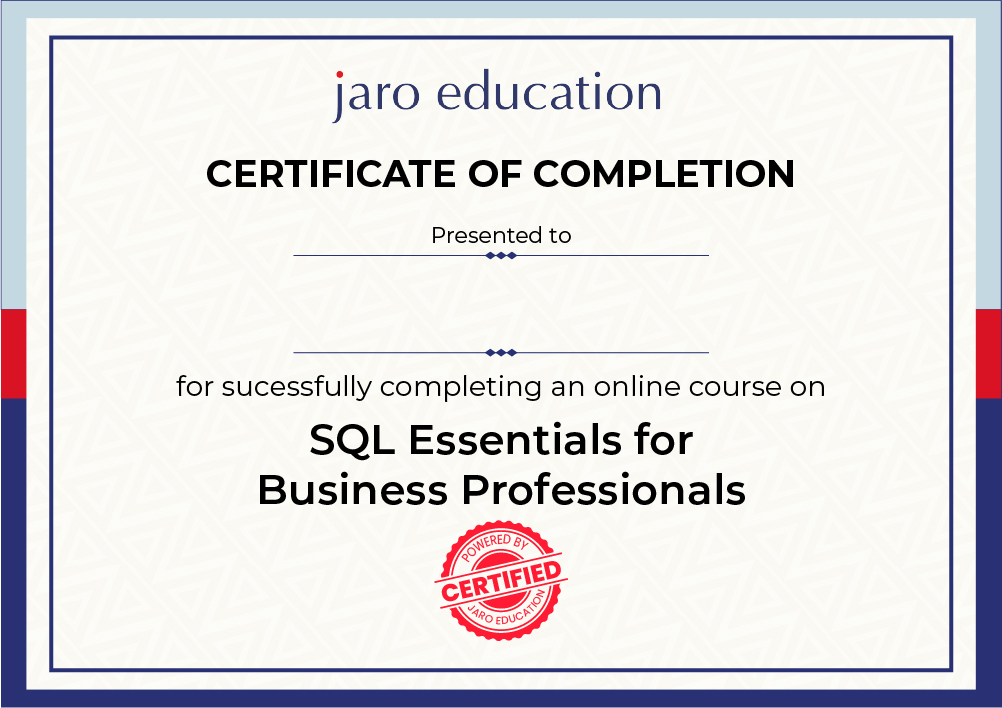
Earn Certificate

Verifiable ID
Unique ID for graduates.

LinkedIn Ready
Instantly shareable.

Global Standard
Recognized worldwide.

Digital & Print
High-res formats.
Our Students Work At Leading Companies





Social Proof of Excellence
Hear from over 10,000 professionals who have redefined their workflows with our expert-led program.
Why SQL Skills Matter
SQL remains the most in-demand data skill across industries. Here’s why learning it can change your career trajectory:
- SQL is consistently ranked the #1 most requested technical skill in data job postings globally, appearing in over 60% of data analyst and data engineer job descriptions.
- Professionals with demonstrated SQL proficiency earn significantly higher salaries — data analysts with SQL skills command up to 30% higher compensation than peers without it.
- According to Stack Overflow’s Developer Survey, SQL has been the most commonly used language for over a decade, used by more than 51% of professional developers worldwide.
- PostgreSQL — the database used in this course — was ranked the most admired and desired database for the third consecutive year, reflecting its industry relevance and community trust.
FAQs
This course is ideal for aspiring data analysts, business analysts, software developers, product managers, and anyone who works with data and wants to query, manipulate, and understand it using SQL. No prior technical background is required.
Perks of Jaro Learning

Expert Mentorship
Live sessions with industry leaders

Global Certificate
Industry-recognized credential

Career Support
Placement & portfolio guidance
ENROLL NOW
You Will Learn
Perks of Jaro Learning
Expert Mentorship
Live sessions with industry leaders
Global Certificate
Industry-recognized credential
Career Support
Placement & portfolio guidance