HOME > BLOG > AI and Machine Learning > Generative AI vs Agentic AI 2026: What Indian Professionals Need to Know for Their Career
AI and Machine Learning
Generative AI vs Agentic AI 2026: What Indian Professionals Need to Know for Their Career
J
By Shubham Lal
July 28, 202610 min read
Published on July 28, 2026
SHARE THIS ARTICLE
Table Of Content
Why AI Skills Matter More Than Ever in 2026
What Is Generative AI?
Popular Applications of Generative AI
What Is Agentic AI?
Artificial Intelligence (AI) has become one of the biggest drivers of innovation across industries. From automating repetitive tasks to generating creative content and making complex business decisions, AI is transforming the way organizations operate. In India, companies across IT, banking, healthcare, manufacturing, retail, education, and consulting are rapidly adopting AI technologies to improve efficiency, reduce costs, and enhance customer experiences.
Until recently, most discussions revolved around Generative AI, thanks to tools like ChatGPT, GitHub Copilot, Gemini, Claude, and Midjourney. These technologies demonstrated how AI could generate text, images, code, videos, and other forms of content in seconds. However, a new evolution of artificial intelligence is now gaining attention—Agentic AI.
Unlike traditional Generative AI, which primarily responds to user prompts, Agentic AI can plan, reason, make decisions, use multiple tools, and complete complex tasks with minimal human intervention. Industry experts believe Agentic AI will significantly reshape workplaces over the next few years, creating new career opportunities while changing existing job roles.
For students, working professionals, and business leaders in India, understanding the difference between Generative AI and Agentic AI is becoming increasingly important. This guide explores both technologies, compares their capabilities, discusses their impact on careers, and explains the skills professionals should develop to stay relevant in 2026 and beyond.
India is experiencing unprecedented growth in digital transformation. Organizations are investing heavily in automation, cloud computing, data analytics, cybersecurity, and AI-driven business solutions. Government initiatives promoting digital innovation and the rapid expansion of AI startups have further accelerated adoption across industries.
Companies are no longer looking only for professionals with domain expertise. They increasingly seek individuals who understand how AI can improve productivity, support decision-making, and drive innovation. Professionals who can effectively collaborate with AI tools are expected to enjoy better career prospects and higher earning potential.
This shift has created strong demand for expertise in both Generative AI and Agentic AI.
What Is Generative AI?
Generative AI refers toartificial intelligence systems designed to create new content based on user instructions or prompts. These systems are trained on massive datasets and use advanced machine learning models, particularly Large Language Models (LLMs), to generate human-like responses.
Depending on the prompt provided, Generative AI can produce written content, computer code, marketing campaigns, presentations, emails, reports, images, videos, music, and even software prototypes.
Unlike traditional automation tools that follow predefined rules, Generative AI creates original outputs by identifying patterns learned during training.
For example, a marketing professional can ask an AI assistant to draft a campaign strategy, while a software developer can generate code snippets to accelerate development. Similarly, designers can create visual concepts, and educators can prepare learning materials in significantly less time.
Generative AI acts as a creative and productivity assistant, helping professionals complete tasks faster while maintaining quality.
Popular Applications of Generative AI
Today, Generative AI is being used across almost every industry.
Agentic AI represents the next stage of artificial intelligence evolution.
Instead of simply responding to prompts, Agentic AI can independently understand goals, plan multiple steps, make decisions, interact with software systems, use external tools, monitor progress, and adapt based on changing conditions.
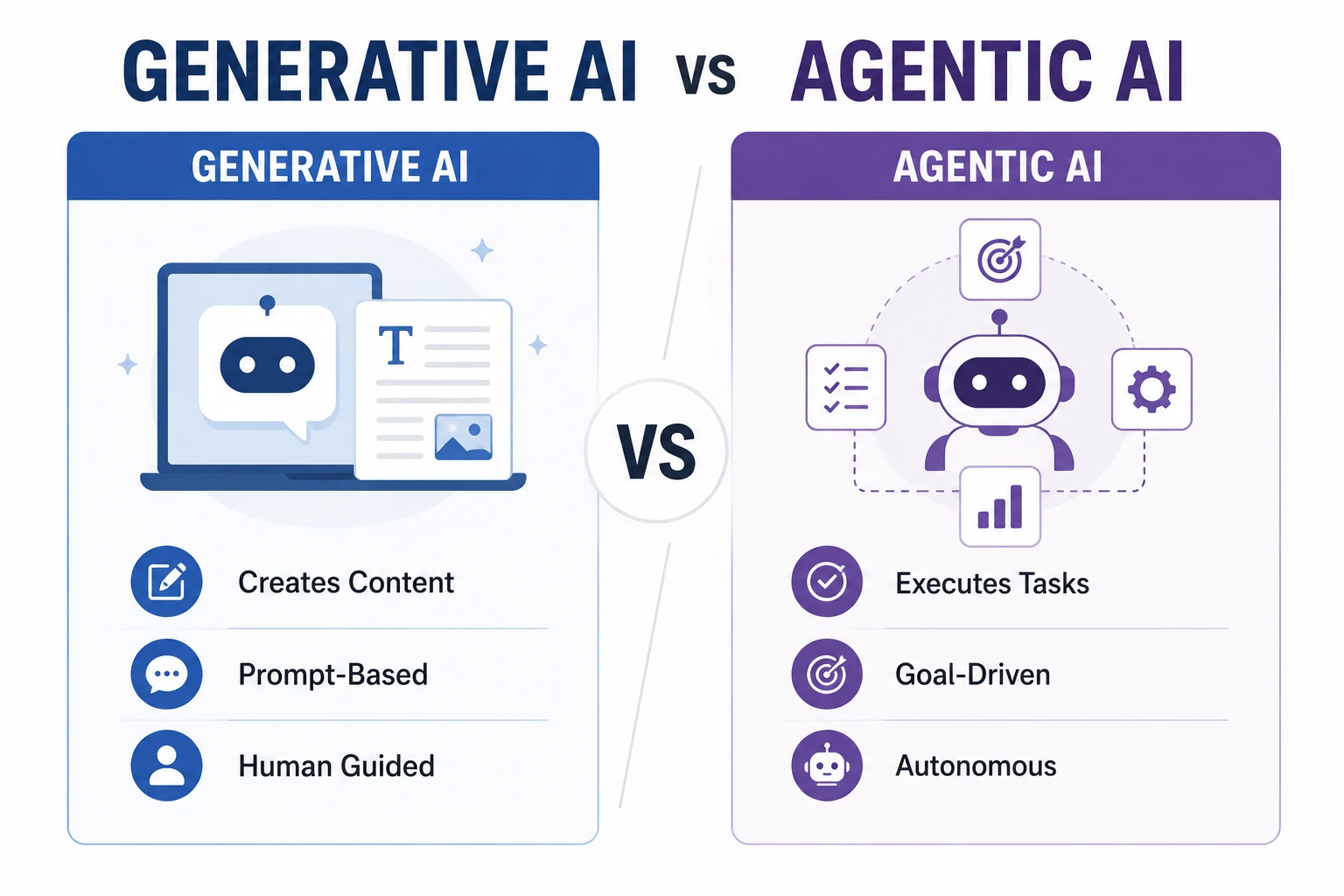
In simple terms, Generative AI creates content when instructed, whereas Agentic AI works toward achieving an objective.
For example, imagine asking an AI assistant to “plan a business conference.”
A Generative AI tool may generate a checklist or event proposal.
An Agentic AI system could go much further by:
researching venues,
comparing prices,
creating a budget,
scheduling meetings,
sending invitations,
coordinating vendors,
monitoring deadlines,
updating stakeholders,
and recommending improvements throughout the planning process.
This ability to execute multi-step workflows with minimal supervision makes Agentic AI significantly more powerful for enterprise applications.
How Agentic AI Works
Agentic AI combines several advanced capabilities that allow it to function almost like a digital teammate.
These include:
Goal understanding
Planning and reasoning
Decision-making
Memory
Tool integration
Continuous learning
Workflow automation
Context awareness
Instead of generating isolated responses, Agentic AI continuously evaluates situations and decides what action should be performed next.
This makes it particularly valuable for businesses managing complex operations involving multiple systems and stakeholders.
Generative AI vs Agentic AI: Key Differences
Although both technologies belong to the broader AI ecosystem, their capabilities and use cases differ considerably.
Feature
Generative AI
Agentic AI
Primary Purpose
Creates content
Completes goals and tasks
User Interaction
Prompt-based
Goal-based
Decision Making
Limited
Advanced
Planning Ability
Minimal
Multi-step planning
Autonomy
Low
High
Tool Integration
Basic
Extensive
Workflow Management
Limited
End-to-end
Human Supervision
Required frequently
Required occasionally
Business Applications
Content creation, coding
Business process automation
Complexity
Moderate
High
The biggest distinction lies in autonomy. Generative AI assists professionals, while Agentic AI collaborates with them by independently executing workflows.
Generative AI Use Cases Across Industries
Generative AI has already become an essential workplace tool.
Information Technology
Software developers use AI assistants for coding, debugging, documentation, and testing.
Marketing
Marketing teams generate advertisements, blogs, email campaigns, product descriptions, and social media content more efficiently.
Healthcare
Medical professionals summarize clinical records, prepare documentation, and support research activities.
Education
Teachers and trainers develop personalized learning materials, quizzes, assessments, and lesson plans.
Banking and Finance
Financial institutions use AI to generate investment reports, customer communication, compliance documentation, and financial summaries.
Agentic AI Use Cases Across Industries
Agentic AI extends beyond content creation by actively performing business operations.
Customer Service
AI agents can independently resolve customer issues by accessing databases, checking order status, processing refunds, and escalating cases only when necessary.
Supply Chain
Organizations use AI agents to monitor inventory, forecast demand, coordinate logistics, and optimize procurement decisions.
Human Resources
Agentic AI can shortlist candidates, schedule interviews, coordinate onboarding, and manage employee documentation.
Healthcare
Hospitals can automate appointment scheduling, patient follow-ups, treatment coordination, insurance verification, and resource allocation.
Why Indian Professionals Should Care About Agentic AI
The rise of Agentic AI is expected to transform how businesses operate. Rather than replacing employees, organizations will increasingly rely on professionals who know how to design, supervise, and collaborate with intelligent AI agents.
This shift will create demand for hybrid professionals who combine technical knowledge with business understanding. Companies will need experts who can define objectives, evaluate AI-generated outcomes, manage governance, ensure ethical AIusage, and optimize automated workflows.
As businesses continue adopting AI-powered systems, professionals who understand both Generative AI and Agentic AI will be better positioned for leadership roles in digital transformation initiatives.
Generative AI vs Agentic AI: Which One Should You Learn First?
For most professionals, Generative AI is the ideal starting point. It is easier to learn, widely accessible, and immediately applicable across roles such as marketing, software development, HR, finance, consulting, education, and operations.
Once you are comfortable using AI toolsfor productivity and content generation, learning Agentic AI becomes a logical next step. Understanding how AI agents plan, reason, and automate workflows can prepare you for advanced roles in AI strategy, automation, and enterprise transformation.
Rather than viewing these technologies as competing options, professionals should see them as complementary skills that together can significantly enhance career prospects in the evolving AI-driven workplace.
Career Opportunities in Generative AI and Agentic AI
The rapid adoption of artificial intelligence has created a wide range of career opportunities across industries. While Generative AI has already become an integral part of many organizations, Agentic AI is expected to drive the next wave of AI-enabled transformation.
Professionals who understand these technologies will find opportunities not only in technology companies but also in banking, healthcare, manufacturing, consulting, retail, logistics, education, media, and government organizations.
Career Opportunities in Generative AI
Generative AI is helping organizations improve creativity and productivity. As businesses continue integrating AI-powered tools into their workflows, the demand for professionals who can effectively leverage these technologies is increasing.
These professionals work on developing AI-powered applications, optimizing workflows, creating intelligent customer experiences, and improving organizational efficiency.
Agentic AI introduces an entirely new category of jobs focused on designing, managing, and governing autonomous AI systems.
Since AI agents can independently plan tasks, interact with software, and make decisions, organizations require skilled professionals who can develop and oversee these intelligent systems responsibly.
Emerging career roles include:
AI Agent Developer
Autonomous Systems Engineer
AI Automation Consultant
AI Workflow Architect
Multi-Agent Systems Engineer
Enterprise AI Strategist
AI Governance Specialist
Intelligent Process Automation Consultant
AI Operations Manager
AI Solutions Architect
As enterprises adopt Agentic AI at scale, these roles are expected to become increasingly common over the next few years.
Skills Professionals Should Learn in 2026
Whether you are a student, recent graduate, or experienced professional, developing AI-related skills can significantly improve your career prospects.
Skills for Generative AI
Professionals interested in Generative AI should focus on:
In addition to technical expertise, professionals must develop strong problem-solving and strategic thinking abilities, as Agentic AI often supports complex business operations.
Generative AI vs Agentic AI: Salary Trends in India (2026)
The demand for AI professionalscontinues to rise, resulting in competitive compensation across industries. Salaries vary depending on experience, technical expertise, organization, and location.
Experience
Generative AI Roles
Agentic AI Roles
Entry-Level
₹6–12 LPA
₹8–15 LPA
Mid-Level (3–6 Years)
₹12–22 LPA
₹18–30 LPA
Senior Professionals
₹25–45 LPA
₹30–60+ LPA
Leadership Roles
₹50 LPA–₹1 Crore+
₹60 LPA–₹1 Crore+
Since Agentic AI is still an emerging field with limited skilled talent, professionals with expertise in autonomous AI systems may command higher salaries in the coming years.
However, salary growth ultimately depends on practical experience, certifications, project exposure, and continuous learning.
Industries Hiring AI Professionals in India
Artificial intelligence is no longer limited to technology companies. Organizations across sectors are actively investing in AI to improve productivity, automate operations, and deliver better customer experiences.
Some of the major industries hiring AI talent include:
Companies are increasingly looking for professionals who understand not only AI tools but also how to apply them effectively to solve real-world business problems.
Can Generative AI and Agentic AI Work Together?
Absolutely.
Rather than competing technologies, Generative AI and Agentic AI complement each other.
Generative AI can create blog articles, email campaigns, advertisements, social media captions, product descriptions, and presentation content.
Agentic AI can then automate the entire campaign by scheduling posts, monitoring campaign performance, generating reports, responding to customer queries, coordinating with CRM platforms, and recommending optimization strategies.
Similarly, in software development:
Generative AI writes code.
Agentic AI manages testing, deployment, debugging, documentation, and monitoring.
In customer support:
Generative AI drafts responses.
Agentic AI resolves customer issues by interacting with business systems and executing workflows.
This collaboration between the two technologies will define the future of enterprise AI.
Which AI Should Students Learn?
Students entering the workforce should begin with Generative AI because it provides immediate practical value across almost every profession.
Learning prompt engineering, AI-assisted research, content generation, coding support, and productivity tools can significantly improve employability.
After building a strong foundation, students can explore Agentic AI concepts such as intelligent automation, AI workflows, and autonomous systems, which are expected to become increasingly important as organizations mature in their AI adoption.
A structured learning approach allows students to stay aligned with evolving industry requirements while preparing for future leadership roles in AI-driven organizations.
Which AI Should Working Professionals Learn?
For working professionals, the ideal learning path depends on current job responsibilities and career goals.
Professionals in marketing, HR, finance, operations, consulting, and customer service can immediately benefit from Generative AI by improving efficiency and reducing repetitive work.
Technology professionals, business leaders, product managers, and digital transformation specialists should additionally explore Agentic AI to understand how autonomous systems can optimize business processes and improve decision-making.
Learning both technologies enables professionals to remain competitive as AI becomes deeply integrated into enterprise operations.
The Future of AI Careers in India
The future of AI is not about replacing human professionals—it is about enhancing human capabilities.
Generative AI has already transformed content creation, software development, customer support, and business productivity. Agentic AI is expected to build on this foundation by introducing intelligent systems capable of planning, reasoning, and independently executing complex workflows.
As organizations embrace these technologies, the demand for professionals who can effectively collaborate with AI, supervise intelligent systems, and drive responsible AI adoption will continue to grow.
Professionals who invest in AI education today will be better prepared for the evolving workplace of tomorrow.
Conclusion
The discussion around Generative AI vs Agentic AIis not about choosing one technology over the other. Instead, it is about understanding how both technologies complement each other and how they will collectively shape the future of work.
Generative AI excels at creating content, accelerating creativity, and improving productivity through human-guided interactions. It has already become an essential tool across industries and is likely to remain a core workplace technology for years to come.
Agentic AI, on the other hand, represents the next evolution of artificial intelligence. By enabling autonomous planning, reasoning, decision-making, and workflow execution, it has the potential to transform enterprise operations and redefine how businesses function.
For Indian professionals in 2026, the most effective strategy is to build a strong foundation in Generative AI while gradually expanding expertise into Agentic AI. Combining technical knowledge with business understanding, ethical AI practices, and continuous learning will position professionals for long-term success in an increasingly AI-driven world.
Frequently Asked Questions
Generative AI creates content such as text, images, code, and videos based on user prompts, whereas Agentic AI goes beyond content generation by planning, reasoning, making decisions, and autonomously completing multi-step tasks to achieve specific goals.
For most professionals, Generative AI is the ideal starting point because it is widely adopted across industries and offers immediate practical applications. Learning Agentic AI afterward helps professionals prepare for advanced AI automation and enterprise transformation roles.
Agentic AI is expected to become a major advancement in enterprise AI by enabling intelligent systems to automate complex workflows. However, it is likely to complement rather than replace Generative AI, with both technologies working together in many business applications.
AI professionals are in demand across IT, banking, healthcare, manufacturing, retail, consulting, logistics, education, telecommunications, pharmaceuticals, and several other industries as organizations continue their digital transformation initiatives.
Yes. Many Generative AI tools are designed for users without programming expertise, making them accessible to professionals in marketing, HR, finance, sales, operations, and management. While Agentic AI concepts may involve greater technical depth, foundational knowledge can still benefit non-technical professionals looking to lead AI-driven projects or digital transformation initiatives.
Shubham Lal
Lead Software Developer
Shubham Lal joined Microsoft in 2017 and brings 8 years of experience across Windows, Office 365, and Teams. He has mentored 5,000+ students, supported 15+ ed-techs, delivered 60+ keynotes including TEDx, and founded AI Linc, transforming learning in colleges and companies.
Get Free Upskilling Guidance
Fill in the details for a free consultation
Related Courses
Explore our programs
Professional Certificate Programme in Gen AI, Agentic Systems & Intelligent Decision-Making
 HOME > BLOG > AI and Machine Learning > Generative AI vs Agentic AI 2026: What Indian Professionals Need to Know for Their Career
 July 28, 2026
 10 min read




 ChatGPT
 Perplexity
 Claude
 Grok
Grok








 ROI Calculator