What Is Agentic AI? (And How It Differs From Generative AI)
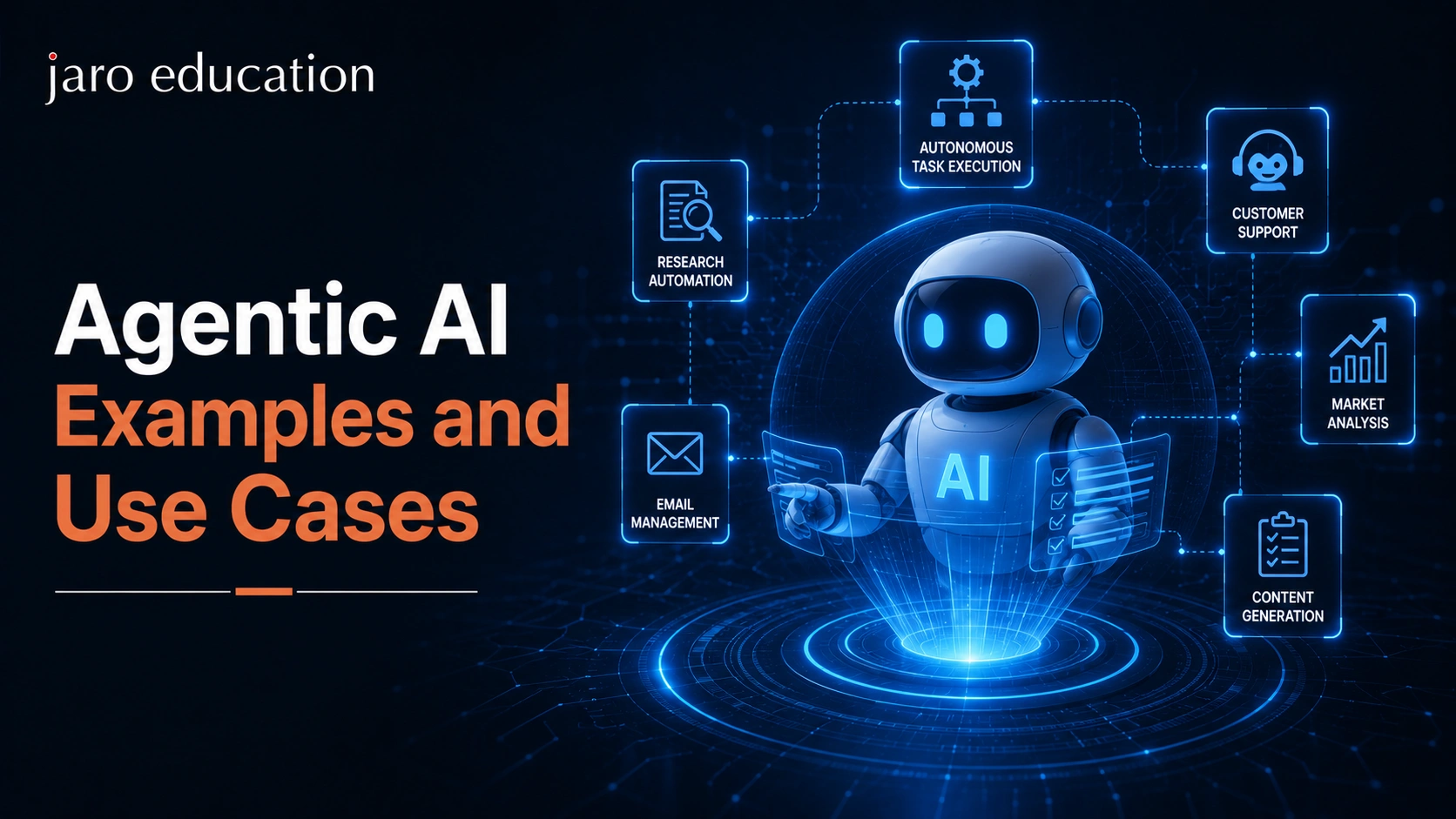
10 Real Agentic AI Examples in 2026
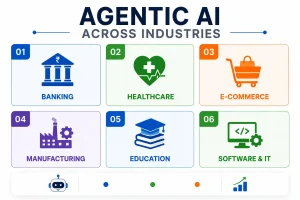
Agentic AI Use Cases by Industry
Top Agentic AI Frameworks in 2026
Agentic AI refers to AI systems that autonomously plan and execute multi-step tasks to achieve a goal — deciding which actions to take, using tools like search, code, and databases, observing results, and adjusting until the job is done. Real examples in 2026 include coding agents like Claude Code, customer service agents resolving most support tickets end-to-end, and finance agents automating research and reporting.
The difference from the chatbots of 2023 is fundamental: generative AIresponds — you ask, it answers. Agentic AI acts — you give it a goal, and it works. That shift from answering to doing is why agentic AI has become the defining enterprise technology story of 2026, why most large companies report deploying AI agents in some form, and why “can build and manage AI agents” now appears in job descriptions far beyond engineering.
This guide covers what agentic AI actually is, ten real examples you can point to today, use cases by industry and business function, the frameworks used to build agents, where the technology is heading, and how to build these skills yourself.
What Is Agentic AI? (And How It Differs From Generative AI)
An AI agent runs a loop: reason → act → observe → repeat. Given a goal, it breaks the task into steps, chooses tools (web search, code execution, database queries, APIs, file systems), executes them, evaluates the results, and continues — or asks a human — until the goal is met.
Generative AI (chatbot)
Agentic AI
Input
A prompt
A goal
Output
A response
A completed task
Steps
Single turn
Multi-step, self-directed
Tools
Usually none
Search, code, APIs, files, other agents
Human role
Asks every step
Sets goals, approves key actions
Example
“Draft a summary of this report”
“Monitor competitor pricing weekly and update our tracker”
Three building blocks make this work: an LLM as the reasoning engine, tools the model can call, and memory/state so the agent tracks progress across steps and sessions. Standards like the Model Context Protocol (MCP) — now adopted across the industry — let agents plug into thousands of tools and data sources in a uniform way.
1. Coding agents (Claude Code, GitHub Copilot agent mode, Cursor). The most mature example anywhere. Given a ticket like “add rate limiting to our API,” a coding agent reads the codebase, plans changes across multiple files, writes the code, runs the tests, fixes failures, and prepares the commit — with the developer reviewing rather than typing. Teams routinely delegate entire bug-fix and feature branches to agents.
2. Customer service agents. Fintech and e-commerce companies run agents that handle the majority of routine support conversations end-to-end — checking order status, processing refunds within policy, updating accounts — escalating to humans only for edge cases. Klarna’s agent famously did the work of hundreds of human agents; that pattern is now standard across the industry.
3. Deep research agents. Tools like Claude’s Research mode and equivalents from other labs take a question — “analyse the Indian edtech market’s shift toward AI upskilling” — and autonomously run dozens of searches, read sources, cross-check claims, and compose a cited report in minutes.
4. Browser and computer-use agents. Agents that operate software the way humans do — clicking, typing, navigating websites — to complete tasks like filling government forms, booking logistics, or migrating data between systems that lack APIs.
5. Sales and CRM agents. Agents that research a prospect across the web and LinkedIn, draft personalised outreach, log everything in the CRM, schedule follow-ups, and nudge deals forward — turning SDR work from manual to supervisory.
6. Financial analysis agents. Banks and funds deploy agents that pull filings and market data, update financial models, flag anomalies, draft investment memos, and run compliance checks — J.P. Morgan and peers run production agent workflows on frameworks like LangGraph.
7. IT and security operations agents. Agents that triage alerts, investigate incidents across logs, execute runbook steps, and open tickets with full context — cutting response times from hours to minutes while humans handle judgment calls.
8. Recruitment agents. Screening applications against role criteria, scheduling interviews across calendars, answering candidate questions, and keeping ATS records updated — the hiring pipeline’s repetitive layer, automated.
9. Marketing operations agents. Agents that monitor campaign performance across platforms, reallocate budgets within guardrails, generate creative variants, run SEO audits, and compile weekly reports — increasingly common in Indian digital teams.
10. Personal and knowledge-work agents. Tools like Claude Cowork bring agents to non-developers: point one at a folder of invoices to reconcile, a stack of resumes to shortlist, or a research task, and it works through the job on your desktop, asking when unsure.
Manufacturing & supply chain: Predictive maintenance scheduling, supplier communication, shipment tracking and exception handling.
Education: Personalised learning-path agents, admissions counselling assistants, grading support, student query resolution — a fast-growing area in Indian edtech.
Software/IT services: Code migration at scale, test generation, documentation upkeep, legacy system modernisation — directly relevant to India’s IT industry, where agentic delivery is reshaping project economics.
Top Agentic AI Frameworks in 2026
If you want to build agents, these are the frameworks that matter:
Framework
What it’s best at
LangChain + LangGraph
The industry standard: high-level agent API plus production-grade stateful orchestration (checkpoints, human-in-the-loop). Powers agents at Uber, Klarna, J.P. Morgan.
CrewAI
Fast multi-agent “crews” with role/task abstractions — great for prototypes.
Two supporting standards complete the stack: MCP (Model Context Protocol) for connecting agents to tools and data, and evaluation/observability platforms like LangSmith for testing agents before trusting them. For a hands-on build walkthrough, see our complete LangChain guide.
Beyond industries, agents map cleanly onto the functions inside every company:
Finance & accounting: Invoice processing and three-way matching, expense auditing, month-end close preparation, variance analysis with drafted commentary.
Human resources: Resume screening against role criteria, onboarding orchestration (accounts, equipment, training assignments), policy Q&A, attrition-signal monitoring.
Marketing: Continuous SEO auditing, competitor content monitoring, campaign reporting across GA4 and ad platforms, first-draft content pipelines with human editorial review.
Sales: Lead enrichment and scoring, meeting-note capture into CRM, proposal assembly from templates and pricing rules, renewal-risk flagging.
Operations: Vendor follow-ups, SLA monitoring with automatic escalation, data reconciliation between systems, report distribution.
The common thread: high-volume, rule-adjacent work with clear success criteria. That’s where agents deliver measurable ROI today — not in judgment-heavy, ambiguous work, which remains firmly human.
How to Spot Agentic AI Opportunities in Your Own Work
Before any framework or vendor conversation, run this five-question checklist against a task:
Is it repetitive? Done weekly or more often — the volume that justifies setup effort.
Are the steps describable? If you could write instructions for a new intern, you can specify it for an agent.
Is the data digital and accessible? Agents can’t act on information locked in someone’s head.
Is success checkable? A clear “done correctly” test enables verification and trust.
Is a mistake recoverable? Start with tasks where errors are cheap and reversible; add approval gates where they aren’t.
Score four or five yeses and you’ve found your pilot. This checklist is also, not coincidentally, the skill hiring managers now probe for: the ability to decompose work into agent-shaped pieces.
1. From single agents to agent teams. The frontier has moved to orchestration: supervisor agents delegating to specialist sub-agents (researcher, coder, reviewer), mirroring how human teams divide work.
2. Agents in the browser and on the desktop. Computer-use capability matured from demo to product — agents now operate real software, extending automation to the long tail of tasks without APIs.
3. Interoperability standards win. MCP’s industry-wide adoption means agents compose tools from different vendors instead of living in walled gardens — the “USB-C moment” for AI.
4. Governance and guardrails go mainstream. With autonomy comes risk; 2026’s enterprise conversation is about permissions, audit trails, human approval gates for consequential actions, and agent identity management. “Trust but verify” is now architecture, not advice.
5. The agentic workforce reshapes roles. Companies increasingly measure output in human+agent teams. The emerging premium skill isn’t doing the task — it’s specifying, supervising, and quality-controlling agents that do it. Analysts project a large share of enterprise software decisions will involve agentic capability by 2027–28.
6. ROI scrutiny replaces hype. After the pilot wave, leaders now demand measured outcomes; the winners deploy agents on narrow, high-volume workflows with clear metrics rather than open-ended “AI transformation.”
Challenges and Risks Worth Knowing
Agentic AI is powerful, not magic. Real deployments contend with: reliability (agents can take wrong actions confidently — hence approval gates for anything consequential), security (prompt injection: malicious instructions hidden in content the agent reads), cost control (multi-step loops consume far more tokens than chat), and accountability (who answers when an agent errs — a governance question every enterprise must settle). The practical pattern that works: start with agents that draft and recommend, graduate to act with approval, and only then to act autonomously on low-risk, reversible tasks.
Agentic AI Courses: How to Build These Skills
Demand for agentic AI skills has outrun supply, and the learning path depends on your starting point:
For a free start:Jaro Education’s free AI courses — Gen AI Tools and Applications and AI for Business Leaders — build the foundations in a few hours each, with certificates. Add Hugging Face’s free AI Agents course and LangChain Academy’s free LangGraph course for hands-on building.
For working professionals and leaders:Executive AI programmes from IIMs and IITs available through Jaro Education increasingly include generative and agentic AI modules — the credential route for managers who must evaluate, procure, and govern agent deployments rather than code them.
For aspiring builders: Combine a structured AI/ML certification (Python, machine learning, LLM applications) with project work: build one agent that automates a real task from your own job. That single portfolio piece — “I built an agent that does X, here’s the before/after” — outperforms any list of course names in interviews.
The window matters: agentic AI skills are today where data science skills were a decade ago — scarce, premium-priced, and about to become table stakes.
The Bottom Line
Agentic AI is the shift from AI that talks to AI that works — and 2026 is the year it moved from pilots to production across coding, support, finance, and operations. The examples above aren’t previews; they’re deployed systems reshaping how work gets divided between humans and machines. For professionals, the implication is direct: the valuable skill is no longer competing with agents at tasks, but directing them at goals. Start free with Jaro Education’s AI courses, build one working agent, and consider an IIM/IIT AI certification when you’re ready to make it a career edge.
Frequently Asked Questions
Claude Code is a clear example: given a goal like “fix this bug,” it autonomously reads the codebase, plans changes, edits files, runs tests, and iterates until the fix works — a multi-step task completed with minimal human input. Customer service agents that resolve tickets end-to-end are another everyday example.
Generative AI produces content in response to prompts (one question, one answer). Agentic AI pursues goals — planning multiple steps, using tools, and acting on systems until the task is complete. Agentic systems use generative models as their reasoning engine.
Base ChatGPT is generative — it responds to prompts. But modern assistants including ChatGPT and Claude now have agentic modes (deep research, computer use, task execution) that plan and act autonomously, so the line runs through capabilities, not brand names.
LangChain with LangGraph is the industry standard for production agents; CrewAI is popular for quick multi-agent prototypes; no-code platforms like n8n suit non-programmers. Choose based on how much control and reliability you need.
Agent engineers, AI workflow designers, agent operations/supervision roles, and AI governance specialists — plus a broad premium for professionals in every function who can direct and quality-control agents.
Start with free foundational AI courses (Jaro Education’s free courses section is a good first stop), learn basic Python if you want to build, then follow a hands-on agent framework course and build one real automation. Structured IIT/IIM AI certifications add depth and credentials.
Dr. Sanjay Kulkarni
Data & AI Transformation Leader
Dr. Sanjay Kulkarni is a Data & AI Transformation Leader with over 25 years of industry experience. He helps organizations adopt data-driven and responsible AI practices through strategic guidance and education. With experience across startups and global enterprises, he bridges the gap between theory and real-world application. His work empowers teams to innovate and thrive in AI-driven environments.
Get Free Upskilling Guidance
Fill in the details for a free consultation
Related Courses
Explore our programs
Admission Open
Advanced Certification Programme in Generative AI & Large Language Models

 July 18, 2026
 8 min read




 ChatGPT
 Perplexity
 Claude
 Grok
Grok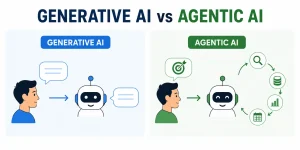


 Admission Open

 Admission Open
 Admission Closed
 Admission Open
 ROI Calculator