Agentic AI vs Generative AI: Key Differences, Use Cases, and Examples
J
By Dr. Sanjay Kulkarni
March 11, 20268 min read
Last updated on March 18, 2026
SHARE THIS ARTICLE
Table Of Content
Agentic AI Meaning
Generative AI Meaning
Agentic AI vs Generative AI: Core Conceptual Differences
Agentic AI Examples Across Industries
AI is no longer just a tool that answers questions or writes emails. It is slowly moving from “assistive” to "decisive". And that shift changes everything. You’ve probably heard about generative AI. It writes blogs, creates images, and codes apps. But now there’s another term entering serious conversations: agentic AI.
Understanding agentic AI vs generative AI isn’t just a technical comparison now. It’s a strategic one. One creates outputs. The other takes actions and decides. This distinction will define how businesses design their AI systems in the coming years.
Artificial intelligence systems that can set objectives, plan actions, make judgments, act, and adjust based on results with little assistance from humans are referred to as agentic AI.
Think of it this way:
Generative AI writes an email when you ask.
Agentic AI decides who should receive the email, drafts it, schedules it, monitors replies, and adjusts follow-ups based on engagement.
That’s a completely different level of capability. Agentic AI systems are goal-driven. They don’t wait passively for instructions. Instead, they’re given an objective. From there, they determine the sequence of actions needed to achieve it. Sometimes they use tools. Sometimes they query databases. Sometimes they call APIs. And importantly, they evaluate whether what they did actually worked.
There are four defining traits of agentic AI:
Autonomy: It can operate independently after being assigned a goal.
Planning Ability: It breaks down complex tasks into multi-step workflows.
Tool Usage: It interacts with external systems, not just text prompts.
Feedback Loops: It tracks outcomes and adjusts activities as necessary.
This is not traditional automation. Traditional automation follows fixed rules. Agentic AI meaning is that it evaluates context dynamically. It can shift strategies. That flexibility is what makes it powerful.
Businesses are paying attention because agentic AI doesn’t just assist employees. It can potentially replace entire process chains. A sales agentic system, for example, could identify leads, craft outreach, optimize messaging, analyze response patterns, and adjust targeting, continuously. And yes, that sounds futuristic. But early-stage implementations are already happening.
Now let’s zoom out and revisit generative AI, because the comparison matters. Generative AI is designed to create content. Text, images, code, audio, video. It learns patterns from massive datasets and predicts the most probable next output based on a prompt.
If you ask it to write a product description, it generates one. If you ask it to create an image, it does. If you give it code instructions, it produces code. It’s reactive. That’s the keyword.
Generative AI responds when prompted. It doesn’t independently decide to act. Here’s what generative AI does exceptionally well:
But it stops at generation. Even advanced chatbots powered by generative AI still operate in a prompt-response loop. They don’t autonomously initiate new workflows or evaluate strategic outcomes unless embedded inside a broader agentic system.
So when comparing agentic AI vs generative AI, the distinction is not about intelligence levels. It’s about behavioral structure.
Generative AI is like a highly skilled specialist waiting for instructions. Agentic AI is like a manager who decides what needs to be done and delegates tasks, sometimes even to generative models.
Agentic AI vs Generative AI: Core Conceptual Differences
*bigid.com
Let’s get clearer. The real difference between agentic AI and generative AI lies in decision authority.
Generative AI answers. Agentic AI acts. Generative AI produces content based on probabilities. Agentic AI evaluates goals, chooses strategies, and executes plans. This changes how systems are architected.
In a generative setup:
User provides a prompt
Model generates output
Human decides what to do next
In an agentic setup:
System is assigned a goal
It plans subtasks
It selects tools
It executes steps
It measures results
It iterates until objective is achieved
Notice the loop. That loop is everything.
Another difference in the agentic AI vs generative AI debate is adaptability. Generative AI adapts within a conversation. Agentic AI adapts within an environment.
For example:
A generative model might rewrite marketing copy five ways.
An agentic system might launch five campaigns, analyze performance metrics, reallocate budget automatically, and refine targeting without human direction.
However, agentic AI often uses generative AI inside it. Generative models become tools within a broader decision-making framework. So it’s not necessarily a competition. It’s evolution.
Still, organizations that treat generative AI as fully autonomous risk overestimating its capability. It doesn’t manage. It assists.
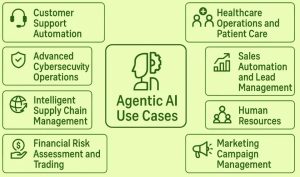
Agentic AI Examples Across Industries
*dextralabs.com
To make this practical, let’s explore real-world agentic AI examples.
1. Autonomous Customer Support Agents
Instead of a chatbot that answers queries, an agentic support system can:
Identify customer sentiment
Escalate cases proactively
Issue refunds automatically
Schedule callbacks
Monitor satisfaction metrics
It doesn’t just respond. It resolves.
2. AI Marketing Campaign Managers
An agentic AI marketing system could:
Analyze audience segments
Generate ad creatives (using generative AI)
Launch campaigns
Track CTR and conversion rates
Reallocate budgets dynamically
Pause underperforming ads
No constant supervision required.
3. Financial Portfolio Management Agents
In finance, agentic AI systems can:
Monitor market conditions
Adjust asset allocations
Execute trades based on predefined risk strategies
Continuously optimize performance
They’re not merely predicting. They’re acting within constraints.
4. Operations Optimization Agents
Manufacturing and logistics companies are testing systems that:
These agentic AI examples demonstrate that autonomy is not about replacing humans entirely. It’s about compressing decision cycles. Speed becomes a competitive advantage.
Now let’s ground this again in generative AI use cases. Generative AI dominates creative and cognitive assistance roles:
Writing reports and blogs
Generating code snippets
Creating design mockups
Drafting legal summaries
Producing product descriptions
It accelerates content velocity. It enhances productivity. A marketing team might use generative AI to create 20 variations of email copy. A developer might use it to debug code faster. HR teams might draft job descriptions in minutes instead of hours.
These are massive efficiency gains. But generative AI alone does not launch campaigns. It does not decide hiring strategies. It does not evaluate quarterly KPIs autonomously. That boundary matters.
When to Choose Agentic AI vs Generative AI
Now comes the real question: Where do you actually use this in business?
Because honestly, most companies right now are experimenting without clarity. They plug in generative tools, automate a few emails, maybe build a chatbot… and call it AI transformation. That’s surface-level. The deeper shift depends on whether you need output creation or outcome ownership. That’s the dividing line in the agentic AI vs generative AI decision.
Use Generative AI When You Need Speed, Scale, and Creative Output
If your core problem is content bottleneck, ideation fatigue, repetitive documentation, or code drafting, generative AI is your weapon. It thrives in environments where:
The task is well-defined
Human review is expected
The output itself is the goal
For example, if your team spends 30 hours a week writing proposals, generative AI cuts that time drastically. But it won’t decide which proposals to send. It won’t qualify the leads. It won’t negotiate. It assists; it doesn’t steer.
And that’s fine. Not every system needs autonomy. In fact, forcing agentic architecture where simple generative support works is overengineering. It increases risk, cost, and complexity unnecessarily. Sometimes you don’t need a self-driving car. You just need a better engine.
Use Agentic AI When You Need End-to-End Goal Execution
Now flip the scenario. Imagine you run performance marketing across five regions. Campaigns change weekly. Budgets shift daily. Competitors react instantly. Human monitoring becomes slow. This scenario is where agentic AI starts making sense. Because you’re not asking for content. You’re asking for results.
Agentic systems are appropriate when:
The objective is measurable
The workflow is multi-step
Real-time decisions matter
Iteration is continuous
Human intervention slows performance
Operations, logistics, trading, dynamic pricing, and cybersecurity monitoring: these domains benefit from systems that act, not just suggest. But here’s the catch. Agentic AI is not “plug and play”. It requires guardrails. Clear goals. Defined constraints. Governance frameworks. Without those, autonomy becomes unpredictability. And unpredictability at scale is dangerous.
How Agentic and Generative AI Work Together
Here’s something practical. The debate isn’t about choosing one permanently. Most powerful systems will combine both. Agentic frameworks often use generative models internally. For example: An AI sales agent might:
Identify leads (analytics engine)
Draft personalized outreach (generative AI)
Schedule follow-ups (automation tools)
Adjust messaging strategy based on open rates (decision engine)
Generative AI becomes a tool inside the agentic system. So instead of thinking, “Which should we adopt?” A more mature question is: Where does generative intelligence stop, and where does autonomous decision-making begin? Draw that boundary carefully.
Besides, here’s a straightforward way to think:
Choose Generative AI if:
You want faster creation
Humans remain in the loop
The task is mostly cognitive or creative
The risk of output errors is manageable
Choose Agentic AI if:
You want measurable goal completion
The system must act across platforms
Speed of decision is critical
Continuous optimization matters
And if you’re unsure, start generative. Build comfort. Understand limitations. Then layer autonomy gradually. Jumping straight to full agentic architecture without internal AI maturity? That’s where projects fail.
Knowing the difference between generative systems and agentic AI is useful. But applying that knowledge in real business environments requires structured learning and the right exposure. This is where Jaro Education fits naturally into the conversation.
For professionals who want to understand how modern AI systems are designed, deployed, and governed, the Online MSc in AI builds strong technical and strategic foundations. It goes beyond surface-level tools and focuses on how intelligent systems actually function inside enterprises.
For leaders who need clarity without going too deep into code, the AI for Business Leaders is a free course that explains how AI drives measurable business outcomes. It helps decision-makers assess where generative AI is enough and where agentic AI can create real impact.
One strengthens execution capability. The other sharpens strategic thinking. Both matter in a world where AI is moving from assistance to autonomous action.
Recommended free courses are:
Free Courses
Stakeholder Communication & Negotiation Skill Sets
A lot of hype exists right now. Every platform claims autonomy. Every tool says it’s “agentic.” But true agentic AI isn’t just a chatbot with workflow automation attached. It’s structured around goals. It makes independent choices. It evaluates impact. It adjusts. That’s a serious capability.
And organizations that understand the structural difference between generative systems and agentic systems won’t just adopt AI for efficiency. They’ll redesign decision-making models entirely.
Frequently Asked Questions
Not exactly “more advanced,” just built differently. Agentic AI handles goals and actions, generative AI focuses on creating outputs.
Beyond basic AI literacy, you need system thinking, data interpretation skills, and an understanding of automation workflows. It’s less about just prompting and more about designing decision loops.
Not replace, but reshape it. Leaders will shift from making every decision to defining guardrails, goals, and accountability structures.
For efficiency gains, yes. For autonomous optimization and continuous performance improvement, usually not. That’s where agentic frameworks start becoming relevant.
Dr. Sanjay Kulkarni
Data & AI Transformation Leader
Dr. Sanjay Kulkarni is a Data & AI Transformation Leader with over 25 years of industry experience. He helps organizations adopt data-driven and responsible AI practices through strategic guidance and education. With experience across startups and global enterprises, he bridges the gap between theory and real-world application. His work empowers teams to innovate and thrive in AI-driven environments.
Get Free Upskilling Guidance
Fill in the details for a free consultation
Related Courses
Explore our programs
Admission Closed
Executive Certification in Advanced Data Science & Gen AI for Managers
 HOME > BLOG > AI and Machine Learning > Agentic AI vs Generative AI: Key Differences, Use Cases, and Examples
 March 11, 2026
 8 min read




 ChatGPT
 Perplexity
 Claude
 Grok
Grok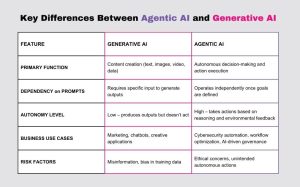





 Admission Closed
 Admission Closed
 Admission Open
 ROI Calculator