The AI Job Market in 2026: What’s Actually Changing
Core Categories of AI Skills You Must Build
Technical AI Skills in Demand for 2026
Data-Centric AI Skills That Power Every Model
In 2026, the conversation isn’t around who knows AI; it is now taking a turn towards who knows how to use AI meaningfully. Companies are already done hiring people who just “understand AI at a high level". What they want now are professionals who can apply AI skills to real business problems, work alongside intelligent systems, and make decisions faster, better, and with more confidence.
That’s the shift. Whether you’re a working professional, a manager trying to stay relevant, or someone planning a strategic career pivot, building the right AI skills is no longer optional. But here’s the catch: not all AI skills are worth your time.
This guide breaks down the AI skills in demand for 2026 that actually matter, along with the information on how to develop AI skills and how different professionals should think about skill-building in the AI era.
The AI Job Market in 2026: What’s Actually Changing
*finalroundai.com
In the last few years, AI moved from research labs to production environments. By 2026, most organisations won’t be asking if they should use AI. They’ll be asking why their AI initiatives aren’t delivering ROI. And that question changes the skill demand dramatically.
Purely theoretical AI knowledge is losing ground. On the other hand, professionals who combine AI skills with data understanding, business context, and execution ability are becoming hard to replace.
A few clear shifts are already visible:
AI roles are becoming hybrid, not isolated
Companies prefer problem-solvers over tool experts
Decision-makers want AI-literate teams, not black-box models
Automation anxiety exists, yes but the real story is augmentation. AI is replacing repetitive effort, not strategic thinking. The professionals who thrive are those who know how to work with AI systems, not compete against them.
This is why “skills for AI” now go beyond coding. Understanding models is useful. Understanding where and when to use them is critical.
One of the biggest mistakes people make is treating AI skills as a single bucket. They’re not. High-impact AI capability is layered. Think of it less like a checklist and more like a skill stack. By 2026, employers will evaluate AI readiness across four broad categories:
Technical AI skills: how AI systems are built and deployed
Data-centric AI skills: how data feeds intelligence
Business and strategic AI skills: how AI drives outcomes
Human-centric and ethical AI skills: how AI is governed and trusted
You don’t need mastery in all four. But you do need relevance in at least two, aligned to your role. Let’s break these down, starting with the most misunderstood category.
Technical AI Skills in Demand for 2026
Technical AI skills still matter. But not in the way social media makes them sound. The market is moving away from “who knows the most algorithms” toward “who understands the full AI lifecycle.” Depth beats breadth here. Employers are less impressed by long tool lists and more interested in how you think about models, data, and deployment.
1. Machine Learning & Deep Learning Foundations
Despite the noise around generative AI, machine learning fundamentals remain non-negotiable. Concepts like supervised vs unsupervised learning, model evaluation, overfitting, and bias are still core AI skills. Why? Because tools change. Foundations don’t.
By 2026, professionals who lack ML fundamentals will struggle to debug, adapt, or scale AI systems. Even non-developers benefit from understanding how models learn and fail. It improves decision-making and reduces blind trust in outputs.
2. Generative AI & LLM Proficiency
This is where demand has surged and will continue to surge. Generative AI is moving from experimentation to enterprise workflows. That means prompting alone is not enough anymore. High-demand AI skills now include:
Designing structured prompts for repeatable outcomes
Knowing when fine-tuning makes sense and when it doesn’t
By 2026, GenAI literacy will be a baseline expectation across roles, not a niche advantage. Professionals who can operationalise large language models rather than just “play” with them will stand out.
3. AI Model Deployment & MLOps
This is where many AI initiatives quietly fail. Building a model is one thing. Deploying, monitoring, and maintaining it in production is another. As organisations scale AI usage, skills around MLOps are becoming increasingly valuable. These include:
Model versioning and monitoring
Performance decay detection
Retraining pipelines
Scalability and reliability
You don’t need to be an infrastructure expert. But understanding how models live beyond notebooks is a serious career advantage.
4. Programming for AI
Python continues to dominate AI development, but the skill isn’t just writing code. It’s knowing how to use programming as a thinking tool. By 2026, high-demand professionals will:
Integrate APIs into workflows
Work comfortably with AI frameworks
Understand how modular, reusable AI systems are built
Programming here is less about elegance and more about effectiveness.
Data-Centric AI Skills That Power Every Model
Here’s an uncomfortable truth: most AI problems are actually data problems. You can have the best model in the world, and it’ll still fail if the data feeding it is flawed. That’s why data-centric AI skills are rising fast in demand and quietly commanding premium roles.
1. Data Engineering & AI Pipelines
AI systems are only as good as their pipelines. Skills around data collection, cleaning, transformation, and integration are becoming essential. In 2026, organisations will prioritise professionals who understand:
How data flows through AI systems
Real-time vs batch data relevance
Data reliability and traceability
This isn’t glamorous work. But it’s high-impact.
2. Analytical Thinking & Statistical Intuition
AI doesn’t replace analysis, it amplifies it. Professionals with strong statistical intuition can:
Question model outputs intelligently
Identify misleading correlations
Translate insights into decisions
This is where AI skills intersect with business judgment. And this intersection is where career acceleration happens.
Business & Strategic AI Skills That Separate Operators from Leaders
*thestrategyinstitute.org
Here’s where many technically strong professionals hit a ceiling.
By 2026, organisations won’t struggle to find people who can build AI models. They’ll struggle to find people who can decide what should be built in the first place. That’s why business and strategic AI skills are climbing the demand curve fast. These skills don’t replace technical knowledge; they multiply its value.
1. Translating Business Problems into AI Use Cases
This is one of the most underrated AI skills in demand.
Most failed AI projects don’t fail because the model was bad. They fail because the problem was framed poorly. Professionals who can convert messy, real-world challenges into solvable AI use cases become indispensable.
This includes:
Identifying where AI adds leverage (and where it doesn’t)
Defining success metrics beyond “model accuracy”
Knowing when a simple rule-based system beats a complex model
In 2026, the ability to say “AI is not the right solution here” will be just as valuable as knowing how to implement one.
2. AI Product Thinking & ROI Awareness
AI is moving into boardroom conversations. And once that happens, ROI becomes unavoidable.
High-impact professionals understand:
Build vs buy trade-offs for AI tools
Cost of maintenance, retraining, and failure
How AI fits into broader product and growth strategies
This is especially relevant for managers, consultants, and product leaders. You don’t need to code models but you do need to understand what makes AI initiatives succeed commercially.
3. Decision-Making with AI, Not Delegation to AI
There’s a subtle but critical difference here. Strong professionals use AI to support decisions, not replace judgment. By 2026, blind reliance on AI outputs will be seen as a risk, not efficiency. Strategic AI skills include:
Interpreting outputs with context
Asking the right follow-up questions
Knowing when human override is essential
This is where leadership and AI literacy intersect.
Human-Centric & Ethical AI Skills
Ethical AI is often treated like a checkbox topic. That’s a mistake. As AI adoption scales, trust becomes currency. And trust is built or broken by how responsibly AI systems are designed and deployed.
1. Responsible AI & Governance
Regulation around AI will only increase post-2026. That means skills related to governance, compliance, and transparency won’t stay niche for long. Professionals who understand these will be in demand across industries, not just regulated ones. So, you must know:
Bias detection and mitigation
Explainability and auditability
Data privacy implications
Even a working-level understanding of responsible AI principles can set you apart in interviews and leadership discussions.
2. Human–AI Collaboration
The future isn’t human vs machine. It’s human + machine.
AI handles scale. Humans handle judgment, creativity, and nuance. Professionals who design workflows that respect this balance will outperform those who try to automate everything.
This includes:
Knowing which tasks to automate
Designing review and feedback loops
Keeping humans meaningfully “in the loop”
It’s a subtle skill, but one that organisations actively look for, even if they don’t always articulate it clearly.
3. Communicating AI Outputs to Non-Technical Stakeholders
This is where many AI professionals quietly struggle. If you can’t explain what your model is doing and why it matters to a non-technical audience, your impact remains limited. By 2026, communication will become a core AI skill, not a soft add-on. Clear explanations build trust. Trust drives adoption.
How to Develop AI Skills Strategically
Learning AI randomly, jumping from tool to tool, creates confusion and not capability. If your goal is relevant in 2026, skill development needs structure.
1. Stop Chasing Tools, Start Building Depth
Tools evolve faster than curriculum. What lasts are concepts, frameworks, and mental models. Instead of asking, “What tool should I learn next?” you should ask, “What problem am I trying to solve better with AI?” That shift alone saves months of wasted effort.
2. Learn AI by Solving Real Problems
Courses are useful. Projects are transformative. Real-world exposure teaches you:
Trade-offs
Constraints
Imperfect data realities
Even small internal projects or self-initiated experiments matter more than stacked certifications with no application.
3. Balance Structured Learning with Hands-On Practice
Self-learning works until it doesn’t. By 2026, professionals who combine these elements will build AI skills faster and with more confidence than solo learners trying to “figure it out” endlessly.:
Guided programs
Mentorship
Practical labs
Peer learning
4. Build an AI Skill Stack (Not a Skill List)
Your stack should align with where you are in your career, not where influencers say you should be.
How We at Jaro Education Support AI-Focused Upskilling
At Jaro Education, we offer a wide range of upskilling programmes designed for professionals at different career stages. Our focus is simple: help working professionals build relevant, future-ready skills without stepping away from their careers.
We also provide free courses to help learners explore foundational concepts before committing to advanced learning paths. Basically, whether you’re exploring AI for the first time or looking to deepen your expertise, we’re here to help you move forward with clarity and confidence. So, are you ready to take the next step? Contact us now!
The future doesn’t belong to people who “know AI.” It belongs to people who use AI intelligently. As 2026 approaches, the most valuable AI skills will be those that sit at the intersection of technology, data, business, and human judgment.
So, if you build AI skills with intention, aligned to your role, your goals, and real-world problems, you won’t just stay relevant. You’ll become hard to replace. And that’s the real advantage.
Frequently Asked Questions
Right now, it’s a mix of generative AI + data understanding. People who can actually use AI models for real problems (not just talk about them) are getting picked faster.
Applied AI, things like machine learning for business, GenAI, analytics, and automation. Pure research roles exist, but industry wants impact, not papers.
Short answer: yes. Roles that combine AI skills with domain knowledge usually pay more than generic tech jobs, especially at mid to senior levels.
You’ll need basics like data handling and ML concepts, plus problem-solving and business thinking. Also, soft skills for AI jobs matter more than people admit.
They can, but only if you show how you apply them. Tools alone won’t land offers, real use cases and projects usually do.
Dr. Sanjay Kulkarni
Data & AI Transformation Leader
Dr. Sanjay Kulkarni is a Data & AI Transformation Leader with over 25 years of industry experience. He helps organizations adopt data-driven and responsible AI practices through strategic guidance and education. With experience across startups and global enterprises, he bridges the gap between theory and real-world application. His work empowers teams to innovate and thrive in AI-driven environments.

 March 8, 2026
 9 min read





 ChatGPT
 Perplexity
 Claude
 Grok
Grok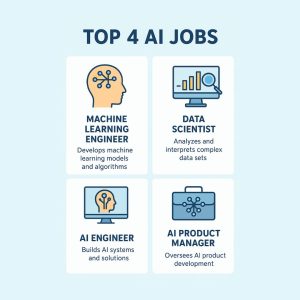



 Admission Closed
 Admission Closed
 Admission Closed

 Admission Open

 ROI Calculator




