Why Generative AI is Creating New Careers in Ethics, Risk, and Governance
J
By Dr. Sanjay Kulkarni
March 3, 20267 min read
Last updated on August 31, 2026
SHARE THIS ARTICLE
Table Of Content
The Emergence of Generative AI and Its Organizational Significance
Why Ethics and Governance are Important in Generative AI
How Regulation Is Shaping AI Risk and Compliance Careers
The Evolution of AI Ethics Jobs
The fast-paced development of artificial intelligence is transforming industries, redefining workflows, and changing the way decisions are made in organizations. Among the most revolutionary technologies is Generative AI, which has progressed from the prototype phase to widespread adoption in the enterprise. Although the spotlight has been on technical professionals, an equally significant shift is underway for professionals in the field of generative AI ethics, governance, and oversight.
As generative AI impacts the recruitment process, credit scoring, healthcare diagnosis, marketing personalization, and legal matters, the need for accountability in organizations has increased. This has led to the need for professionals who can incorporate ethics and governance into AI systems, from development to implementation. As a result, a new generation of AI ethics careers, AI governance careers, and AI risk and compliance careers is being developed worldwide.
This blog post examines why the need for careers in generative AI ethics, governance, and oversight is being created, what these careers entail, and how professionals can adapt to this new field.
The Emergence of Generative AI and Its Organizational Significance
Generative AI technologies, including large language models, image generation models, and autonomous agents, have the ability to generate content, predictions, and decisions with very little human intervention. This is the first time in history that such a capability has been achieved, and it is revolutionizing the way productivity, innovation, and decision-making are accomplished. With organizations embracing these technologies, the scope of careers in generative AI is no longer restricted to data scientists and engineers.
But at the same time, generative AI also presents new risks, including bias amplification, misinformation, privacy issues, and decision transparency. These risks underscore the pressing need for ethics and governance frameworks that ensure responsible use. If not managed properly, decisions made by AI systems can cause harm to individuals, erode brand trust, and put organizations at risk of legal repercussions.
It is this very reason that AI ethics careers, as well as AI risk and compliance careers, are becoming increasingly strategic.
Why Ethics and Governance are Important in Generative AI
The datasets that generative AI models are trained on are massive and may include historical biases, inaccuracies, and ethical ignorance. When these models produce outputs at scale, even small problems can quickly snowball. Ethics and governance, therefore, are no longer optional considerations in the adoption of AI but are instead core considerations.
Organizations are now being called upon to show that they are fair, transparent, accountable, and explainable in their AI-driven results. At the same time, regulatory authorities in different regions are also cracking down on compliance, and this has become a necessity for businesses. This is creating a need for responsible AI governance roles that integrate innovation with ethics.
How Regulation Is Shaping AI Risk and Compliance Careers
Governments around the world are starting to draft regulations that are AI-specific. These regulations are aimed at protecting consumers and ensuring that innovation is responsible. Regulations like the EU AI Act, data protection regulations, and industry-specific regulations are changing the way AI systems are developed and used. These regulations have a direct impact on AI risk and compliance careers.
Organizations are now required to:
Perform algorithmic impact assessments
Keep records and audit trails
Provide human oversight for high-risk AI systems
Use bias mitigation and explainability techniques
To comply with these requirements, there is a need for professionals who are knowledgeable about technology and regulation. This is why careers in generative AI are no longer limited to technical areas but are also entering risk-related areas.
The Evolution of AI Ethics Jobs
Another area that has seen a significant change in the AI job market is the evolution of AI ethics jobs. AI ethics jobs involve the assessment of how AI affects individuals, groups, and society as a whole. Professionals in this field work together with engineers, lawyers, and executives to ensure that AI is aligned with the values of the organization and society.
Some of the key responsibilities of AI ethics jobs include:
Developing ethical guidelines for AI
Assessing training data for bias and fairness
Providing guidance on responsible AI use
Supporting transparency and explainability initiatives
The evolution of AI ethics jobs is a recognition of the fact that ethics and governance are critical to the success of AI, not obstacles to innovation.
Responsible AI Governance Jobs: Connecting Strategy and Governance
With the increasing use of generative AI in core business operations, there is a need for proper governance structures in organizations. This has resulted in the development of responsible AI governance jobs that connect strategy, risk, and governance.
Experts in responsible AI governance jobs develop governance structures that outline responsibility, decision-making, and escalation procedures for AI-related matters. They also make sure that AI systems are continuously monitored throughout their entire life cycle, from development to post-launch analysis.
These governance-related jobs are now an essential part of careers in generative AI, particularly in the finance, healthcare, insurance, and public sectors.
AI Risk and Compliance Careers in the Enterprise
There are new operational, reputation, and legal risks posed by generative AI. To address these risks, new skills are needed, and as a result, AI risk and compliance careers are increasing rapidly. These careers involve risk identification, assessment, and mitigation related to AI systems.
Some of the key responsibilities of these careers include:
Model risk management
Data privacy and security compliance
Regulatory reporting and audits
Incident response and remediation
These professionals, by incorporating ethics and governance into the risk management structure of the enterprise, enable enterprises to use AI in a responsible manner.
Why Non-Technical Professionals Are Entering Careers in Generative AI
While classical AI jobs demand a high level of programming skills, many governance and ethics-related jobs can be pursued by professionals with a background in law, policy, business, philosophy, and social sciences. This trend is opening up careers in generative AI to more professionals.
Critical thinking, ethics, regulatory knowledge, and communication skills are being increasingly sought after. As AI is increasingly being used in decision-making, there is a need for varied perspectives to foresee social implications and mitigate unforeseen effects.
This is what makes the current AI ethics career jobs and responsible AI governance jobs so distinctive.
Skills Needed for Ethics and Governance Roles in AI
For one to be successful in ethics and governance-related roles in AI, they need to have a set of skills that combine technical knowledge with domain knowledge. While it may not be necessary to have high-level coding knowledge, it is important to have knowledge of how generative models function.
These skills will help one grow in a career related to risk and compliance in AI and in a governance-related career in generative AI.
Industry Demand for Responsible AI Governance Jobs
The industry demand for governance-oriented AI jobs is on the rise. Technology firms, banking organizations, healthcare organizations, management consulting firms, and the government are all hiring professionals to manage AI ethics and compliance.
Organizations have come to realize that trust is a source of competitive advantage. Organizations with good ethics and governance practices are able to instill trust in their customers, and this has led to a steady demand for responsible AI governance jobs.
The adoption of generative AI is expected to increase, and this is likely to lead to an increase in the demand for responsible AI governance jobs.
Career Paths in AI Ethics and Governance
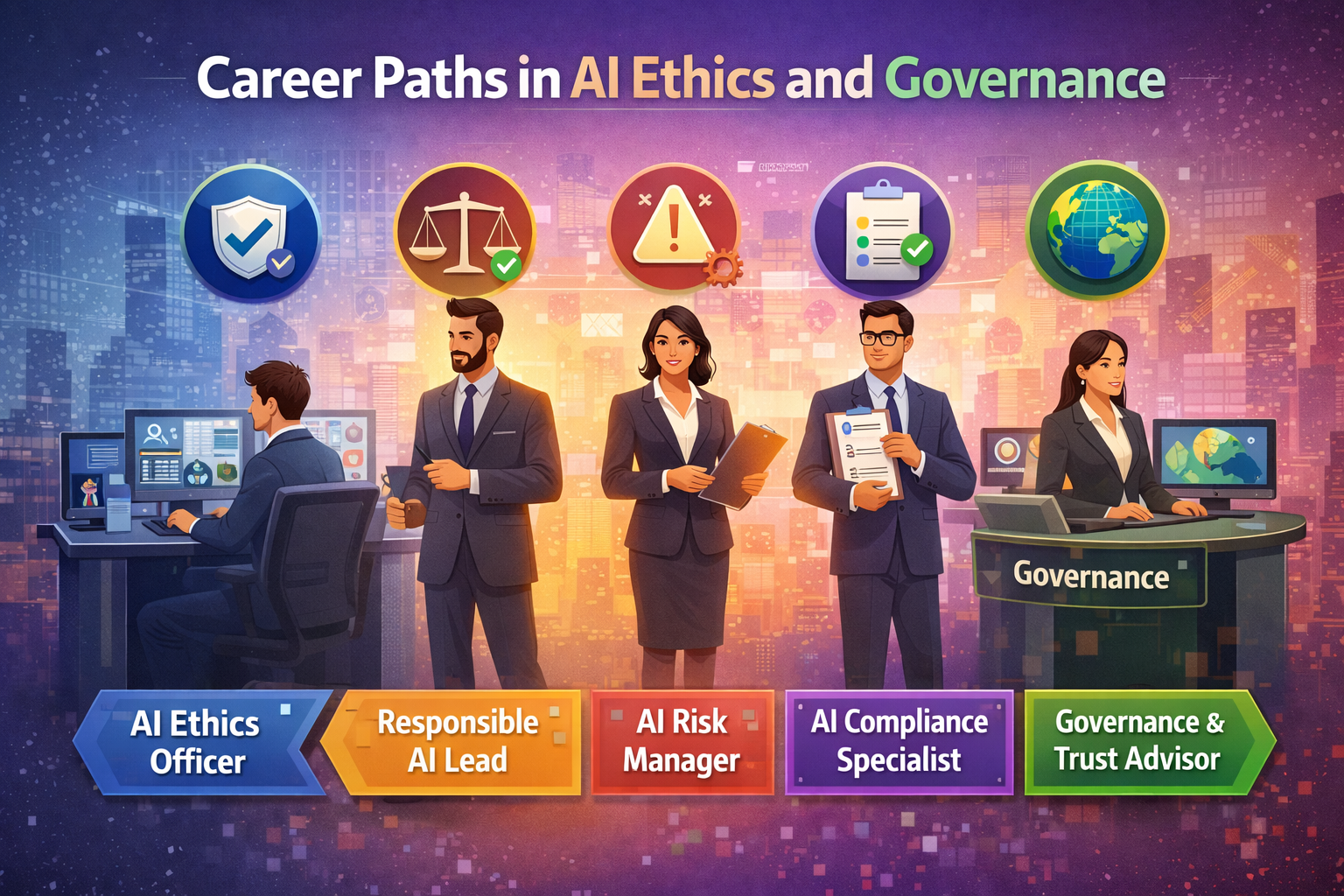
There are many career paths that are emerging in this area. People can begin their careers in such roles as AI policy analyst, risk analyst, or compliance specialist, before moving on to more senior roles in governance.
Some of the common job titles in this area are:
AI Ethics Officer
Responsible AI Lead
AI Risk Manager
AI Compliance Specialist
Governance and Trust Advisor
These are just a few examples of how AI ethics career jobs and AI risk and compliance careers are becoming more formalized as career paths.
Colleges and professional organizations are addressing this transition by introducing specialized courses in AI ethics, governance, and risk management. Business schools, law schools, and technology colleges are incorporating ethics and governance modules into AI and data science courses.
Courses and executive education programs on responsible AI are also becoming popular. These educational programs will help professionals switch to a career in generative AI without having to begin their journey anew.
Upskilling and continuous learning will continue to play an important role as regulations, technologies, and societal norms continue to change.
Future Prospects for Careers in AI Ethics and Governance
The future prospects for careers in AI ethics and governance are bright. As generative AI becomes more autonomous and powerful, the need for ethics and governance will only increase. Companies that do not handle AI ethics and governance well will face legal consequences, public outcry, and loss of customer trust.
This means that the future of AI ethics careers, AI governance careers, and AI risk and compliance careers will be bright. These careers will not hinder the development of AI but will help the responsible scaling of AI technologies.
In the future, ethics and governance will be an integral part of all careers in generative AI.
The impact of generative AI is not only changing the way work is done, but it is also changing who needs to be involved to ensure that this transformation is done responsibly. The emergence of new careers in generative AI related to ethics and governance is an indication that there is a recognition of the need for accountability to match the power of technology.
With careers in AI ethics, AI governance, and AI risk and compliance, professionals have the chance to influence the future of AI in a way that is balanced between innovation and trust. These careers will be instrumental in ensuring that the impact of generative AI is positive for organizations and society.
Frequently Asked Questions
Yes, careers in generative AI are very promising because of the fast adoption rate in the industry. The increasing demand for ethics and governance professionals is also leading to stable and long-term career opportunities.
The career paths include AI ethics career roles, prompt engineering, AI policy analysis, and responsible AI governance jobs. Companies also require professionals in risk assessment, fairness, and compliance as AI adoption increases.
The salaries for careers in generative AI depend on the type of job and experience, with great growth in AI risk and compliance careers. Jobs in ethics, governance, and risk are also becoming better-paying because of their regulatory significance.
The best courses to pursue for career readiness include the basics of generative AI and ethics and governance. Courses in responsible AI governance jobs and policy, risk, and compliance are also very career-aligned.
Dr. Sanjay Kulkarni
Data & AI Transformation Leader
Dr. Sanjay Kulkarni is a Data & AI Transformation Leader with over 25 years of industry experience. He helps organizations adopt data-driven and responsible AI practices through strategic guidance and education. With experience across startups and global enterprises, he bridges the gap between theory and real-world application. His work empowers teams to innovate and thrive in AI-driven environments.
Get Free Upskilling Guidance
Fill in the details for a free consultation
Related Courses
Explore our programs
Admission Closed
Executive Programme in Applied Data Science using Machine Learning & Artificial Intelligence
 HOME > BLOG > AI and Machine Learning > Why Generative AI is Creating New Careers in Ethics, Risk, and Governance
 March 3, 2026
 7 min read




 ChatGPT
 Perplexity
 Claude
 Grok
Grok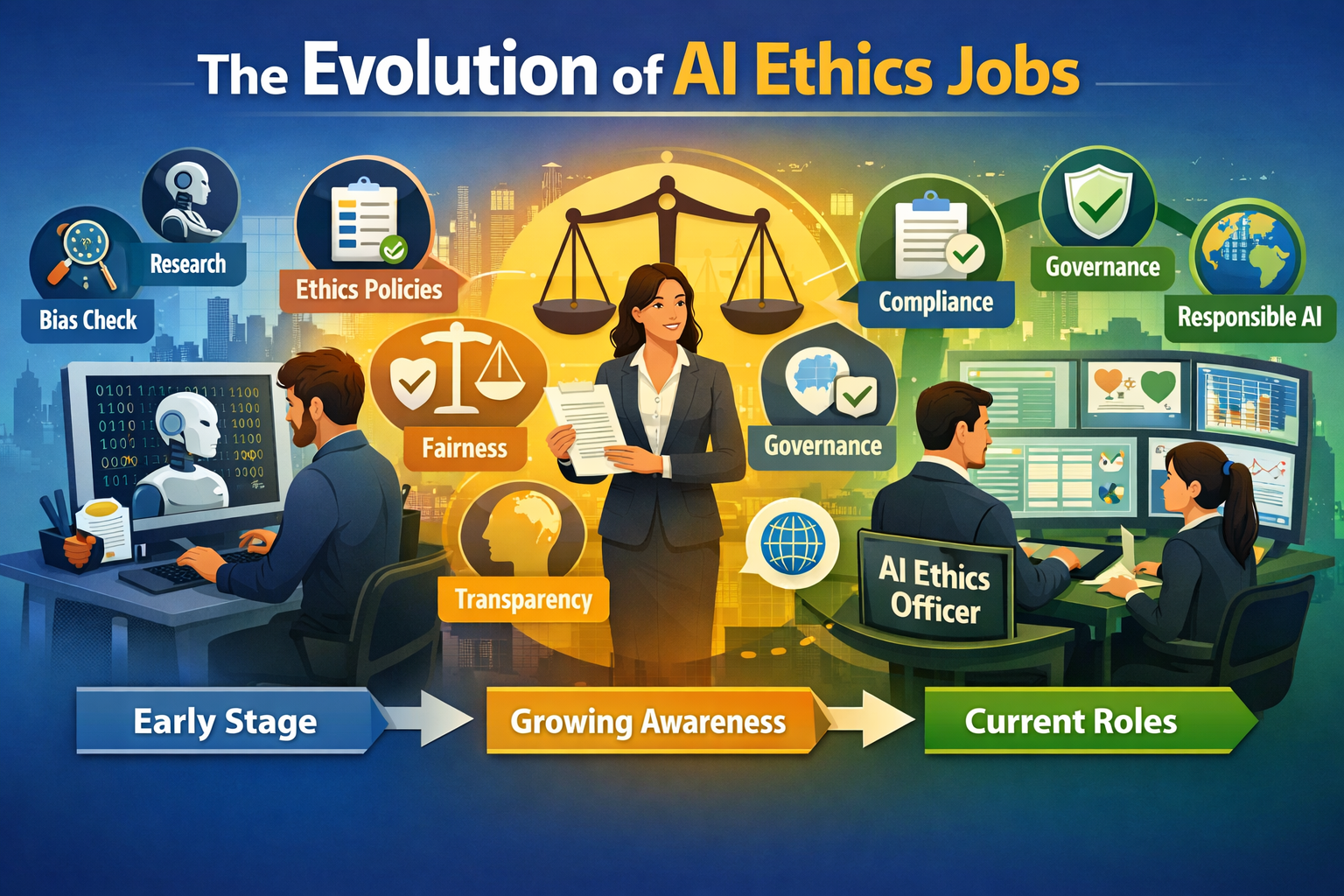



 Admission Closed

 Admission Open

 ROI Calculator