What Is Healthcare Industry 5.0? Meaning, Principles & Evolution from 4.0
J
By Nuthana Reddy
July 27, 20265 min read
Published on July 27, 2026
SHARE THIS ARTICLE
Table Of Content
From Industry 4.0 to Industry 5.0: The Conceptual Shift
What Healthcare Industry 5.0 Actually Looks Like in Practice
Healthcare Industry 5.0 vs Healthcare Industry 4.0: A Direct Comparison
Why Healthcare Industry 5.0 Matters for India in 2026
If you work in healthcare — as a clinician, hospital administrator, medical technology professional, or health policy researcher — you have likely heard the term Industry 5.0 increasingly in conversations about the future of the sector. But the phrase is used loosely, and the actual meaning is often obscured by the buzzword cloud that surrounds it.
This guide gives you a clear, grounded explanation of Healthcare Industry 5.0: what it actually means, how it evolved from Industry 4.0, what its core principles are, and why it matters for healthcare professionals and organisations in India in 2026.
From Industry 4.0 to Industry 5.0: The Conceptual Shift
To understand Healthcare Industry 5.0, you first need to understand what it is reacting to.
Industry 4.0 — the fourth industrial revolution — brought automation, artificial intelligence, the Internet of Things (IoT), big data analytics, and robotics into manufacturing and, subsequently, into healthcare. Industry 4.0 in healthcare meant: electronic health records (EHRs), AI-powered diagnostics, robotic surgery, telemedicine, and data-driven hospital management.
The dominant logic of Industry 4.0 was efficiency through automation. The question was: how do we use machines and data to do more, faster, at lower cost?
Industry 5.0 does not reject this — it extends it. The European Commission’s 2021 Industry 5.0 framework introduced three defining principles that mark the shift:
Human-centricity: Technology serves human needs — not the other way around. In healthcare, this means AI and robotics that augment the clinician, not replace them.
Sustainability: Operations must be environmentally sustainable. In healthcare, this includes green hospital design, sustainable supply chains, and reduced medical waste.
Resilience: Systems must be able to withstand and recover from disruption — a principle that became viscerally clear during COVID-19.
Healthcare Industry 5.0 applies these three principles to the full spectrum of healthcare delivery — clinical care, hospital operations, medical technology development, and health policy
What Healthcare Industry 5.0 Actually Looks Like in Practice
The conceptual shift is useful, but what does Healthcare Industry 5.0 look like on the ground? Here are the practical manifestations:
Human-AI Collaboration in Clinical Care
In Industry 4.0, the aspiration was AI-driven diagnosis. In Industry 5.0, the reality is AI-assisted diagnosis — where the AI flags patterns in radiology images, pathology slides, or patient data, and the clinician makes the decision. The AI does not replace clinical judgment; it augments it.
Collaborative robots — cobots — work alongside surgeons in precision procedures, providing stability and data feedback that the human surgeon uses in real time. The human remains in the loop.
Personalised, Preventive Medicine
Industry 5.0 in healthcare is characterised by a shift from treatment to prevention, and from population-level protocols to individual-level care. Genomic data, wearable health monitoring, and AI-driven risk modelling make it possible to predict and prevent disease at the individual level — not just manage it after onset.
Sustainable Healthcare Operations
Healthcare is one of the most resource-intensive sectors globally. A single hospital’s carbon footprint can equal that of a mid-size manufacturing facility. Industry 5.0 principles push healthcare organisations toward energy-efficient infrastructure, sustainable procurement, and circular economy approaches to medical equipment and supplies.
Resilient Health Systems
COVID-19 exposed the fragility of supply chains, staffing models, and surge capacity in healthcare systems globally — India’s included. Healthcare Industry 5.0 builds resilience through: diversified supply chains for critical medical equipment, distributed care delivery models (telemedicine, home care), surge capacity planning, and cross-sector collaboration frameworks.
Why Healthcare Industry 5.0 Matters for India in 2026
India’s healthcare sector is at a specific inflection point that makes the Industry 5.0 framework particularly relevant:
Ayushman Bharat Digital Mission (ABDM):India’s digital health infrastructure is being built in real time. The architecture choices being made now — about interoperability, data governance, AI integration — will define healthcare delivery for the next 20 years.
Medical technology manufacturing: India’s 2024 Medical Devices Policy targets ₹3 lakh crore in medical technology production by 2030. Building and operating these manufacturing systems at Industry 5.0 standards is a genuine skill requirement.
Rural healthcare access: Telemedicine, AI-powered diagnostic tools, and remote patient monitoring are not aspirational in India — they are operational necessities for last-mile healthcare delivery.
Clinical workforce: India faces a significant shortage of trained healthcare professionals relative to its population. Human-AI collaboration in diagnosis and treatment creates a force multiplier effect — one specialist can serve more patients with AI augmentation.
The Skills Healthcare Industry 5.0 Demands
Healthcare Industry 5.0 is not just a technology story — it is a human capability story. The professionals who will lead in this environment need:
Technical literacy — understanding AI, robotics, IoT, and data analytics well enough to deploy, evaluate, and govern them in clinical and operational settings
Systems thinking — seeing healthcare as a complex adaptive system, not a collection of isolated departments or functions
Human-centred design — keeping the patient and the clinician at the centre of technology deployment decisions
Sustainability knowledge — understanding environmental impact of healthcare operations and how to reduce it
Resilience planning — designing systems that can withstand supply shocks, workforce crises, and demand surges
For healthcare professionals who want to build these capabilities through a structured IIT-level programme, the IIT Delhi Executive Programme in Healthcare for Industry 5.0 is specifically designed to develop exactly this skill set. Admissions close June 30, 2026.
The term was formally introduced by the European Commission in its 2021 Industry 5.0 framework as a policy direction for the future of European industry, including healthcare. It is a directional framework adopted and built upon by academic researchers, technology companies, and healthcare organisations globally — not a formal ISO or regulatory standard.
Industry 4.0 asked: how do we automate this? Industry 5.0 asks: how do we make technology work with humans more effectively, more sustainably, and more resiliently? In healthcare specifically: 4.0 was about digitising records and automating diagnostics; 5.0 is about AI that genuinely helps clinicians serve patients better, not just faster.
It means hospital administrators need to understand AI governance, sustainability reporting, resilience planning, and human-centred design — not just operational management. The role is expanding in scope. For structured learning in this space, see the IIT Delhi Executive Programme in Healthcare for Industry 5.0.
Very much so. India’s Ayushman Bharat Digital Mission, medical device manufacturing push, telemedicine scale-up, and public health infrastructure investments are all being built in the Industry 5.0 era. The frameworks and skills covered in this series are directly applicable to India’s healthcare transformation context.
The IIT Delhi Executive Programme in Healthcare for Industry 5.0is the only IIT-level programme in India structured around the Healthcare Industry 5.0 framework. It covers AI governance, robotics in clinical settings, digital health management, and sustainability — exactly the skill set this article describes. Admissions close June 30, 2026.
Nuthana Reddy
Nuthana Reddy is a Senior Manager at Procter & Gamble, specializing in operations, digitization, and cross-functional leadership. She has driven multimillion-dollar impact through innovation, process optimization, and strategic execution across global markets.
Get Free Upskilling Guidance
Fill in the details for a free consultation
Related Courses
Explore our programs
Executive Programme in Healthcare for Industry 5.0
 HOME > BLOG > Healthcare Management > What Is Healthcare Industry 5.0? Meaning, Principles & Evolution from 4.0
 July 27, 2026
 5 min read




 ChatGPT
 Perplexity
 Claude
 Grok
Grok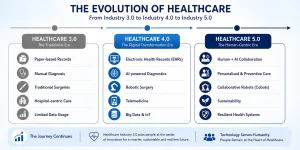







 ROI Calculator