Roles and Responsibilities of an AI Product Manager
How to become an AI Product Manager in 2026: The 7- step Roadmap
Skills Required to Become an AI Product Manager
Key Insights
An AI Product Manager connects business goals, customer needs, and artificial intelligence to create valuable digital solutions.
Skills include Strong product management, analytical thinking, communication, and problem-solving abilities are essential for this career. Familiarity with AI concepts, data analysis, user research, and Agile methodologies can provide an added advantage.
In India, AI Product Manager salaries typically range from ₹8–20 LPA for entry-level roles and ₹19–36 LPA for mid-level professionals.
With extensive experience and strong AI expertise, senior professionals can earn ₹40–50 LPA or more, depending on the organisation and location.
The IIT Roorkee Strategic Product Management Programme offers practical learning in product strategy, AI, analytics, roadmapping, and go-to-market planning.
AI is transforming how we run our businesses, innovate and grow. Within every sector from recommending TV shows on OTT platforms to using AI for fraud detection in banks and predictive diagnostics in the healthcare sector, AI-powered products are becoming increasingly common. And behind every successful AI-driven product there is a skilled professional called an AI Product Manager who ensures that technology can be used to address real-world needs.
The rapid growth of AI in India is reflected in the hiring demand for AI expertise within the job market. The Job Report 2026 by Taggd states that Karnataka's new "Silicon Beach" area plans to recruit over 5,000 IT professionals in 2026 with about 60-70% of those positions targeted at fresh graduates. Additionally, this technology ecosystem is projected to create an estimated 200,000 tech jobs in the next ten years, the majority of which will be in AI-led fields.
An AI Product Manager is a professional who combines product management with AI to develop solutions that meet customer needs and business goals. They work with data, technology, and cross-functional teams to take AI-powered products from idea to launch and improvement. They also define product strategy, prioritise features, and ensure AI solutions deliver measurable value to users and the business.
Roles and Responsibilities of an AI Product Manager
An AI Product Manager combines product strategy with AI and machine learning knowledge to build products that solve real customer and business problems. Key roles and responsibilities include:
Product Strategy: Define the product vision, roadmap, goals, and AI use cases based on customer needs and business objectives.
AI & Machine Learning: Identify suitable AI/ML solutions, understand data requirements, evaluate model feasibility, and work with technical teams to improve AI features
Data & Insights: Use customer and product data to identify opportunities, measure performance, and support data-driven product decisions.
Cross-Functional Collaboration: Work closely with data scientists, ML engineers, developers, designers, marketers, and business teams throughout the product lifecycle.
Ethics & Governance: Ensure AI products are developed responsibly by addressing bias, fairness, privacy, transparency, and regulatory requirements.
Execution & Delivery: Prioritize features, manage product development, coordinate launches, monitor user experience, and continuously improve the product based on feedback and performance.
How to become an AI Product Manager in 2026: The 7- step Roadmap
Becoming an AI Product Manager requires a combination of product thinking, AI knowledge, and practical experience. Follow these seven steps to build the skills needed to create and manage AI-powered products.
1. Learn Product Management Fundamentals
Start by understanding the core principles of product management, including customer research, product strategy, roadmapping, prioritisation, and product lifecycle management. Build a strong foundation before moving into AI-specific concepts.
2. Build AI Literacy
Learn the basics of artificial intelligence, generative AI, machine learning, large language models, and concepts such as RAG and AI evaluation. You do not need to become a coder, but understanding how AI systems work will help you make better product decisions.
3. Develop Prompting and AI Product Skills
Learn how prompting can be used to improve AI outputs and shape product experiences. Explore how AI tools can help with research, ideation, prototyping, and creating products without extensive coding.
4. Develop Strong Product Sense
Focus on understanding user problems, identifying valuable use cases, and deciding which AI features are actually worth building. Strong product sense helps you balance customer needs, technical feasibility, business value, and AI capabilities.
5. Build a Practical AI Product
Put your knowledge into practice by creating a small AI-powered product or prototype. This could be a chatbot, recommendation tool, AI assistant, or another solution that addresses a genuine user problem and gives you a project to showcase.
6. Apply AI in Your Current Role
Look for opportunities to use AI tools and workflows in your existing work. This practical exposure helps you understand how AI can improve productivity, decision-making, customer experiences, and business processes.
7. Prepare for AI Product Management Roles
Build a strong portfolio featuring your AI projects, product case studies, and measurable outcomes. You can also consider an AI product management course, or relevant AI product manager certification to strengthen your knowledge and demonstrate your commitment to the field.
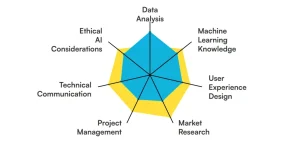
A successful career in AI product management requires a combination of technical knowledge, business understanding, and strong product leadership skills. AI Product Managers need to understand how AI and machine learning work while also focusing on user needs, market opportunities, and product outcomes. They should be able to communicate with technical teams, manage projects, evaluate AI solutions, and make responsible decisions around data and ethical AI.
AI & Machine Learning Knowledge: Understand supervised and unsupervised learning, generative AI, NLP, computer vision, model training, and evaluation.
Data Analysis & Data Literacy: Ability to interpret data, identify trends, define metrics, and make data-driven decisions. Knowledge of SQL, Excel, Python, Tableau, or Power BI is useful.
Technical Skills: Familiarity with APIs, databases, cloud computing, system architecture, model deployment, prompt engineering, and basic Python helps in working with technical teams.
AI & Product Tools: Knowledge of tools such as ChatGPT, Claude, Gemini, GitHub Copilot, Hugging Face, OpenAI APIs, and Google Vertex AI can help evaluate and prototype AI solutions.
Product Management: Strong skills in product strategy, roadmapping, requirements gathering, prioritization, user stories, product discovery, and KPI tracking are essential.
User Experience (UX): Understanding user research, usability testing, prototyping, and human-AI interaction helps create intuitive AI products.
Market & Competitive Research: Ability to analyze market trends, competitors, customer needs, and emerging AI opportunities helps identify valuable product ideas.
Project & Stakeholder Management: Strong communication and collaboration skills are needed to work with engineers, data scientists, designers, marketers, and business teams.
Responsible AI: Understanding AI bias, privacy, security, transparency, explainability, and hallucinations helps build trustworthy AI products.
Business & ROI Thinking: Ability to evaluate customer value, costs, revenue potential, and ROI helps prioritize AI initiatives that deliver measurable business results.
AI Product Managers can command competitive salaries because they combine product management expertise with AI and technical knowledge. In India, compensation varies based on experience, company size, location, technical skills, and the complexity of AI products handled. Current salary data shows substantial variation, with reported AI Product Manager compensation ranging from around ₹19.5 lakh to ₹42.4 lakh annually across the broader market.
Experience Level
Typical Salary Range in India
Common Role
0–2 years
₹8–18 LPA
Associate / Junior AI Product Manager
2–5 years
₹18–30 LPA
AI Product Manager
5–8 years
₹30–45 LPA
Senior AI Product Manager
8–12 years
₹45–70 LPA
Lead / Principal Product Manager
12+ years
₹60 LPA–₹1 Cr+
Head of Product / Product Director
AI Product Manager Career Path and Progression
An AI Product Manager career typically progresses from building strong foundations in AI product management to taking ownership of complex AI products and eventually leading product strategy. Professionals can start with entry-level product roles, develop expertise through an AI product manager course, and gradually move into senior and leadership positions. Along the way, gaining practical experience, understanding AI technologies, and completing an AI product manager certification can strengthen career opportunities and earning potential.
Career Stage
Typical Role
Key Responsibilities
Entry Level
Associate Product Manager
Support product research, user analysis, documentation, and feature planning
Early Career
AI Product Manager
Define AI product requirements, work with technical teams, and manage product launches
Mid-Level
Senior AI Product Manager
Own AI product strategy, roadmap, KPIs, and cross-functional execution
Experienced
Lead / Principal Product Manager
Manage complex AI initiatives and mentor product teams
Leadership
Head of AI Product / Product Director
Define AI product vision, manage portfolios, and drive business growth
Top Industries Hiring AI Product Managers
The growing adoption of artificial intelligence across industries has increased demand for professionals skilled in AI product management. AI Product Managers help organisations build, launch, and improve AI-powered products while balancing business goals, customer needs, and technical requirements.
Technology & SaaS: AI Product Managers develop chatbots, recommendation engines, predictive analytics, and automation solutions, focusing on scalability and user experience.
Banking & Financial Services: They manage AI applications for fraud detection, credit risk assessment, personalised banking, and algorithmic trading, with emphasis on accuracy and compliance.
Healthcare: AI PMs work on diagnostic tools, medical imaging, patient monitoring, and predictive healthcare solutions while considering data privacy and regulatory requirements.
E-Commerce & Retail: They develop personalised recommendations, dynamic pricing, demand forecasting, and inventory management solutions to improve customer experience and operational efficiency.
Automotive & Manufacturing: AI PMs oversee applications such as autonomous systems, predictive maintenance, quality inspection, and supply chain optimisation. Completing an AI product manager course can help professionals build the skills needed to pursue opportunities across these growing industries.
Build your AI Product Management Career with Jaro education
If you aspire to build a successful career as an AI Product Manager in India, developing the right combination of product strategy, AI, business, and digital transformation skills is essential. Professionals with strong expertise in these areas can access better career opportunities and competitive compensation. To help you strengthen your product management skills, explore these programmes:
The Mastering Product Management programme is a free course designed to help aspiring and working product managers understand essential tools, techniques, product strategy, and decision-making approaches. These programmes can help strengthen your profile and prepare you for rewarding opportunities in AI product management with Certification.
AI product management is becoming an increasingly valuable career path as businesses adopt artificial intelligence across industries. An AI Product Manager plays an important role in connecting business goals, customer needs, and technical capabilities to create useful and scalable AI-powered products. Success in this role requires a combination of product knowledge, technical understanding, analytical thinking, and effective communication.
Along with learning AI concepts, aspiring professionals should focus on gaining practical experience through projects, experimentation, and collaboration with technical teams. Staying updated with emerging AI technologies and understanding how they can solve real business problems can also provide a competitive advantage.
With the right skills, hands-on experience, and continuous learning, professionals can build a strong foundation and pursue rewarding opportunities in the growing field of AI product management.
Frequently Asked Questions
An AI Product Manager manages the development of AI-powered products by connecting customer needs, business objectives, and technical capabilities. They work with engineering, data science, design, and business teams throughout the product lifecycle.
Key skills include product strategy, AI and machine learning fundamentals, data analysis, technical communication, user research, project management, and business analysis. Knowledge of AI tools and responsible AI practices is also valuable.
Advanced coding skills are not always required, but a basic understanding of programming, APIs, databases, and machine learning concepts can help AI Product Managers communicate effectively with technical teams.
AI Product Managers may use tools such as Jira, Confluence, Productboard, Aha!,Notion, Linear, Mixpanel, Amplitude, Figma, and Miro for product planning, roadmapping, analytics, collaboration, and user research. AI tools such as ChatGPT, Hugging Face, and other AI platforms can also support product development.
Yes. As businesses increasingly integrate AI into their products and operations, professionals with a combination of product management and AI knowledge can find opportunities across technology, finance, healthcare, retail, e-commerce, and other industries.
AI Product Managers can progress from associate and early-career roles to Senior AI Product Manager, Lead or Principal Product Manager, and eventually Head of AI Product or Product Director positions.
Aspiring professionals can consider programmes that strengthen product strategy, business, and technology skills. The Post Graduate Certificate Programme in Strategic Product Management offered by IIT Roorkee and Mastering Product Management: Roadmap, Vision, and Strategy by Jaro Education are two programmes mentioned for developing product management expertise.
Dr. Sanjay Kulkarni
Data & AI Transformation Leader
Dr. Sanjay Kulkarni is a Data & AI Transformation Leader with over 25 years of industry experience. He helps organizations adopt data-driven and responsible AI practices through strategic guidance and education. With experience across startups and global enterprises, he bridges the gap between theory and real-world application. His work empowers teams to innovate and thrive in AI-driven environments.
Get Free Upskilling Guidance
Fill in the details for a free consultation
Related Courses
Explore our programs
Post Graduate Certificate Programme in Product & Brand Management
 HOME > BLOG > AI and Machine Learning > AI Product Manager: Skills, Roles, Salary & Career Opportunities
 January 21, 2026
 8 min read




 Key Insights
 ChatGPT
 Perplexity
 Claude
 Grok
Grok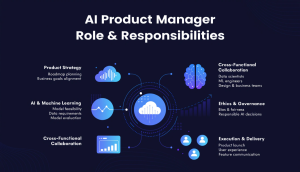








 ROI Calculator