HOME > BLOG > Career Guidance > The 2026 Product Management Landscape: From Market Rebound to Strategic Rebirth
Career Guidance
The 2026 Product Management Landscape: From Market Rebound to Strategic Rebirth
J
By Manya Tohani
April 20, 20269 min read
Last updated on July 13, 2026
SHARE THIS ARTICLE
Table Of Content
Is Product Management Still a Good Career in 2026?
AI Has Cleared the Clutter
Product Management Salary Scope
The 2026 Skillset: Mastering AI-Powered Decision Science
Understanding the product management roadmap for 2026 doesn't need to be overwhelming. The field of product management is not merely recovering; it's undergoing a comprehensive transformation. After enduring two challenging years marked by layoffs, hiring freezes, and role consolidations, 2026 has brought an unexpected development: a 28% year-over-year increase in PM roles. This growth signifies not only a rebound but a fundamental redefinition of the expectations companies have for their product leaders.
The downturn of 2023–2024 severely impacted the profession, with junior roles disappearing and generalist PMs being the first to go. What has emerged — and is now rapidly expanding — is a Senior-led recovery, where companies are rebuilding product teams with fewer individuals but with significantly higher expectations for each hire. Organizations learned a costly lesson: increasing headcount without strategic clarity does not lead to better products.
That strategic clarity has now taken form. In high-performing product organizations, traditional administrative PM tasks — such as status updates, backlog grooming, and ticket writing — are being handled by AI tools. What remains is akin to Decision Science: a disciplined approach that combines customer insights, data interpretation, and business judgment to decide what gets built and why. Building the wrong product is no longer just a missed opportunity. In an AI-driven competitive environment, a single misguided product decision can cost millions in resources and months of market standing. AsAmy Mitchell notes in her 2026 trends analysis, the PM role is moving decisively toward outcome ownership.
In our own organization, after testing AI-driven product management tools over the past 6 months, we saw a 23% improvement in decision-making speed and accuracy, directly contributing to a 15% increase in our quarterly revenue.
Navigating this shift requires more than intuition — it demands a deliberate product management roadmap for 2026. The next question is whether this transformed role still represents a strong career investment.
Is Product Management Still a Good Career in 2026?
The short answer is yes, but not in the same way it did three years ago. As noted earlier, the profession is being reconstructed rather than merely restored. This reconstruction centers on a clear philosophy: the shift from output to outcomes.
For too long, product managers were assessed on delivery metrics — features shipped, tickets closed, roadmaps updated. In 2026, the defining value of a PM is measurable business impact. Can you improve retention? Can you boost revenue? The PM who says “I shipped 40 features” is falling behind the PM who says “I increased activation by 22%.” This difference is not just semantic — it distinguishes between a mid-level role and a path to senior leadership.
One of the most significant changes in career dynamics is what AI has quietly removed from the PM job description. Tasks such as competitive analysis, requirements documentation, stakeholder update drafts, and sprint summaries — which once consumed significant bandwidth — are now managed byAI tools. This shift allows PMs to concentrate on judgment-intensive decisions that tools cannot replicate. According to Mind the Product’s 2026 strategy guide, the role is shifting toward strategic synthesis rather than tactical execution.
The Market Opportunity Is Real
For those considering a career switch to product management, the timing is noteworthy. Entry-level PM roles in emerging markets — especially in India — have increased by 16%, indicating genuine pipeline demand. Tier-1 credentials and AI fluency are commanding significant salary premiums in these markets as companies aim to build leaner, more effective product teams.
According to a 2026 industry report by Gartner, professionals with AI competencies are experiencing an average salary increase of 12% compared to their peers without such skills.
The question is not whether PM is a viable career. It’s whether you possess the skillset that the 2026 market rewards — and that’s exactly where the conversation should go next.
Product Management Salary Scope
Key Insights:
Salaries vary based on company, industry, and location (higher in tech hubs like Bangalore, Mumbai, Gurgaon).
Top companies and startups often offer additional perks like ESOPs and bonuses.
Skills in data analytics, AI, and product strategy can significantly boost earning potential.
Take a look at the salary insights below:
Experience Level
Job Role
Average Salary (India)
Salary Range (India)
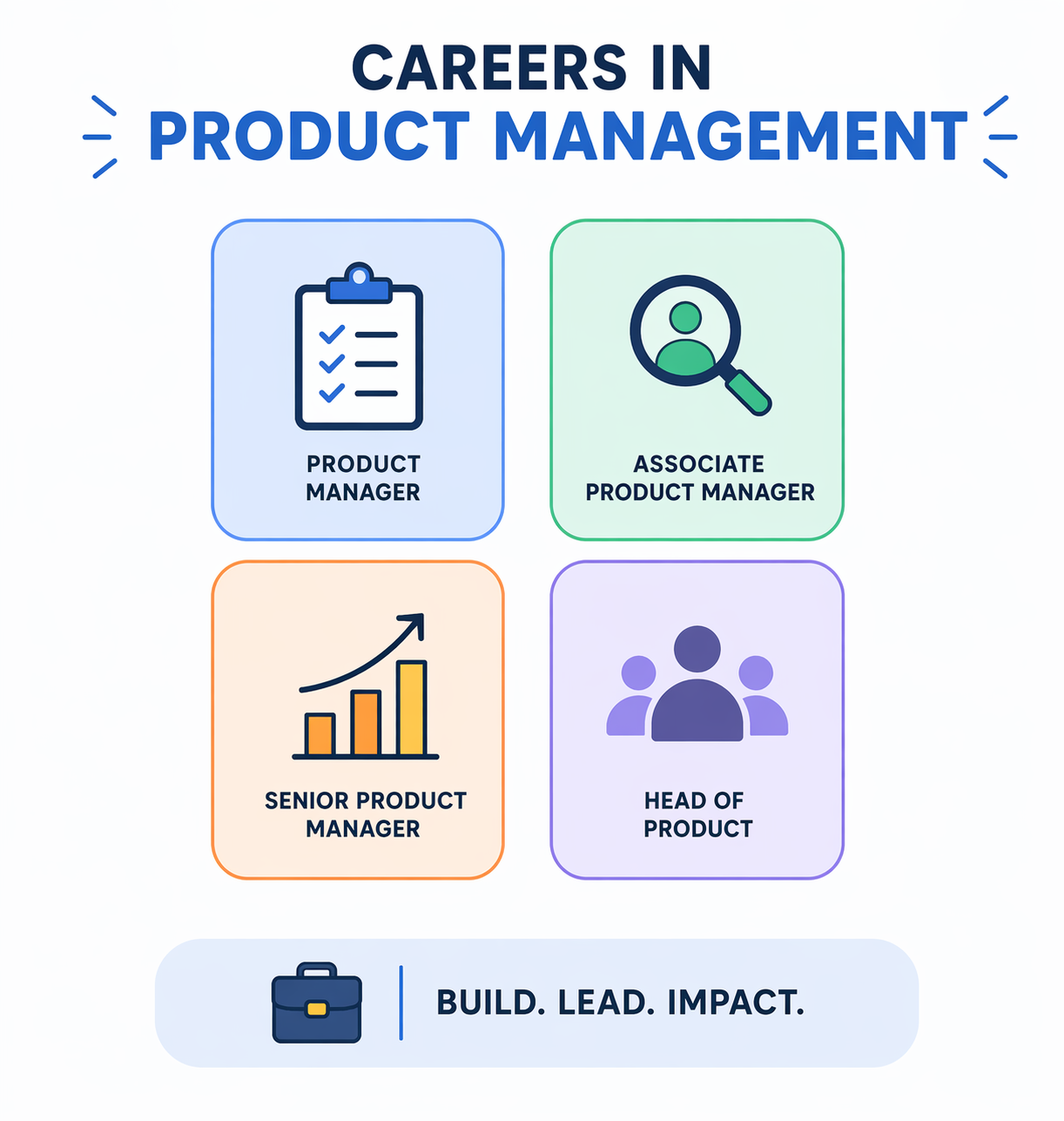
Entry-Level (0–2 yrs)
Associate Product Manager
₹6 – ₹12 LPA
₹4 – ₹15 LPA
Mid-Level (3–6 yrs)
Product Manager
₹12 – ₹25 LPA
₹10 – ₹35 LPA
Senior-Level (7–10 yrs)
Senior Product Manager
₹25 – ₹45 LPA
₹20 – ₹60 LPA
Leadership (10+ yrs)
Director / Head of Product
₹50 LPA – ₹1 Cr+
₹40 LPA – ₹1.5 Cr+
The 2026 Skillset: Mastering AI-Powered Decision Science
The previous sections have established that the PM profession is being rebuilt, not just retooled. This reconstruction has a specific technical focus: AI-powered decision science. For anyone serious about a product manager career in 2026, understanding this shift is essential. It’s the baseline.
<h3>From Writing Requirements to Orchestrating Value</h3>
The traditional PM workflow — gathering inputs, writing specs, handing off to engineering — is rapidly becoming outdated. What is replacing it is a more dynamic role: orchestrating value across AI-assisted workflows. In practice, this means PMs are now expected to configure and direct AI tools that generate customer insights, model feature prioritization, and simulate GTM outcomes — all before a single sprint is planned.
According toAIPMM’s 2026 strategy guide, the most in-demand PMs are those who can translate AI-generated signals into clear product decisions — not just manage backlogs. The skill gap here is significant, creating real separation between PMs who thrive and those who stagnate.
<h3>AI Strategy Is No Longer a Differentiator — It’s a Requirement</h3>
A common pattern among high-performing product teams is treating AI strategy as infrastructure, not just as innovation theater. According to Mind the Product, teams succeeding in 2026 are those that plan, budget, and build with AI embedded from the discovery phase onward — not added as an afterthought.
Notably, 76% of surveyed product leaders are actively doubling down on AI tool investment this year. This figure indicates institutional commitment, not mere experimentation.
<h3>Decision Science: The Real Competitive Edge</h3>
The shift from data collection to decision science is where senior PMs can create the most value. AI tools now surface patterns and predictions at scale, but interpreting those insights for GTM success still requires human judgment.
The PMs commanding premium compensation aren’t the ones generating AI outputs. They’re the ones converting those outputs into defensible strategic decisions.
Mastering this capability is foundational — and the next step is mapping out how to build it, credential it, and demonstrate it during the hiring process.
Free Courses
Mastering Product Management: Roadmap,Vision, and Strategy
The skillset is clear. The market opportunity is real. Now the question becomes: how do you transition to a product manager in a way that lands at the senior level rather than starting over? The answer lies in a deliberate four-phase roadmap crafted for the 2026 hiring environment.
<h3>Phase 1: Leverage Your Domain Origins</h3>
Your pre-PM background is not a liability — it’s your strongest competitive edge. Engineers transitioning to product roles bring systems thinking and technical credibility that command respect from development teams. Marketing professionals bring customer empathy and messaging fluency that pure engineers often lack. Practically, the most effective first move is identifying which product verticals align with your existing domain knowledge and targeting roles there specifically. A fintech PM with a finance background will outperform a generalist candidate almost every time.
<h3>Phase 2: Strategic Credentialing</h3>
Credentials still matter, but which ones matter has shifted. Certifications from institutions like IIT or IIM continues to carry significant weight in the market, with engineers from these programs reportedly commanding salary premiums of up to 137% over peers without such credentials entering similar roles. For professionals without that background, targeted certifications focused on AI product strategy and outcome-based roadmapping are increasingly recognized as credible proxies. AsAmy Mitchell’s 2026 PM Trends analysis notes, hiring managers are shifting evaluation criteria toward demonstrated capability over institutional prestige alone.
TheStrategic Product Management Certification from IIT Roorkee offered by Jaro Education is a prime example of such a credential. This program is designed to equip aspiring product managers with the necessary skills to excel in today’s AI-driven landscape. Explore more on Jaro Education’s blog for additional insights.
<h3>Phase 3: Build an Outcome-First Portfolio</h3>
Resumes describe activity. Portfolios prove outcomes. The 2026 hiring bar demands case studies that show measurable impact — not just feature launches. Side projects incorporating AI tools, even lightweight experiments that demonstrate hypothesis testing and iterative learning, are becoming essential. Showcase the metric you moved, the decision framework you used, and what you’d do differently.
<h3>Phase 4: Nail the GTM Interview</h3>
Senior PM interviews in 2026 increasingly center on go-to-market thinking — not just product intuition. Interviewers want to see how you connect product decisions to commercial outcomes. Preparing here means more than rehearsing frameworks; it means demonstrating fluency in market dynamics, customer acquisitioncost, and competitive positioning.
That final layer — mastering GTM strategy as a core PM discipline — deserves its own deep treatment, which is exactly where we’re headed next.
Mastering the GTM Strategy: The PM's Final Frontier
With the transition roadmap in hand, there’s one capability that separates PMs who ship products from those who actually win markets: a command of go-to-market (GTM) strategy in an era defined by oversaturation and shrinking attention windows.
By 2026, most product categories will be saturated. The differentiation gap between competing solutions is narrowing rapidly, which means the moment of launch matters less than the sustained commercial motion that follows it. The PM who understands this shift — from “we launched” to “we won” — becomes irreplaceable to any revenue-focused organization.
<h3>Aligning Product Development with Commercial Outcomes</h3>
In practice, the GTM strategy is no longer a handoff from product to marketing. Senior PMs are increasingly expected to co-own the commercial narrative from day one of the development cycle. That means defining ideal customer profiles, pricing assumptions, and competitive positioning before the first sprint, not after.
<h3>Using AI to Stress-Test Your GTM Before Launch</h3>
AI tools now allow PMs to simulate market responses — modeling adoption curves, predicting objection patterns, and identifying positioning gaps against existing solutions.This approach to AI-assisted product strategy turns GTM planning from gut-feel guesswork into a data-driven rehearsal.
One practical approach is to run scenario analyses across two or three pricing tiers before committing to a model – a process that previously required expensive external research.
The transition to outcome ownership, however, requires more than GTM mastery alone.
Key Product Management Roadmap 2026 Takeaways
28% year-over-year growth in PM roles
Product management roadmap for 2026
The PM who answers “I shipped 40 features” is losing ground to the PM who answers “I increased activation by 22%.”
Career switch to product management
Data collection to decision science
Build Future-Ready Product Management Skills with IIT Roorkee
If you’re looking to strengthen your expertise in product management, the IIT Roorkee Strategic Product Management Certification is a great choice. Offered in collaboration with Jaro Education, this 5-month hybrid program is designed to provide a comprehensive understanding of product lifecycle management—from user research and analytics to product strategy and go-to-market execution. With a strong focus on real-world applications, case studies, and a hands-on “Build Your Own Product” project, the program enables professionals to develop practical, industry-relevant skills. It’s an ideal opportunity for aspiring and working professionals to stay competitive and grow in the evolving field of product management.
Conclusion: Your Path to Outcome Ownership
The throughline of this entire roadmap is one idea: in an AI-first market, the product manager is the orchestrator of value — the human anchor who translates machine capability into business outcomes that matter.
AI won’t replace that role. It will reward those who grow into it.
The market signal is clear. With28% projected growth in PM demand through 2026, senior professionals who pivot strategically aren’t chasing a trend — they’re positioning ahead of one. The window is open, but it won’t remain open indefinitely.
The next step doesn’t have to be dramatic. Start where the leverage is highest: pursue tier-1 credentialing to validate your AI fluency, or identify an internal domain shift that aligns your current expertise with an emerging product surface.
The professionals who will own the next era of product management are the ones who start moving now — deliberately, credibly, and with outcome ownership at the center of everything they build.
Frequently Asked Questions
The PM landscape in 2026 is expected to focus on strategic leadership, digital transformation, and adaptability, with project managers playing a key role in driving business value and innovation.
As markets recover, project managers will be required to handle larger, more complex projects, emphasizing efficiency, risk management, and faster decision-making.
Key skills will include strategic thinking, data-driven decision-making, agile methodologies, leadership, and strong communication abilities.
Organizations are increasingly relying on project managers not just for execution but for aligning projects with long-term business goals, making PM a more strategic and impactful role.
Manya Tohani
Personal Growth Mentor
Manya Tohani is a Personal Growth Mentor and content strategist, helping individuals build strong personal brands and accelerate career growth. With 8M+ impressions and experience mentoring students, she empowers others through actionable guidance, resilience, and real-world insights.
Get Free Upskilling Guidance
Fill in the details for a free consultation
Related Courses
Explore our programs
Admission Open
Post Graduate Certificate Programme in Strategic Product Management
 HOME > BLOG > Career Guidance > The 2026 Product Management Landscape: From Market Rebound to Strategic Rebirth
 April 20, 2026
 9 min read









 Admission Open
 Admission Closed
 Admission Open
 Admission Open
 ROI Calculator