How to Improve Your Product Management Skills in 2026
Key Insights
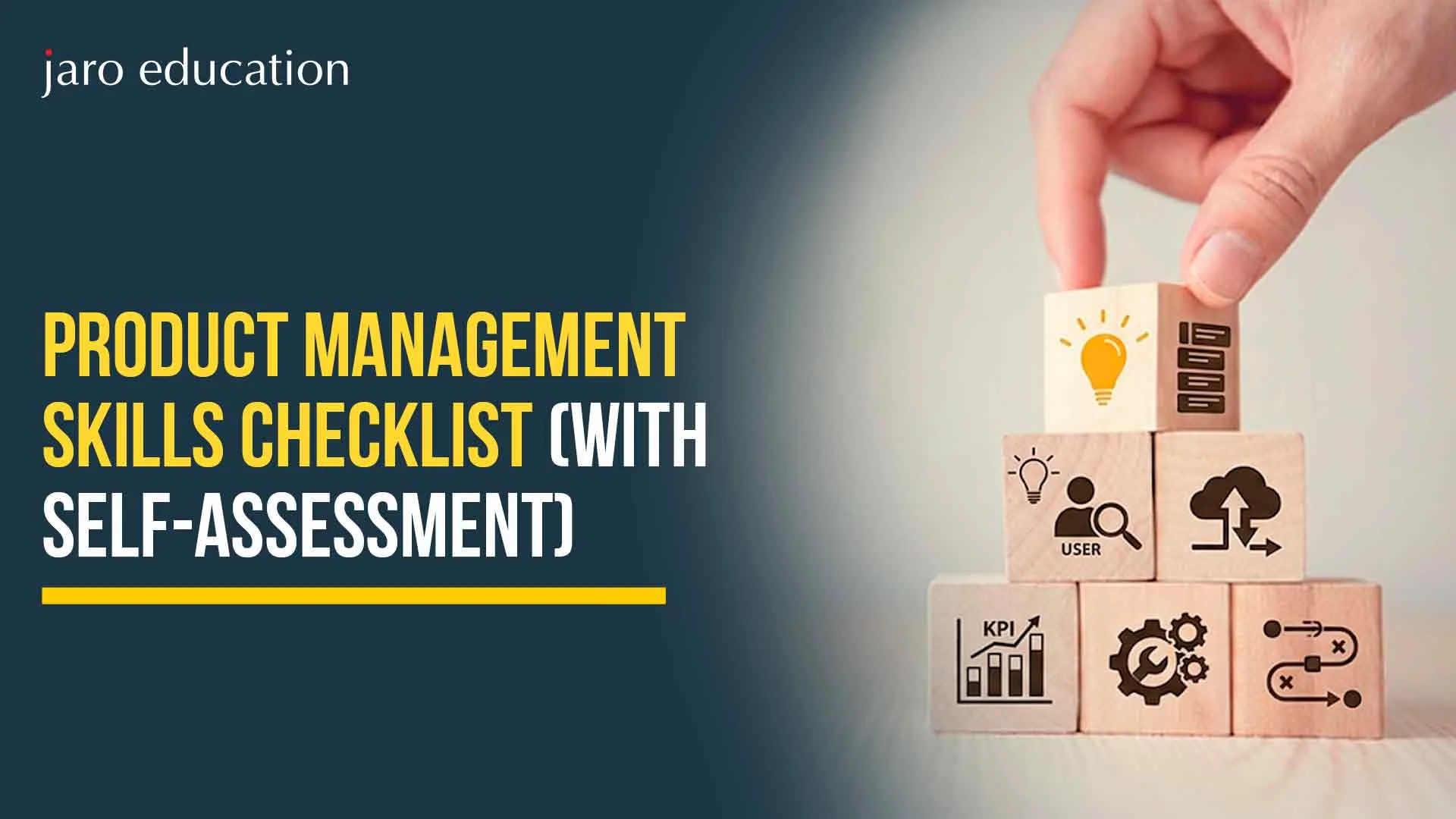
Product Management requires a combination of strategic, analytical, technical, communication, and leadership capabilities to address customer needs and business objectives effectively.
A strong product management skills checklist includes product strategy, customer research, product sense, roadmapping, prioritisation, analytics, business understanding, and technical awareness.
The self-assessment approach helps professionals rate their capabilities from 1 to 5, identify their three lowest-scoring skills, and focus their development efforts accordingly.
Continuous improvement can come from product case studies, mock interviews, product analysis, roadmapping exercises, prioritisation activities, and real-world projects.
In this blog, you'll learn about the essential product manager skills for 2026, how to assess your capabilities, interpret your score, and identify areas for professional development.
Product Management continues to evolve as businesses increasingly focus on customer experience, digital products, data, and emerging technologies. In 2026, Product Managers are expected to do more than manage product roadmaps or coordinate with development teams. They need to understand customers, interpret data, make strategic decisions, communicate with stakeholders, and work effectively with Artificial Intelligence (AI) and technology teams.
This makes it important for aspiring and experienced professionals to regularly evaluate their capabilities. A well-defined product management skills checklist can help professionals identify their strengths, recognise development areas, and prepare for changing expectations in the role.
Whether you are planning to become a Product Manager, preparing for a product interview, or looking to move into a senior product role, this guide covers the essential product management skills you should assess in 2026.
Product management skills are the capabilities required to identify customer problems, define product opportunities, develop product strategies, prioritise initiatives, and work with cross-functional teams to deliver valuable products.
The role sits at the intersection of business, technology, design, and customer needs. As a result, Product Managers need a combination of strategic, analytical, technical, communication, and leadership capabilities.
Some skills can be developed through formal learning, while others improve through hands-on experience, projects, customer interactions, and collaboration with different teams.
The most effective way to evaluate your current capabilities is to look at them as a combination of product thinking, execution, business understanding, data literacy, and people skills.
Product strategy is one of the most important capabilities on any product manager skills checklist.
A Product Manager should be able to connect customer needs with business objectives and define a clear direction for the product. This involves understanding the market, identifying opportunities, defining the product vision, and establishing priorities.
Ask yourself:
Can I define a clear product vision?
Can I connect product goals with business objectives?
Can I identify meaningful product opportunities?
Can I explain why a product or feature should be built?
Self-assessment: Rate yourself from 1 to 5.
1–2: Need significant improvement 3: Developing 4: Strong 5: Advanced
2. Customer and User Research
Successful products begin with an understanding of the customer.
Product Managers should know how to identify customer pain points, understand user behaviour, gather feedback, and convert insights into product opportunities. User interviews, surveys, customer feedback, usability research, and observation can contribute to this understanding.
A Product Manager should also be able to distinguish between what customers say they want and the underlying problem they are trying to solve.
Self-assessment: Can you independently identify a customer problem, validate it, and translate your findings into product requirements?
If your answer is no, customer research should be an area of focus in yourdevelopment plan.
3. Product Sense
Product sense refers to the ability to understand what makes a product useful, desirable, and valuable to its users.
It involves thinking about the customer experience, identifying friction points, evaluating product features, and developing solutions that address genuine user needs.
Strong product sense develops through regular interaction with products and customers. Analysing why a product works, where users struggle, and how an experience could be improved can strengthen this capability.
Self-assessment: Pick a digital product you use regularly. Can you identify its primary user problem, target audience, key value proposition, and three improvements without relying solely on personal preference?
If yes, rate yourself 4 or 5. If you find it difficult to connect features with customer problems, this skill requires further development.
4. Roadmapping and Prioritisation
Product Managers rarely have unlimited time, people, or resources. They must decide what deserves attention first.
Roadmapping and prioritisation are therefore essential product management skills. A Product Manager should be able to evaluate competing initiatives based on factors such as customer value, business impact, effort, urgency, and strategic alignment.
Frameworks can support prioritisation, but the ability to explain the reasoning behind a decision is equally important.
Self-assessment: If you receive 10 feature requests but can only develop three, can you confidently explain which three you would prioritise and why?
If you can make the decision using clear criteria rather than personal preference, you have a strong foundation.
5. Data and Product Analytics
Data has become an important part of product decision-making. Product Managers do not necessarily need to become data scientists, but they should be comfortable working with product metrics and interpreting data.
Important capabilities include understanding user behaviour, identifying relevant metrics, analysing trends, and using data to evaluate product performance.
A Product Manager should know the difference between metrics that measure activity and metrics that indicate meaningful product outcomes.
Self-assessment: Can you define the key metrics for a product and explain what you would do if one of those metrics suddenly declined?
If you can connect metrics with potential causes and actions, your data literacy is developing well.
6. Business and Commercial Understanding
Product decisions influence business performance. Therefore, Product Managers need to understand how products create value for both customers and organisations.
Business understanding can include knowledge of revenue models, pricing, costs, market positioning, customer acquisition, competition, and profitability.
You should be able to answer a basic question: How does this product create value, and how does the business benefit from it?
Self-assessment: Can you explain your product’s business model and identify the main factors that could influence its commercial performance?
Product Managers do not need to be expert developers, but a basic understanding of technology can make collaboration with engineering teams more effective.
In 2026, technical awareness may include understanding APIs, databases, cloud technologies, software developmentprocesses, data structures, and AI-related concepts, depending on the product.
The objective is not to write production-level code. It is to understand technical possibilities and constraints well enough to participate meaningfully in product discussions.
Self-assessment: Can you explain how a product feature might interact with an application, database, API, or external service at a high level?
If you can, you have a useful technical foundation.
8. Artificial Intelligence and Emerging Technology Awareness
Product Managers should understand where AI can add value, where it may introduce limitations, and how AI-enabled features should be evaluated from a customer and business perspective.
This does not mean every Product Manager needs advanced machine learningexpertise. Instead, professionals should develop sufficient awareness to identify meaningful use cases and collaborate with technical specialists.
Self-assessment: Can you identify a genuine customer problem that could benefit from AI and explain why AI would be preferable to a conventional solution?
If yes, you are building an important future-focused capability.
9. Communication and Storytelling
Product Managers communicate with multiple stakeholders, including engineers, designers, marketers, senior leaders, sales teams, and customers.
Being able to explain a product vision, present research findings, communicate priorities, and build alignment is therefore essential.
Good product communication is not only about speaking clearly. It is also about presenting the right information to the right audience.
Self-assessment: Can you explain the same product decision to a developer, marketing professional, and senior executive in a way that is relevant to each audience?
If you can adapt your communication without changing the core message, this is a strong capability.
10. Stakeholder Management
Product decisions often involve competing expectations. Different teams may have different priorities, timelines, and perspectives.
Product Managers need to create alignment while making decisions based on customer needs, business objectives, and product strategy.
Stakeholder management involves listening, negotiating, communicating trade-offs, and maintaining productive working relationships.
Self-assessment: When stakeholders disagree with your product decision, can you understand their concerns, explain your reasoning, and work towards an aligned outcome?
If yes, you are demonstrating an important product leadership skill.
11. Execution and Delivery
A product strategy has little value if it cannot be translated into execution.
Product Managers should understand product development processes, requirements, dependencies, risks, timelines, and delivery priorities. They also need to work closely with design and engineering teams throughout development.
Strong execution does not mean controlling every task. It means ensuring that teams understand what needs to be achieved and why.
Self-assessment: Can you convert a product objective into clear requirements, priorities, milestones, and measurable outcomes?
If yes, execution is likely one of your stronger skills.
12. Leadership and Collaboration
Product Managers often influence teams without directly managing everyone involved in product development.
This requires collaboration, empathy, accountability, negotiation, and the ability to create shared ownership.
Leadership in Product Management is often demonstrated through decision-making, clarity, communication, and the ability to bring different teams together around a common objective.
Self-assessment: Can you motivate cross-functional teams around a shared product goal even when you do not have direct authority over them?
If yes, you are developing an important leadership capability.
Use the following simple scorecard to evaluate yourself:
Skill
Your Score /5
Product Strategy
__ / 5
Customer Research
__ / 5
Product Sense
__ / 5
Roadmapping & Prioritisation
__ / 5
Product Analytics
__ / 5
Business Understanding
__ / 5
Technical Understanding
__ / 5
AI & Emerging Technology
__ / 5
Communication & Storytelling
__ / 5
Stakeholder Management
__ / 5
Execution & Delivery
__ / 5
Leadership & Collaboration
__ / 5
How to Interpret Your Score
If most of your scores are between 1 and 2, focus on building foundational knowledge and gaining practical exposure.
Scores between 3 and 4 indicate that you have a developing or strong foundation, but there may still be opportunities to strengthen your practical application.
Scores of 5 suggest that you are confident in the particular capability. However, continuous learning remains important because product practices, technologies, customer expectations, and business priorities continue to evolve.
Rather than focusing only on your total score, identify your three lowest-scoring skills. These should become the starting point for your development plan.
How to Improve Your Product Management Skills in 2026
Improving your product management skills requires more than completing courses or reading frameworks. The strongest development comes from combining learning with practical application.
Start by selecting one skill that you want to improve. For example, if your product analytics score is low, practise defining metrics for different products. If stakeholder management is a challenge, observe how experienced Product Managers communicate trade-offs and handle disagreements.
You can also work on product case studies, conduct mock product interviews, analyse existing products, create sample roadmaps, and practise prioritising hypothetical feature requests.
For aspiring Product Managers, personal projects can provide an opportunity to demonstrate product thinking. For experienced professionals, applying structured frameworks to current work can help strengthen existing capabilities.
A checklist provides a structured way to look at Product Management as a combination of capabilities rather than a single skill.
You may be excellent at customer research but need to improve your technical understanding. You may be strong in execution but need to develop strategic thinking. Identifying these gaps can help you focus your learning instead of trying to improve everything simultaneously.
The product manager skills checklist is particularly useful when preparing for interviews, planning a career transition, evaluating your current role, or preparing for greater product responsibilities.
Final Thoughts
Product Management in 2026 requires a balance of customer understanding, strategic thinking, business awareness, analytical ability, technology awareness, execution, communication, and leadership.
There is no expectation that every Product Manager will have an identical skill profile. The role can vary significantly depending on the industry, product type, organisation, and level of responsibility.
The purpose of a product management skills checklist is therefore not to create a perfect scorecard. Instead, it helps you understand where you currently stand and where you should focus next.
Use the self-assessment regularly, track your progress, and look for opportunities to apply each skill through real product problems. Over time, this approach can help you build a more balanced and practical Product Management skill set.
Frequently Asked Questions
Key product management skills include product strategy, customer research, product sense, prioritisation, product analytics, business understanding, technical awareness, AI awareness, communication, stakeholder management, execution, and leadership.
Use a product management skills checklist and rate yourself from 1 to 5 across areas such as strategy, research, analytics, communication, technical understanding, and leadership. Focus on your three lowest-scoring areas for improvement.
Product Managers do not necessarily need to be expert developers. However, a basic understanding of APIs, databases, cloud technologies, software development processes, and relevant technologies can support effective collaboration with technical teams.
AI awareness is increasingly relevant to Product Management. Product Managers should understand potential AI use cases, customer value, limitations, and how AI-enabled features can contribute to product and business objectives.
You can improve by combining structured learning with practical application. Product case studies, mock interviews, product analysis, roadmapping exercises, prioritisation exercises, and real-world projects can help develop and assess different capabilities.
Nuthana Reddy
Nuthana Reddy is a Senior Manager at Procter & Gamble, specializing in operations, digitization, and cross-functional leadership. She has driven multimillion-dollar impact through innovation, process optimization, and strategic execution across global markets.
Get Free Upskilling Guidance
Fill in the details for a free consultation
Related Courses
Explore our programs
Post Graduate Certificate Programme in Strategic Product Management

 August 17, 2026
 9 min read




 Key Insights
 ChatGPT
 Perplexity
 Claude
 Grok
Grok









 ROI Calculator