RPA Developer Salary in India: Jobs, Pay & Career Scope
J
By Dr. Sanjay Kulkarni
May 22, 20268 min read
Published on May 22, 2026
SHARE THIS ARTICLE
Table Of Content
RPA Developer Salary in India: The 2026 Benchmark
The Experience Factor: YoE vs. Salary Trajectory
Geographic Hotspots: RPA Developer Jobs in India
Is RPA in Demand in 2026? The AI Convergence
Automation is no longer a buzzword — it's the backbone of how competitive businesses operate. In 2026, Robotic Process Automation (RPA) sits at the center of every serious digital transformation strategy, and the professionals who build it are among the most sought-after in India's tech talent market.
"India is reaping the benefits of a new genre of jobs created from RPA... RPA is creating jobs that are expected to push a higher percentage of the population into the middle class." — Daniel Dines, CEO of UiPath
Definition: What is RPA? Robotic Process Automation (RPA) is a software-driven approach that uses intelligent bots to automate repetitive, rule-based business processes — from data entry to invoice processing — without replacing core IT infrastructure. In 2026, RPA has evolved beyond simple task scripts into Intelligent Automation (IA), combining machine learning, natural language processing, and decision-making capabilities into a single strategic business layer.
This evolution matters enormously for compensation. As RPA matures from basic bots into enterprise-grade intelligent systems, the skill premium rises sharply alongside it. The RPA developer salary landscape in India reflects exactly that shift — rewarding expertise, not just familiarity.
Curious what those numbers actually look like in 2026? The benchmarks reveal a wide range.
If you’re mapping out your automation career, the first number you want is a reliable baseline. The good news: RPA developer salary in India sits at a genuinely competitive level — and the ceiling is higher than most tech roles at the same experience bracket.
According to verified salary data from 6figr.com (based on 194 confirmed professional profiles), the average annual compensation for RPA-skilled professionals in India lands at approximately ₹24.4 lakhs per year. That figure alone puts RPA well above the national median for software roles — but the range is where the real story lives.
The salary spread is unusually wide — and that’s actually good news for ambitious developers.
The same dataset shows total compensation ranging from ₹18.4 lakhs at the lower end to ₹49.1 lakhs at the upper tier. That’s not statistical noise — it reflects how dramatically tool expertise, industry, and project complexity can shift your market value.
The top 10% of RPA professionals in India earn in excess of ₹40 lakhs per year — a threshold that rivals senior engineering roles at mid-size product companies.
Breaking into that bracket isn’t luck. It’s almost always tied to platform depth.
Why Tool Expertise Drives Such a Wide Salary Range
The RPA market isn’t monolithic. Certifications and hands-on deployment experience with platforms like UiPath, Blue Prism, and Automation Anywhere each command different premiums depending on enterprise demand. UiPath-certified developers, for instance, consistently attract higher bids in the current market due to platform adoption rates in banking, insurance, and shared services sectors.
In practice, two developers with identical years of experience can sit at opposite ends of that ₹18–49 lakh range purely based on which platform they’ve mastered and at what depth.
2026 RPA Salary Snapshot: India
Metric
Annual Compensation
Average
₹24.4 Lakhs
Entry Range
₹18.4 Lakhs
Elite Range (Top 10%)
₹40+ Lakhs
These benchmarks set the playing field. But raw averages only tell part of the story — how quickly you move through experience tiers has an outsized impact on where you land within that range.
The salary data covered earlier tells a compelling story at the aggregate level, but the real picture emerges when you break compensation down by experience. In RPA, years of hands-on practice don’t just pad a resume; they translate directly into measurable pay increases that outpace many traditional development roles.
Junior Developers (0–2 Years)
Freshers entering RPA developer jobs are stepping into a market that rewards foundational skills. Demand for trained automation professionals consistently exceeds supply, giving even entry-level candidates more negotiating power than comparable Java orPython beginners.
Typical range: ₹3.5 LPA – ₹6 LPA
Key drivers: UiPath or Automation Anywhere certification, internship exposure, basic process mapping skills
Senior RPA Developers (5+ Years)
This is where the experience premium becomes unmistakable. Senior professionals who’ve delivered end-to-end automation projects — particularly across complex enterprise environments — command significantly higher packages.
Typical range: ₹10 LPA – ₹18 LPA
Key drivers: Multi-platform expertise, leadership on COE teams, process re-engineering track record
In practice, senior RPA professionals often out-earn senior developers in standard coding stacks by 20–30%, largely because domain expertise and tool-specific knowledge take years to replicate.
RPA Solution Architects (8+ Years)
The Solution Architect role represents the salary ceiling of the automation career ladder — and it’s a high one.
Typical range: ₹15 LPA – ₹25 LPA, with elite consultants earning beyond that
Where you work matters almost as much as what you know. Across India’s automation landscape, location remains one of the strongest predictors of total compensation — and the gaps between cities are wider than many developers expect.
Bangalore: The Premium Tier
RPA developer jobs in Bangalore consistently sit at the top of the national pay scale. The city’s concentration of multinational tech firms, product companies, and Global Capability Centers (GCCs) creates fierce competition for automation talent — and competition drives salaries up. A senior RPA developer salary in Bangalore routinely lands 20–30% above the national average, according to Glassdoor salary data. Despite the cost-of-living premium, experienced professionals still benefit from a net compensation advantage.
Delhi NCR and Mumbai: Strong but Secondary
Delhi NCR benefits from a dense corridor of BFSI (banking, financial services, and insurance) firms that are heavy RPA adopters. Mumbai mirrors this pattern, particularly in fintech and insurance verticals. Both markets offer competitive packages, though they typically trail Bangalore by a measurable margin for mid-to-senior roles.
The Rising Contenders: Pune and Hyderabad
Pune and Hyderabad are emerging as significant markets. Both cities are attracting GCC investment at an accelerating pace, which directly inflates local RPA compensation.
GCCs, in particular, represent a structural salary accelerant — these centers often pay closer to global benchmarks than traditional domestic IT service firms do. Choosing the right city isn’t just a lifestyle decision; it’s a financial strategy.
Understanding where the jobs are concentrated naturally raises the next question: is demand itself sustainable, especially as AI reshapes what automation tools can do?
So, is RPA actually still relevant in 2026 — or has AI made it obsolete?
Short answer: RPA isn’t just surviving; it’s accelerating. The smarter question is no longer “RPA or AI?” but rather “How do you combine them effectively?” According to Q3edge Consulting, 60% of RPA projects fail without AI integration — a statistic that explains why Intelligent Automation specialists are commanding premium salaries across the market right now.
AI Is an Accelerant, Not a Replacement
Think of traditional RPA as a highly disciplined rule-follower. It executes defined tasks with precision, but it stumbles the moment a process requires judgment. AI — specifically, large language models and computer vision — fills exactly that gap. The result is a new automation stack where RPA handles structured execution and AI handles ambiguity.
“RPA without AI hits a ceiling. AI without RPA lacks execution. Together, they form the backbone of enterprise-grade automation.”
This synergy is reshaping the talent market. Developers who understand both layers are increasingly rare and disproportionately valued — including those hunting for RPA developer jobs in Bangalore, where product companies are aggressively building Intelligent Automation centers of excellence.
From Rule-Based to Judgment-Based Automation
“The shift from rule-based to judgment-based automation is the single biggest career inflection point for RPA developers since the technology launched.”
In practice, this means bots now need to interpret unstructured data — emails, PDFs, voice inputs — before acting. Skills in Generative AI integration, NLP pipelines, and process orchestration are no longer optional extras.
“Developers who can wire Generative AI outputs directly into RPA workflows aren’t just relevant — they’re indispensable.”
Understanding which certifications and cross-skills move the salary needle most is the logical next step.
How to Maximize Your Market Value as an RPA Developer
Knowing where the salaries are is only half the equation. The other half is positioning yourself to actually command them. For professionals in robotic process automation RPA, the jump from a mid-tier package to the ₹40L+ bracket isn’t accidental — it’s engineered. Here’s how to do it strategically.
Stack the Right Certifications First: Top-paying roles consistently list UiPath Advanced Developer and Blue Prism. Professional certifications as differentiators, not just nice-to-haves. According to PayScale, certified RPA developers earn measurably more than their non-certified peers at equivalent experience levels. Prioritize platform depth over breadth early on.
Cross-Skill Into Python and Cloud: Automation projects increasingly live on Azure or AWS infrastructure. Adding Python scripting to your toolkit — even at an intermediate level — signals that you can own end-to-end automation pipelines, not just build bots. This single addition routinely unlocks senior-level conversations.
Target High-Value Industries: As covered earlier, BFSI, Healthcare, and Logistics pay a visible premium. Actively seek roles or freelance projects within these verticals to build domain-specific credibility alongside your technical skills.
Develop Process Mining Expertise: Understanding where automation should go is increasingly valuable, as is building it. Process mining tools help you identify inefficiencies before proposing solutions — a skill that positions you closer to the consultant end of the spectrum.
Master Stakeholder Management: Technical skills get you hired. Communication skills get you promoted. The ability to translate automation ROI into business language for non-technical decision-makers is genuinely rare — and compensated accordingly.
Pro Tip: The professionals who break into the top salary tier fastest aren’t necessarily the best coders. They’re the ones who combine solid technical execution with the ability to lead discovery workshops and frame automation as a business outcome. Build both muscles simultaneously.
The culmination of these moves — credentials, cross-skills, industry focus, and strategic communication — creates a compounding career advantage that sets up a clear path forward.
Conclusion
The picture painted by rpa developer salary in india 2026 data is genuinely encouraging. Across every experience level, specialization, and city, compensation is trending upward — driven by enterprise adoption, AI integration, and a persistent skills gap that favors developers who keep learning.
A few things stand out from everything covered in this guide:
Entry-level salaries are competitive from day one, with real ceiling-breaking potential within three to five years
Specialization pays — certifications, tool fluency, and hybridAI skills can add lakhs to your annual package
Geography and sector still matter, but remote-friendly roles are steadily narrowing those gaps
The market isn’t slowing — AI is expanding the roles of RPA developers, not replacing them
The developers who will command top-tier packages are those treating automation as a career architecture, not just a job skill.
According to PayScale’s RPA developer data, experience remains the single strongest predictor of earning potential in this field — which means every skill you add today compounds tomorrow.
Still have specific questions about salaries, certifications, or career paths? The FAQs section ahead covers the most common ones directly.
Frequently Asked Questions
Entry-level RPA developers typically earn between ₹3.5–6 LPA, mid-level professionals with 3–5 years of experience command ₹8–15 LPA, and senior developers or architects can reach ₹20–30+ LPA. According to PayScale, compensation varies significantly based on tool specialization, city, and industry vertical.
UiPath and Automation Anywhere certifications consistently attract the highest premiums. Developers with expertise in both platforms — plus adjacent skills like AI and machine learning — tend to command salaries at the upper end of the range.
Absolutely. The RPA market’s trajectory makes this one of the more future-resistant automation careers available today. Demand continues to outpace the supply of skilled developers, keeping compensation competitive.
In practice, certified developers consistently report stronger offers and faster promotions. Vendor-recognized credentials signal verified competency to employers and reduce hiring risk, translating directly to higher starting packages.
Dr. Sanjay Kulkarni
Data & AI Transformation Leader
Dr. Sanjay Kulkarni is a Data & AI Transformation Leader with over 25 years of industry experience. He helps organizations adopt data-driven and responsible AI practices through strategic guidance and education. With experience across startups and global enterprises, he bridges the gap between theory and real-world application. His work empowers teams to innovate and thrive in AI-driven environments.

 May 22, 2026
 8 min read





 ChatGPT
 Perplexity
 Claude
 Grok
Grok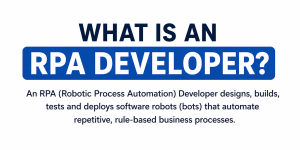







 Admission Open
 Admission Open
 Admission Open
 ROI Calculator