What Are the Features of Python? A Complete Guide for 2026
J
By Shubham Lal
September 19, 20268 min read
Published on September 19, 2026
SHARE THIS ARTICLE
Table Of Content
What Is Python?
What Are the Features of Python?
Basic Features of Python
Best Features of Python for Developers
Key Insights
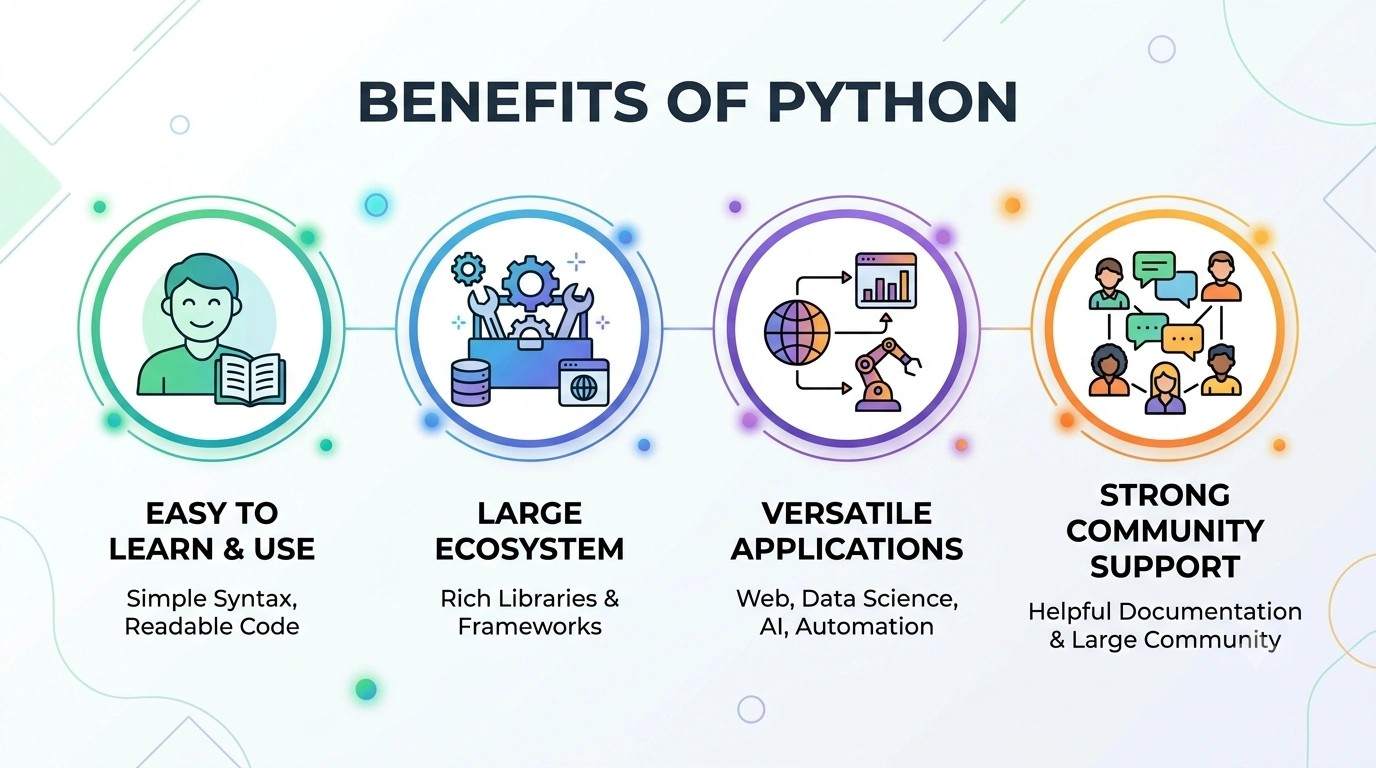
Python is known for its simple, readable syntax, making it accessible to beginners while supporting experienced developers in building complex applications.
The basic features of Python include high level programming, interpreted execution, dynamic typing, object oriented programming support, and an extensive standard library.
The best features of Python include its large third party ecosystem, cross platform compatibility, open source nature, automatic memory management, and strong community support.
Python's versatility allows it to be used for web development, data science, artificial intelligence, machine learning, automation, scientific computing, and software development.
In this blog, you'll learn about the features of Python, its key features, characteristics, advantages, limitations, common uses, and why learning Python can be useful in 2026.
Python continues to be one of the most widely used programming languages in the world, powering applications in web development, data science, artificial intelligence, automation, and more. Its simple syntax and broad ecosystem make it accessible to beginners while providing the tools experienced developers need to build complex applications.
But what makes Python so popular? The answer lies in its combination of simplicity, flexibility, readability, extensive libraries, and strong community support. In this blog, we explore the features of Python, its basic features, key characteristics, advantages, and why it remains relevant for developers in 2026.
Python is a high-level, general purpose programming language designed with an emphasis on code readability and developer productivity. It can be used to create everything from simple automation scripts to web applications and data-driven systems.
Python supports multiple programming approaches, including procedural, object oriented, and functional programming. This flexibility allows developers to choose an approach based on the requirements of their projects.
One reason Python is beginner-friendly is its relatively straightforward syntax. Developers can often write Python code using fewer lines than they would need in some other programming languages.
The features of Python are the qualities that make the language useful for different types of software development. These features influence how easily developers can write, understand, test, and maintain Python programs.
Some of the most important features include:
Simple and readable syntax
High level programming
Interpreted execution
Dynamically typed nature
Object oriented programming support
Extensive standard library
Large collection of third party libraries
Cross platform compatibility
Open source availability
Automatic memory management
Support for multiple programming paradigms
Strong community support
Let’s explore these key features of Python in more detail.
Understanding the basic features of Python can help beginners understand why the language is used across such a wide range of applications.
1. Simple and Readable Syntax
Python is known for its clean and relatively easy to understand syntax. Its design emphasizes readability, which can make code easier to write and maintain.
For beginners, this means they can focus more on programming concepts instead of spending too much time learning complicated syntax.
Readable code can also make collaboration easier because developers can understand and modify code written by others.
2. High Level Language
Python is a high level programming language. Developers do not generally need to manage low level computer operations directly while writing most Python programs.
This allows programmers to focus on solving problemsand building applications rather than dealing with hardware level details.
3. Interpreted Language
Python is commonly described as an interpreted language because Python programs are executed through the Python interpreter.
This makes it convenient for development and testing because developers can run code and identify issues during the development process.
The execution model can vary depending on the Python implementation, but the important point for beginners is that Python provides an interactive environment for writing and testing programs.
4. Dynamically Typed
Python uses dynamic typing. Developers do not need to explicitly declare a variable’s data type in the same way required by some statically typed languages.
For example, a variable can be assigned an integer and later assigned a string.
This can make Python code quicker to write, although developers still need to understand data types and how they behave during program execution.
5. Object Oriented Programming Support
Another important characteristic of Python is its support for object oriented programming.
Python allows developers to create classes and objects and use concepts such as inheritance, encapsulation, and polymorphism.
Object oriented programming can be particularly useful when building larger applications where developers need to organize code into reusable components.
Best Features of Python for Developers
The best features of Python are not limited to its syntax. Its ecosystem and flexibility also make it useful for professional software development.
6. Extensive Standard Library
Python comes with a large standard library that provides modules for many common programming tasks.
Developers can use these modules for tasks involving files, mathematics, dates, data formats, networking, testing, and other operations.
This reduces the need to build every basic functionality from scratch.
7. Large Third Party Ecosystem
Python has a broad ecosystem of third party packages and frameworks. Developers can install additional tools to extend what Python can do.
For example, developers working with data can use tools such as NumPy and pandas, while web developers can use frameworks such as Django and Flask.
For machine learning and artificial intelligence projects, Python also has a large ecosystem of specialized libraries and frameworks.
8. Cross Platform Compatibility
Python can be used across major operating systems, including Windows, macOS, and Linux.
This cross platform capability allows developers to create and run Python applications in different computing environments without completely rewriting the program for each platform.
9. Open Source
Python is open source and can be used without purchasing a proprietary language license.
Its source code is publicly available, and developers around the world contribute to its ecosystem.
This has helped Python develop a large community and a wide range of learning resources.
10. Automatic Memory Management
Python includes automatic memory management. Developers generally do not need to manually allocate and release memory for every object.
Python’s memory management system handles many of these tasks automatically, making development more convenient.
However, developers still need to write efficient code and understand how memory is used when building larger applications.
Key Features of Python That Support Modern Development
Python’s usefulness extends beyond basic programming. Several of its characteristics make it suitable for modern development environments.
11. Multiple Programming Paradigms
Python supports multiple programming styles. Developers can use procedural, object oriented, and functional programming approaches.
This flexibility allows teams to select an approach based on the application and development requirements.
12. Easy Integration
Python can interact with other programming languages and technologies. This makes it useful in projects where Python needs to work alongside existing systems.
For example, Python applications can communicate with databases, APIs, web services, and other software components.
13. Extensible and Embeddable
Python can be extended with components written in languages such as C and C++. It can also be embedded into applications to provide scripting capabilities.
This makes Python useful beyond standalone applications and allows developers to combine Python with other technologies.
14. Interactive Development
Python provides an interactive interpreter that allows developers to execute commands and test ideas quickly.
This can be particularly useful when learning programming, experimenting with functions, testing calculations, or exploring data.
15. Strong Community Support
Python has a large global developer community. Beginners can find tutorials, documentation, discussion forums, courses, and other learning resources.
For experienced developers, community support can make it easier to find solutions to common development challenges and discover useful tools.
Characteristics of Python
The characteristics of Python explain how the language behaves and why developers use it for different types of projects.
Characteristic
What It Means
Readable
Python code is designed to be relatively easy to understand
High level
Developers can work at a higher level of abstraction
Dynamically typed
Variable types do not usually need explicit declaration
Object oriented
Python supports classes and objects
Interpreted
Python code can be executed through an interpreter
Open source
Python is freely available and developed openly
Portable
Python can run across different operating systems
Extensible
Python can work with components written in other languages
Versatile
Python can be used across multiple technology domains
These characteristics contribute to Python’s flexibility and broad adoption.
Where Is Python Used?
One of the reasons Python remains relevant is its use across multiple technology fields.
Web Development
Python can be used to build websites and web applications with frameworks such as Django and Flask.
Data Science
Python is widely used for data analysis, data processing, visualization, and statistical work. Libraries such as pandas and NumPy provide tools for working with datasets.
Artificial Intelligence and Machine Learning
Python is commonly used in AI and machine learning projects. Its ecosystem provides tools for developing, training, testing, and deploying machine learning models.
Automation
Python can automate repetitive tasks such as file management, data processing, reporting, and other routine operations.
Scientific Computing
Researchers and engineers can use Python for numerical calculations, simulations, data analysis, and scientific applications.
Software Development
Python can also be used to build applications, scripts, tools, and software components for different business requirements.
Advantages of Python
The features of Python translate into several practical benefits for developers and organizations.
Easy to learn: Its readable syntax can make Python approachable for beginners.
Faster development: Developers can use Python’s libraries and straightforward syntax to build solutions efficiently.
Versatility: Python can be used in areas ranging from web development to AI, automation, and data science.
Large ecosystem: Developers have access to numerous libraries, frameworks, and development tools.
Maintainable code: Readability can make Python programs easier to understand and maintain.
Community resources: A large community provides documentation, learning resources, and technical support.
While Python has many advantages, it is not the ideal choice for every situation.
Python can have performance limitations compared with some compiled programming languages for certain CPU intensive applications. Its memory consumption can also be a consideration for specific use cases.
Python may not always be the first choice for applications that require extremely low level hardware control or highly optimized performance.
Therefore, developers should select a programming language based on the requirements of the specific project rather than choosing Python for every application.
Why Learn Python in 2026?
Python remains useful for people entering technology because its applications extend across several growing areas of software development.
A learner can begin with basic Python syntax and gradually move toward areas such as web development, data analytics, automation, artificial intelligence, or machine learning.
The language also provides a practical way to learn important programming concepts such as variables, functions, loops, data structures, classes, and modules.
For professionals, learning Python can also complement existing skills in areas such as data, cloud computing, software development, and automation.
Conclusion
Python’s popularity comes from more than its simple syntax. Its readability, flexibility, extensive libraries, cross platform capabilities, open source nature, and broad ecosystem make it suitable for beginners as well as experienced developers.
Understanding the features of Python provides a strong foundation for learning the language and exploring areas such as web development, automation, data science, and artificial intelligence. From the basic features of Python to its more advanced capabilities, each characteristic contributes to the language’s versatility.
For anyone planning to enter or grow in technology in 2026, learning Python can provide a useful programming foundation. The right way to use Python, however, depends on the project, its technical requirements, and the goals of the developer.
Frequently Asked Questions
The main features of Python include simple syntax, readability, high level programming, dynamic typing, object oriented programming support, portability, extensive libraries, automatic memory management, and open source availability.
The basic features of Python include its simple syntax, dynamic typing, high-level structure, interpreted execution, object oriented programming support, and extensive standard library. These features make it accessible for beginners.
Python combines readable syntax with a large ecosystem of libraries and frameworks. It can be used for web development, automation, data science, artificial intelligence, scientific computing, and software development.
The key characteristics of Python include readability, portability, dynamic typing, object oriented programming support, extensibility, versatility, and open source availability.
Shubham Lal
Lead Software Developer
Shubham Lal joined Microsoft in 2017 and brings 8 years of experience across Windows, Office 365, and Teams. He has mentored 5,000+ students, supported 15+ ed-techs, delivered 60+ keynotes including TEDx, and founded AI Linc, transforming learning in colleges and companies.
Get Free Upskilling Guidance
Fill in the details for a free consultation
Related Courses
Explore our programs
Online MCA Course | Master of Computer Applications

 September 19, 2026
 8 min read





 Key Insights
 ChatGPT
 Perplexity
 Claude
 Grok
Grok




 Artificial Intelligence and Machine Learning






 ROI Calculator




