Working with data structures in Python involves how efficiently one is able to store, access, and manipulate data. Two of the most usable data structures are arrays and lists. The differentiation between an array and a list in Python is very important for both a beginner in Python programming and an experienced programmer who wants to write optimized and scalable code.
This debate among array vs list, array vs list in Python, and array and list in Python crops up because superficially, both look similar. But their internal working, use cases, performance, and memory management totally differ from each other. In this blog, we will do a deep dive into all these differences with some practical sections for lists in Python examples to make concepts crystal clear.
What is an Array in Python? Understanding Array vs List
An array in Python is a data structure that stores elements of the same data type in contiguous blocks of memory. Arrays are particularly handy in situations where one operates with numerical data and big sets of data when performance and memory efficiency are the key to success.
Having said that, arrays in Python are normally created through either an array module or using third-party libraries like NumPy. Therefore, due to such characteristics, arrays are much more efficient for mathematical operations and scientific computing.
Key Characteristics of Arrays in Python
Stores elements of single data type
Faster execution for numerical operations
Requires importing the array module
Uses less memory than lists
Ideal for big number-crunching applications
Knowing about arrays extends your basic understanding of the difference between array and list in Python; in particular, when performance matters.
What is a list in Python? | Array and List in Python Explained
data types within a single collection. Lists are dynamic; their size may vary during execution. While comparing array vs list, the latter one is flexible and easier to use.
Python has one of the most powerful tools in programming: a list example that may comprise integers, strings, floats, or even other lists.
Key Features of Lists in Python:
It can store mixed data types.
Dynamic resizing capability
Built-in support without importing modules
slower than arrays for numeric computation
The program is extremely flexible and very newbie-friendly
The flexibility of lists underlines one of the important points in the comparison of arrays and lists in Python.
Both arrays and lists are fundamental when it comes to Python programming. Choosing the right structure based on your use case will directly affect performance, memory usage, and code clarity.
Another important understanding that comes into view when building data-intensive applications, machine learning models, or even just simple automation scripts in Python is the understanding of arrays versus lists. Lists are generally used for general-purpose programming in Python, while arrays are mostly chosen for computation-heavy tasks.
Array vs List in Python: Memory Management
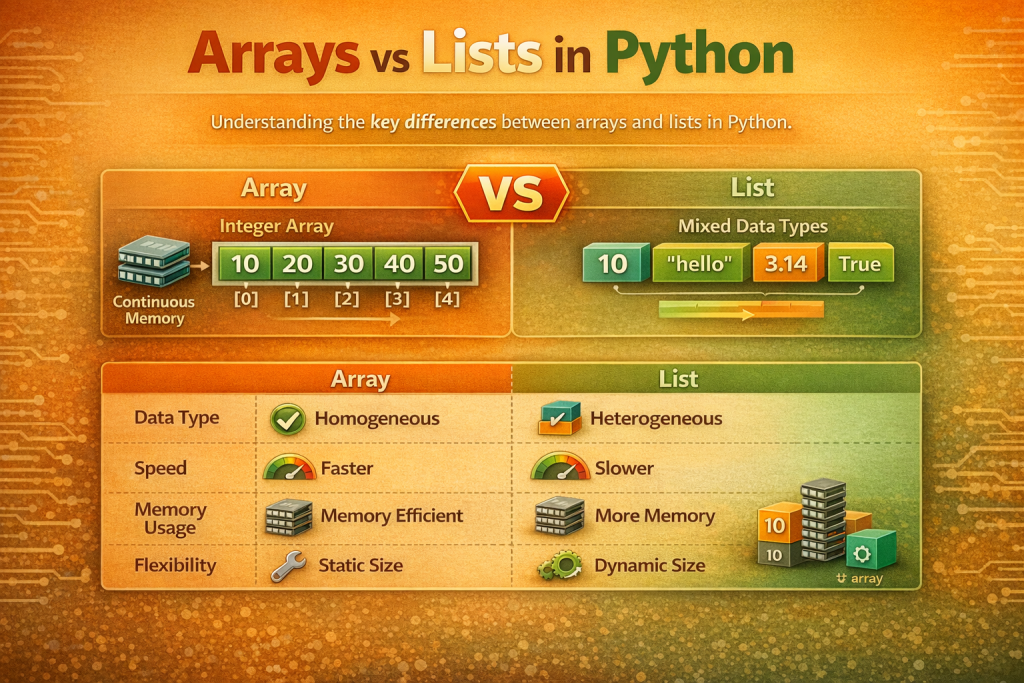
One of the main differences between arrays and lists in Python is how they use memory. Arrays hold elements of the same data type, allowing Python to use memory efficiently. Lists store references to objects, which takes up more memory.
Memory Comparison: Array and List in Python
– Arrays are memory-efficient.
– Lists consume more memory due to object references.
– Arrays are better for large numeric datasets.
– Lists offer flexibility but use more memory.
This distinction is important when looking at the differences between arrays and lists in Python for large-scale applications.
Performance Comparison: Array vs List
Performance is another important factor when comparing arrays and lists. Arrays work better than lists in mathematical operations because they are designed for numerical data.
Execution Speed in Array vs List in Python
– Arrays execute faster for arithmetic operations.
– Lists are slower because of type checking.
– Arrays are ideal for scientific computing.
– Lists are good for small datasets.
This performance gap highlights the differences between arrays and lists in Python.
Understanding syntax differences helps explain how arrays and lists are used in Python.
Array Syntax Example
from array import array
numbers = array(‘i’, [1, 2, 3, 4]) );
List in Python Example
numbers = [1, 2, 3, 4] );
A list in Python shows simplicity, while arrays need more setup. This reinforces the discussion of arrays versus lists.
Flexibility: Array and List in Python
Lists clearly win in flexibility when comparing arrays and lists in Python. They allow you to insert, delete, and modify elements easily.
Arrays are efficient but more rigid. This rigidity makes lists the preferred choice in most programming tasks.
Built-in Functions and Operations
Lists offer a variety of built-in functions like append(), extend(), remove(), and pop(). Arrays have fewer built-in operations. This highlights another difference between arrays and lists in Python.
Use Cases: When to Use Array vs List
Deciding between an array and a list depends on your needs.
Use Arrays When:
– Working with numerical data
– Performance is critical
– You need to optimize memory
Use Lists When:
– Handling mixed data types
– Flexibility is important
– Writing general-purpose programs
These cases illustrate when to use arrays and lists in Python.
Advantages of Arrays in Python
– Faster computation
– Lower memory consumption
– Ideal for data science and analytics
– Better performance in loops
These advantages make arrays a strong option in the arrays versus lists debate.
Advantages of Lists in Python
– Easy to use
– Very flexible
– Supported by built-in functions
– Suitable for beginners
A list in Python demonstrates why lists are popular.
Limitations of Arrays vs Lists
Arrays lack flexibility and need uniform data types. Lists are flexible, but they are slower and use more memory. Understanding these limitations helps clarify the difference between arrays and lists in Python.
Real-World Example: Array and List in Python
Think about storing student marks:
– Use arrays for numerical analysis
– Use lists for names, marks, and grades together
This example shows the differences between arrays and lists in Python more clearly.
Key Differences Between Array and List in Python
Feature
Array
List
Data Type
Same
Mixed
Speed
Faster
Slower
Memory
Efficient
Less efficient
Flexibility
Low
High
Common Mistakes When Choosing Between Array and List in Python
One of the biggest challenges developers face is picking the right data structure when comparing arrays and lists in Python. While both may seem similar at first, choosing the wrong one can result in inefficient code, increased memory use, and slower execution. Knowing how arrays and lists behave internally can help avoid these common mistakes.
A common error in the array and list decision process is using lists for large-scale numerical computations. Although a list in Python is easy to write and understand, they are not optimized for heavy math operations. Arrays, on the other hand, are built for numeric consistency and faster computation, making them a better choice in these situations.
Another frequent mistake in the array and list discussion is assuming arrays can store mixed data types like lists do. Arrays require uniform data types, which boosts performance but limits flexibility. Developers who don’t know this rule might run into runtime errors when trying to mix strings and integers in an array, which is allowed in a list.
Array & List in Python - Roles While Working on Data Science & Analytics
In contemporary data-driven applications, knowing the differences between array and list in Python programming has become even more important. Data science tasks include the manipulation of enormous data. In data science tasks, efficient memory use has become important because arrays greatly help data scientists perform numerical data manipulation tasks since they work seamlessly with NumPy.
Despite the similarity in the usage of array and list in Python, they have different applications in data science scenarios. An array in Python is applicable when matrix operations or vector computation is involved, and in statistics. A list, on the other hand, is typically applied in data processing or storing data temporarily before being stored in the array in Python. An example of a list in Python may include storing data before storing it in the array.
The use of lists instead of arrays in resource-intensive operations results in performance bottlenecks. This again highlights that knowledge about the difference between array and list concepts in Python programming is critical to people dealing with large datasets.
When Not to Use Array vs List in Python
Despite the advantages of arrays, they are not the most preferable in the context of the comparison of the array and the list in Python presented in this chapter. Arrays are less flexible and demand the same type for all elements, which makes them less usable in dynamic environments.
For instance, operations that include frequently changing data structure such as deleting elements would be better done in a list. An example of a Python list illustration provides efficient modification without worrying about the constraints of the data types. It is unlike arrays where consistency must be upheld.
It’s essential to comprehend the use cases where an array might not be preferred. A balance in the use of both the array and the list in Python makes the code both memory and time-efficient.
Best Practices for Utilization of Array & List in Python
To reap the maximum benefit from arrays vs. list, programmers should apply the best practices according to their application requirement. Arrays should be chosen in applications that involve large numbers with faster execution and memory savings as priorities. A list should be used in applications where flexibility and ease of implementation are important.
Another best practice for array vs. list in Python is that lists should be used during the initial stage of development, and after that, the performance-critical part should be optimized with arrays. This practice combines the benefits of both array and list in Python. By familiarizing themselves with these best practices, coders can develop cleaner, faster, and scalable code in the Python programming language and make well-informed decisions regarding the list vs. array debate.
Conclusion: Array vs List in Python – Which One Should You Choose?
Whether to use array vs list, array vs list in Python programming, and an array and list in Python programming depends on your final requirements. For example, arrays are used mainly when there is a need to have large amounts of mathematical and efficient computations.
Beginners can opt to use a list in Python examples. But as you advance with increasing projects where speed is important, you will rely on arrays. This understanding will help you in coding, as you will make optimized Python programs.
Frequently Asked Questions
The primary difference between array and list in Python is that the elements in the array are of the same data type, but in the case of a list, the data types can be different. Arrays in the context of array vs list in Python are more memory-efficient than lists.
While comparing array vs list, an array is fixed in size and holds data types that are similar in nature, whereas an ArrayList, which is common in the case of Java, can resize dynamically, like a list in Python example. In the case of array vs list Python, the list in Python acts in the same manner as an ArrayList by resizing dynamically.
In array vs list in Python, arrays are preferred for their efficiency in operations involving large numerical arrays, while lists are preferred for their programming applications. Whether to use arrays or lists in Python depends on whether the need for flexibility or speed has to be given preference.
In Python, an array is a data structure that stores a list of elements of the same kind in a contiguous manner. For a comparison between array and list in terms of their usage, an array in Python is used when a mathematical operation has to be performed.
Shubham Lal
Lead Software Developer
Shubham Lal joined Microsoft in 2017 and brings 8 years of experience across Windows, Office 365, and Teams. He has mentored 5,000+ students, supported 15+ ed-techs, delivered 60+ keynotes including TEDx, and founded AI Linc, transforming learning in colleges and companies.
 HOME > BLOG > IT/Software Development > Difference Between Array and List in Python: Key Uses & Examples
 January 8, 2026
 8 min read





 ChatGPT
 Perplexity
 Claude
 Grok
Grok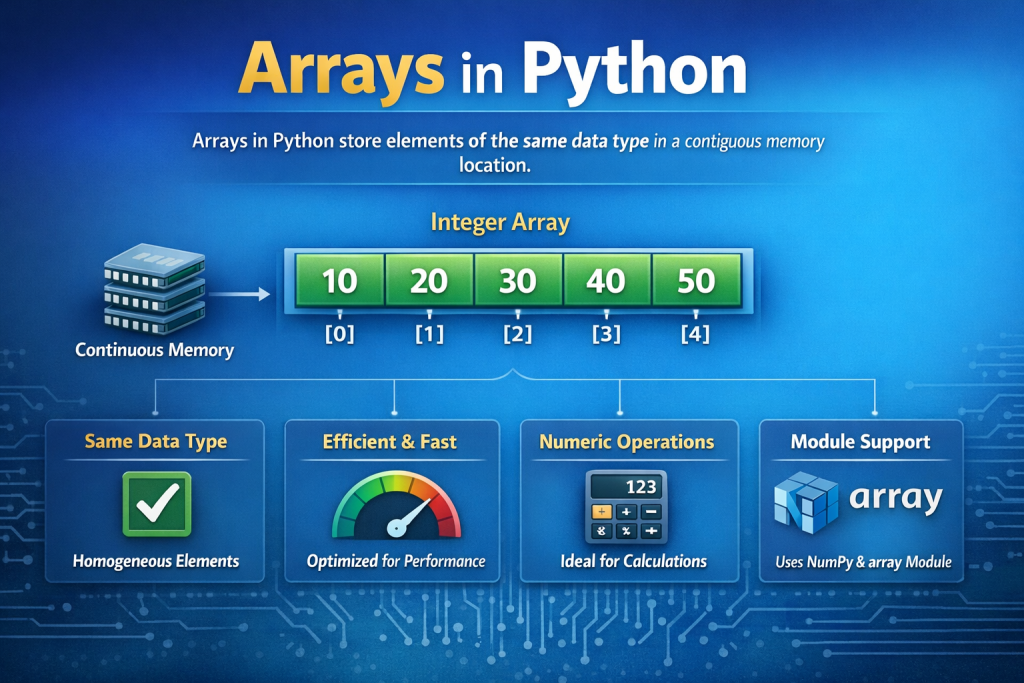






 Admission Open
 Admission Closed

 ROI Calculator