What is Application Development? Types, Process & Career Scope
J
By Shubham Lal
May 11, 20267 min read
Last updated on July 13, 2026
SHARE THIS ARTICLE
Table Of Content
The Core Pillars: Web vs. Mobile Application Development
The Blueprint: A 7-Phase Application Development Process
Strategic Build: Why Partnering with an App Development Company Wins
The Future: Career Scope for App Developers in 2026
Software doesn't exist in isolation anymore. Application development — the end-to-end process of designing, building, testing, and maintaining software for specific platforms and users — has evolved from producing standalone tools into engineering entire interconnected ecosystems where apps communicate, share data, and adapt in real time.
A decade ago, "building an app" meant shipping a discrete product. Today, it means architecting a node within a broader digital infrastructure. A single business applicationmight integrate with a CRM, a payment processor, an AI engine, and a customer data platform simultaneously. According to The Ultimate Guide to Application Development in 2026, this ecosystem-first mindset is now a baseline expectation, not a premium feature.
The biggest paradigm shift heading into 2026, however, is the move from mobile-first to AI-first development. Where teams once prioritized responsive design and touch interfaces, they now architect applications with embedded intelligence — predictive features, natural language inputs, and adaptive user experiences — from the very first sprint.
The modern app developer is fundamentally a solution architect. Technical execution still matters, but understanding business outcomes, data flows, and system dependencies defines what separates good developers from great ones.
That foundation shapes everything about how modern applications get built — starting with the platform choices developers face between web and mobile.
The Core Pillars: Web vs. Mobile Application Development
Now that we’ve established what application development means in 2026, it’s worth zooming in on the two categories that dominate most development conversations: web and mobile. They’re related, but they demand very different strategies, skill sets, and trade-offs.
Web Application Development: More Than a Website
Modern web applications have outgrown the humble webpage. Today’s browser-based tools — think project management platforms, CRM systems, and SaaS dashboards — rival desktop software in complexity and capability. The engine behind this shift is a combination of powerful JavaScript frameworks, serverless backends, and cloud-native architecture.
Web apps offer a critical advantage: universal access. Any device with a browser can run them, which makes deployment and updates dramatically simpler. No app store approvals. No version fragmentation. For businesses building internal tools or B2B software, this accessibility is often the deciding factor, as outlined in this complete guide to business application development.
Mobile Application Development: Three Paths, One Goal
Mobile application development splits into three distinct approaches, each with genuine strengths:
Native development — Built specifically for iOS (Swift/Objective-C) or Android (Kotlin/Java). It delivers maximum performance, hardware access, and a polished platform-specific experience. For applications that are graphics-intensive, security-critical, or deeply integrated with device sensors, native remains the gold standard.
Cross-platform development — Frameworks like Flutter and React Native allow a single codebase to run on multiple platforms. It’s faster and more cost-efficient, though some performance ceiling exists compared to native builds.
Progressive Web Apps (PWAs) — PWAs are web apps engineered to behave like native mobile apps. They’re installable, work offline, and load fast. For teams with limited budgets, a PWA can bridge the gap between a full website and a native app without doubling development costs.
The practical reality is that no single approach is universally correct — the right choice depends on your audience, performance requirements, and available resources. A consumer gaming app and an internal HR toolhave almost nothing in common from a development standpoint.
Understanding these pillars sets the stage for the next critical question: once you’ve chosen your platform, how does the actual development process unfold step by step?
The Blueprint: A 7-Phase Application Development Process
Understanding what application development is sets the stage — but knowing how it actually gets built is where theory meets reality. Whether you’re evaluating an internal project or vetting an app development company, recognizing each phase of the process is essential for setting realistic expectations and avoiding costly missteps.
Phase 1–2: Planning and Analysis (Discovery)
Every successful application starts with a clearly defined problem. The planning phase establishes project scope, budget, timeline, and stakeholder alignment. This feeds directly into requirements analysis, where teams document functional needs, technical constraints, and user expectations.
Skipping or rushing discovery is one of the most common causes of project failure. In practice, incomplete requirements account for a significant share of budget overruns and delayed launches. A thorough Software Development Life Cycle framework treats this stage as non-negotiable — not a formality.
Phase 3–4: Design and Architecture, Then Coding
Once requirements are locked, the design phase translates business logic into a technical architecture: system design, UI/UX wireframes, database schema, and API structure. Decisions made here echo through every subsequent phase, making it worth the time investment.
Development then brings the design to life. Modern teams typically work in Agile sprints, delivering working code incrementally rather than building everything at once before review. This iterative model, outlined well in Riseup Labs’ methodology overview, reduces risk and surfaces problems early.
Phase 5: Testing and QA — The Most Overlooked Step
Testing is where failed projects reveal themselves. Teams that treat QA as an afterthought routinely pay for it post-launch through security vulnerabilities, performance issues, and user churn. A rigors QA phase covers unit testing, integration testing, performance benchmarking, and user acceptance testing (UAT).
Phase 6–7: Deployment and Ongoing Maintenance
Launching is not the finish line. According to application lifecycle management best practices, post-launch maintenance – including patches, performance monitoring, and feature iteration – typically represents 60–80% of total lifetime application cost.
The application lifecycle doesn’t end at launch; it simply enters its most expensive phase. Understanding this reality is critical before you decide who should own the development process— a question the next section addresses directly.
Strategic Build: Why Partnering with an App Development Company Wins
The 7-phase process outlined earlier looks clean on paper. In practice, executing it demands a breadth of talent that most businesses simply don’t have sitting on the bench. That gap is exactly where the decision to build in-house versus partner with an external team gets real.
The True Cost of Building In-House
Assembling your own development team sounds appealing — until the spreadsheet reveals the full picture. Recruiting senior app developers alone can take three to six months. Add onboarding, benefits, software licenses, and ongoing training, and the overhead climbs fast. Retention compounds the problem; specialized engineers are perpetually in demand, meaning turnover can derail a project mid-sprint. The hidden costs of in-house development frequently exceed the project budget before a single line of production code ships.
Immediate Access to Specialized Talent
A dedicated app development company arrives with benched expertise in areas that are genuinely hard to hire for — particularly AI integration and application security. Rather than spending months recruiting niche specialists, businesses gain immediate access to teams who have already solved similar architecture challenges. In practice, this compression of ramp-up time translates directly into faster time-to-market.
The Citizen Developer Advantage
The rise of low-code platforms is reshaping how work gets divided. Business teams can now prototype workflows and handle straightforward internal tools independently, freeing professional developers to focus on core architecture, performance, and security — the areas where expertise genuinely matters.
Risk Mitigation Through Established QA
Experienced development partners bring structured QA processes that are difficult to replicate quickly in-house. Consistent testing frameworks, documented review cycles, and defined release gates reduce costly post-launch failures.
All of this sets an important stage: understanding who builds these applications — and what their career trajectory looks like in 2026 — is the natural next question.
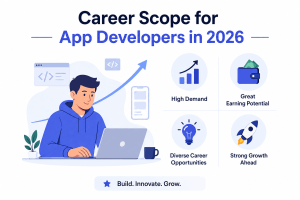
The Future: Career Scope for App Developers in 2026
The strategic advantages of partnering with a development firm are clear — but what about the individuals powering those teams? The talent landscape behind application development is shifting fast, and the numbers tell a compelling story.
Demand Is Outpacing Supply
Developer demand shows no signs of cooling. According to The Ultimate Guide to Application Development in 2026, the field continues to expand well beyond the available pool of qualified professionals. That gap creates genuine leverage for developers entering or advancing within the industry — qualified candidates can expect faster hiring cycles, stronger offers, and more negotiating power than in almost any comparable technical field.
Specializations That Command Premium Salaries
Not all development paths are equal in earning potential. The highest-demand specializations right now include:
AI integration — building intelligent features into consumer and enterprise apps
Cloud-native architecture — designing systems built for scalability from day one
Salary trends also differ meaningfully by discipline. Mobile application developers, particularly those working in iOS and Android ecosystems, consistently command competitive packages. Meanwhile, web application development specialists with expertise in modern frameworks and API-first architecture are seeing strong salary growth driven by enterprise digital transformation budgets.
From Coder to AI Orchestrator
Perhaps the most significant career shift is conceptual. The role of the developer is evolving from someone who writes code to someone who directs AI tools to generate, test, and optimize it. Developers who learn to orchestrate AI effectively will outpace those who don’t — not because coding skills become worthless, but because strategic thinking becomes the true differentiator.
Understanding where the profession is headed naturally raises broader questions about the state of the industry itself — which is exactly where a clear summary and practical answers become essential.
Application development in 2026 sits at a powerful intersection:AI-driven tools, freemium and subscription distribution models, and structured Software Development Life Cycle (SDLC) frameworks are converging to lower barriers while raising expectations. Businesses that understand this landscape — and respond strategically— will consistently outpace those that don’t.
The throughline across every section of this guide is straightforward: technical skill alone isn’t enough. Success requires pairing strong engineering execution with clear business strategy, whether you’re choosing between native and cross-platform development, evaluating development partners, or planning a tech career path.
The apps that win aren’t just well-built — they’re well-positioned from day one.
Frequently Asked Questions
Application development is the end-to-end process of designing, building, testing, and deploying software to solve a specific user or business problem, guided by a structured Software Development Life Cycle.
The primary types are native (iOS or Android-specific), cross-platform, and progressive web apps — each balancing performance, cost, and reach differently.
A specialized firm brings multidiscipline teams, proven processes, and faster time-to-market — reducing costly rework and strategic missteps.
Strong. Demand for mobile, AI-integrated, and enterprise app developers continues growing, with specializations in security and low-code platforms commanding premium compensation through 2030 and beyond.
Shubham Lal
Lead Software Developer
Shubham Lal joined Microsoft in 2017 and brings 8 years of experience across Windows, Office 365, and Teams. He has mentored 5,000+ students, supported 15+ ed-techs, delivered 60+ keynotes including TEDx, and founded AI Linc, transforming learning in colleges and companies.
Get Free Upskilling Guidance
Fill in the details for a free consultation
Related Courses
Explore our programs
Admission Closed
Information Technology Management for Strategic Business Leadership: A Programme for Future CIOs and CTOs
 HOME > BLOG > IT/Software Development > What is Application Development? Types, Process & Career Scope
 May 11, 2026
 7 min read





 ChatGPT
 Perplexity
 Claude
 Grok
Grok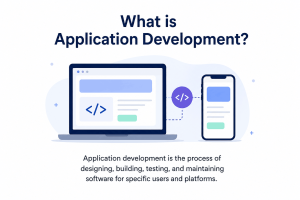



 Admission Closed

 Admission Closed
 Admission Open
 Admission Open
 ROI Calculator