Modular Programming: Fundamental Guide to Concepts, Benefits & Applications
J
By Shubham Lal
April 19, 20267 min read
Published on April 19, 2026
SHARE THIS ARTICLE
Table Of Content
What is Modular Programming?
Principal Elements of Modular programming
Advantages of Modular Programming
Difference Between Modular Programming and Structured Programming
Modern systems are more complex than ever. They are now capable of handling large amounts of data, integrating with multiple services, delivering high performance, and remaining easy to maintain. In practice, managing large-scale systems with a single block of code can be very difficult. To save from this hassle, modular programming was introduced.
Modular programming is a software development process that breaks large programmes into smaller, manageable parts, known as modules. Each module is responsible for performing its own function, but it works together with other modules to form a complete system. This technique allows developers to manage complex programmes efficiently and create adaptable software solutions.
Companies relying mostly on digital systems, the need for structured and maintainable code has increased. Now developers are responsible for writing code that is not only functional but also easy to maintain, update, and test whenever required. Thus, if you’re here to understand what modular programming is, this blog is for you. You will read about the advantages of modular programming and also how it will shape the future of software development.
Think of modular programming as creating a machine out of multiple parts. To build a working machine, you take many smaller pieces and assemble them together; each part has its own job, and when combined, they produce a single unit.
In programming, modular programming is like building software using modules (the small pieces). A large piece of software can be broken down into modules; each will have a feature (or task it performs). Examples of features within a module include capturing user input, processing data, and connecting to a database.
Every module usually contains:
A clearly defined purpose
Instructions on how to accomplish that purpose
A way to communicate with other modules
For example, in an online shopping application, different modules may perform tasks such as:
User login and authentication
Product listing and search
Order processing
Payment handling
The other advantage of using a modular programming technique is that if a modification needs to be made to an existing module, the developer could make that change without having to rewrite the rest of the application. Therefore, using a modular programming approach saves time and minimizes the risk of introducing new problems while making changes to an application.
The following fundamental aspects of modular programming will help to enhance the design and functionality of your software systems.
1. Separation of Concern
Each module is responsible for performing a single task. This helps to prevent code from becoming complicated and make sure other parts of the programme do not overlap each other.
2. Encapsulation
Each module will encapsulate its own inner workings and provide only the interfaces necessary for other modules to communicate with it. This will protect the internal logic of your module while also providing a means for other modules to access your module’s services via well-defined methods.
3. Reusability
One module can be used on other projects. It means that when a module is created and tested, it can be used in other applications, saving developers time to rewrite the same code all over again.
4. Maintainability
The concept of breaking complex programmes into modules makes maintenance easier. Developers now easily find the specific module where a problem is seen and fix the bugs without affecting other programmes.
Advantages of Modular Programming
AI tools
There are many benefits of modular programming, making it ideal to be used in modern software development. Some of those benefits are:
1. Better Code Readability
When code is divided into smaller modules or functions, it becomes much easier to understand. Each function is designed to handle one specific task, which keeps the code organized and clean.
Compared to large monolithic files containing thousands of lines of code, modular programs usually have smaller files that are easier to follow. For example, many well-structured applications keep functions within a few hundred lines, making it simpler for developers to understand what each part of the program is doing.
However, it’s important not to overdo modularization. If the code is split into too many tiny functions or spread across too many files, it can become confusing. When done correctly, though, small functions with clear names can explain what the code does without needing many comments.
2. Easier Testing
Modular programming also makes testing much easier. Since each module focuses on a specific function, developers can test that module independently without worrying about the entire system.
Testing small pieces of code allows for more detailed and accurate tests. It’s much easier to identify issues in a small function than in a large block of code that performs several tasks at once.
In many cases, test cases also act as examples of how the code works. If someone wants to understand how a module behaves, looking at the tests can provide useful insights.
3. Easier to Locate Code
Modular programming allows developers to organize related functions into separate files or libraries. This structured strategy makes it easier to locate specific parts of the code later.
Developers can also create consistent naming conventions and folder structures, which further simplifies navigation. When code follows a clear structure, it becomes easier to predict where certain functions or files might be located.
This saves time when debugging, updating features, or adding new functionality.
4. Code Reusability Without Duplication
One of the most useful benefits of modular programming is code reusability. Instead of writing the same code multiple times, developers can create a module once and reuse it in different parts of the program.
For example, if a function performs a common task such as handling data or interacting with the user interface, it can be placed in a shared module and used across multiple projects.
This avoids unnecessary duplication and keeps the codebase smaller and more efficient.
5. Faster Bug Fixes
Since each module serves as a single source for specific functionality, fixing bugs becomes much simpler. If a problem occurs within a module, developers only need to fix the code in that one place.
Once the issue is resolved, every part of the program that relies on that module automatically benefits from the fix. This approach reduces the chances of inconsistent behavior caused by multiple versions of the same code.
6. Safer Updates
Modular programming often uses APIs (Application Programming Interfaces) to define how different parts of the program interact with each other. As long as these APIs remain unchanged, developers can update the internal logic of a module without affecting other parts of the program.
This reduces the risk of accidentally breaking existing features when making improvements or updates.
7. Easier Refactoring
Refactoring refers to improving or reorganizing code without changing its functionality. Modular programming makes this process much easier.
Since the code is already separated into logical components, developers can modify or improve individual modules without touching the entire system. This is particularly useful when migrating projects to new technologies or optimizing performance.
8. Better Team Collaboration
Modular programming is especially helpful when multiple developers or teams work on the same project. By dividing the software into separate modules, teams can work on different components simultaneously without interfering with each other’s code.
This reduces version conflicts and allows teams to focus on their assigned modules. Each module can have its own responsibilities, ownership, and documentation, making collaboration smoother and more efficient.
Difference Between Modular Programming and Structured Programming
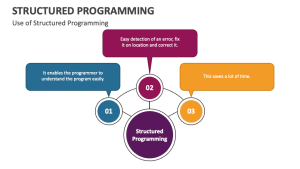
Many learners get confused between modular programming and structure programming. This is because both share the same aim to enhance the code organization. But there are also some differences between these two:
Structured Programming
*collidu.com
Structured programming mainly focuses on organising code with logical control structures such as loops, conditional statements, and functions. Its primary goal is to prevent complex control flows and improve programme clarity.
Modular Programming
On the other hand, modular programming mainly focuses on categorising a programme into independent modules that perform specific functions.
Key Differences
Feature
Modular Programming
Structured Programming
Focus
Dividing programs into modules
Organizing code with control structures
Complexity Management
High
Moderate
Reusability
Strong
Limited
Team Collaboration
Easier
More difficult
Real-World Application of Modular Programming
Modular programming has become central to modern software development. Most large applications rely on modular programming to manage complexity.
Web Applications
In web apps, there are modules responsible for Authentication, Database access, API integrations, and User Interface. Most web frameworks, such as React, Angular, and Django, use modular architecture extensively.
Mobile Applications
There are several mobile apps using modular programming to create separate blocks for features such as User Interface, Syncing Data, and Notifications. With modular programming, developers can modify and update certain modules without affecting the rest of the application.
Enterprise Applications
For larger enterprise applications, it is common to have numerous modules working together. Modular programming helps provide maintainability and scalability for the application over time.
How Professionals Can Learn Modular Programming Skills
To become proficient in modular programming, you need to have an understanding of programming techniques, software architecture, and good software development practices. So, if you want to gain advanced technical and analytical skills, register for the executive education programme offered by various prestigious universities in collaboration with Jaro Education.
Our programme is designed for real-world application and offers exposure to modern technologies used in the Industry. Also, if you’re enrolling with us, you’re not getting educational support, but career-building opportunities, academic assistance, and networking are plus benefits. Visit our website to learn about us.
Frequently Asked Questions
Modular programming is a software development technique where a program is divided into smaller components called modules, each responsible for a specific function within the system.
Some advantages of modular programming include improved code readability, easier testing, better collaboration among developers, and increased code reusability.
Structured programming focuses on organizing code using control structures like loops and conditions, while modular programming divides the program into independent modules.
Modular programming helps developers manage complex systems by breaking them into smaller components, making software easier to maintain, test, and expand.
Shubham Lal
Lead Software Developer
Shubham Lal joined Microsoft in 2017 and brings 8 years of experience across Windows, Office 365, and Teams. He has mentored 5,000+ students, supported 15+ ed-techs, delivered 60+ keynotes including TEDx, and founded AI Linc, transforming learning in colleges and companies.
 HOME > BLOG > IT/Software Development > Modular Programming: Fundamental Guide to Concepts, Benefits & Applications
 April 19, 2026
 7 min read





 ChatGPT
 Perplexity
 Claude
 Grok
Grok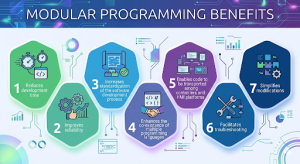




 Admission Open
 Admission Closed

 Admission Open
 Admission Open

 ROI Calculator




