HOME > BLOG > Web Design > What Is Web Development? (Definition, Types, Career)
Web Design
What Is Web Development? (Definition, Types, Career)
J
By Shubham Lal
April 19, 20269 min read
Last updated on July 15, 2026
SHARE THIS ARTICLE
Table Of Content
Web Development Definition
Major Responsibilities of a Web Developer
Types of Web Development
Essential Skills for Web Development
Ever wondered how websites you visit daily are created? In this cyberage, digitalisation has become a huge part. From reading online books to shopping and booking tickets, these activities are done smoothly with the help of websites or mobile applications. And each of these platforms is developed through the process called 'website development'. It is the process of creating and deploying websites that are not only responsive but also user friendly and smooth for users.
Whether we talk about individual, profit or non-profit organisation, everyone has their own website. The website is the face of the brand that represents its services and products. This has led to an increase in the need for professional web developers who can design and develop strong, secure, and responsive websites. Thus, if you are planning to enrol in a web development programme or choose courses, this first step is to understand fundamentals. In this guide, you will get to know about web development, its various types, the skills required to be a developer, and career opportunities. Let’s get started.
To understand what web development is, imagine building a house. Before the house is constructed, architects create a blueprint that outlines the structure and layout. Construction workers then build the house based on that plan, and finally, interior designers make sure everything looks appealing and comfortable.
The process of creating a website works in a very similar way.
In the digital world, web developers act like construction workers of the internet. They take the design ideas and plans created by designers and turn them into a fully functional website using programming languages and tools. Without web developers, websites would only exist as visual concepts but would not function in real life.
Web development is not just about writing code. It involves multiple stages that ensure a website works correctly, looks good, and meets the goals of the client or business.
A functional website is a result of great planning. This is the stage where developers, designers, and project managers collaborate with the client or business owner to get a clear idea of their needs and wants.
During the planning phase, several important questions are asked:,
What is the primary goal of the website?
Who is the target audience?
What features should be included in the website?
What type of content will be shown?
Mapping
Developers prepare a site map that lists all the web pages of the website and their relationships. Imagine it as a navigation map for the website. Each page is linked via navigation menus so that users can smoothly transition from one section to another. For instance, a basic website structure could consist of: Home page, About Us page, Services page, Blog section. And Contact page.
Design
Before writing any code, designers focus on how the site looks. They’re often handled by graphic or web designers. A strong design matters because it sets the first impression and helps users feel more comfortable. They consider the following things:
What colors to use
Which fonts work best
How pages are structured, where images are placed, and how buttons and forms are designed.
Coding
Web developers use various technologies to build different parts of the website. These may include languages for structuring content, styling the interface, and adding interactive features.
During coding, developers ensure that the website:
Works properly on different devices such as smartphones, tablets, and desktops
Loads quickly and efficiently
Provides smooth navigation for users
Integrates with databases or external services if required
Review
Before launching, the site goes through testing. That’s called quality assurance. In testing, developers check several factors such as, Broken links or missing pages, Bugs in how features work, compatibility across different browsers, loading speed, and any hidden security risks.
Launch
After all testing is completed and the client approves the final version, the website is uploaded to a web server and made available to the public. At this point, anyone with the website link can access it.
However, web development does not end with the launch. Developers often continue to maintain the website by fixing bugs, updating features, and improving performance over time.
If you want to explore more about technologies used in web development, you can
Web development is not only limited to just designing the website, the field is broad. Here are three main types of web development you should know about:
Front-End Development
The term ‘front-end’ is related to a part of the website that is visible and interactable by the users. It is in charge of the visual design and user-friendliness of the website. The front-end developer may work on various components, including:
Website layouts
Navigation menus
Buttons and forms
Animations and interactive components
To design the front-end of any website which is called interface, various programming languages like HTML, CSS, and JavaScript are used. This also makes the user navigation and interaction with the website smooth and engaging.
Back-End Development
Back-end development is concerned with the aspects that are invisible to users. Common languages for back-end development include Python, Ruby, Java, and PHP. Back-end developers are responsible for server-side logic, databases, and application functionality. Essentially, they make sure that data is accurately exchanged between the server and the user interface. Some of their major responsibilities are as follows:
Managing databases
Creating APIs
Handling user authentication
Processing form submissions
Managing server operations
Full-Stack Development
Full-stack development is a fusion of front-end and back-end development. A full-stack developer has the knowledge and ability to cover all aspects of a web application, e.g., working on the user interface design, database management, and server operations. In fact, there are many professionals who begin with learning front-end or back-end development, after which they master both to become full, stack developers.
For example, a full-stack developer might:
Build the website interface using React
Create server logic using Node.js
Manage databases using MongoDB
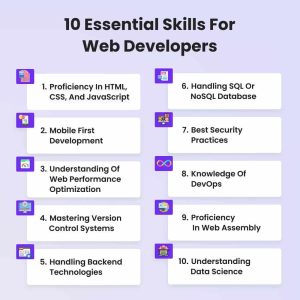
Essential Skills for Web Development
*betatestsolutions.com
Here are some of the most important abilities required in this field.
Technical Skills
Web development stands on technical abilities. Knowing key tools like HTML CSS and also JavaScript matters most. A grasp of programming languages such as Python, PHP, or Ruby matters just as much when diving into back-end work.
What counts here isn’t just interest; it’s hands-on familiarity with these tools that shapes real progress. Working well with tools such as GitHub matters for coders, since these keep track of edits while making teamwork smoother. A solid grasp lets groups avoid confusion when updating software together.
Design and User Experience
A good website should function as intended and be enjoyable for the user.
A basic understanding of design will allow developers to use proper design principles in creating their layouts so that they are visually appealing and easy to navigate through.
Knowledge of user experience (UX) principles, developers will also ensure that users can find the information they are looking for.
Problem-Solving and Attention to Detail
After website designing and development, testers test the website to check if there is any bug or error. Thus, a developer must be a quick problem-solver by analysing issues carefully. Attention to detail is equally important because even small mistakes in code can cause functionality issues.
Communication and Collaboration
Websites are rarely built by a single person. Most projects involve teams of designers, developers, project managers, and clients.
Clear communication helps ensure that everyone understands the project requirements and works together efficiently to achieve the desired outcome.
Let’s explore the different career roles in web development and the salary expectations associated with them.
Front-End Developer
A Front-End Developer focuses on the part of the website that users interact with directly. Their job is to create visually appealing and user-friendly interfaces. They work closely with designers to convert design mockups into fully functional web pages.
Front-end developers mainly use technologies such as:
HTML
CSS
JavaScript
Frameworks like React, Angular, or Vue.js
Average Salary
The salary of a front-end developer depends on experience, location, and skill level.
Entry-level: ₹3 LPA – ₹6 LPA
Mid-level: ₹6 LPA – ₹12 LPA
Experienced professionals: ₹12 LPA – ₹20 LPA or more
Note: Developers with strong knowledge of modern frameworks like React often receive higher salary packages.
Back-End Developer
A Back-End Developer works on the server side of a website or application. While front-end developers handle the visible interface, back-end developers manage the systems that process data, run applications, and communicate with databases.
Their responsibilities include:
Building server-side logic
Creating APIs
Managing databases
Implementing security and authentication systems
Average Salary
Back-end development roles generally offer competitive salaries because of the complexity involved in managing server infrastructure.
Entry-level: ₹4 LPA – ₹7 LPA
Mid-level: ₹8 LPA – ₹15 LPA
Senior developers: ₹15 LPA – ₹25 LPA or higher
Full-Stack Developer
A Full-Stack Developer is skilled in both front-end and back-end development. This means they can work on every layer of a web application, from designing the interface to managing the server and database.
Because of their broad knowledge, full-stack developers are highly valued by companies, especially startups where developers are expected to handle multiple responsibilities.
Typical tasks include the following:
Building user interfaces
Writing server-side logic
Integrating databases
Deploying applications to servers
Average Salary
Since full-stack developers possess a wider skill set, they usually command higher salaries.
Entry-level: ₹5 LPA – ₹8 LPA
Mid-level: ₹10 LPA – ₹18 LPA
Senior professionals: ₹20 LPA – ₹35 LPA or more
Web Designer / UI Developer
A Web Designer or UI Developer focuses on the visual and aesthetic aspects of websites. Their work ensures that websites are visually attractive and easy to navigate.
They typically work with:
Design tools like Figma, Adobe XD, or Sketch
Basic HTML and CSS for implementing designs
UX principles to improve usability
Average Salary
Entry-level: ₹2.5 LPA – ₹5 LPA
Mid-level: ₹5 LPA – ₹9 LPA
Senior designers: ₹10 LPA – ₹15 LPA
Freelance Web Developer
Many developers choose to work independently as freelancers. Freelancing allows developers to work with multiple clients and choose projects based on their interests.
Freelance developers usually build websites for businesses, startups, bloggers, or e-commerce platforms.
The income of a freelance web developer can vary widely depending on experience, skills, and project complexity.
Typical Earnings
Small website projects: ₹15,000 – ₹50,000 per project
Medium business websites: ₹50,000 – ₹2,00,000
Advanced web applications: ₹2,00,000 – ₹10,00,000 or more
For individuals who want to build a strong foundation in web development and software technologies, learning through a structured program can be extremely helpful. Jaro Education provides professional upskilling programmes in collaboration with reputed universities and institutions.
We are known for offering online and blended learning programs designed to help students and working professionals enhance their technical and professional skills. We collaborate with leading universities and institutions to provide industry-relevant programs that prepare learners for modern digital careers.
Relevant Courses for Learning Web Development
If you are planning to build a career in web development or IT, Jaro Education offers several web development courses that can help you gain the required knowledge and technical expertise.
Master of Science (Information Technology) – Amity University
One of the most relevant programs for aspiring developers is the Master of Science (Information Technology) offered by Amity University through Jaro Education.
This program covers several essential technology areas, including:
The future of web development is extremely promising as businesses continue to expand their digital presence. Skilled developers are in high demand across industries, making this one of the most attractive career options in the technology sector.
By learning the right programming languages, gaining practical experience, and enrolling in professional web development courses, aspiring developers can build a strong foundation and unlock numerous career opportunities.
Frequently Asked Questions
Web development is a combination of tasks such as coding, designing layouts, and making websites really work on various devices and browsers. It mainly deals with creating and keeping websites or web- based applications.
Major skills are coding talents with languages like HTML, CSS, and JavaScript, as well as back-end languages like Python, PHP, or Java at times. Besides, problem-solving and a dash of design are also helpful.
You can acquire the fundamentals of web development within 3 to 6 months, but attaining a highly skilled level may require 1, 2 years of continuous training and practice.
Definitely! Web development courses are beneficial as they offer a planned way of learning, hands- on tasks, and help which enable even the beginners to comprehend the concepts quicker and acquire the skills necessary for work.
Shubham Lal
Lead Software Developer
Shubham Lal joined Microsoft in 2017 and brings 8 years of experience across Windows, Office 365, and Teams. He has mentored 5,000+ students, supported 15+ ed-techs, delivered 60+ keynotes including TEDx, and founded AI Linc, transforming learning in colleges and companies.

 April 19, 2026
 9 min read




 ChatGPT
 Perplexity
 Claude
 Grok
Grok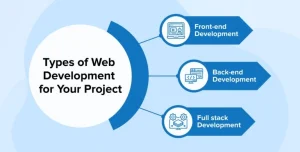



 Admission Open
 Admission Closed

 Admission Open
 Admission Open
 ROI Calculator