10 Resume Skills That Employers Value Across Industries
J
By Bhargavi R
August 12, 20269 min read
Published on August 12, 2026
SHARE THIS ARTICLE
Table Of Content
Why Are Skills Important on a Resume?
10 Resume Skills Employers Value Across Industries
Soft Skills vs Technical Skills: What Should You Include?
How to Choose the Right Skills to Add to Resume
Key Insights
Employers value a combination of technical and interpersonal resume skills, including communication, problem-solving, teamwork, adaptability, leadership, analytical thinking, organisation, creativity, and customer focus.
A strong resume should balance technical skills for resume with relevant soft skills for resume, based on the requirements of the specific role .
Instead of simply listing skills, demonstrate them through projects, responsibilities, achievements, action-oriented examples, and measurable outcomes to make your capabilities more credible.
When choosing skills to add to resume, review the job description, prioritise relevant strengths, and include only skills you can confidently discuss and support with experience.
In this blog, you'll learn about 10 valuable resume skills, how to demonstrate them with practical examples, how to balance soft and technical skills, and how to tailor your skills to different career stages and job requirements.
A strong resume does more than list your education and work experience. It should quickly communicate what you can contribute to an organisation. While job-specific qualifications vary across industries, certain resume skills are valued by employers almost everywhere.
Whether you are applying for a role in technology,finance, marketing, healthcare, education, consulting, operations, or management, demonstrating the right combination of technical capabilities and interpersonal strengths can make your resume more relevant. Employers increasingly look for candidates who can solve problems, communicate effectively, work with others, adapt to changing situations, and use technology to improve outcomes.
However, simply creating a long list of skills is not enough. The key is knowing which skills to add to resume and how to demonstrate them through your professional experience.
This guide explores 10 valuable skills that can strengthen your resume across industries, along with practical examples of how to present them.
The skills section gives recruiters a quick overview of your capabilities. It can also help demonstrate whether your profile aligns with the requirements of a particular position.
Different jobs naturally require different competencies. Asoftware developer may need programming and database skills, while a marketing professional may need campaign management and analytics expertise. However, both professionals can benefit from communication, problem-solving, collaboration, and adaptability.
This is why an effective resume should balance technical skills for resume with relevant soft skills.
Instead of adding every skill you have ever learned, focus on capabilities that are relevant to the role and supported by your experience. Whenever possible, demonstrate the skill through an achievement, project, responsibility, or measurable outcome.
10 Resume Skills Employers Value Across Industries
1. Communication
Communication is one of the most transferable workplace skills. Professionals across industries need to communicate with colleagues, managers, customers, clients, vendors, and other stakeholders.
Strong communication includes written communication, verbal communication, presentations, active listening, and the ability to explain complex information clearly.
For example, a technology professional may need to explain a technical issue to a non-technical stakeholder, while a sales professional may need to communicate a product’s value to a customer.
When adding communication to your resume, avoid simply writing “good communication skills.” Instead, demonstrate how you used communication in your work.
Resume skills sample: “Presented project updates to cross-functional stakeholders and translated technical requirements into clear business objectives.”
This provides more context than simply listing communication as a skill.
2. Problem-Solving
Employers value professionals who can identify problems, analyse possible causes, evaluate solutions, and take appropriate action.
Problem-solving is relevant to almost every profession. An operations professional may need to resolve process inefficiencies, while a finance professional may investigate discrepancies in financial data. A product manager may analyse customer problems and determine potential solutions.
To demonstrate problem-solving, describe a situation where you identified an issue and contributed to a solution.
Resume skills sample: “Identified process bottlenecks and implemented workflow improvements that reduced delays.”
This approach shows the skill through an outcome rather than simply mentioning it.
3. Teamwork and Collaboration
Modern workplaces often depend on cross-functional collaboration. Employees may work with people from different departments, locations, backgrounds, and areas of expertise.
Teamwork involves contributing to shared goals, listening to colleagues, managing differences, sharing information, and taking responsibility for your role.
This is one of the most important soft skills for resume content because it demonstrates how you work with others.
Instead of adding only “team player,” explain how you collaborated.
Resume skills sample: “Collaborated with marketing, sales, and product teams to coordinate a multi-channel product launch.”
This demonstrates teamwork while also giving recruiters context about your experience.
4. Adaptability
Businesses frequently experience changes in technology, customer expectations, market conditions, processes, and organisational priorities. Employers therefore value professionals who can adjust to new situations and continue performing effectively.
Adaptability can involve learning a new tool, taking responsibility for a new process, working in a changing environment, or responding to shifting priorities.
If you are changing careers, adaptability can be especially valuable because it can demonstrate your ability to transfer existing capabilities into a new professional environment.
Resume skills sample: “Adapted to a newproject management platform and supported the team during the transition to the updated workflow.”
The example shows that adaptability is demonstrated through action.
5. Leadership
Leadership is not limited to people who have a formal managerial title. Professionals can demonstrate leadership by taking ownership, mentoring colleagues, coordinating projects, making decisions, or driving initiatives.
Employers value candidates who can take responsibility and contribute beyond their assigned tasks.
If you have managed a team, mention the team size and relevant outcomes. If you do not have formal management experience, highlight instances where you led a project, coordinated stakeholders, or mentored colleagues.
Resume skills sample: “Led a cross-functional team of eight members to deliver a client project within the agreed timeline.”
Leadership is particularly useful among the skills to add to resume when applying for senior or managerial positions.
6. Analytical Thinking
Analytical thinking involves examining information, identifying patterns, interpreting data, and using evidence to support decisions.
This capability is valuable in fields ranging from finance and consulting to marketing, technology, healthcare, and operations.
Professionals are increasingly expected to make decisions based on data rather than assumptions. Therefore, analytical ability can strengthen your profile, particularly when supported by relevant tools or examples.
Resume skills sample: “Analysed customer engagement data to identify behavioural trends and support campaign optimisation.”
If your role involves data, you can also mention relevant tools such as Excel, SQL, Power BI, Tableau, or other platforms you genuinely use. These can be included under technical skills for resume where appropriate.
7. Digital and Technical Skills
Technology is now part of almost every industry, making digital capabilities increasingly important.
The specific technical skills for resume will depend on your profession. A technology professional may list programming languages, cloud platforms, databases, or development tools. A finance professional may highlight financial modelling and analytics tools. A marketing professional may mention CRM platforms, analytics tools, or digital marketing technologies.
The important point is relevance. Do not create a long list of tools simply to make your resume appear more technical.
Instead, prioritise tools and technologies that are relevant to the position you are applying for.
Resume skills sample: “Used SQL and Power BI to analyse business data and create performance dashboards.”
8. Time Management and Organisation
Professionals often manage multiple priorities simultaneously. Time managementand organisation help employees structure their workload, meet deadlines, coordinate activities, and maintain productivity.
These skills are particularly relevant to roles involving multiple projects, clients, deadlines, or stakeholders.
Rather than writing “excellent time management,” demonstrate how you handled competing priorities.
Resume skills sample: “Managed multiple client deliverables simultaneously while maintaining project timelines and quality standards.”
This provides evidence of organisation while making the statement more specific.
9. Creativity and Innovation
Creativity is not limited to traditional creative professions. Employers across industries value employees who can identify new approaches, improve processes, develop ideas, and find alternative solutions to problems.
In marketing, creativity may involve developing campaigns. In technology, it may involve designing a new product solution. In operations, it could mean finding a more efficient process.
When presenting creativity on your resume, focus on the result of your idea.
Resume skills sample: “Developed a new customer engagement approach that improved participation in a digital campaign.”
This demonstrates creativity in a business context.
10. Customer Focus
Understanding customer needs is important across industries. Whether you work directly with customers or contribute to a product or service behind the scenes, understanding the end user’s expectations can improve decision-making.
Customer focus includes understanding customer problems, responding to feedback, improving experiences, and ensuring that products or services deliver value.
This skill is particularly relevant for roles in sales, marketing, product management, consulting, hospitality, banking, and customer success.
Resume skills sample: “Analysed customer feedback to identify recurring service issues and supported improvements to the customer experience.”
Soft Skills vs Technical Skills: What Should You Include?
A strong resume usually benefits from a combination of technical and interpersonal capabilities.
Technical skills for resume content demonstrates your ability to use specific tools, technologies, processes, or professional techniques. These skills are often closely connected to the requirements of the role.
Soft skills for resume content, meanwhile, demonstrates how you approach work and interact with others. Communication, teamwork, adaptability, leadership, and problem-solving are common examples.
The right balance depends on the position. A technical role may require greater emphasis on specialised capabilities, while a leadership or client-facing position may require stronger emphasis on communication, decision-making, and stakeholder management.
Rather than treating technical and soft skills as separate lists, try to demonstrate how they work together.
For example, a data analyst may list SQL and Power BI as technical skills but can also demonstrate communication by explaining how they presented insights to business stakeholders.
One of the most common resume mistakes is using the same skills list for every job application.
Instead, start with the job description. Identify the qualifications, tools, competencies, and responsibilities that the employer mentions. Then determine which of those requirements genuinely match your background.
Next, prioritise your strongest and most relevant capabilities.
If a position requires project management, stakeholder communication,data analysis, and a specific software platform, your resume should clearly demonstrate your experience in those areas if you possess them.
Avoid adding skills simply because they are popular. Every skill listed on your resume should ideally be something you can confidently discuss during an interview.
How to Show Resume Skills Through Experience
The skills section provides an overview, but your work experience should provide evidence.
The skills you highlight can also change as your career progresses.
For freshers, useful resume skills sample content may include communication, teamwork, analytical thinking, adaptability, digital tools, research, and project-related capabilities developed through internships, academic projects, or certifications.
Mid-career professionals can focus on specialized technical expertise, stakeholder management, leadership, problem-solving, project management, analytics, and industry-specific capabilities.
For senior professionals, strategic thinking, leadership, decision-making, business communication, stakeholder management, innovation, and functional expertise may become more important.
The key is to keep your skills relevant to your current career objective rather than simply listing everything you have learned throughout your career.
Final Takeaway
The best resumes do not simply tell employers what skills a candidate claims to have. They demonstrate how those skills have been applied to solve problems, achieve goals, collaborate with others, and create value.
Communication, problem-solving, teamwork, adaptability, leadership, analytical thinking, technical expertise, organisation,creativity, and customer focus can all contribute to a strong professional profile across industries.
When deciding which skills to add to resume, focus on relevance, evidence, and the requirements of the position. Combine appropriate soft skills for resume with role-specific technical skills for resume, and support important capabilities with examples from your experience.
A well-selected skills section can make your resume more targeted, while strong examples can show employers how you can contribute to their organisation. Jaro Education’s ATS Resume Checker can help identify areas such as keyword matching, formatting, resume score, and skills gaps, allowing you to make improvements before submitting your application.Try the ATS Resume Checker now.
Frequently Asked Questions
Employers value a combination of transferable and role-specific skills. Communication, problem-solving, teamwork, adaptability, leadership, analytical thinking, technical expertise, organisation, creativity, and customer focus are among the skills discussed in this guide.
There is no fixed number that works for every resume. Focus on the most relevant skills to add to resume based on the position, your experience, and the requirements mentioned in the job description rather than creating an unnecessarily long list.
Common soft skills for resume content include communication, teamwork, adaptability, leadership, problem-solving, organisation, and customer focus. Choose skills that you can demonstrate through your professional experience.
Technical skills for resume are job-related capabilities involving specific tools, technologies, software, processes, or professional techniques. Examples depend on the industry and role, such as SQL and Power BI for data-related work or programming technologies for software roles.
Instead of only listing skills, demonstrate them through your work experience, projects, and achievements. A strong resume skills sample should explain how you applied a capability and, where possible, show the outcome or impact of your work.
Bhargavi R
HR Professional
Bhargavi Reddy is an HR professional with over 6 years of experience in IT recruitment and talent acquisition. She specializes in hiring across technologies like Java, DevOps, Python, and Data Engineering. With strong expertise in full-cycle recruitment and stakeholder management, she focuses on building high-performing teams. Currently, she works as an HR Manager driving strategic hiring initiatives.

 August 12, 2026
 9 min read





 Key Insights
 ChatGPT
 Perplexity
 Claude
 Grok
Grok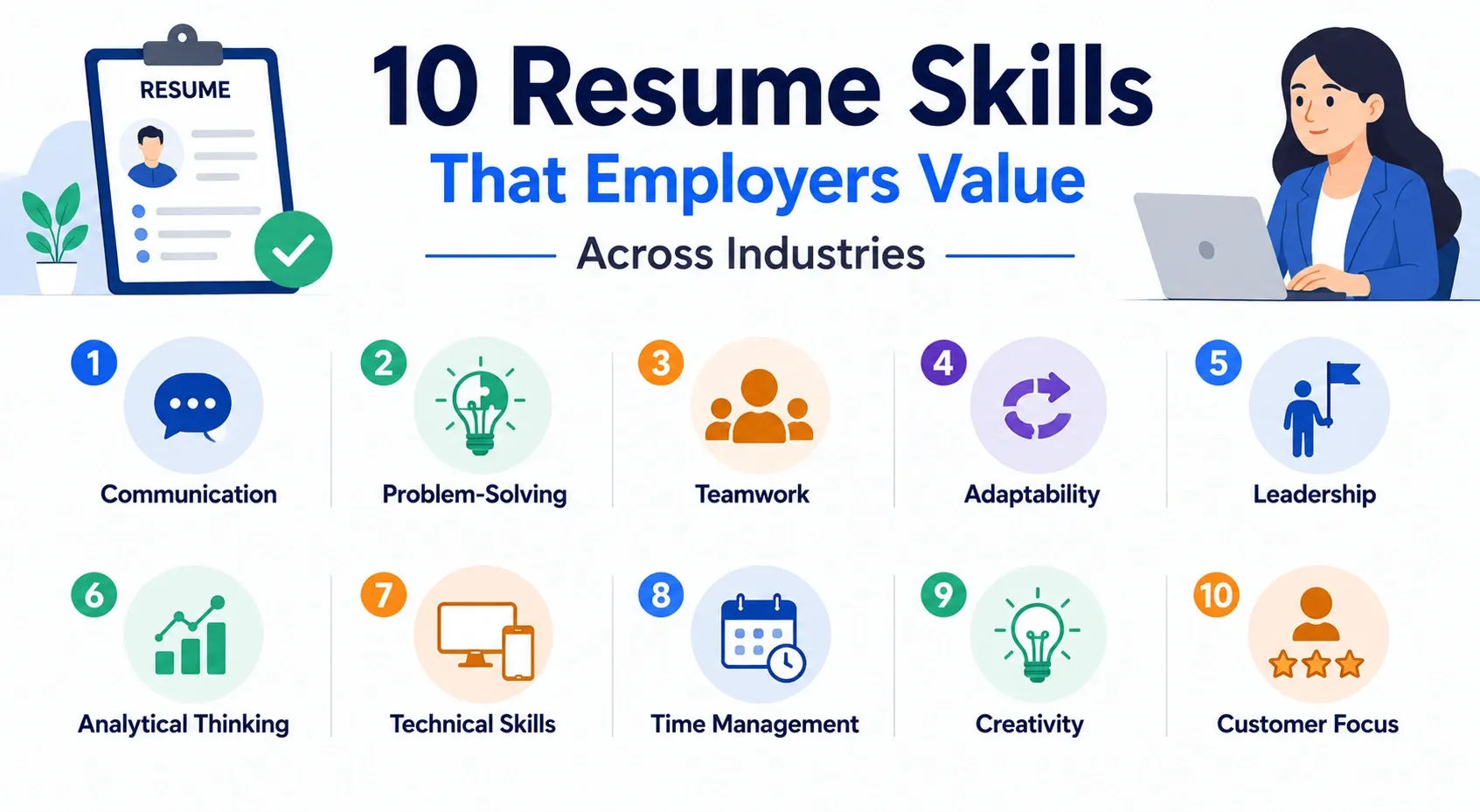









 ROI Calculator