What Is an ATS-Friendly Resume? The 2026 Formatting Rules
How to Write an ATS Resume: Keywords Done Right
An ATS resume is a resume formatted so that Applicant Tracking Systems — the software companies use to collect, scan, and rank job applications — can read it accurately. It uses standard headings, simple layouts, common fonts, and keywords from the job description, ensuring your qualifications are correctly parsed and you aren’t filtered out before a human ever sees your application.
If you’ve applied to dozens of jobs and heard nothing back despite being qualified, there’s a strong chance your resume never reached a recruiter’s eyes. Over 97% of Fortune 500 companies and the vast majority of large employers — including major Indian IT firms, banks, and consultancies hiring through Naukri, LinkedIn, and their career portals — run every application through an ATS first. In 2026, with AI-powered screening layered on top of traditional keyword matching, understanding how these systems read your resume is no longer optional. This guide explains what an ATS actually does, why it matters more than ever, exactly how to make your resume ATS-friendly, and how to test it — including with Jaro Education’s free ATS Resume Checker, which shows you in seconds how tracking software reads your resume.
An Applicant Tracking System is recruitment software that manages the entire hiring pipeline: posting jobs, collecting applications, parsing resumes into structured data, screening and ranking candidates, and tracking them through interview stages. Popular systems include Workday, Oracle Taleo, Greenhouse, Lever, SAP SuccessFactors, iCIMS, and Zoho Recruit — the last being especially common among Indian companies.
Here’s the crucial part: when you upload your resume, the ATS doesn’t store it as a pretty document. It parses it — extracting your name, contact details, work history, skills, education, and dates into database fields. Recruiters then search and filter that database (“show me candidates with 3+ years of digital marketing and GA4 experience”), and the system ranks applicants by how well their parsed data matches the job requirements.
If the parsing goes wrong — because your resume uses tables the software can’t read, or headings it doesn’t recognise — your experience can end up in the wrong fields or vanish entirely. You’re not rejected because you’re unqualified; you’re rejected because the system literally couldn’t see your qualifications.
Application volume has exploded. AI writing tools have made applying nearly effortless, so a single opening at a well-known company can attract hundreds or thousands of applications within days. Recruiters cannot read them all; the ATS shortlist is the shortlist.
AI screening sits on top of keyword matching. Modern ATS platforms and add-ons no longer just count keywords — they use AI to assess semantic relevance, summarise candidates, and score fit. This helps candidates whose resumes clearly evidence their skills with context and outcomes, and hurts those relying on keyword-stuffing tricks (like white-text keywords, which modern systems detect and flag).
Remote and hybrid roles widened competition. You’re no longer competing with applicants in your city alone. When a Bengaluru role draws candidates from across India and beyond, ranking in the ATS’s top slice is what earns the recruiter’s ninety-second skim.
The widely cited statistic that “75% of resumes are rejected by ATS before a human sees them” is partly myth — most systems don’t auto-reject; they rank. But the practical outcome is identical: a poorly parsed, poorly matched resume sits at position 340 of 800, which no recruiter ever scrolls to.
What Is an ATS-Friendly Resume? The 2026 Formatting Rules
An ATS-friendly resume follows conventions that every major parser handles reliably:
Layout and structure
Single-column layout. Multi-column designs are the top parsing killer — text gets read in the wrong order or skipped. (Some modern parsers handle two columns, but you can’t know which ATS a company uses, so don’t gamble.)
Standard section headings. Use “Work Experience,” “Education,” “Skills,” “Certifications,” “Projects.” Creative headings like “My Journey” or “What I Bring” confuse parsers.
No text in headers/footers. Many parsers skip these zones entirely — never put contact details there.
No tables, text boxes, columns, or graphics for core content. Icons, photos, charts, and skill-rating bars either vanish or garble the parse. (Photos are also increasingly discouraged for bias reasons.)
Reverse-chronological format. It’s the structure both parsers and recruiters expect. Purely functional resumes parse poorly and raise red flags.
Text and file details
Standard fonts: Calibri, Arial, Helvetica, Georgia, or Times New Roman, 10–12pt body.
Simple bullet points (round dots or hyphens, not decorative symbols).
Consistent date format: “Jan 2023 – Present” style, month and year, for every role.
File type: A text-based PDF is safe with virtually all modern systems — unless the job posting requests .docx, in which case follow the instruction. Never submit an image-based/scanned PDF: quick test — if you can’t select the text in your PDF, an ATS can’t read it either.
File name: Firstname-Lastname-Role.pdf looks professional in the recruiter’s download folder.
Length: One page for freshers and early career; two pages is perfectly acceptable (and often better) for 8+ years of experience. ATS systems don’t penalise length — irrelevance penalises you.
How to Write an ATS Resume: Keywords Done Right
Formatting gets you parsed; keywords get you ranked. Here’s the process professionals use:
Mine the job description. Highlight every hard skill, tool, certification, and repeated phrase. If “stakeholder management,” “GA4,” or “Python” appears multiple times, it’s almost certainly a search filter.
Mirror exact phrasing. ATS search is often literal. If the posting says “Search Engine Optimization,” write “Search Engine Optimization (SEO)” — using both the full term and abbreviation covers every search variant. Same for “B.Tech (Bachelor of Technology).”
Place keywords in context, not lists alone. A skills section matters, but AI-era screening rewards evidence: “Improved organic traffic 42% in six months by executing a technical SEO audit and content strategy across 80+ pages” beats a bare “SEO” every time.
Quantify achievements. Numbers (revenue, percentages, team size, timelines) survive parsing perfectly and instantly communicate impact to the human who reads the shortlist.
Tailor for every application. You don’t need to rewrite your resume each time — adjust the headline, the top summary, and 6–10 keywords to match each role. Fifteen minutes of tailoring routinely doubles response rates.
Never keyword-stuff. Hidden white text, keyword walls, and irrelevant skill dumps are detected by modern systems and torch your credibility with the recruiter who eventually reads the document.
ATS Resume Checker: How to Test Your Resume Before You Apply
An ATS resume checker simulates what tracking software sees: it parses your file, shows you what was extracted (and what broke), and scores how well your resume matches what recruiters search for. Using one before big applications is the closest thing to seeing your resume through the recruiter’s database.
Jaro Education’s Free ATS Resume Checker
The fastest way to test your resume is Jaro Education’s ATS Resume Checker — a free tool we built after seeing thousands of capable learners lose interview calls to formatting and keyword issues, not to lack of skill. Upload your resume and in seconds you get:
An ATS compatibility score showing how well tracking systems can parse and rank your resume.
Parsing and formatting diagnostics — the exact elements (tables, headers, non-standard headings) that break ATS reading.
Keyword and content feedback so you know what to strengthen before you apply, not after the silence.
It’s completely free, works with the standard PDF/DOCX resumes Indian job portals expect, and there’s no trial-wall — check your resume as many times as you need while you iterate. Fix, re-scan, repeat until the score is where you want it.
Other ATS resume checkers worth knowing in 2026:
Jobscan — established job-description matching tool; paste the JD, get a match score and keyword gaps. Limited free scans per month.
Resume Worded — line-by-line feedback on impact, brevity, and structure; paid tier unlocks full detail.
Naukri resume quality score — useful signal for the Indian market, since Naukri’s own recruiter search behaves like an ATS.
Teal — free job tracker with a built-in resume-to-JD matching feature.
LLM-based checking: paste your resume text and the job description into an AI assistant like Claude or ChatGPT and ask it to act as an ATS — identify missing keywords, parsing risks, and weak bullet points.
How to run a free ATS resume scan (3 methods):
Run the Jaro ATS Resume Checker. Upload your resume at atsresumechecker.jaroeducation.com, note your score and every flagged issue, fix them, and re-scan — the full loop takes under ten minutes.
The copy-paste test. Select all text in your PDF and paste it into a plain text file. If sections are jumbled, out of order, or missing, an ATS will see the same mess.
AI cross-check. Use the LLM method above against your top target job description for role-specific keyword tailoring.
Treat scores as directional, not gospel: a checker’s “68/100” doesn’t mean rejection, and chasing 100 leads to keyword-stuffed robotic writing. Fix parsing errors and genuine keyword gaps, then stop.
“The ATS auto-rejects 75% of resumes.” Mostly false — systems rank and filter based on recruiter-set criteria (like knockout questions); humans still make rejection decisions in the overwhelming majority of processes.
“PDFs don’t work with ATS.” Outdated. Text-based PDFs parse fine in modern systems; only scanned/image PDFs fail.
“You must score 90%+ keyword match.” No — recruiters typically shortlist strong partial matches; 60–80% relevant alignment with well-evidenced skills is competitive.
“One perfect resume works for every job.” The costliest myth. Ranking is relative to each job description — tailoring is the entire game.
“Fancy design shows creativity.” Save the designed version for interviews, your portfolio site, and LinkedIn. Give the ATS the clean version.
ATS Resume Example: Structure That Works
A reliable skeleton, top to bottom: Name and contact line (phone, email, LinkedIn URL, city) → Professional headline matching the target role (“Digital Marketing Specialist | SEO & Performance Marketing”) → 2–3 line summary containing your top keywords and one quantified achievement → Skills section grouped by category → Work Experience in reverse-chronological order with 3–5 quantified bullets per role → Education → Certifications. Every element parses cleanly, and every zone a recruiter skims lands a keyword.
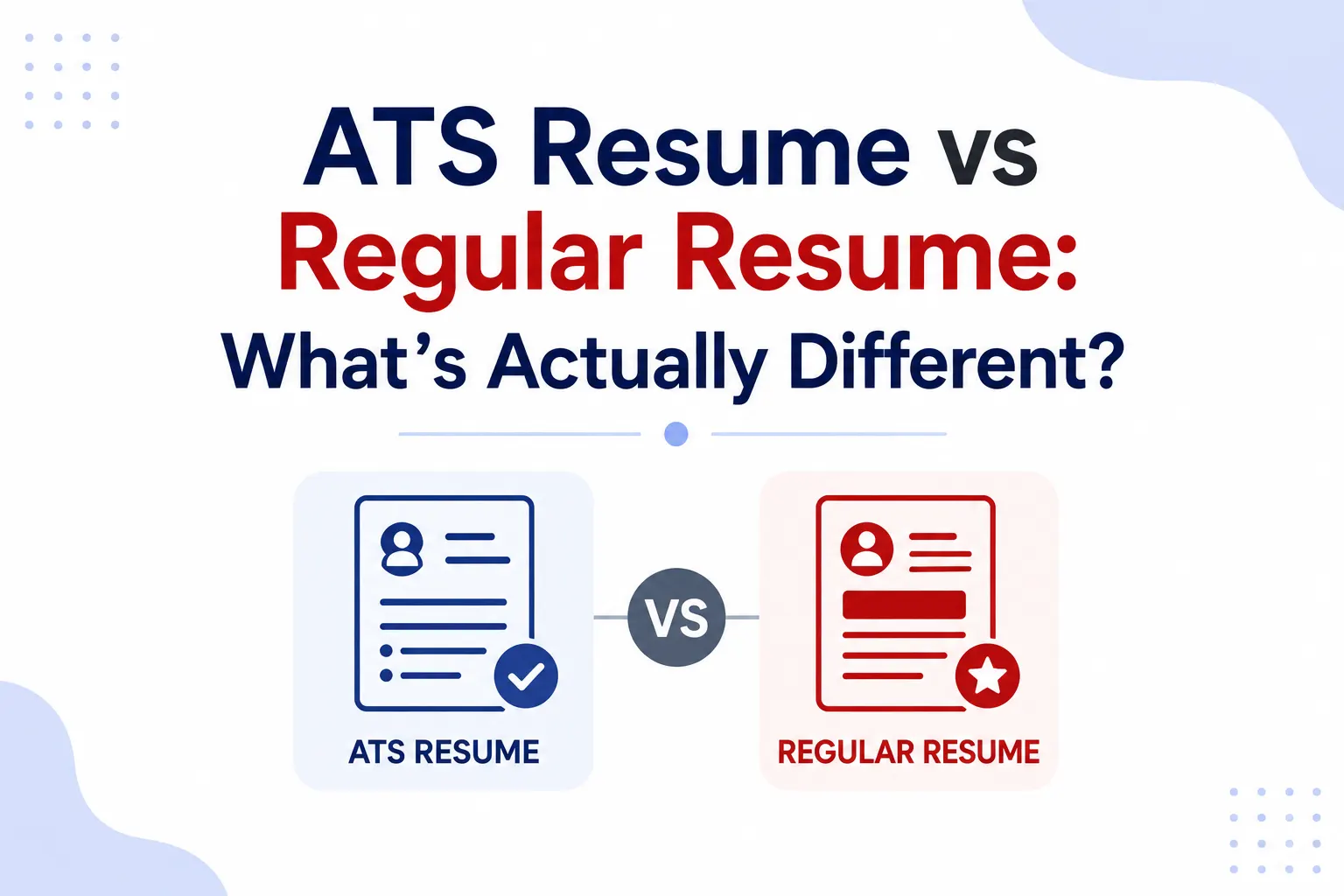
ATS Resume vs Regular Resume: What’s Actually Different?
Element
Regular / designed resume
ATS resume
Layout
Multi-column, sidebars, creative sections
Single column, top-to-bottom flow
Visuals
Icons, photos, skill bars, colour blocks
Text only; minimal colour, no graphics
Headings
Creative (“My Journey”, “Toolbox”)
Standard (“Work Experience”, “Skills”)
Fonts
Decorative or brand fonts
Calibri, Arial, Georgia, Times
Keywords
Written for human impression
Mirrored from each job description
Contact info
Often in a header/sidebar
In the main body, top of page
Best used for
Interviews, portfolio, LinkedIn, networking
Every online application
The smart approach isn’t choosing one — it’s maintaining both. Apply with the ATS version; hand the designed version across the table at the interview.
How to Convert Your Existing Resume to ATS Format (10-Minute Checklist)
Open your current resume and copy all text into a fresh, blank document — this strips tables, text boxes, and columns in one move.
Rebuild in a single column: contact line, headline, summary, skills, experience, education, certifications.
Rename every creative heading to its standard equivalent.
Move anything sitting in the header or footer (usually your contact details) into the document body.
Standardise all dates to “Month YYYY – Month YYYY.”
Replace skill bars, icons, and graphics with plain text lists.
Open your target job description and weave 6–10 of its exact key terms into your summary, skills, and bullets — only where genuinely true.
Add numbers to at least half your experience bullets (percentages, revenue, volumes, team size).
Export as a text-based PDF named Firstname-Lastname-Role.pdf.
Run the copy-paste test, then upload the final file to the free Jaro ATS Resume Checker before submitting.
The Bottom Line
An ATS resume isn’t about tricking software — it’s about removing every technical obstacle between your qualifications and the human who needs to see them. Clean single-column formatting gets you parsed correctly; job-specific keywords backed by quantified achievements get you ranked; and testing before you apply catches problems while they’re still fixable. In a 2026 market where AI reads before humans do, candidates who understand the system apply less and interview more.
Don’t guess whether your resume passes — check it. Run your resume through Jaro Education’s free ATS Resume Checker right now; it takes under a minute to see your score and exactly what to fix. And if the deeper goal is a resume with stronger credentials on it, explore the executive certification programmes in AI, analytics, and management from IIMs and IITs on Jaro Education — qualifications that pass both the ATS scan and the human one.
Frequently Asked Questions
ATS stands for Applicant Tracking System — software that collects, parses, and ranks job applications. An “ATS resume” is one formatted so this software reads it correctly.
The quickest way is to upload it to Jaro Education’s free ATS Resume Checker (atsresumechecker.jaroeducation.com), which scores ATS compatibility and flags parsing and formatting issues. You can also do the copy-paste test: paste your PDF’s text into a plain file and check nothing is jumbled or missing.
Yes — Jaro Education’s ATS Resume Checker is completely free with unlimited re-scans at atsresumechecker.jaroeducation.com. Naukri also scores resumes for the Indian market, and pasting your resume plus the job description into an AI assistant provides a free match analysis.
A single-column, reverse-chronological resume in a standard font, saved as a text-based PDF (or .docx if the employer requests it), with conventional section headings.
Yes. Large Indian employers — IT services firms, banks, consultancies, and startups — commonly use systems like Workday, Taleo, SAP SuccessFactors, Zoho Recruit, and Darwinbox, and Naukri’s recruiter search functions the same way.
Unreliably at best. Tables often scramble reading order, and graphics, icons, charts, and photos are ignored or misparsed. Keep core content in plain formatted text.
AI assistants are excellent for tailoring bullet points to a job description and checking keyword gaps — but you must still apply the formatting rules yourself, and every claim on the resume must be true.
Dr. Sanjay Kulkarni
Data & AI Transformation Leader
Dr. Sanjay Kulkarni is a Data & AI Transformation Leader with over 25 years of industry experience. He helps organizations adopt data-driven and responsible AI practices through strategic guidance and education. With experience across startups and global enterprises, he bridges the gap between theory and real-world application. His work empowers teams to innovate and thrive in AI-driven environments.

 July 16, 2026
 9 min read




 ChatGPT
 Perplexity
 Claude
 Grok
Grok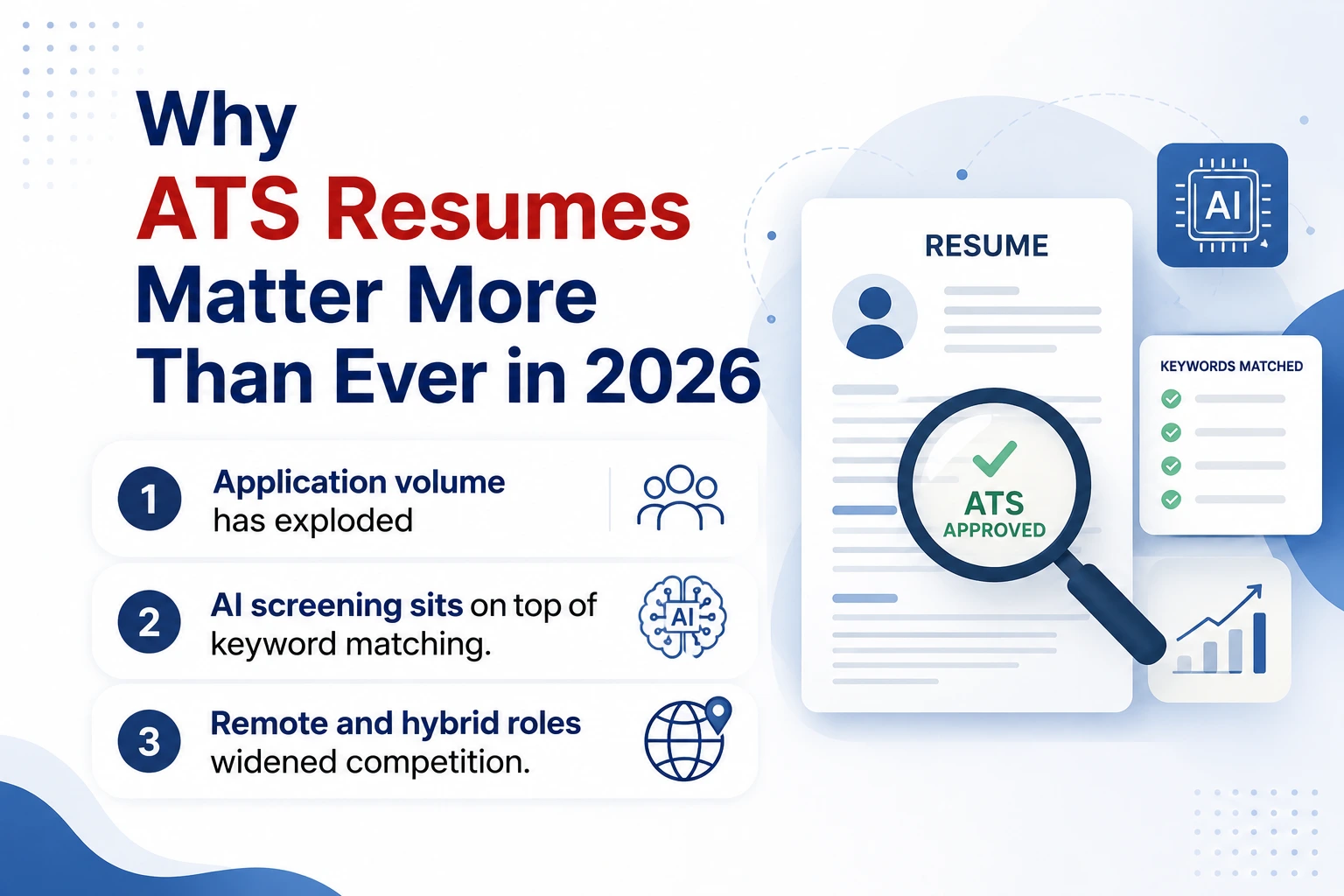











 ROI Calculator



