What Is End-to-End Encryption? How It Works, Benefits & Examples
J
By Shubham Lal
September 27, 20267 min read
Published on September 27, 2026
SHARE THIS ARTICLE
Table Of Content
What Is End-to-End Encryption?
How Does End-to-End Encryption Work?
Encryption Keys and End-to-End Encryption
End-to-End Encryption vs Encryption in Transit
Key Insights
End-to-end encryption protects communication by encrypting information on the sender's device and allowing it to be decrypted only by the intended recipient.
E2EE converts readable messages into ciphertext, which remains encrypted while traveling through networks and is decrypted using the appropriate cryptographic key on the recipient's device.
End-to-end encryption provides benefits such as protecting private communication, reducing the risk of interception, supporting data privacy, protecting business information, and building user trust.
E2EE is not a complete cybersecurity solution because metadata, compromised devices, account security, and backups require separate consideration.
In this blog, you'll learn the end-to-end encrypted meaning, how end-to-end encryption works, its benefits and limitations, a practical end-to-end encryption example, and how end-to-end encryption on WhatsApp helps protect communication.
Imagine sending a private message to a friend and knowing that the message is transformed into unreadable data before it leaves your device. Even if someone intercepts it while it is traveling across the internet, they cannot understand what it says. Only you and the intended recipient can access the original message.
That is the basic idea behind end-to-end encryption, commonly abbreviated as E2EE.
Today, encryption is an important part of online privacy and cybersecurity. People use messaging apps, online banking services, cloud platforms, video conferencing tools, and other digital services every day. As more personal and business information moves online, protecting that information from unauthorized access has become increasingly important.
But what exactly does end-to-end encryption mean? How does it work, and why is it used by popular messaging platforms? This blog explains end-to-end encrypted meaning, how the technologyworks, its benefits and limitations, and a practical end-to-end encryption example.
End-to-end encryption is a security method that protects information while it is being sent between two users or devices. The information is encrypted on the sender’s device and can only be decrypted by the intended recipient’s device.
The important idea is that the data remains encrypted throughout its journey. The service provider or an unauthorized third party generally cannot read the content while it is being transmitted.
For example, suppose Alice sends a private message to Bob.
Without end-to-end encryption, the message may be readable by systems handling or storing the communication, depending on the service’s security architecture.
With E2EE, Alice’s device encrypts the message before sending it. The message travels as encrypted data and is decrypted only when it reaches Bob’s device.
End-to-End Encrypted Meaning
The end-to-end encrypted meaning can be explained simply:
End-to-end encryption protects communication from one endpoint to another so that only the intended communicating parties can access the message content.
The two endpoints are generally the sender’s and recipient’s devices.
This is different from simply encrypting data while it travels between a user’s device and a server. In that situation, the connection may be encrypted, but the service itself may still be able to access the underlying information.
Understanding end-to-end encryption becomes easier when you break the process into a few simple steps.
1. The Sender Creates a Message
Suppose you type “Meet me at 6 PM” into a messaging application.
Before the message is sent, the application uses encryption technology to protect its contents.
2. The Message Is Encrypted
The readable message, known as plaintext, is transformed into ciphertext.
Ciphertext is designed to look like meaningless data to anyone who does not have the appropriate key.
Instead of seeing:
Meet me at 6 PM
an unauthorized person might see a sequence of seemingly random characters or data.
3. The Encrypted Message Travels
The encrypted information travels through networks and servers before reaching the recipient.
Even though the message may pass through infrastructure operated by a service provider, the content remains encrypted.
4. The Recipient’s Device Decrypts It
When the message reaches the intended recipient, their device uses the appropriate cryptographic key to decrypt it.
The recipient can then see the original message.
This entire process happens extremely quickly, usually without users having to manually encrypt or decrypt anything.
Encryption Keys and End-to-End Encryption
Encryption relies heavily on cryptographic keys.
A key is information used by an encryption algorithm to transform data or reverse that transformation.
Modern E2EE systems commonly use public key and private key techniques alongside other cryptographic methods.
A public key can be shared, while a private key is kept protected by its owner. The exact architecture varies depending on the system.
In a messaging application, cryptographic keys can help establish secure communication between users. The implementation may also use additional mechanisms to provide features such as forward secrecy and protection when keys change.
The technical details can become complex, but the basic goal remains straightforward: protect the message so that only the intended endpoints can read it.
End-to-End Encryption vs Encryption in Transit
These two concepts are often confused.
Encryption in Transit
Encryption in transit protects information while it moves between a user’s device and a server or between systems.
For example, HTTPS helps protect communication between your browser and a website.
However, depending on the architecture, the server may be able to access the data after receiving and decrypting it.
End-to-End Encryption
With end-to-end encryption, the content is encrypted at the originating endpoint and remains protected until it reaches the intended endpoint.
This creates an additional privacy layer because the communication provider is generally designed not to have access to the message’s plaintext.
Therefore, encryption in transit and E2EE are not necessarily competing technologies. A system can use encryption in transit while also implementing end-to-end encryption.
End-to-End Encryption Example
One of the easiest ways to understand E2EE is through a messaging example.
Imagine you send a personal photo to a friend through an E2EE messaging service.
First, your device prepares the photo for transmission. The application encrypts it before sending it. The encrypted data then travels across the internet and may pass through servers that help deliver the message.
Those servers can handle the encrypted data without necessarily being able to read the photo.
When the recipient’s device receives the encrypted content, it uses the relevant cryptographic information to decrypt it.
The recipient can then view the original photo.
This is a simple end-to-end encryption example because the protection extends from the sender’s endpoint to the recipient’s endpoint.
A widely recognized example of E2EE is WhatsApp messaging.
End-to-end encryption in WhatsApp is designed to protect the content of personal messages and calls so that they can only be accessed by the communicating participants.
For users, this means they do not normally need to activate encryption manually every time they send a message. The protection is built into supported communications.
WhatsApp’s security architecture uses the Signal Protocol, which is also associated with features designed to provide strong protection for message content.
However, it is important to understand that E2EE protects the content of communication. It does not automatically mean that every piece of information associated with an account or communication is hidden.
For example, information such as account details, device information, settings, or other metadata may be handled separately depending on the service and its policies.
This distinction is important when discussing end-to-end encryption on WhatsApp or any other encrypted communication platform.
Benefits of End-to-End Encryption
Why has E2EE become such an important cybersecurity technology?
1. Protects Private Communication
One of the biggest advantages of end-to-end encryption is that it helps protect the contents of private conversations.
This can be especially useful when people exchange sensitive personal or business information.
2. Reduces the Risk of Interception
Data can travel through multiple networks and systems before reaching its destination.
If an unauthorized party intercepts properly encrypted content, the information should be difficult to understand without the necessary cryptographic keys.
3. Supports Data Privacy
E2EE can provide an additional layer of privacy by limiting who can access the content of a communication.
This is particularly relevant for messaging, file sharing, and other services where users expect private communication.
End-to-end encryption can help protect such information while it is being transferred between authorized users.
5. Builds User Trust
People are increasingly concerned about how their digital information is protected.
Strong encryption can help organizations demonstrate that security and privacy are important parts of their digital services.
Why Is End-to-End Encryption Important in Cybersecurity?
Cybersecurity is not only about protecting large databases from hackers. It also involves protecting information as it moves between people, devices, applications, and systems.
Without appropriate protection, sensitive information could potentially be exposed through interception, compromised networks, or unauthorized access.
E2EE addresses one important part of this problem by protecting communication between endpoints.
End-to-End Encryption and the Future of Digital Privacy
As people use more digital services, the amount of information exchanged online continues to grow. Messages, photos, documents, financial information, and other forms of data can move between multiple devices and systems.
This makes technologies such as end-to-end encryption increasingly relevant.
At the same time, encryption is only one part of cybersecurity. Strong passwords, multi-factor authentication, secure devices, software updates, access controls, and safe digital practices are also important.
The future of digital privacy will likely involve a combination of these technologies rather than relying on a single security mechanism.
Conclusion
End-to-end encryption is a technology designed to protect communication from the sender’s device to the intended recipient’s device. It converts readable information into encrypted data and ensures that the intended endpoint can decrypt it.
Understanding the end-to-end encrypted meaning helps explain why E2EE is widely used in modern communication services. From private messaging to business collaboration, the technology can help reduce the risk of unauthorized access to communication content.
The end-to-end encryption example of sending a private message or photo shows how the process works in everyday situations. Similarly, end-to-end encryption in WhatsApp demonstrates how E2EE can be integrated into a widely used communication platform.
However, E2EE is not a complete solution for every cybersecurity risk. Metadata, compromised devices, account security, and backups all require separate consideration.
Ultimately, end-to-end encryption is an important tool for protecting digital communication and strengthening privacy in an increasingly connected world.
Frequently Asked Questions
End-to-end encryption protects a message by encrypting it on the sender’s device and allowing it to be decrypted by the intended recipient’s device. This helps prevent unauthorized parties from reading the message while it is being transmitted.
A simple end-to-end encryption example is sending a private message through an E2EE messaging service. The message is encrypted before leaving the sender’s device and decrypted when it reaches the intended recipient.
WhatsApp uses end-to-end encryption for supported personal communications. Its security architecture is designed to protect the content of messages and calls between communicating participants.
Encryption is a broad term for protecting data by converting it into an unreadable form. End-to-end encryption specifically protects communication between the originating and intended receiving endpoints, so the content remains encrypted during its journey between them.
Shubham Lal
Lead Software Developer
Shubham Lal joined Microsoft in 2017 and brings 8 years of experience across Windows, Office 365, and Teams. He has mentored 5,000+ students, supported 15+ ed-techs, delivered 60+ keynotes including TEDx, and founded AI Linc, transforming learning in colleges and companies.
Get Free Upskilling Guidance
Fill in the details for a free consultation
Related Courses
Explore our programs
Executive Programme in Artificial Intelligence and Cyber Security for Organizations
 HOME > BLOG > Cloud Computing and Cyber Security > What Is End-to-End Encryption? How It Works, Benefits & Examples
 September 27, 2026
 7 min read




 Key Insights
 ChatGPT
 Perplexity
 Claude
 Grok
Grok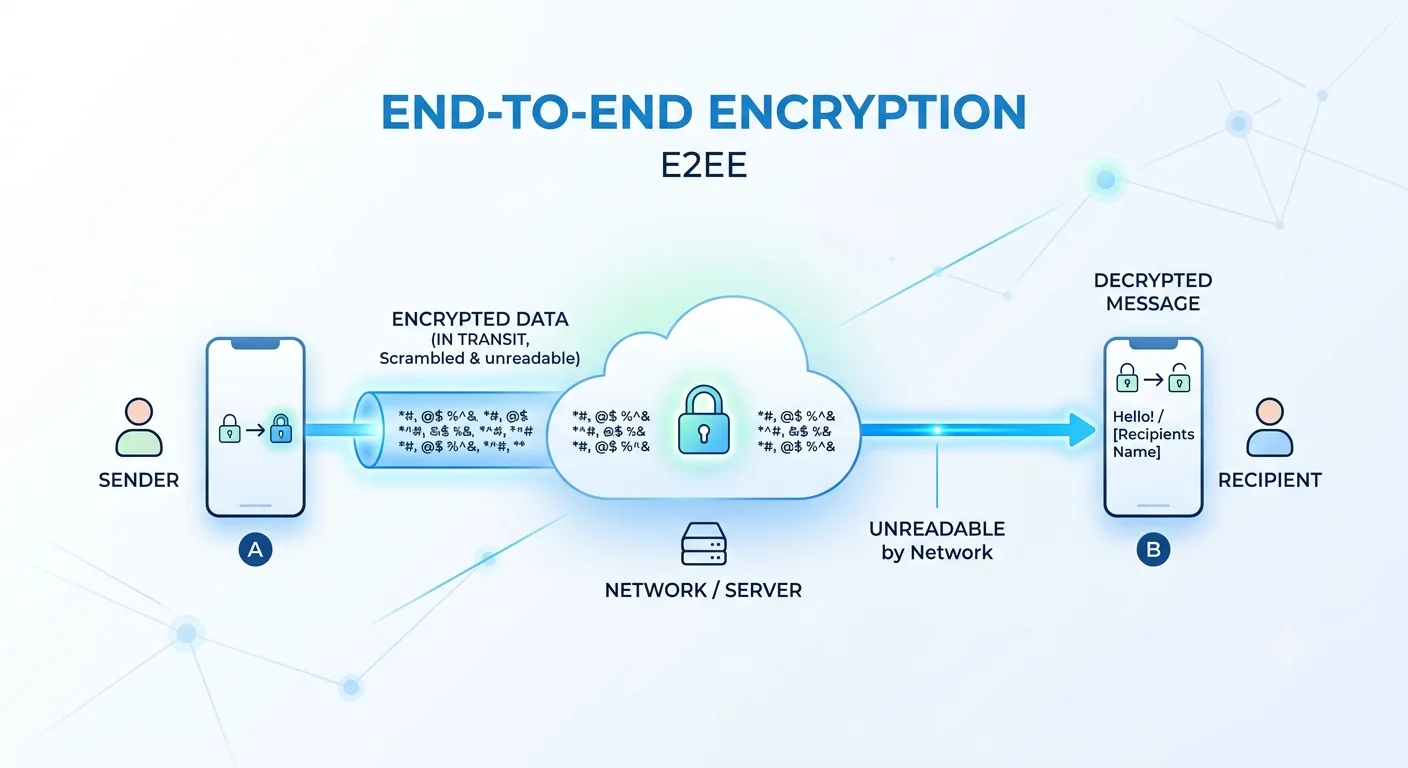












 ROI Calculator



