HomeHOME > BLOG > Cloud Computing and Cyber Security > Data Encryption Standard: Concept and Modes of Operations
Cloud Computing and Cyber Security

Data Encryption Standard: Concept and Modes of Operations

J
By Dr. Sanjay Kulkarni
UpdatedApril 9, 2026Read time5 min read
Published on April 9, 2026
SHARE THIS ARTICLE
Jaro Education Facebook PageJaro Education Instagram PageJaro Education Twitter PageJaro Education Whatsapp Page Jaro Education Linkedin PageJaro Education Youtube Page
Data encryption standard
Table of Contents

Table Of Content

  • What is the Data Encryption Standard (DES)?
  • History of Data Encryption Standard
  • How Does Data Encryption Standard Work?
  • Structure of DES Algorithm

In an era where data is constantly shared across digital platforms, protecting sensitive information has become a top priority. Encryption plays a critical role in ensuring that confidential data remains secure from unauthorised access. One of the earliest and most influential encryption techniques is the Data Encryption Standard (DES), which laid the foundation for modern cryptography.

Understanding the data encryption standard helps professionals learn how encrypted communication works, how information is protected from cyber threats, and why encryption continues to evolve. Although DES has largely been replaced by more advanced algorithms, it remains an essential concept for building a strong foundation in cybersecurity and data protection.

What is the Data Encryption Standard (DES)?

The Data Encryption Standard (DES) is a symmetric-key encryption algorithm used to protect digital data. It encrypts plaintext into ciphertext using a fixed-length key, ensuring that only authorised users with the correct key can access the original information.

DES was developed in the 1970s and became a widely adopted encryption standard for securing electronic communication and stored data.

Simple Definition

The data encryption standard is a cryptographic algorithm that uses a single secret key to convert readable data into an unreadable format to protect confidentiality.

Key Characteristics of DES

  • Symmetric encryption algorithm
  • Uses the same key for encryption and decryption
  • Operates on fixed-size data blocks
  • Applies multiple rounds of transformation
  • Designed for secure data communication
  • Based on substitution and permutation techniques

DES played an important role in early digital security systems.

History of Data Encryption Standard

DES was developed by IBM in the early 1970s and later adopted by the National Institute of Standards and Technology (NIST) as a federal encryption standard.

The algorithm became widely used in industries such as banking, telecommunications, and government communication systems.

Evolution of DES

Key milestones in DES development:

  • 1970s: IBM developed the original encryption algorithm
  • 1977: DES adopted as an official encryption standard
  • 1990s: Increased computing power made DES vulnerable to brute-force attacks
  • 2000s: Advanced Encryption Standard (AES) replaced DES for stronger security

Although DES is no longer widely used for high-security systems, it remains important for academic learning.

How Does Data Encryption Standard Work?

The data encryption standard (DES) algorithm works by transforming plaintext into ciphertext through multiple rounds of encryption operations.

DES processes data in fixed-size blocks and applies a secret key to perform mathematical transformations.

Key Components of DES

DES consists of several core components:

  • Plaintext (original readable data)
  • Ciphertext (encrypted, unreadable data)
  • Secret key
  • Encryption algorithm
  • Decryption algorithm

Block Size and Key Length

DES operates on:

  • 64-bit data blocks
  • 56-bit effective key length

Although the key is 64 bits long, 8 bits are used for parity checking.

Also Read:

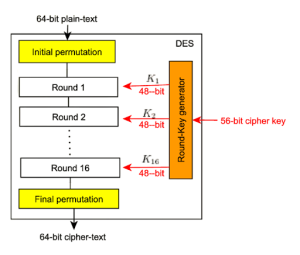
Structure of DES Algorithm

DES uses a structured encryption approach involving multiple rounds of processing.

Data Encryption Standard Algorithm

*ACTETechnologies

Initial Permutation

The plaintext block is rearranged using a predefined permutation table.

Permutation rearranges the order of bits without changing their values.

16 Rounds of Encryption

DES uses 16 rounds of processing to transform plaintext into ciphertext.

Each round includes:

  • Substitution
  • Permutation
  • Key mixing
  • Expansion
  • XOR operations

These transformations improve security.

Final Permutation

After completing 16 rounds, a final permutation is applied to produce ciphertext.

The encrypted output appears random and unreadable.

Key Generation Process in DES

The DES algorithm generates multiple subkeys from the main encryption key.

Steps in Key Generation

  • Initial key permutation
  • Splitting key into two halves
  • Bit-shifting operations
  • Subkey generation for each round

Each round uses a slightly different subkey.

This improves resistance to pattern-based attacks.

Modes of Operations in Data Encryption Standard

DES uses different modes of operation to encrypt data blocks securely.

These modes determine how plaintext blocks are processed and encrypted.

Understanding modes of operation helps professionals apply encryption effectively.

Electronic Codebook (ECB) Mode

ECB is the simplest encryption mode.

Each block of plaintext is encrypted independently.

Characteristics

  • Easy to implement
  • Fast processing
  • No dependency between blocks

Limitation

Identical plaintext blocks produce identical ciphertext blocks.

This may expose patterns in data.

Example

If the same password appears multiple times, the encrypted output may look similar.

Cipher Block Chaining (CBC) Mode

CBC improves security by linking plaintext blocks.

Each block is combined with the previous ciphertext block before encryption.

Characteristics

  • Improved security compared to ECB
  • Reduces visible patterns
  • Widely used in early encryption systems

Working Principle

Ciphertext from the previous block influences the next encryption process.

This creates more randomness.

Cipher Feedback (CFB) Mode

CFB mode converts block cipher into stream cipher behaviour.

Encryption depends on previous ciphertext blocks.

Characteristics

  • Suitable for real-time communication
  • Supports partial data encryption
  • Provides improved security

CFB is useful for streaming applications.

Output Feedback (OFB) Mode

OFB mode generates keystream blocks independent of plaintext.

The keystream is combined with plaintext using XOR operations.

Characteristics

  • Prevents error propagation
  • Suitable for noisy communication channels
  • Consistent encryption pattern

OFB ensures stable encryption performance.

Counter (CTR) Mode

CTR mode converts block cipher into stream cipher using counters.

Each block uses a unique counter value.

Characteristics

  • High processing speed
  • Parallel encryption capability
  • Strong security performance

CTR mode is widely used in modern cryptographic systems.

Free Courses

Online MBA Degree ProgrammeOnline MBA Degree Programme
Finance for All – Free Finance Certification Course
  • Duration Icon
    Duration : 2 - 4 Hours
  • Aplication Date Icon
    Application Closure Date :
Enquiry Now
Online MBA Degree ProgrammeOnline MBA Degree Programme
FinTech 101: Digital Banking & Payments
  • Duration Icon
    Duration : Flexible Schedule
  • Aplication Date Icon
    Application Closure Date :
Enquiry Now

Data Encryption Standard Example

A data encryption standard example helps illustrate the encryption process.

Example Scenario

Suppose a user sends a confidential message:

Plaintext: “Secure Data”

Encryption process:

  • Message converted into binary format
  • Binary data divided into 64-bit blocks
  • Secret key applied through 16 rounds
  • Output converted into ciphertext

Ciphertext appears unreadable without the correct key.

Only authorised users can decrypt the message.

Advantages of Data Encryption Standard

DES offered several benefits during its early adoption.

Strong Foundation for Cryptography

DES introduced structured encryption techniques used in modern algorithms.

It helped establish encryption standards.

Efficient Encryption Process

DES was efficient for early computing systems.

It required relatively low computational resources.

Widely Tested Algorithm

DES was extensively analysed by researchers.

Its structure influenced modern encryption design.

Simple Implementation

DES was easy to implement in hardware systems.

It became popular in financial systems.

Limitations of Data Encryption Standard

Despite its advantages, DES has several limitations.

Short Key Length

A 56-bit key length is vulnerable to brute-force attacks.

Modern computers can break DES quickly.

Vulnerability to Attacks

DES is susceptible to:

  • Brute-force attacks
  • Cryptanalysis techniques
  • Pattern detection

Limited Security for Modern Systems

DES does not meet current cybersecurity requirements.

Stronger algorithms, such as AES provide better protection.

Performance Constraints

DES may not be suitable for high-speed secure applications.

Modern algorithms provide improved efficiency.

Difference Between DES and AES

AES replaced DES as the modern encryption standard.

FactorDESAES
Key length56-bit128-bit,

192-bit, 

256-bit

Security levelLowerHigher
PerformanceModerateHigh
AdoptionLegacy systemsModern systems
Block size64-bit128-bit

AES provides stronger encryption and improved resistance to attacks.

Applications of Data Encryption Standard

DES has been used across multiple industries.

Banking Systems

DES secured financial transactions and ATM communications.

Telecommunications

DES protected data transmitted across communication networks.

Government Systems

DES helped protect confidential government information.

Password Protection

DES encrypted stored passwords in early computer systems.

Educational Purposes

DES is widely taught in cybersecurity courses.

It helps students understand cryptography basics.

Also Read:

Importance of Learning Encryption Concepts

Understanding encryption algorithms such as DES helps professionals build strong cybersecurity foundations.

Knowledge of encryption supports:

  • Data protection strategies
  • Network security planning
  • Risk management
  • Secure software development
  • Information privacy compliance

Professionals interested in cybersecurity careers benefit from learning cryptographic principles.

Programmes focused on emerging technologies help professionals understand encryption methods and their real-world applications.

Key Takeaways

The data encryption standard is one of the most important historical encryption algorithms used to secure digital information.

DES uses symmetric encryption with a 56-bit key and processes data in 64-bit blocks.

Different modes of operation such as ECB, CBC, CFB, OFB, and CTR determine how plaintext blocks are encrypted.

Although DES is no longer considered secure for modern applications, it remains essential for understanding cryptographic principles.

Learning encryption concepts helps professionals strengthen cybersecurity knowledge and understand modern encryption technologies.

Frequently Asked Questions

The data encryption standard (DES) is a symmetric-key encryption algorithm that converts plaintext into ciphertext using a secret key to protect sensitive information.

DES uses the same key for both encryption and decryption, which makes it a symmetric encryption algorithm.

An example of DES is encrypting confidential text such as passwords or financial data using a secret key so that only authorised users can access the original information.

DES is mostly considered outdated due to its short key length. Modern systems use AES for stronger security.

Modes of operation define how encryption processes data blocks. Common modes include ECB, CBC, CFB, OFB, and CTR.
Dr. Sanjay Kulkarni

Dr. Sanjay Kulkarni

Data & AI Transformation Leader
Dr. Sanjay Kulkarni is a Data & AI Transformation Leader with over 25 years of industry experience. He helps organizations adopt data-driven and responsible AI practices through strategic guidance and education. With experience across startups and global enterprises, he bridges the gap between theory and real-world application. His work empowers teams to innovate and thrive in AI-driven environments.

Get Free Upskilling Guidance

Fill in the details for a free consultation

*By clicking "Submit Inquiry", you authorize Jaro Education to call/email/SMS/WhatsApp you for your query.

Find a Program made just for YOU

We'll help you find the right fit for your solution. Let's get you connected with the perfect solution.

Confused which course is best for you?

Is Your Upskilling Effort worth it?

LeftAnchor ROI CalculatorRightAnchor
Confused which course is best for you?
Are Your Skills Meeting Job Demands?
LeftAnchor Try our Skill Gap toolRightAnchor
Confused which course is best for you?
Experience Lifelong Learning and Connect with Like-minded Professionals
LeftAnchor Explore Jaro ConnectRightAnchor
EllispeLeftEllispeRight
whatsapp Jaro Education