What is Edge Computing and Why You Need Edge Computing
J
By Dr. Sanjay Kulkarni
April 20, 20268 min read
Published on April 20, 2026
SHARE THIS ARTICLE
Table Of Content
What is Edge Computing?
Growing Challenge of Data Processing
Key Reasons Businesses Need Edge Computing
What is IoT Edge Computing?
Today's world heavily depends on data. Each time you unlock your smartphone, use advanced home applications, track a package, or stream a video, there is data that is huge data created and processed at the backend. For years, much of this huge amount of data has been sent to a centralised cloud server system for processing. As more and more connected devices and applications enter the marketplace, sending every bit of information that is generated out to the cloud system has become increasingly inefficient.
Here is where edge computing steps in.
With edge computing, businesses radically change how they process data, run applications, and provide digital services. Instead of shipping all data to faraway data centers, it enables computing to be done near the data source. This method increases speed, cuts down on waste, and raises the level of reliability.
In this blog, we'll define what Edge Computing actually means, look at why this is so important to businesses today, analyze how it relates to IoT devices, and discuss why so many organizations are utilizing edge computing technologies.
To define the term ‘Edge Computing’, let’s look at the traditional sources of data transfer in computing. In a standard cloud computing paradigm, data is acquired from different devices and sent to a centralised location, which is typically a data centre (or cloud), to be processed. Once the data has been processed, it is returned to the original source.
It may take quite a while for data to be transferred via the Internet, which may result in lengthy waits (latency) when transferring large volumes of data over long distances. For this reason, Edge Computing processes data at the locations from which it was acquired. Basically, it provides computer resources at the edge, close to devices like sensors, cameras or machines, instead of relying entirely on a centralised cloud computing environment.
*cdebyte.com
The term “Edge” refers to the outermost point of the network where the physical devices that are generating or consuming the data are situated.
For example:
Smart cameras used to analyse vehicle movements.
Industrial sensors are used to monitor the performance of manufacturing machines/systems.
Retail systems used to track customer activity in retail stores. Instead of sending the raw data from those locations to the cloud to be processed, those systems can process the information locally at the edge of the network.
As the number of connected devices continues to increase, the amount of data being produced is expanding at an unprecedented rate. Traditional computing models rely heavily on centralised cloud data centers to process this information.
However, sending all data to a distant cloud server creates several challenges:
Network congestion due to massive data transfers
Higher latency because data must travel long distances
Increased infrastructure costs for data storage and processing
Delays in decision-making, especially for time-sensitive applications
For example, an autonomous vehicle simply cannot delay the detection of obstacles on the road. Likewise, production machines should respond at once to performance issues in order to prevent breakdowns.
That is the reason why just sticking to centralized cloud computing is not going to work for many contemporary applications.
Key Reasons Businesses Need Edge Computing
1. Faster Data Processing
One of the biggest advantages of edge computing is low latency.
Latency refers to the delay between sending data and receiving a response.
When data has to travel to a distant cloud server, even a small delay can affect performance. For applications such as autonomous vehicles, medical monitoring systems, or industrial automation, milliseconds matter.
By processing data locally, it delivers faster responses.
2. Reduced Network Bandwidth Usage
Sending massive volumes of raw data to the cloud consumes large amounts of network bandwidth.
Edge computing reduces this burden by processing data locally and sending only relevant information to the cloud.
This approach:
Reduces data transmission costs
Optimizes network performance
Prevents network congestion
3. Improved Reliability
Many systems operate in environments where internet connectivity is limited or unstable. Edge computing allows devices to operate independently even when connectivity is weak. This ensures continuous operation without relying entirely on cloud connectivity.
Examples include:
Offshore oil rigs
Remote mining sites
Rural healthcare facilities
4. Enhanced Security and Data Privacy
When sensitive data travels across networks, it becomes vulnerable to cyber threats. Edge computing helps mitigate this risk by keeping much of the data processing local.
Since less data is transmitted across networks, the attack surface becomes smaller. Industries that handle sensitive information, such as healthcare, banking, and defence, benefit greatly from this approach.
5. Real-Time Decision Making
Many modern applications require instant responses. Edge computing allows systems to analyze data in real time and take immediate action. Without edge computing, these systems would struggle with delays caused by cloud processing.
To fully understand it, we must look at its connection with the Internet of Things (IoT). The Internet of Things refers to networks of connected devices that collect and exchange data.
Examples of IoT devices include:
Smart thermostats
Fitness trackers
Industrial sensors
Smart city infrastructure
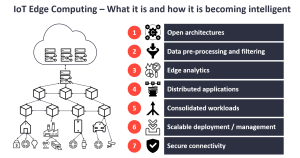
*iot-analytics.com
IoT Edge Computing Explained
IoT edge computing refers to processing and analyzing data generated by IoT devices at or near the device itself, rather than sending everything to a centralized cloud system.
This approach helps IoT systems become faster, more efficient, and scalable.
For example:
In a smart factory, hundreds of sensors monitor equipment performance. Instead of sending raw data continuously to the cloud, an edge device processes the data locally and only sends alerts when a problem occurs. This reduces bandwidth usage and enables faster responses.
Real-World Examples of Edge Computing
Edge computing is already being used across many industries. Let’s look at some practical examples.
Autonomous Vehicles
Self-driving automobiles depend on sensors, cameras, and AI systems to safely traverse roads. In order for these vehicles to be aware of their surroundings and make driving decisions, they have to process data instantly. It enables vehicles to do data analysis on their own without depending on distant cloud servers.
Smart Cities
Urban areas are introducing smart infrastructure to handle traffic, energy use, and public safety. Edge computing supports such systems in analyzing data locally and responding rapidly.
Examples include:
Intelligent traffic lights
Smart parking systems
Public surveillance systems
Healthcare Monitoring
Public surveillance systems, Healthcare Monitoring and Medical instruments like wearable health monitors capture patient data in real-time.
Using edge computing, these devices can immediately analyze health signals and notify doctors in case of abnormalities. This not only leads to better patient care but also quicker medical interventions
Industrial Automation
Factories are using edge computing to power Industry 4.0 technologies.
Machines equipped with sensors monitor production processes, detect defects, and predict equipment failures.
Processing data locally helps factories reduce downtime and improve efficiency.
Retail Analytics
Factories are leveraging edge computing to enhance Industry 4.0 technologies. Utilizing sensor-equipped machines, manufacturers keep an eye on production processes, identify defects, and forecast equipment failures. By handling data locally, production plants are able to minimize downtime and increase effectiveness.
Several technologies are driving the growth of edge computing.
Internet of Things (IoT)
IoT devices are the biggest drivers of edge computing adoption because they generate enormous amounts of data.
Artificial Intelligence (AI)
AI models are increasingly being deployed at the edge to enable real-time decision-making.
For example:
Object detection in surveillance cameras
Predictive maintenance in factories
Voice assistants in smart devices
5G Networks
The rollout of 5G networks is accelerating edge computing adoption. 5G provides high bandwidth and ultra-low latency, enabling faster communication between devices and edge nodes.
Edge AI
Edge AI combines artificial intelligence with edge computing to allow devices to run AI models locally.
This enables real-time applications such as:
Facial recognition
Smart surveillance
Industrial defect detection
Challenges of Edge Computing
Although edge computing offers many benefits, it also comes with certain challenges.
Infrastructure Complexity
Deploying edge systems across multiple locations requires careful planning and infrastructure management.
Security Management
While edge computing improves data privacy, it also increases the number of devices that must be secured.
Managing security across thousands of edge devices can be challenging.
Hardware Limitations
Edge devices typically have limited computing power compared to large cloud data centers.
This requires efficient software and optimized AI models.
The Future of Edge Computing
Edge computing is expected to become one of the most important technologies in the digital economy.
Several trends are driving its growth:
Expansion of IoT devices
Growth of AI-powered applications
Deployment of 5G networks
Demand for real-time analytics
Industry experts believe that a significant portion of enterprise data processing will occur outside traditional cloud data centers in the coming years.
As organizations adopt digital transformation strategies, edge computing will play a central role in enabling faster and smarter systems.
How Can Professionals Benefit from Learning Edge Computing?
Edge computing is not only transforming technology infrastructure but also creating new career opportunities.
Professionals working in fields such as data science, cloud computing, artificial intelligence, cybersecurity, and IoT development can benefit from learning about edge technologies.
Understanding it helps professionals design systems that can handle real-time data processing, distributed computing, and smart automation.
Many advanced technology programs and certifications now include edge computing as part of their curriculum.
How Does Jaro Education Help Professionals Learn Edge Computing?
As edge computing continues to transform industries, professionals across technology domains are looking to build expertise in this emerging field. Understanding concepts like distributed computing, IoT, AI integration, and real-time data processing has become essential for modern tech careers.
This is where Jaro Education plays an important role in helping professionals stay ahead in the digital economy.
Jaro Education is one of India’s leading online higher education and upskilling companies that collaborates with top universities and institutions to offer industry-relevant programs in technology, data science, and digital transformation. Through its carefully curated programs, professionals gain practical knowledge in areas such as cloud computing, artificial intelligence, machine learning, and IoT technologies, which are closely connected with edge computing applications.
Conclusion
Edge computing is reshaping the way data is processed and delivered in modern digital systems. Instead of relying solely on centralized cloud infrastructure, it enables data processing to happen closer to where the data is generated.
This shift provides several advantages, including faster response times, reduced network congestion, improved security, and better reliability.
As technologies such as IoT, artificial intelligence, and 5G continue to grow, the demand for it will increase significantly.
Organizations across industries, from healthcare and manufacturing to retail and transportation, are already adopting edge computing to build smarter and more efficient systems.
For businesses aiming to stay competitive in the digital age, understanding and implementing edge computing is no longer optional. It is quickly becoming a fundamental part of modern technology infrastructure.
Frequently Asked Questions
Edge computing meaning is a technology that processes data closer to the device where it is generated instead of sending it to a distant cloud server. This reduces delays and allows faster data processing.
Cloud computing processes data in centralized data centers, while edge computing processes data locally near devices such as sensors, cameras, or machines. It is often used for real-time applications where speed is critical.
IoT edge computing refers to analyzing and processing data generated by IoT devices directly at or near the device instead of sending all data to the cloud. This improves speed, efficiency, and scalability.
Edge computing helps businesses reduce latency, improve security, lower bandwidth costs, and enable real-time decision-making for applications such as smart manufacturing, autonomous vehicles, and healthcare monitoring.
Dr. Sanjay Kulkarni
Data & AI Transformation Leader
Dr. Sanjay Kulkarni is a Data & AI Transformation Leader with over 25 years of industry experience. He helps organizations adopt data-driven and responsible AI practices through strategic guidance and education. With experience across startups and global enterprises, he bridges the gap between theory and real-world application. His work empowers teams to innovate and thrive in AI-driven environments.
 HOME > BLOG > Cloud Computing and Cyber Security > What is Edge Computing and Why You Need Edge Computing
 April 20, 2026
 8 min read




 ChatGPT
 Perplexity
 Claude
 Grok
Grok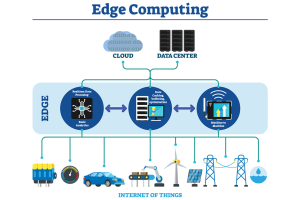



 Admission Open
 Admission Closed

 Admission Closed
 Admission Open

 ROI Calculator



