Business Analyst to Product Manager: Skills Gap and How to Bridge It
J
By Nuthana Reddy
August 13, 20268 min read
Published on August 13, 2026
SHARE THIS ARTICLE
Table Of Content
Business Analyst vs Product Manager: What Is the Difference?
What Skills Do Business Analysts Already Bring?
What Is the Product Management Skills Gap for Business Analysts?
How to Transition From BA to Product Manager
Key Insights
Business Analysts already have valuable transferable skills such as analytical thinking, requirements understanding, stakeholder management, process knowledge, and problem-solving.
The key product management skills gap for business analysts includes product strategy, customer discovery, prioritisation, product analytics, ownership, and roadmap planning.
A successful BA to PM career switch involves learning Product Management fundamentals, gaining product exposure, building case studies, developing technical understanding, and preparing for product interviews.
BAs can reframe their existing experience by highlighting customer insights, prioritisation, data analysis, product improvements, stakeholder influence, and cross-functional collaboration.
In this blog, you'll learn about the business analyst to product manager transition, business analyst vs product manager roles, how to transition from BA to product manager, and the skills needed to become a product manager.
Moving from a Business Analyst (BA) role to Product Management is becoming an increasingly relevant career transition for professionals who want greater ownership of products, customer problems, and business outcomes. Both roles involve analysing requirements, understanding business needs, working with stakeholders, and supporting technology-driven initiatives. However, the responsibilities and decision-making expectations of a Product Manager extend beyond traditional business analysis.
For professionals considering a business analyst to product manager transition, the good news is that the BA background already provides a strong foundation. Skills such as analytical thinking, requirements gathering, stakeholder communication, process understanding, and problem-solving can be highly relevant to Product Management.
The challenge is understanding what is different, identifying the product management skills gap for business analysts, and deliberately building capabilities around product strategy, customer discovery, prioritisation, product analytics, and ownership.
This guide explains the key differences between the roles, the skills BAs already possess, the areas they need to strengthen, and practical ways to make a successful transition.
Business Analyst vs Product Manager: What Is the Difference?
Understanding business analyst vs product manager responsibilities is the first step toward planning the transition.
A Business Analyst generally focuses on understanding business requirements, analysing processes, documenting needs, identifying gaps, and helping teams develop solutions that address business problems. BAs may work closely with business stakeholders, technology teams, project managers, and users.
A Product Manager, on the other hand, typically owns the product direction and works across the product lifecycle. The role involves identifying customer problems, defining product strategy, prioritising opportunities, developing roadmaps, collaborating with cross-functional teams, launching products, and measuring outcomes.
The difference can be simplified as follows:
Business Analyst
Product Manager
Focuses on business requirements
Focuses on product outcomes
Analyses processes and requirements
Defines product strategy and priorities
Works closely with stakeholders
Works across customers and multiple teams
Helps define what the solution should address
Decides what should be built and why
Supports implementation
Owns product direction and outcomes
Focuses heavily on analysis
Balances strategy, customer needs, technology, and business
The boundaries can vary between organisations. Some BAs already perform responsibilities that overlap with Product Management, while some Product Manager roles may include substantial analytical or business-focused work.
What Skills Do Business Analysts Already Bring?
A BA is not starting from zero. In fact, several existing capabilities can make the transition easier.
Analytical Thinking
Business Analysts regularly analyse information, identify patterns, evaluate processes, and solve business problems. This analytical foundation is useful for Product Managers who need to interpret product data, understand customer behaviour, and evaluate opportunities.
Requirements Understanding
BAs are often experienced in gathering requirements and translating stakeholder needs into clear documentation. This experience can be valuable when learning product discovery and defining product requirements.
Stakeholder Management
Working with different stakeholders is an important part of both roles. BAs often communicate with business users, technical teams,leadership, and other stakeholders. This experience can help aspiring PMs develop the ability to align teams with different expectations.
Problem-Solving
BAs are trained to investigate problems and identify possible solutions. Product Managers similarly need to understand the underlying customer problem before deciding which solution to pursue.
Process and Business Understanding
A BA’s familiarity with business processes and organisational objectives can help when evaluating product opportunities and understanding how products contribute to broader business goals.
These transferable capabilities give BAs a strong starting point. The bigger challenge is shifting from requirements-oriented thinking to product-oriented thinking.
What Is the Product Management Skills Gap for Business Analysts?
The product management skills gap for business analysts usually appears in areas where Product Managers are expected to take ownership of product direction rather than simply analyse or document requirements.
1. Product Strategy
A Product Manager needs to understand where a product should go and why. This means connecting customer needs, market opportunities, business objectives, and product capabilities.
BAs may be accustomed to working within an established business requirement. To move into PM, they need to become more comfortable defining the product problem and thinking strategically about possible opportunities.
2. Customer Discovery
Product Management is strongly focused on understanding customers. PMs need to identify pain points, conduct user research, analyse feedback, validate assumptions, and determine whether a problem is worth solving.
A BA may have significant stakeholder experience but may not have extensive exposure to direct customer discovery. Developing customer empathy andresearch skills can therefore be an important part of the transition.
3. Prioritisation
BAs may help document requirements, but Product Managers often need to decide which opportunities or features should receive attention first.
Prioritisation involves evaluating factors such as customer value, business impact, effort, strategic relevance, and available resources. PMs must also communicate why certain initiatives are prioritised while others are delayed.
4. Product Metrics and Analytics
Analytical ability is already a BA strength, but Product Management requires applying analytics specifically to product decisions.
Aspiring PMs should become familiar with product metrics, user behaviour, conversion, retention, engagement, experimentation, and other indicators relevant to the product they are managing.
5. Product Ownership
One of the biggest differences is ownership. A Product Manager is expected to take responsibility for product outcomes rather than simply completing an analysis or requirement.
This means becoming comfortable with ambiguity, making decisions with incomplete information, taking calculated risks, and learning from product outcomes.
6. Product Vision and Roadmapping
BAs may contribute to project planning or requirements documentation, while PMs typically need to connect individual features with a broader product vision and roadmap.
Learning how to create and communicate a product roadmap can therefore help bridge the gap.
How to Transition From BA to Product Manager
If you are wondering how to transition from BA to product manager, focus on building product experience rather than simply changing your job title.
Step 1: Learn Product Management Fundamentals
Start with core concepts such as product discovery, product strategy, customer research, prioritisation, roadmaps, product-market fit, product analytics, experimentation, and go-to-market strategy.
Understanding these concepts gives you a framework for thinking beyond requirements and processes.
Step 2: Reframe Your Existing Experience
Look at your current BA responsibilities through a product lens.
Instead of simply saying that you gathered requirements, consider whether you identified customer problems, influenced prioritisation, worked with technology teams, analysed user behaviour, or contributed to product decisions.
This can make your existing experience more relevant when applying for PM positions.
Step 3: Take Ownership of Product-Like Work
Look for opportunities within your current organisation to contribute to product initiatives. You could participate in customer research, roadmap discussions, feature prioritisation, product analytics, experimentation, or product improvement projects.
The objective is to demonstrate that you can think and operate like a Product Manager.
Step 4: Build Product Case Studies
Create practical case studies around products you use or understand. Analyse a customer problem, identify potential users, research competing solutions, propose features, prioritise them, and define success metrics.
These projects can demonstrate your product thinking during interviews.
Step 5: Develop Technical Understanding
You do not necessarily need to become a developer to work in Product Management. However, understanding APIs, databases, analytics, cloud technology, software developmentprocesses, and AI concepts can make it easier to collaborate with engineering teams.
Technical understanding becomes particularly valuable for professionals targeting technical or digital product roles.
Step 6: Prepare for Product Interviews
A successful BA to PM career switch also requires interview preparation. Product interviews can assess product sense, strategy, prioritisation, analytics, estimation, technical understanding, and behavioural decision-making.
Practise explaining your thought process rather than simply giving an answer. Interviewers often want to understand how you identify problems, evaluate alternatives, make trade-offs, and define success.
Free Courses
Stakeholder Communication & Negotiation Skill Sets
The skills needed to become a product manager extend beyond technical or analytical capabilities. A strong PM needs a combination of strategic, customer-focused, analytical, and interpersonal skills.
Some of the most important areas to develop include:
For BAs, the focus should not be on replacing their existing skills but on expanding them.
For example, strong analytical ability can be extended into product analytics. Requirements gathering can evolve into customer discovery. Stakeholder management can develop into cross-functional leadership. Business understanding can become product strategy.
This shift in application is often more important than starting from scratch.
How to Position Your Resume for a Product Management Role
Your resume plays an important role in communicating your readiness for Product Management.
Instead of listing only traditional BA responsibilities, highlight experiences that demonstrate product-relevant capabilities.
For example, if you analysed customer feedback and identified an improvement opportunity, explain the problem, your analysis, the recommendation, and the outcome.
If you influenced stakeholders or helped prioritise requirements, highlight the decision-making aspect.
Similarly, mention experiences involving data analysis, user research, product improvements, experimentation, cross-functional collaboration, process optimisation, or technology initiatives.
The goal is not to misrepresent your experience. It is to clearly communicate the product-related impact of the work you have already performed.
Yes. A Business Analyst can transition into Product Management by leveraging existing analytical, business, stakeholder, and problem-solving capabilities while developing product-specific skills.
The transition is likely to be easier when the BA has exposure to software products, technology teams, customer-facing initiatives, Agile environments, requirements prioritisation, or product development.
However, there is no universal path. Some professionals may move directly into Associate Product Manager or Product Manager roles, while others may first take on Product Owner, Product Analyst, Business Product Manager, or similar positions that provide additional product exposure.
The most important consideration is not simply getting the PM title. It is developing the ability to understand customers, define problems, make strategic decisions, prioritise opportunities, and take ownership of product outcomes.
Build Strategic Product Management Skills With IIT Roorkee
Professionals looking to bridge their product management skills gap can explore the Post Graduate Certificate Programme in Strategic Product Management by CEC, IIT Roorkee. The five-month programme covers product strategy, user research, product analytics, AI integration, business models, GTM strategies, product lifecycle management, and product launches. It also includes case-based learning, hands-on sessions, industry expert interactions, and a Build Your Own Product initiative. The programme is delivered through live online sessions with a mandatory campus immersion.
Final Thoughts
Moving from Business Analysis to Product Management is not about abandoning the skills you have already developed. It is about applying those skills in a broader product context.
The BA background can provide valuable strengths in analytics, requirements understanding, stakeholder communication, business processes, and problem-solving. The key is to complement these strengths with customer discovery, product strategy, prioritisation, product analytics, roadmap planning, technical awareness, and product ownership.
If you are planning a business analyst to product manager transition, start by identifying the areas where your current experience overlaps with Product Management. Then deliberately build the missing capabilities through practical projects, cross-functional exposure, product case studies, structured learning, and interview preparation.
The transition may require a shift in mindset—from analysing what the business wants to defining what customers need and deciding what the product should do next. With the right approach, your BA experience can become a strong foundation for a Product Management career.
Frequently Asked Questions
Yes. Business Analysts already possess transferable skills such as analytical thinking, requirements understanding, stakeholder management, business knowledge, and problem-solving. They need to strengthen product-specific capabilities such as customer discovery, product strategy, prioritisation, product analytics, and product ownership.
The product management skills gap for business analysts is often most visible in product strategy, customer discovery, prioritisation, product vision, roadmap ownership, and outcome-based decision-making. BAs can bridge these gaps through practical product exposure and structured learning.
There is no fixed timeline. The transition depends on your existing experience, exposure to product work, skills, organisation, and the type of PM role you target. Building practical product experience alongside your current BA role can help strengthen your profile.
An MBA is not the only route into Product Management. Professionals can transition by developing product skills, gaining relevant experience, building case studies or portfolios, and demonstrating product thinking during interviews.
The skills needed to become a product manager include product strategy, customer research, product analytics, prioritisation, roadmap planning, communication, stakeholder management, business understanding, technical awareness, problem-solving, and product ownership.
Nuthana Reddy
Nuthana Reddy is a Senior Manager at Procter & Gamble, specializing in operations, digitization, and cross-functional leadership. She has driven multimillion-dollar impact through innovation, process optimization, and strategic execution across global markets.
Get Free Upskilling Guidance
Fill in the details for a free consultation
Related Courses
Explore our programs
Advanced Certificate Programme in Smart Supply Chain Management & Transformation
 HOME > BLOG > Business Management > Business Analyst to Product Manager: Skills Gap and How to Bridge It
 August 13, 2026
 8 min read





 Key Insights
 ChatGPT
 Perplexity
 Claude
 Grok
Grok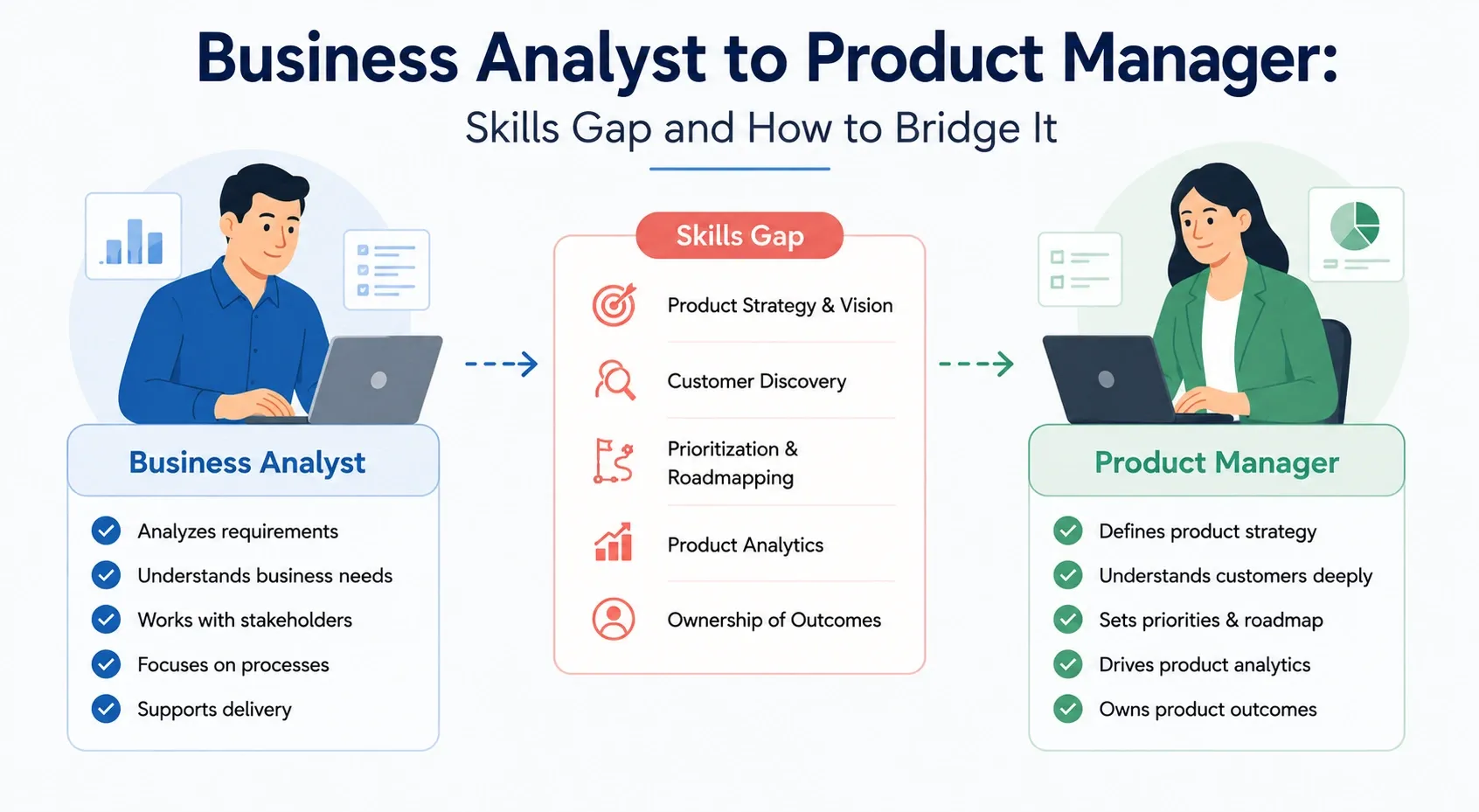









 ROI Calculator